

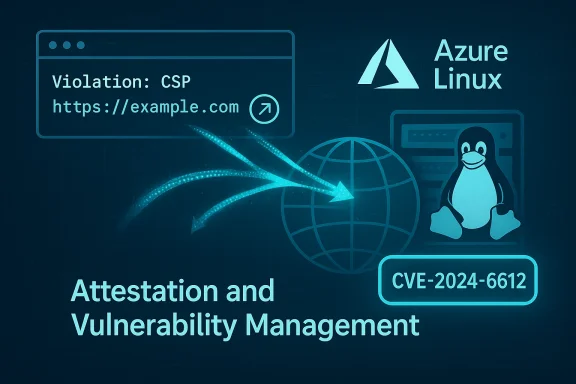
CSP violations that printed clickable links into the Developer Tools console — which in turn triggered DNS prefetches pointing at the violating host — created a subtle but real information‑leak that was assigned CVE‑2024‑6612 and fixed in Mozilla products; the short, operational truth is simple: update affected browsers, but the longer and more important truth for defenders is that Microsoft’s one‑line attestation naming Azure Linux as a carrier is an authoritative inventory statement for that product and not a categorical guarantee that no other Microsoft product could contain the same vulnerable component.
Background / Overview
CVE‑2024‑6612 is a low‑impact information‑disclosure flaw in how developer tools in Firefox and Thunderbird created console links for Content Security Policy (CSP) violations. When a CSP violation occurred, a clickable link to the violating resource was generated in the console tab. That link — rather than being inert — triggered a browser DNS prefetch, which could leak the fact that a CSP violation had occurred to a network observer. The vulnerability affects Firefox and Thunderbird versions prior to 128. The practical mitigation for end users is straightforward: install the update that ships with the fix (Firefox/Thunderbird 128 or later).Microsoft’s Security Response Center (MSRC) page for this CVE includes a short attestation: “Azure Linux includes this open‑source library and is therefore potentially affected.” That statement reflects Microsoft’s newly adopted VEX/CSAF attestation process — a machine‑readable approach that clarifies which products Microsoft has inventory‑checked and what the results were. Microsoft has been explicit that the Azure Linux distro is the first product family for which it publishes these attestations and that it will update CVE mappings if additional products are found to ship the implicated upstream component.
But the criti miss: a product‑level attestation is an authoritative confirmation that the product named contains the implicated component; it is not an exclusionary statement that proves no other Microsoft product could or does contain the same code. That important distinction is the core theme of this article: what Microsoft’s statement means in practice, what it doesn’t mean, and what defenders should do next.
The technical issue: what CVE‑2024‑6612 actually did
How console links turned into DNS leaks
Developer tools show CSP violations to help developers diagnose policy breaks. In the affected versions, CSP violations were printed with a console entry that linked to the violating resource (for example, an offending script URL). Clicking such links is useful for debugging. However, the browser also performed an automatic DNS prefetch for link targets to improve perceived performance; this prefetch caused an outgoing DNS request for the violating hostname as soon as the link was present — even if the user never clicked it.That DNS request could be observed on the network, revealing that a page had triggered a CSP violation for a specific host. The leaked signal is modest — it doesn’t grant code execution or provide page content — but it is an information leak that could be used in reconnaissance or privacy‑infringing analysis. Effectively, the browser’s own debugging convenience (console links + DNS prefetch) created an avoidable side channel.
Scope and impact
- Affected products: Mozilla Firefox and Thunderbird versions earlier than 128. Upgrading to 128 or later removes the behavior.
- Impact: information disclosure (CWE‑200 style), low severity in isolation — it leaks the existence of a CSP violation and potentially the hostname involved.
- Exploitability: limited; an attacker would need to observe DNS traffic or control a network path to detect the prefetch. Still, any unintended network signal created by a widely used client is worth fixing.
Microsoft’s attestation: what the company said and why
Microsoft’s CVE entry includes the line quoted by the user: Azure Linux “includes this open‑source library and is therefore potentially affected.” On its face, that is an accurate product inventory statement — MSRC has inspected Azure Linux artifacts and found the implicated upstream component present in images they ship, and therefore Azure Linux customers should treat their Azure Linux images as in scope for mitigation and updates. Microsoft has also publicly committed to publishing CSAF/VEX attestations (machine‑readable advisories) and to update CVE records if the inventory effort finds additional Microsoft products that carry the same component.Two important follow‑ups flow from this:
- First, treat Microsoft’s attestation as an authoritative, operable signal: if you run Azure Linux, you must treat your images as potentially affected and apply the recommended fixes or updates.
- Second, do not interpret the short attestation as an exhaustive inventory of all Microsoft artifacts. The phrasing indicates what Microsoft has checked and reported so far; it does not say “no other Microsoft product includes this library.” Several security analyst‑ups have highlighted exactly this point: Azure Linux is the product Microsoft has publicly attested to, but the attestation is product‑scoped and not a categorical exclusivity guarantee.
Is Azure Linux the only Microsoft product that could be affected?
Short answer: No — Azure Linux is the only Microsoft product Microsoft has publicly attested so far to include the implicated open‑source component for this CVE, but that is an attestation of scope, not a proof of exclusivity. Put another way: Microsoft says “we found it in Azure Linux”; it does not say “we lnowhere else has it.” That is consequentially different for defenders who maintain diverse fleets of images, virtual appliances, and developer toolchains.Why the attestation doesn’t imply exclusivity
There are several technical and operational reasons the Azure Linux attestation should not be read as an exclusivity statement:- Microsoft ships many artifacts that reuse upstream open‑source components: kernels, images for cloud VMs, WSL2 kernels, Marketplace appliances, container base images, SDKs, and baked‑in libraries in services can all contain upstream code depending on build choices and packaging. Any of these could plausibly include the same component depending on version, configuration, and packaging choices.
- The VEX/CSAF program is a rolling inventory: Microsoft began publishing CSAF/Ving with Azure Linux and intends to expand the program. Until attestations are published for other product families, absences of a name are not proof that the component is absent. Microsoft has explicitly framed the program as iterative.
- Product‑level inventory vs. artifact‑level reality: a product family attestation names a product image or distribution; it einternal build artifact Microsoft produces. Lone artifacts — for example a WSL2 kernel shipped inside Windows, a Marketplace VM image, or a container image used in a Microsoft service — could still carry the same vulnerable code even while the product‑attestation list remains unchanged.
Evidence from community analysis
Independent community reporting and forum analyses repeatedly make the same observation: Microsoft’s short MSRC line is correct and useful for Azure Linux customers, but it is not a blanket statement that other Microsoft products are safe. Security professionals should treat the Azure Linux attestation as a high‑priority remediation cue while also performing artifact‑level discovery across other Microsoft images they run. These analyses are consistent across multiple CVE‑focused threads and advisories.What defenders should do now — practical, prioritized steps
If your organization consumes Microsoft images or runs environments where Azure Linux and other Microsoft artifacts appear, the operational playbook should be clear, concrete, and prioritized:1. Patch immediately where Microsoft has identified a carrier
- Prioritize Azure Linux images: tstation as authoritative for that product and install the updated package or rebuild the image with the upstream fix. Azure Linux customers should apply Microsoft’s updates right away.
- End‑user clients: ensure Firefox and Thunderbird in your fleet are updated to version 128 or later; that eliminates the CSP console link DNS prefetch behavior in user agents. Network‑only mitigations (below) help in the short term but are second‑line.
2. Inventory and scan every Microsoft artifact you run
- Run SBOMs, package manifests, and image scans against every Microsoft‑supplied image you operate: Marketplace VMs, container images, WSL kernels, Azure VM images, and any Microsoft‑packaged Linux kernels. Treat every image as a potential carrier until proven otherwise.
- Use runtime checks to detect the vulnerable code paths or library versions when static metadata is missing. Where possible, use binary inspection and symbol/version checks against known upstream fixes.
3. Use Microsoft’s VEX/CSAF artifacts and watch for updates
- Microsoft has committed to machine‑readable VEX/CSAF attestations and to updating CVE mappings when additional products are found to include the upstream component. Automate pulls of VEX artifacts where available, and use them as authoritative inputs to your vulnerability management pipeline. Until VEX attestations cover your product set, continue independent scanning.
4. Apply short‑term network mitigations where practical
- For CVE‑2024‑6612 specifically, disabling DNS prefetch in managed browser deployments (or enforcing a policy to restrict developer tools access) reduces the immediate leakage signal for endpoint users who cannot update immediately. For Mozilla clients, setting network.dns.disablePrefetch to true is a temporary measure. Network teams can also monitor DNS traffic for suspicious prefetch requests to detect unpatched clients.
5. Treat MSRC attestation as an actionable signal, not a complete inventory
- Use Microsoft’s attestation as a high‑confidence directive for the named product, but keep your artifact discovery and scanning pipelines running until VEX/CSAF coverage expands to all products you rely on. The best security posture is to combine vendor attestations with your own telemetry.
Why this matters for software supply‑chain hygiene
CVE‑2024‑6612 is a modest technical flaw, but the way it was handled and communicated exposes larger supply‑chain and vulnerability‑management lessons.1. Small client‑side behaviors can produce significant telemetonvenience behaviors like DNS prefetching or link pre‑resolution are legitimate performance optimizations — but when combined with debugging or logging features, they can produce signals that leak privacy‑sensitive state. This is not new: many side‑channels and timing leaks arise from innocuous features. The fix and the upstream discussion remind vendors to consider privacy/security impacts of developer UX features.
2. Vendor attestatiobut not omniscient
Microsoft’s move to publish VEX/CSAF attestations is a material win for transparency; customers now get machine‑readable statements about which products have been inventory‑checked and what the results are. That said, an attestation naming one product does not prove absence everywhere else — a subtle but essential distinction for entens or hundreds of images and artifacts. The correct operational posture is to consume vendor attestations as authoritative for the named products and simultaneously continue independent artifact discovery.3. Automation and SBOMs win the day
The practical path to eliminating these blind spots is automation: automatic SBOM generation, automatic image scanning in your CI/CD pipelines, and integration of vendor VEX/CSAF artifacts into your vulnerability-management logic. Where automation is missing, manual checks are error‑prone and slow. Several community writeups emphasize rebuilding and redeploying artifacts after applying upstream fixes — that operational work, not the code change itself, drives real risk reduction.Risk assessment and pitfalls to avoid
Overreliance on single‑line vendor statements
A short vendor attestation is authoritative for the named scope, but reading it as a global “no other product is affected” statement is a mistake. Many security teams have been burned by assuming non‑mention equals non‑presence; don’t repeat that mistake.Failing to inventory transient artifacts
Marketplace images, ephemeral container images, developer toolkits, and CI build agents often slip outside formal patching regimes. Those artifacts can carry vulnerable libraries even if the core product family is clean. Make artifact inventories part of your standard patching playbook.Not automating VEX/CSAF consumption
VEX/CSAF is only as useful as it is consumed. If your vulnerability pipeline ignores machine‑readable attestations, you lose the speed advantage they provide. Integrate VEX/CSAF feeds into your ticketing and remediation systems.A deeper look: what the community is saying
Forum analyses and advisory threads that tracked Microsoft’s wording reached convergent conclusions: Microsoft’s statement is correct for Azure Linux and is an actionable remediation cue, but it does not exclude the possibility that other Microsoft artifacts could carry the vulnerable upstream component. The recommended practical posture in these analyses is consistent across multiple writeups: (1) patch Azure Linux immediately, (2) scan every Microsoft artifact you run, and (3) consume Microsoft’s VEX/CSAF attestations as they become available to close blind spots. These community analyses are useful because they translate vendor attestation language into operational steps security teams can act on.Conclusion — how to interpret Microsoft’s line and what to do next
Microsoft’s statement that “Azure Linux includes this open‑source library and is therefore potentially affected” is accurate and important: it tells Azure Linux customers to act now. However, it should be read as a scope attestation, not an exclusivity guarantee. Azure Linux is the product Microsoft has publicly mapped for this CVE so far; it is not, by itself, proof that no other Microsoft product or artifact contains the same vulnerable code. Defenders should therefore:- Patch Azure Linux images immediately where applicable.
- Update Firefox and Thunderbird to version 128 or later across managed clients.
- Run thorough artifact‑level discovery and SBOM-based scanning across all Microsoft images, kernels, and containers you consume.
- Integrate Microsoft’s VEX/CSAF attestations into your automation and watch for updates.
- Use short‑term mitigations (disable DNS prefetch, restrict developer tools) only as a stopgap until updates are deployed.
Source: MSRC Security Update Guide - Microsoft Security Response Center
