

Microsoft has published a Security Update Guide entry for CVE-2026-32194, identifying it as a Microsoft Bing Images Remote Code Execution Vulnerability. The advisory is notable not just because it concerns a Microsoft cloud-facing image surface, but because Microsoft’s own metadata is explicitly meant to communicate how confident the company is that the flaw exists and how credible the public technical details are. In practical terms, that puts defenders on notice even when the public page is sparse. The result is a familiar modern security dilemma: enough signal to prioritize response, but not enough detail to fully map exploitation paths.
Microsoft’s Security Update Guide has become one of the company’s most important disclosure channels for product and cloud-service vulnerabilities. That matters because the guide is not merely a static catalog; it is a living record that helps security teams judge whether a vulnerability is a confirmed issue, a suspected issue, or a lower-confidence report that still deserves attention. For defenders, that confidence signal can be just as important as the CVSS score.
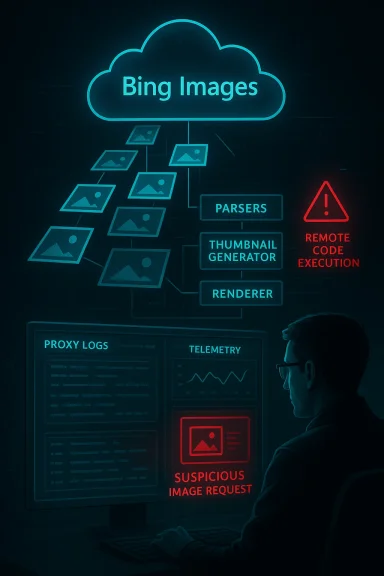
Bing, meanwhile, is no longer “just a search engine” in the narrow old sense. Its image-related services sit inside a broader ecosystem of content ingestion, ranking, preview rendering, caching, transformation, and delivery. Those are exactly the kinds of workflows that have historically attracted attackers because image pipelines frequently touch multiple parsers, decoders, metadata handlers, and downstream rendering layers. When a service called Bing Images is tied to remote code execution, the immediate concern is not only a web-facing bug, but the possibility that an attacker could reach deeper processing stages than users ever see.
That is why image-centric RCE issues carry a special kind of concern in enterprise security. They sit at the intersection of browser access, cloud service processing, and content handling. A weakness in any one of those layers can turn a simple “view image” interaction into code execution, and that path can be especially dangerous if the vulnerable component is shared across Microsoft’s own backend services.
There is also a broader historical context here. Microsoft has repeatedly dealt with image- and content-processing vulnerabilities over the years, from legacy Windows graphics issues to Office file parsing bugs and browser rendering flaws. The lesson has been consistent: content that looks passive often is not passive at all. It can trigger complex code paths that were never intended to face hostile input at internet scale.
The current CVE also arrives in an era where cloud service vulnerabilities are disclosed more openly than they once were. That is an improvement for defenders, but it can create a confusing middle ground where the vulnerability is public, the product name is public, and the risk is public, while the precise root cause remains intentionally obscured. That tension is part of the modern disclosure model.
It also influences attacker expectations. If Microsoft’s confidence is high, that suggests the underlying issue is more than rumor, which can encourage exploit development even when the technical description is limited. If confidence is lower, defenders may still act conservatively, but exploit authors may have less to work with. That distinction is subtle, but it matters.
In a modern cloud environment, an image service can become a chain of parsers and processors. Even if the user only sees a thumbnail, the backend may be normalizing formats, stripping metadata, validating file types, and precomputing delivery assets. If any of those steps is insufficiently hardened, a malicious file or crafted response can steer the service into unintended behavior.
This is why the phrase remote code execution is so serious in an image context. It implies that the attacker’s input crossed a line from data into execution. That can happen through memory corruption, unsafe deserialization, command invocation, plugin abuse, path manipulation, or logic flaws that ultimately permit code loading. Without more public details, the exact mechanism in CVE-2026-32194 remains unconfirmed.
That complexity is compounded by the fact that image services often have to support many formats. The more formats and edge cases a system accepts, the larger the parsing surface becomes. And the larger the parsing surface, the more important robust input validation becomes.
These bugs also tend to scale well for attackers. A single malformed item can potentially affect many users, many previews, or many backend workers. That makes service-side image flaws more valuable than isolated client-only issues.
That said, there is still meaningful information in the label itself. Microsoft does not hand out CVEs casually; the assignment implies enough internal certainty to acknowledge the issue as real. That is particularly important for cloud services, where vendors sometimes stage disclosures before all technical specifics are ready.
The absence of more detail is itself instructive. Microsoft may be withholding the exact attack path to reduce the risk of premature exploitation, to coordinate remediation, or because the technical analysis is still being finalized. In all three cases, the operational takeaway is the same: treat the issue as real, and treat the lack of detail as a reason to be conservative rather than complacent.
The label also does not tell us whether the flaw was internally found, reported by researchers, or discovered through incident response. That matters because provenance can change how quickly defenders should expect proof-of-concept activity to emerge.
This is especially relevant for organizations that use Microsoft ecosystems heavily across endpoints, browsers, identity, and cloud productivity. A compromise in a Microsoft service can ripple into corporate workflows even if the direct target is not a local Windows machine. Security teams should think in terms of trust boundaries, not just product names.
The practical enterprise question is whether the vulnerability could enable code execution in a way that affects backend infrastructure, user sessions, or adjacent Microsoft services. We do not know that yet. But if the flaw is service-side and reachable through normal web traffic, defenders should prepare for the possibility of broad impact and rapid weaponization.
Enterprises should also review telemetry for unusual Bing-related traffic patterns, especially if they maintain proxy logs, CASB visibility, or browser security controls. Even if no exploit details are public, anomalous access can help distinguish routine usage from targeted probing.
A consumer does not need to be “doing something dangerous” for a cloud-side RCE to matter. Simply searching for images, loading previews, or interacting with content that triggers backend processing can be enough if the service is vulnerable. That makes ordinary behavior potentially risky in a way that users cannot easily detect.
The consumer angle is also relevant because browsers and cloud services increasingly blur together. A user may not know whether a rendered image was fetched, transformed, or processed through a Microsoft backend. When the service layer is the vulnerable part, the user sees only the result, not the danger behind it.
The security implication is that users should take any Microsoft service RCE seriously, even if the issue seems abstract. In cloud security, the line between “service bug” and “user compromise” can be much thinner than it first appears.
The significance of CVE-2026-32194 is that it fits that pattern at a cloud-service level. Rather than a local document or desktop component, the attack surface is a Microsoft-hosted image workflow. That shift matters because it moves the risk from endpoint-only hardening into service trust and content processing controls.
This also reflects the broader evolution of Microsoft’s platform. As more user activity routes through cloud-hosted experiences, security bugs increasingly live where content is ingested, normalized, and transformed. That makes service-layer security every bit as important as endpoint patching.
The difference now is that cloud services can amplify the effect of a single flaw. One vulnerable processing path can potentially touch millions of requests. That makes the stakes higher than in older client-only eras.
A cloud image pipeline also raises the possibility of flawed sandboxing or malformed-content handling. Even when the core parser is safe, surrounding glue code can undermine security if it mishandles temporary files, paths, or helper invocations. In other words, the bug may not be “in the image format” so much as in the infrastructure built around it.
Another possibility is that the issue affects a service that prepares or sanitizes images for display. These components sometimes use multiple libraries, and library interoperability bugs can create security gaps that no single component owner anticipated. That is one reason image pipelines remain a fertile ground for serious flaws.
For operations teams, the key challenge is that cloud-side issues do not always map neatly onto traditional patch windows. If Microsoft services the bug server-side, customers may receive protection without a local update. But if browser behavior, service integration, or client components are involved, endpoint remediation may also matter.
That creates a dual-response problem. Teams must track both the cloud service itself and the endpoint/browser layer that interacts with it. In Microsoft-heavy environments, that usually means coordination across identity, browser management, endpoint protection, and cloud security operations.
A good starting point is behavior-based monitoring rather than signature hunting. If Bing Images is involved in content processing, unusual request volume, abnormal image types, or repeated attempts to fetch malformed content may be early signs of probing. Even without a confirmed exploit chain, those behaviors can help establish whether the issue is being tested in the wild.
Security teams should also watch for Microsoft guidance that might tie the issue to browser behavior, service endpoints, or downstream dependencies. Cloud vulnerabilities often surface indirectly through patches to components that are not obviously named in the CVE title. The title is your clue, not your full map.
There is also an opportunity here for security teams to improve cross-domain coordination. Bing Images may sound like a consumer-facing feature, but the risk spans enterprise browser use, cloud trust, and endpoint controls. Organizations that already align those teams will respond faster than those still treating them as separate silos.
There is also the risk that organizations misclassify this as a consumer problem and fail to include it in enterprise prioritization. In Microsoft-heavy environments, that would be a mistake. Service-side vulnerabilities can still affect corporate browsing, automated content workflows, and downstream trust chains.
It is also likely that additional context will come from external researchers if the issue is technically interesting or if exploitation is observed. In cloud-service cases, vendor timing and researcher validation often arrive on different clocks. Defenders should be prepared for that gap and should not wait for the perfect explanation before tightening controls.
Source: MSRC Security Update Guide - Microsoft Security Response Center
 Background
Microsoft’s Security Update Guide has become one of the company’s most important disclosure channels for product and cloud-service vulnerabilities. That matters because the guide is not merely a static catalog; it is a living record that helps security teams judge whether a vulnerability is a confirmed issue, a suspected issue, or a lower-confidence report that still deserves attention. For defenders, that confidence signal can be just as important as the CVSS score.Bing, meanwhile, is no longer “just a search engine” in the narrow old sense. Its image-related services sit inside a broader ecosystem of content ingestion, ranking, preview rendering, caching, transformation, and delivery. Those are exactly the kinds of workflows that have historically attracted attackers because image pipelines frequently touch multiple parsers, decoders, metadata handlers, and downstream rendering layers. When a service called Bing Images is tied to remote code execution, the immediate concern is not only a web-facing bug, but the possibility that an attacker could reach deeper processing stages than users ever see.
That is why image-centric RCE issues carry a special kind of concern in enterprise security. They sit at the intersection of browser access, cloud service processing, and content handling. A weakness in any one of those layers can turn a simple “view image” interaction into code execution, and that path can be especially dangerous if the vulnerable component is shared across Microsoft’s own backend services.
There is also a broader historical context here. Microsoft has repeatedly dealt with image- and content-processing vulnerabilities over the years, from legacy Windows graphics issues to Office file parsing bugs and browser rendering flaws. The lesson has been consistent: content that looks passive often is not passive at all. It can trigger complex code paths that were never intended to face hostile input at internet scale.
The current CVE also arrives in an era where cloud service vulnerabilities are disclosed more openly than they once were. That is an improvement for defenders, but it can create a confusing middle ground where the vulnerability is public, the product name is public, and the risk is public, while the precise root cause remains intentionally obscured. That tension is part of the modern disclosure model.
Why Microsoft’s confidence signal matters
Microsoft’s report-confidence framing is more than bureaucratic metadata. It helps organizations decide whether to treat an issue as an acknowledged vulnerability, a provisional issue, or a case requiring extra validation before operationalizing mitigations. In a busy patch cycle, that can change priorities quickly.It also influences attacker expectations. If Microsoft’s confidence is high, that suggests the underlying issue is more than rumor, which can encourage exploit development even when the technical description is limited. If confidence is lower, defenders may still act conservatively, but exploit authors may have less to work with. That distinction is subtle, but it matters.
What Makes Bing Images a Security-Relevant Surface
Bing Images is a service that sits in a deceptively broad attack surface. Search results are not just static HTML; they involve preview generation, remote resource handling, thumbnailing, metadata extraction, and content transformations that can span multiple systems. Each step adds complexity, and complexity is where security bugs tend to accumulate.In a modern cloud environment, an image service can become a chain of parsers and processors. Even if the user only sees a thumbnail, the backend may be normalizing formats, stripping metadata, validating file types, and precomputing delivery assets. If any of those steps is insufficiently hardened, a malicious file or crafted response can steer the service into unintended behavior.
This is why the phrase remote code execution is so serious in an image context. It implies that the attacker’s input crossed a line from data into execution. That can happen through memory corruption, unsafe deserialization, command invocation, plugin abuse, path manipulation, or logic flaws that ultimately permit code loading. Without more public details, the exact mechanism in CVE-2026-32194 remains unconfirmed.
Image pipelines are unusually complex
A single image request may pass through several layers before it is displayed. Those layers can include fetchers, file-type detectors, transcoding engines, thumbnail generators, and security scanners. If one component makes assumptions about another, an attacker can exploit that mismatch.That complexity is compounded by the fact that image services often have to support many formats. The more formats and edge cases a system accepts, the larger the parsing surface becomes. And the larger the parsing surface, the more important robust input validation becomes.
Why attackers love media-processing bugs
Media-processing bugs are attractive because they often provide a high payoff from a relatively ordinary user action. A target may never consciously “run” anything, yet the service does the dangerous work on their behalf. That makes content-triggered execution especially dangerous in large-scale platforms.These bugs also tend to scale well for attackers. A single malformed item can potentially affect many users, many previews, or many backend workers. That makes service-side image flaws more valuable than isolated client-only issues.
Interpreting the CVE Entry Without Overreading It
The public label tells us three things with confidence: Microsoft has assigned a CVE, the affected surface is Bing Images, and the vulnerability class is remote code execution. Beyond that, caution is warranted. Until Microsoft publishes more detail, it is not responsible to infer the root cause, exploit method, or threat actor interest as fact.That said, there is still meaningful information in the label itself. Microsoft does not hand out CVEs casually; the assignment implies enough internal certainty to acknowledge the issue as real. That is particularly important for cloud services, where vendors sometimes stage disclosures before all technical specifics are ready.
The absence of more detail is itself instructive. Microsoft may be withholding the exact attack path to reduce the risk of premature exploitation, to coordinate remediation, or because the technical analysis is still being finalized. In all three cases, the operational takeaway is the same: treat the issue as real, and treat the lack of detail as a reason to be conservative rather than complacent.
What the label does not tell us
The label does not reveal whether the bug is in parsing, rendering, validation, authentication, or some backend component. It does not say whether exploitation is remote-only, whether user interaction is required, or whether the issue affects all Bing Images users or only a specific service tier. Those are critical distinctions, but they are not public yet.The label also does not tell us whether the flaw was internally found, reported by researchers, or discovered through incident response. That matters because provenance can change how quickly defenders should expect proof-of-concept activity to emerge.
Enterprise Impact
For enterprises, a Bing Images RCE should be read as a cloud trust issue rather than a consumer-only problem. Even if the bug ultimately affects a Microsoft-managed service rather than an on-premises endpoint, enterprises still depend on Bing-related workflows, embedded searches, browser use, and identity-linked Microsoft services. The blast radius is therefore broader than a casual user might assume.This is especially relevant for organizations that use Microsoft ecosystems heavily across endpoints, browsers, identity, and cloud productivity. A compromise in a Microsoft service can ripple into corporate workflows even if the direct target is not a local Windows machine. Security teams should think in terms of trust boundaries, not just product names.
The practical enterprise question is whether the vulnerability could enable code execution in a way that affects backend infrastructure, user sessions, or adjacent Microsoft services. We do not know that yet. But if the flaw is service-side and reachable through normal web traffic, defenders should prepare for the possibility of broad impact and rapid weaponization.
What defenders should examine first
Security teams should review whether Bing Images is used in workflows that feed downstream automation, browser previews, or content ingestion. They should also confirm whether web filtering, secure browsing, and application controls are actively limiting image-related exposure. Those controls matter when the underlying service may be handling attacker-controlled content.Enterprises should also review telemetry for unusual Bing-related traffic patterns, especially if they maintain proxy logs, CASB visibility, or browser security controls. Even if no exploit details are public, anomalous access can help distinguish routine usage from targeted probing.
- Audit reliance on Bing image search or preview workflows.
- Review web proxy and browser telemetry for suspicious image-related traffic.
- Confirm exploit-mitigation controls on endpoints and gateways.
- Ensure Microsoft 365 and browser patching stays current.
- Watch for service-side advisories or follow-on updates from Microsoft.
- Treat new PoC claims with skepticism until independently validated.
Consumer Risk
Consumers may be tempted to dismiss a Bing Images vulnerability as something that only matters to Microsoft engineers or corporate admins. That would be a mistake. Consumer exposure is often the first line of exploitation when a flaw affects a public-facing service, because public services provide the broadest target pool and the least predictable browsing behavior.A consumer does not need to be “doing something dangerous” for a cloud-side RCE to matter. Simply searching for images, loading previews, or interacting with content that triggers backend processing can be enough if the service is vulnerable. That makes ordinary behavior potentially risky in a way that users cannot easily detect.
The consumer angle is also relevant because browsers and cloud services increasingly blur together. A user may not know whether a rendered image was fetched, transformed, or processed through a Microsoft backend. When the service layer is the vulnerable part, the user sees only the result, not the danger behind it.
Why consumer risk can still be serious
Consumer exposure often provides attackers with the scale they want. A public web service gives them broad reach and a low-friction delivery mechanism. Even if the eventual exploit requires additional conditions, the potential target base is enormous.The security implication is that users should take any Microsoft service RCE seriously, even if the issue seems abstract. In cloud security, the line between “service bug” and “user compromise” can be much thinner than it first appears.
Historical Parallels
Microsoft has a long history of image and rendering vulnerabilities becoming major security events. Old Windows graphics issues, Office parsing bugs, browser renderer flaws, and preview-handler problems all share a common trait: they turn untrusted content into trusted execution paths. That is the classic recipe for serious exploitation.The significance of CVE-2026-32194 is that it fits that pattern at a cloud-service level. Rather than a local document or desktop component, the attack surface is a Microsoft-hosted image workflow. That shift matters because it moves the risk from endpoint-only hardening into service trust and content processing controls.
This also reflects the broader evolution of Microsoft’s platform. As more user activity routes through cloud-hosted experiences, security bugs increasingly live where content is ingested, normalized, and transformed. That makes service-layer security every bit as important as endpoint patching.
Lessons from older content-processing flaws
Historically, the most dangerous bugs were often the ones users never realized were “code execution” vectors. Image files, documents, and preview panes looked harmless until they were not. That lesson still applies today, but at a larger scale.The difference now is that cloud services can amplify the effect of a single flaw. One vulnerable processing path can potentially touch millions of requests. That makes the stakes higher than in older client-only eras.
Likely Technical Patterns
Because Microsoft has not publicly disclosed the root cause, any technical discussion here must remain inferential. Still, image-related RCE in a large service usually falls into a few familiar categories: memory-safety issues in parsers, unsafe handling of embedded metadata, command injection in preprocessing, or problematic interactions between services and helper components. Those are patterns, not confirmed facts about CVE-2026-32194.A cloud image pipeline also raises the possibility of flawed sandboxing or malformed-content handling. Even when the core parser is safe, surrounding glue code can undermine security if it mishandles temporary files, paths, or helper invocations. In other words, the bug may not be “in the image format” so much as in the infrastructure built around it.
Another possibility is that the issue affects a service that prepares or sanitizes images for display. These components sometimes use multiple libraries, and library interoperability bugs can create security gaps that no single component owner anticipated. That is one reason image pipelines remain a fertile ground for serious flaws.
Common RCE patterns in media services
- Parser memory corruption.
- Unsafe file-type handling.
- Command injection via helper utilities.
- Insecure temporary file management.
- Sandbox escape through orchestration bugs.
- Deserialization or template handling errors.
Patch Management Implications
The presence of a public CVE means Microsoft has judged the issue important enough to track, but patching strategy may still depend on whether the advisory is fully serviced or still maturing. Security teams should watch the update guide closely for changes in severity, exploitability, and revision history. Those fields often tell you as much as the initial headline does.For operations teams, the key challenge is that cloud-side issues do not always map neatly onto traditional patch windows. If Microsoft services the bug server-side, customers may receive protection without a local update. But if browser behavior, service integration, or client components are involved, endpoint remediation may also matter.
That creates a dual-response problem. Teams must track both the cloud service itself and the endpoint/browser layer that interacts with it. In Microsoft-heavy environments, that usually means coordination across identity, browser management, endpoint protection, and cloud security operations.
What a responsible response looks like
- Confirm whether Microsoft has issued a remediation note or service-side fix.
- Review whether any local Microsoft software participates in the Bing Images flow.
- Validate browser and endpoint protection baselines.
- Check security logs for unusual image-service activity.
- Monitor for exploit proof-of-concepts or emergency guidance.
- Prepare communication language for users and support teams.
Threat Intelligence and Hunting
At this stage, defenders should assume that threat intelligence will arrive in fragments. Public CVE labels often precede exploit narratives by days or weeks, and sometimes the first meaningful indicators come from researchers or security vendors rather than the vendor itself. That means hunting posture matters more than waiting for a polished exploit write-up.A good starting point is behavior-based monitoring rather than signature hunting. If Bing Images is involved in content processing, unusual request volume, abnormal image types, or repeated attempts to fetch malformed content may be early signs of probing. Even without a confirmed exploit chain, those behaviors can help establish whether the issue is being tested in the wild.
Security teams should also watch for Microsoft guidance that might tie the issue to browser behavior, service endpoints, or downstream dependencies. Cloud vulnerabilities often surface indirectly through patches to components that are not obviously named in the CVE title. The title is your clue, not your full map.
Hunting priorities
- Review proxy logs for unusual Bing Images access patterns.
- Correlate image-search activity with endpoint and browser telemetry.
- Look for repeated malformed content requests.
- Track Microsoft advisory updates and revision notes.
- Watch credible threat intel feeds for proof-of-concept chatter.
- Validate whether any downstream services cache or reprocess Bing content.
Strengths and Opportunities
The main strength of Microsoft’s current disclosure model is that it gives defenders early visibility, even when the technical details are not complete. That helps teams prioritize risk before an exploit becomes a headline. It also reinforces the idea that cloud service vulnerabilities should be treated with the same seriousness as endpoint flaws.There is also an opportunity here for security teams to improve cross-domain coordination. Bing Images may sound like a consumer-facing feature, but the risk spans enterprise browser use, cloud trust, and endpoint controls. Organizations that already align those teams will respond faster than those still treating them as separate silos.
- Early CVE visibility helps defenders act before exploitation scales.
- Microsoft’s confidence framing provides useful context for triage.
- Cloud-service disclosures can improve threat modeling maturity.
- Image-pipeline scrutiny may reduce risk across other services.
- Browser and proxy telemetry can support faster detection.
- Enterprises can use the event to strengthen service-to-endpoint coordination.
- Security leaders can refine policy around public web-service risk.
Risks and Concerns
The biggest concern is the possibility that the public label underestimates the practical exploitability of the issue. A service-side RCE in a widely used Microsoft surface can move quickly from “advisory” to “active campaign” if researchers or attackers confirm the path. The lack of public technical detail does not reduce that risk; in some cases, it increases uncertainty.There is also the risk that organizations misclassify this as a consumer problem and fail to include it in enterprise prioritization. In Microsoft-heavy environments, that would be a mistake. Service-side vulnerabilities can still affect corporate browsing, automated content workflows, and downstream trust chains.
- Sparse details can delay accurate risk estimation.
- Attackers may weaponize the issue before full public analysis.
- Enterprises may wrongly assume only consumers are affected.
- Image services are often embedded in broader workflows.
- Cloud vulnerabilities can propagate through trusted integrations.
- Limited technical disclosure can hinder detection engineering.
- Overconfidence in “it’s just search” can create blind spots.
Looking Ahead
The next step is Microsoft’s own follow-up disclosure. Security teams should watch for changes to the advisory, severity, exploitability, or mitigation guidance, because those updates often transform a vague alert into actionable operations guidance. The most important thing right now is not to guess the exploit chain, but to keep tracking the official record.It is also likely that additional context will come from external researchers if the issue is technically interesting or if exploitation is observed. In cloud-service cases, vendor timing and researcher validation often arrive on different clocks. Defenders should be prepared for that gap and should not wait for the perfect explanation before tightening controls.
- Monitor the MSRC entry for revisions.
- Watch for proof-of-concept claims from reputable researchers.
- Review whether Bing-related traffic should be more tightly controlled.
- Reassess browser and proxy logging around image-heavy workflows.
- Update internal advisories if Microsoft publishes mitigation steps.
Source: MSRC Security Update Guide - Microsoft Security Response Center
Last edited:
