

Microsoft Has Confirmed the Weakness, but Not the Playbook
The most important fact about CVE-2026-32193 is also the least dramatic: Microsoft has assigned and published it. That gives defenders more confidence than a rumor, a scanner artifact, or a blog post speculating about a vulnerable component. In the language of vulnerability handling, vendor acknowledgement moves the issue out of the fog.
But acknowledgement is not the same as disclosure. The public advisory tells us the affected product and impact class, while withholding the mechanical details that would explain exactly how an attacker gets from network position to code execution. That is normal for a cloud-service vulnerability, especially when the affected surface may include managed infrastructure that customers cannot patch directly.
The user-provided metric language is useful here because it describes the difference between knowing that a vulnerability exists and knowing how it works. Confidence in existence appears high because Microsoft has published the CVE through MSRC. Confidence in root cause, exploit preconditions, and attacker workflow is lower because those details are not yet public.
That gap creates a familiar operational problem. Security teams must act before they can fully explain the bug to developers, auditors, and business owners. With AKS, that means checking version posture, maintenance windows, release channels, add-ons, network exposure, workload identity boundaries, and any unusual exceptions that might delay Microsoft’s managed updates.
AKS Makes Patch Tuesday Feel Different
Traditional Windows vulnerabilities have a relatively legible rhythm. A CVE lands, an update appears, WSUS or Intune distributes it, and administrators can argue about rings, reboots, and regressions. AKS does not fit that old model cleanly.
In managed Kubernetes, some pieces belong to Microsoft, some belong to the customer, and many sit in a gray zone where Microsoft supplies the image, the customer schedules the disruption, and Kubernetes decides how gracefully the cluster absorbs change. A remote code execution issue in AKS therefore raises a deceptively simple question: which part of the shared machine is vulnerable?
It could be a managed control-plane component, a node image package, a Kubernetes component version, an add-on, or an integration with Azure infrastructure. Each case implies a different remediation path. Some fixes arrive without customer action. Others require node image upgrades, Kubernetes minor-version movement, add-on changes, policy adjustments, or a maintenance-window decision that platform teams have postponed for months.
That is why the phrase “Azure Kubernetes Service vulnerability” should never be read as “Microsoft will handle everything while we watch.” In AKS, Microsoft owns a large part of the platform, but customers still own configuration, workload placement, privileged pods, exposed services, RBAC design, and the timing of many disruptive upgrades.
Remote Code Execution Is a Category, Not a Diagnosis
The RCE label attracts attention because it sounds like the end of the story. In practice, it is the beginning of triage. A browser RCE, a kernel RCE, a kubelet-adjacent RCE, and an admission-controller RCE all have radically different blast radii.
For AKS operators, the key issue is whether exploitation requires prior cluster credentials, access to a pod, access to the Kubernetes API, exposure of a service, or simply network reachability to a managed endpoint. Those distinctions determine whether the vulnerability is mostly a cloud-provider patching event or a customer-facing incident-response trigger.
The absence of public exploit detail is not a reason to downgrade the risk. It is a reason to avoid overfitting the response. Teams that immediately hunt for a single indicator of compromise may miss the broader hygiene work that matters in managed Kubernetes: least-privilege RBAC, node isolation, pod security controls, admission policy, image provenance, and egress monitoring.
The strongest near-term assumption is conservative but not alarmist. CVE-2026-32193 should be treated as a confirmed AKS security issue whose full exploit chain is intentionally opaque. That makes patch status and configuration hardening more important than clever speculation.
The Confidence Metric Cuts Both Ways
The metric text supplied with the advisory points to a subtle but important truth in vulnerability management. Confidence is not merely about whether defenders believe the vendor. It is also about how much technical knowledge is available to would-be attackers.
When only the existence of a vulnerability is public, defenders face uncertainty but attackers do too. When root-cause details leak, research papers appear, proof-of-concept code circulates, or exploit paths are inferred from patches, the clock changes. The same CVE can become materially more urgent without its severity score changing, simply because the attacker community learns how to reproduce it.
That is why sparse MSRC entries can feel unsatisfying to engineers but strategically useful to security teams. They reduce immediate attacker enablement while giving enterprise customers a marker to prioritize remediation. The trade-off is that administrators must make decisions with incomplete evidence.
For AKS, this trade-off is especially visible. Kubernetes is transparent by design, but managed Kubernetes is not fully inspectable by customers. You can inspect your pods, RBAC, network policies, node pools, images, and many control-plane-facing settings. You cannot diff every managed service-side change Microsoft makes on your behalf.
The Vulnerability May Be Managed, but the Blast Radius Is Yours
The most dangerous misconception in cloud security is that managed services eliminate operational responsibility. They mostly relocate it. Microsoft may patch a vulnerable managed component, but customers decide whether their clusters are overprivileged, publicly reachable, loosely segmented, or running workloads that turn a platform flaw into a business compromise.
If an AKS RCE path touches a privileged add-on, the customer’s add-on inventory matters. If it involves kubelet access, node hardening and network paths matter. If it requires Kubernetes API permissions, RBAC sprawl and stale service accounts matter. If it can be amplified through workload identity, Azure role assignments matter.
That is why platform teams should resist the urge to ask only, “Are we patched?” The better question is, “If this class of bug were exploitable in one of our clusters, what would it reach?” In a mature AKS environment, the answer should be bounded by namespaces, identities, policies, and logging. In a rushed environment, the answer may be “nearly everything.”
This is where AKS differs from a single vulnerable library inside one application. A Kubernetes flaw can become an infrastructure problem, an identity problem, and a data-access problem at the same time. The remediation path may begin with Microsoft’s fix, but the resilience story is written in the customer’s architecture.
Administrators Should Read Silence as a Signal to Inventory
A thin advisory is not an excuse to wait. It is a prompt to inventory. Before exploit details arrive, defenders have the advantage because they can reduce exposure without telling attackers which door matters.
The first pass should be boring: enumerate AKS clusters, Kubernetes versions, node image versions, add-ons, release channels, maintenance configurations, and any clusters excluded from normal upgrade workflows. The most vulnerable cluster in the estate is often not the most important production cluster. It is the forgotten one built for a migration, proof of concept, or internal tool.
The second pass should be architectural. Look for public API exposure patterns, permissive RBAC bindings, privileged containers, hostPath mounts, broad Azure role assignments, and namespaces where “temporary” exceptions became permanent. RCE vulnerabilities punish environments where administrative convenience has quietly accumulated into ambient authority.
The third pass is procedural. Confirm who can approve AKS upgrades, who owns emergency maintenance windows, which business units must be notified, and which clusters cannot tolerate node cycling without manual intervention. Security advisories become outages when organizations discover during the incident that the upgrade process exists only in a wiki page no one trusts.
Microsoft’s AKS Security Model Is Becoming More Transparent, but Not Simple
Microsoft has been moving AKS toward more explicit vulnerability communication through security bulletins, release notes, and a vulnerability data API for managed AKS components. That is a healthy shift. Enterprise customers need machine-readable ways to correlate scanner findings, AKS releases, Kubernetes versions, node images, and mitigated CVEs.
But more transparency does not automatically mean less complexity. AKS customers still need to understand the difference between a CVE in an upstream package, a CVE in a node image, a CVE in Kubernetes itself, and a vulnerability in an AKS-managed integration. The operational answer can vary from “no action required” to “upgrade immediately.”
CVE-2026-32193 sits in that broader transition. It is not enough to watch the MSRC page once and move on. Teams should track the AKS security bulletins, release notes, cluster upgrade availability, and any Microsoft updates that clarify affected versions or customer actions.
This also argues for automation. If a security team still gathers AKS posture by asking application owners to paste screenshots from the Azure portal, it will lose time. The right operating model is continuous inventory, policy-driven upgrade governance, and enough observability to know when a supposedly patched fleet still has a straggler.
The WindowsForum Angle Is the Hybrid Estate
For WindowsForum readers, the AKS label can be misleading. This is not only a Linux-container story or a cloud-native team’s problem. Many Windows shops now run hybrid estates where Microsoft Entra ID, Azure networking, Windows Server workloads, SQL back ends, developer pipelines, and AKS clusters share identity and operational dependencies.
A compromise in AKS may not stay neatly inside Kubernetes. Workloads often carry secrets, managed identities, storage access, container registry permissions, and network routes into older enterprise systems. The cluster may be “cloud native,” but the blast radius can include very traditional Windows assets.
That is why sysadmins who do not manage Kubernetes directly should still care. If AKS hosts internal APIs, build agents, automation workers, or services that talk to Windows infrastructure, then a platform vulnerability can become an enterprise pathway. The question is not whether every Windows administrator must become a Kubernetes expert. The question is whether the organization has a bridge between the people who understand AKS and the people who understand the rest of the estate.
The same applies to incident response. Logs may live in Azure Monitor, Microsoft Sentinel, Kubernetes audit streams, container runtime telemetry, application traces, and identity sign-in records. If those teams do not already know how to assemble a timeline, the middle of an RCE scare is a poor time to learn.
Vendors Patch Products; Defenders Patch Assumptions
The deeper story behind CVE-2026-32193 is not a single bug. It is the erosion of old assumptions about where the perimeter lives. Managed Kubernetes compresses infrastructure, application delivery, identity, and cloud networking into one programmable fabric, and vulnerabilities in that fabric rarely respect organizational charts.
Security programs that still divide the world into “server patching,” “network firewalling,” and “application security” will struggle with AKS. A Kubernetes RCE may require all three teams and still leave out the cloud platform group that controls managed identities and subscriptions. The incident boundary is not the cluster; it is the trust graph.
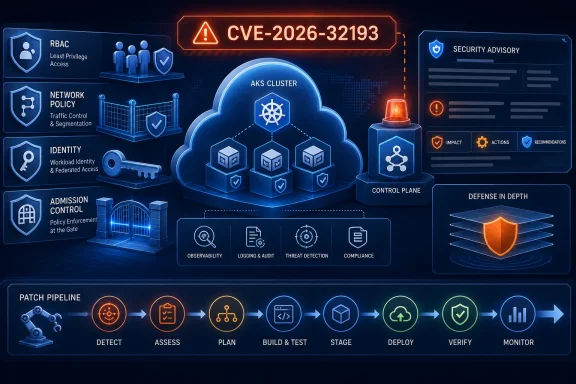
This is why governance matters. Strong AKS operations include enforced baseline policies, restricted privileged workloads, private clusters where appropriate, network policy, workload identity discipline, admission control, image scanning, secrets hygiene, and tested upgrade rings. None of these controls is glamorous. Together, they decide whether a platform CVE becomes a contained event or a sprawling incident.
CVE-2026-32193 should also push organizations to revisit exception handling. Every “temporary” privileged daemonset, every cluster-admin binding granted to a CI system, every namespace exempted from policy enforcement, and every old node pool left behind for compatibility becomes more expensive when a managed platform bug appears.
The Concrete Work Starts Before the Exploit Details Arrive
CVE-2026-32193 is still information-poor in public, but it is not action-poor. The safest response is to combine Microsoft-tracked remediation with customer-controlled reduction of blast radius. That means treating the advisory as a trigger for both patch governance and Kubernetes hygiene.
- Confirm that every AKS cluster is inventoried, including development, migration, lab, and abandoned subscription environments.
- Verify Kubernetes versions, node image versions, add-ons, maintenance windows, and upgrade-channel settings against Microsoft’s current AKS guidance.
- Prioritize clusters with public exposure, privileged workloads, broad RBAC grants, sensitive managed identities, or direct paths into production data.
- Review monitoring for Kubernetes audit events, suspicious pod exec activity, unexpected service account use, anomalous Azure role usage, and unusual egress.
- Prepare an emergency upgrade path now, because the hardest part of responding to a managed-service CVE is often organizational approval rather than technical execution.
The uncomfortable truth is that defenders rarely get perfect information at the moment they need to act. CVE-2026-32193 is a reminder that managed Kubernetes reduces some kinds of toil while concentrating other kinds of risk. Microsoft can patch the service, but customers still have to know what they run, how it is exposed, and what a compromised workload could touch next. The organizations that come out ahead will be the ones that treat this advisory not as a one-off RCE notice, but as another test of whether their cloud platform can absorb bad news without turning it into a crisis.