

Microsoft’s Linux Problem Is Now Microsoft’s Customer Problem
For years, a Linux kernel CVE in Microsoft’s Security Update Guide would have looked like a curiosity, the kind of entry that made sense only after remembering Azure, WSL, CBL-Mariner, and the cloud supply chain behind Microsoft’s modern platform. CVE-2026-46333 is not a Windows vulnerability in the classic desktop sense, and it is not something most Windows 11 home users need to race to patch on a personal laptop. But for WindowsForum’s IT readership, that distinction is less comforting than it sounds.
Microsoft now ships and supports Linux in places where enterprise Windows shops actually live. Azure Linux 3.0 underpins Microsoft-controlled infrastructure, container hosts, appliances, and images that may sit just outside the mental perimeter of a Windows administrator. The old division — Windows vulnerabilities go to the Windows team, Linux vulnerabilities go somewhere else — has been eroding for a decade.
That is why this advisory matters. It is not because ptrace is suddenly a household word. It is because Microsoft’s security boundary is no longer defined by the Windows kernel alone, and administrators who treat Linux advisories as someone else’s paperwork are increasingly misreading their own estate.
A Small Kernel Logic Bug With an Uncomfortably Large Blast Radius
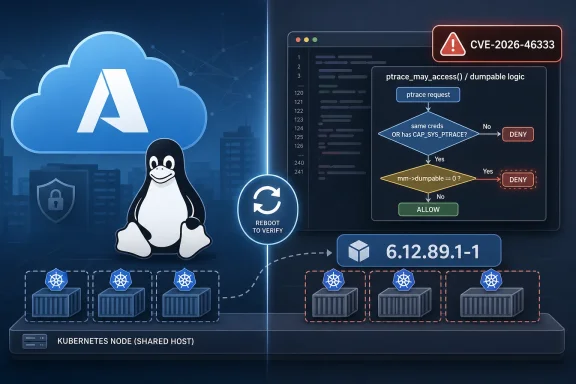
The vulnerability sits in the Linux kernel’s ptrace access logic, specifically around how the kernel reasons about whether a process is “dumpable.” In Linux terms, dumpability is tied to whether a task’s memory image can be exposed through mechanisms such as core dumps and process inspection. The concept is old, practical, and easy to underestimate.
The awkward bit in CVE-2026-46333 is that this dumpability logic was being used in a context where the task may no longer have an associated memory descriptor. In plain English, the kernel had to decide whether one process could inspect or access details associated with another process, but the state it consulted did not always mean what the surrounding security check assumed it meant.
That is the kind of bug kernel developers often describe with modest language and security teams later translate into incident-response urgency. The upstream phrasing — “slightly saner” logic — has the understatement of a maintainer fixing a sharp edge that has existed longer than anyone wants to admit. But access-control bugs in introspection paths are rarely just semantic cleanups.
ptrace is one of those Unix mechanisms that sits at the crossroads of debugging, observability, forensics, exploit development, and post-compromise tooling. It is legitimate when a debugger uses it. It is suspicious when malware uses it to peer into another process. It is operationally necessary when tracing tools use it to understand a system in distress.
That dual nature is what makes the vulnerability worth attention. Anything that changes ptrace access decisions can ripple into hardening models, container boundaries, privilege assumptions, and local attacker workflows. Even if exploitation requires local access, local access is precisely what attackers often gain first in a chained intrusion.
The Word “Moderate” Does Not Mean “Ignore”
Microsoft’s listing shows CVE-2026-46333 as affecting Azure Linux 3.0 kernel packages, with the kernel-hwe 6.12 package receiving a fixed build of 6.12.89.1-1. The visible severity in Microsoft’s table is Moderate for the HWE row, while one related kernel row is listed without the same level of detail. That asymmetry is itself a small lesson in vulnerability management: advisory tables are not threat models.
A “Moderate” label can be perfectly defensible in scoring terms while still demanding attention in specific environments. Local privilege escalation, credential exposure, and process-inspection bugs often look less dramatic than remote code execution because they usually require a foothold. But modern attacks are built from footholds. The first bug gets code onto the machine; the second bug gets better privileges; the third bug gets persistence or secrets.
For Azure Linux users, the severity label should be read alongside deployment context. A single-purpose appliance with tight controls is not the same as a multi-tenant build worker, a Kubernetes node, a CI runner, or a bastion-adjacent Linux VM where developers and automation accounts both operate. Kernel bugs live closer to the trust floor than application bugs, and their risk changes dramatically with who can run code nearby.
The practical interpretation is simple: do not panic, but do not let the word Moderate become an excuse for drift. Kernel updates are disruptive enough that administrators often defer them until the next maintenance window. CVE-2026-46333 is exactly the sort of issue that tests whether those maintenance windows are real or aspirational.
The ptrace Family Keeps Teaching the Same Lesson
ptrace has always been a compromise between power and danger. It exists because operating systems need debuggers, profilers, crash handlers, sandbox helpers, and diagnostic tools. It is dangerous because the ability to inspect another process can become the ability to extract secrets, manipulate execution, or bypass assumptions about process isolation.
Linux tries to mediate that danger with credentials, capabilities, dumpability flags, namespaces, Yama restrictions, seccomp filters, and distribution-specific hardening choices. None of those controls is magic. They are layers of policy wrapped around a primitive that was designed in an era before container platforms, cloud tenants, and ephemeral CI infrastructure became normal.
CVE-2026-46333 lands in the uncomfortable space between “this is how Unix works” and “this is not how modern isolation should fail.” The issue is not that ptrace exists. The issue is that access checks around ptrace-like behavior must be painfully precise, because every odd task state becomes a possible policy gap.
The kernel’s own language around dumpability points toward the root problem. Dumpability is fundamentally about a memory image; it becomes conceptually strained when used for tasks without the memory context that gives the concept meaning. When access-control logic borrows a concept outside its clean domain, the code may work for years until an unusual path exposes the mismatch.
That is a familiar pattern in security engineering. The bug is rarely a single dramatic line. It is a small semantic assumption, carried forward through refactors and special cases, until an attacker or researcher asks what happens when the system is in the least convenient state.
Azure Linux Puts the Advisory in Microsoft’s Front Yard
The affected Microsoft product row is Azure Linux 3.0, not Windows Server. That matters because Azure Linux is not a hobby distribution living at the edge of Microsoft’s portfolio. It is Microsoft’s own Linux distribution lineage for cloud workloads, containers, and platform infrastructure.
This is the post-Windows Microsoft in its most practical form. The company still sells and services Windows, but it also maintains Linux components because Azure, Kubernetes, developer tooling, and cloud-native workloads demand it. A vulnerability in Azure Linux is therefore not a detour from Microsoft security coverage; it is central to what Microsoft now operates.
For administrators, the question is not whether they personally chose Azure Linux. It is whether Azure Linux appears in their environment through a managed service, a marketplace image, a container host, a Microsoft appliance, a build image, or an inherited platform decision. Many organizations have Linux exposure they do not inventory with the same discipline they apply to Windows endpoints.
That gap becomes painful when a kernel CVE appears. Windows patching has decades of process behind it: WSUS, Intune, Configuration Manager, rings, compliance reports, emergency out-of-band workflows. Linux kernel patching in mixed estates is often more fragmented, especially when ownership is split among cloud teams, DevOps teams, security teams, and traditional infrastructure teams.
CVE-2026-46333 should prompt a basic but revealing exercise: find every Azure Linux 3.0 instance, identify its kernel package line, determine whether the fixed build is present, and confirm that the system has actually rebooted into the patched kernel. Installing a kernel package is only half the work. Running it is the point.
Containers Make Local Bugs Feel Less Local
The phrase “local vulnerability” has lost some of its calming power. In a simple server model, local access means the attacker already has a shell on the machine. In a containerized model, local access might mean the attacker has code execution inside a workload that shares enough kernel surface with the host to make the next move interesting.
Containers do not bring their own kernel. They share the host kernel, which is why kernel vulnerabilities remain central to container security. Namespaces, cgroups, seccomp, AppArmor, SELinux, and runtime defaults all reduce exposure, but they do not turn a vulnerable host kernel into a safe one.
This is where ptrace-related bugs become especially sensitive. Container platforms often restrict process inspection and debugging features precisely because they cut across isolation assumptions. A vulnerability that changes access checks around ptrace-adjacent behavior can matter differently depending on runtime configuration, seccomp profile, namespace layout, and whether privileged containers are present.
The safest interpretation for platform teams is not “this CVE breaks containers.” That would be too broad and too confident. The safer interpretation is that any kernel bug involving process access logic deserves closer review on shared nodes, especially where untrusted or semi-trusted workloads run.
For Kubernetes operators, this means node image management is part of vulnerability response. Patching application containers does nothing if the vulnerable component is the host kernel. Draining nodes, applying the updated kernel, rebooting, and verifying the running version are still the core steps, however automated the platform looks from above.
The Disappointing Part Is the Advisory Shape
Microsoft’s Security Update Guide entry is useful because it gives affected product rows, release dates, update status, and fixed build information. It is less useful because it leaves the most important operational questions for administrators to infer. That is not unique to Microsoft; it is a common flaw in vulnerability portals built for compliance workflows rather than engineering decisions.
A sysadmin reading the entry wants to know what kind of access an attacker needs, what hardening settings reduce risk, whether exploitation is known, whether containers materially change exposure, and which Microsoft services or images may inherit the vulnerable kernel. The advisory format instead gives the skeletal facts and moves on.
This is where the broader vulnerability ecosystem fills the gaps, sometimes helpfully and sometimes noisily. Third-party trackers may assign higher severity, add exploitability speculation, or describe likely attack chains. Distribution advisories may include richer status information for their own packages. Forums and social posts may surface mitigations before vendors endorse them.
The problem is that administrators must sort signal from theater. A kernel access-control CVE can be serious without being a five-alarm emergency for every environment. Conversely, a Microsoft Moderate rating can coexist with high urgency for a specific fleet of exposed Linux nodes.
The right response is disciplined triage. Treat Microsoft’s advisory as the authoritative source for Microsoft package status, not as the complete risk narrative. Treat external reporting as useful context, not as a replacement for testing, inventory, and environment-specific exposure analysis.
The Patch Is the Clean Fix, but Reboots Remain the Tax
Kernel vulnerabilities always bring the same operational tax: the fix usually requires a reboot to take effect. Live patching can soften that reality in some ecosystems, but most administrators still need to plan for workload movement, node draining, maintenance windows, and verification after restart.
For Azure Linux 3.0 systems on the affected HWE line, the fixed build shown by Microsoft is 6.12.89.1-1. Administrators should not stop at confirming that an update package exists in a repository. They need to confirm the installed package, the booted kernel, and the state of workloads after reboot.
That last step is where many organizations quietly fail. Compliance dashboards often record package installation. Attackers care about the code currently running in memory. If the updated kernel is installed but the machine has not rebooted, the vulnerability remains in the active kernel.
The basic workflow is old-fashioned but reliable. Inventory systems by distribution and kernel line. Apply the vendor update. Reboot into the fixed kernel. Confirm the running kernel version. Reconcile exceptions. Repeat for golden images, scale sets, build agents, and container host pools that might recreate vulnerable nodes after today’s patching run.
Golden images deserve special mention. A manually patched VM is good for the life of that VM. A vulnerable base image is a factory for future vulnerable machines. Cloud environments make it easy to destroy and recreate infrastructure, but that convenience becomes a liability when the image pipeline lags behind the advisory pipeline.
Mitigation Is Not a Substitute for Knowing Your Kernel
There are hardening controls that can reduce exposure to ptrace-style abuse. Linux systems may restrict ptrace behavior, container runtimes may enforce seccomp profiles, and administrators may remove unnecessary privileges from workloads. These controls are valuable, and in some environments they may block known exploitation techniques.
But mitigation should not become a story administrators tell themselves to avoid patching. Kernel access-control bugs are not a great place to rely on partial workarounds unless there is no other choice. The reason is simple: the kernel is the shared substrate beneath all those controls, and the exact exploit path may differ from the proof-of-concept path that a mitigation blocks.
This is especially true in mixed Windows and Linux shops, where Linux hosts may be treated as appliances. Nobody wants to own them because they are “just” container nodes, “just” CI runners, or “just” managed images. That language is dangerous. Attackers do not care whether a system is culturally Windows or Linux; they care whether it has credentials, network reach, and a kernel bug.
The better approach is layered. Apply the patch as the durable fix. Keep ptrace restrictions and seccomp profiles as defense in depth. Review privileged containers, hostPID usage, broad capabilities, and debugging exceptions as part of the same response. The CVE is a forcing function to revisit assumptions that should have been audited anyway.
Security teams should also watch for operational overcorrection. Blocking all debugging or tracing functionality without coordination can break incident response, performance diagnostics, and developer workflows. The goal is not to make systems opaque. The goal is to ensure that introspection is deliberate, authorized, and narrow.
Windows Admins Are Now Linux Kernel Stakeholders
The Windows administrator’s job description has been expanding for years, but CVEs like this make the expansion explicit. If your organization runs Azure workloads, Kubernetes clusters, WSL-backed developer workflows, Linux build agents, or Microsoft-maintained Linux images, then Linux kernel hygiene is no longer outside your lane. It may not be your only lane, but it crosses yours.
This does not mean every Windows admin needs to become a kernel maintainer. It does mean patch governance must reflect reality. Asset inventories should not end at Active Directory-joined servers. Vulnerability reports should not collapse Linux nodes into a vague “cloud” category. Change boards should understand that a kernel reboot on a node pool can be as security-relevant as a cumulative update on Windows Server.
Microsoft’s presence in the advisory chain cuts both ways. On one hand, it centralizes useful information for Azure Linux customers who already monitor MSRC. On the other hand, it can create a false sense that if the item appears in a Microsoft portal, then standard Windows patch processes will automatically handle it. They will not.
Azure Linux patching belongs to the Linux and cloud-management workflow, even when the advisory arrives through Microsoft channels. That means package repositories, image versions, VM extensions, automation scripts, cluster node rotations, and reboot orchestration. It is adjacent to Windows patching, not identical to it.
The organizations that handle this well will be the ones that stop organizing vulnerability response by operating-system nostalgia. The estate is hybrid. The patch process has to be hybrid too.
The CVE Record Is Also a Supply-Chain Signal
CVE-2026-46333 is assigned by Linux, surfaced by Microsoft, tracked by distributions, and consumed by enterprise vulnerability scanners. That path is a compact example of how modern security information moves. No single vendor owns the whole story, but each vendor owns a piece customers depend on.
For Microsoft, the important responsibility is not merely to mirror the CVE. It is to state clearly which Microsoft-maintained products are affected, which builds contain the fix, and how customers should consume the update. The MSRC entry does that at a minimum viable level. For administrators under pressure, minimum viable guidance can still leave too much ambiguity.
For the Linux ecosystem, the issue is another illustration of how kernel CVEs have become more formalized and more numerous. As the kernel project and distributions improve vulnerability tracking, more fixes receive CVE identifiers, including fixes that may once have been treated as obscure correctness patches. That is good for transparency, but it also increases triage load.
For enterprises, the only sustainable answer is context. Not every kernel CVE deserves an emergency bridge. Not every “Moderate” CVE can wait for quarterly maintenance. The difference depends on workload exposure, local-user boundaries, container posture, exploit maturity, and the operational cost of patching.
This is why security teams should resist both extremes: CVE fatigue and CVE absolutism. Fatigue says the list is too long, so nothing matters. Absolutism says every CVE matters equally, so teams drown. CVE-2026-46333 sits in the middle: specific, technical, probably environment-dependent, and still important enough to force action where Azure Linux 3.0 is present.
The Practical Signal Hidden in the “Slightly Saner” Patch
There is a useful lesson in the modest upstream wording. “Slightly saner” sounds like cleanup, but security often lives in cleanup. Making logic match the concept it claims to enforce is not cosmetic when that logic decides who can inspect whom.
Kernel maintainers often fix bugs by tightening semantics rather than announcing a grand security boundary. That makes sense from the maintainer’s seat. Code should be correct whether or not someone has branded the incorrectness as a vulnerability. But from the administrator’s seat, the CVE label changes the urgency because it connects the fix to an actionable risk.
This gap between engineering language and operational language is one of the recurring tensions in security. Developers may see an edge case. Attackers may see a primitive. Administrators may see a reboot. Executives may see a severity score. All four views can be true, and none is sufficient alone.
The best security programs translate among those views quickly. They can tell platform teams which kernel line is affected. They can tell management why a Moderate label still requires scheduled disruption. They can tell developers why debugging exceptions are being reviewed. They can tell auditors which systems are patched and which are pending reboot.
CVE-2026-46333 is not the largest kernel story of the year, and it does not need to be inflated into one. Its value is as a concrete reminder that access-control correctness in the kernel remains foundational, and that Microsoft’s cloud-era product surface includes Linux components whose patch state belongs in mainstream enterprise governance.
The Azure Linux Row Administrators Should Not Scroll Past
The immediate action is narrow enough to be manageable. If you run Azure Linux 3.0, check whether your systems use the affected kernel packages and whether the fixed kernel build is installed and active. If you operate containers or Kubernetes nodes on Azure Linux, treat host kernel verification as part of the response, not as an afterthought.
The broader action is more strategic. Add Microsoft-maintained Linux assets to the same vulnerability-management muscle memory that already exists for Windows. That does not mean using the same tools everywhere. It means expecting the same outcomes: inventory, prioritization, deployment, reboot, verification, exception tracking, and image refresh.
A vulnerability like this also belongs in tabletop conversations. Ask who owns Azure Linux node images. Ask who approves emergency kernel reboots. Ask whether vulnerability scanners can distinguish installed kernel packages from running kernels. Ask whether build agents and ephemeral hosts are rebuilt from patched images or merely patched after launch.
These questions are not glamorous. They are the difference between a patched fleet and a dashboard that says “mostly patched” while old kernels continue to run. Kernel CVEs punish that kind of ambiguity.
The Small Advisory That Exposes a Bigger Operating Model
CVE-2026-46333 is useful because it compresses several modern security truths into one unassuming advisory. Microsoft is a Linux vendor where Azure requires it. Linux kernel bugs are Microsoft customer issues where Microsoft ships the kernel. Local vulnerabilities matter in cloud and container environments because local code execution is often one step in a longer chain.
The concrete response should be equally compressed:
- Administrators should identify Azure Linux 3.0 systems and confirm whether they are on an affected kernel line.
- Systems using the affected HWE 6.12 package should be updated to the fixed build and rebooted into that kernel.
- Container and Kubernetes operators should verify host kernels, not just application images.
- Security teams should treat ptrace restrictions, seccomp profiles, and privilege reduction as defense in depth rather than replacements for patching.
- Image owners should refresh base images so newly created systems do not reintroduce the vulnerable kernel.
- Windows-focused teams should include Microsoft-supported Linux assets in normal vulnerability governance.
The lesson is not that every Windows administrator must become a Linux specialist overnight. The lesson is that the Microsoft estate has changed faster than many patch processes have. CVE-2026-46333 is a modest kernel advisory with a bigger message: in 2026, Microsoft security hygiene includes Linux kernel hygiene, and the organizations that accept that now will have fewer surprises when the next “slightly saner” fix turns out to matter a great deal.
References
- CVE-2026-46333 ptrace: slightly saner 'get_dumpable()' logic MSRC · 2026-05-21T01:01:46-07:00