

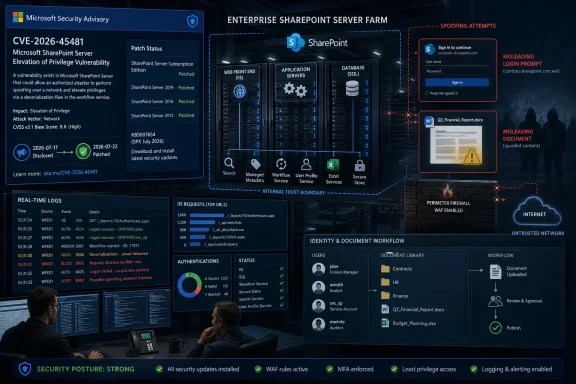
Microsoft’s Acknowledgement Changes the Patch Math
A spoofing vulnerability in SharePoint Server rarely produces the same visceral reaction as a remote code execution flaw with a 9.8 severity score. That is partly because “spoofing” sounds softer than “code execution,” and partly because the practical impact depends heavily on where the flaw sits in the authentication, request-routing, document, or user-interface path. But SharePoint is not a desktop utility; it is a collaboration platform that often mediates trust between users, documents, workflows, add-ins, identity providers, and internal line-of-business systems.
That makes Microsoft’s acknowledgement the first real threshold. A CVE entry in the Microsoft Security Response Center pipeline is not a rumor, a scanner heuristic, or a speculative blog post. It is a vendor-recognized security issue in a supported Microsoft product family, and that moves the question from “is this real?” to “where does it sit in our exposure model?”
The user-supplied metric text points to exactly this distinction. Confidence in a vulnerability is not just an academic scoring field; it is a measure of how much defenders and attackers know. A flaw whose root cause is unknown may be hard to weaponize, but also hard to defend against precisely. A flaw acknowledged by the vendor may still lack public exploit details, but it is real enough to drive patching, change windows, and compensating controls.
For SharePoint administrators, that should be familiar terrain. The platform has spent the last several years reminding enterprises that on-premises collaboration servers are high-value targets. They are often internet-adjacent, heavily customized, integrated with Active Directory or Entra-backed identity, and slow to patch because updates require farm planning rather than a casual reboot.
Spoofing Is a Trust Failure, Not a Cosmetic Bug
The term spoofing tends to flatten too many different bug classes into one label. In Microsoft advisories, spoofing can cover anything from misleading a user interface to impersonating a resource, tampering with rendered content, abusing path handling, or causing a victim or server component to trust the wrong origin. Some spoofing bugs are irritating but narrow. Others become stepping stones in larger chains.
That distinction matters for SharePoint because the product is fundamentally a trust broker. Users trust it to show the right document, from the right library, under the right permissions. Workflows trust it to pass metadata and state correctly. Administrators trust farm boundaries, web applications, zones, authentication providers, and service applications to behave in predictable ways.
A spoofing flaw in that environment is not automatically catastrophic, but it is also not automatically low priority. If an attacker can make SharePoint misrepresent identity, location, content, or intent, the result may be credential theft, malicious document delivery, workflow confusion, or a social-engineering assist that looks more credible because it originates from a trusted internal system.
That is why the confidence metric quoted in the submission is useful. It reminds defenders that vulnerability severity is not just about impact after exploitation. It is also about the maturity of knowledge around the bug. A confirmed vulnerability with limited technical detail can be a race: Microsoft and defenders know enough to patch, while attackers may be probing updates, diffing binaries, or watching for organizations that delay deployment.
SharePoint Server Remains the Enterprise’s Difficult Patch Target
SharePoint Online changed the patching model for many organizations by moving infrastructure maintenance into Microsoft’s cloud. SharePoint Server did not disappear. Government agencies, regulated industries, hybrid enterprises, manufacturers, universities, and companies with years of custom workflows still run on-premises farms because migration is expensive, politically complicated, or technically constrained.
Those environments are exactly where patch urgency becomes messy. SharePoint updates are not small browser patches. A proper maintenance cycle often includes backing up databases, validating farm health, applying updates across servers, running the SharePoint Products Configuration Wizard, checking custom solutions, and confirming search, workflow, authentication, and service application behavior afterward.
That friction creates a predictable lag between advisory and protection. Attackers know this. Security teams know this. Microsoft knows this. The result is a recurring pattern in which SharePoint flaws receive a patch, public attention spikes, scanners begin probing exposed servers, and the long tail of unpatched farms remains visible for weeks or months.
CVE-2026-45481 should be read against that background. Without public technical specifics, it may not deserve panic. But it does deserve inventory, version checks, and a patch plan that treats SharePoint as infrastructure rather than as a business application someone else owns.
The Real Risk Lives Between the Advisory and the Farm
The most dangerous period for many Microsoft server vulnerabilities is not always before disclosure. It is the interval after disclosure, when patches exist, metadata is public, and enterprise deployment is uneven. That is when attackers can compare patched and unpatched systems, infer the vulnerable component, and test the internet for laggards.
For SharePoint, this period is especially uncomfortable because the platform has many moving parts. Farms may expose different web applications to different networks. Some servers may be patched while others are not. A reverse proxy, load balancer, or web application firewall may obscure the real state of the farm from casual inspection while still allowing vulnerable code paths to be reached.
This is where administrators should resist the temptation to treat a spoofing label as a deferrable item. The right question is not “can this directly execute code?” The right question is whether the vulnerable behavior can help an attacker cross a trust boundary, phish with internal credibility, poison a workflow, abuse a document-handling path, or combine with another weakness.
Modern exploitation is compositional. One vulnerability supplies initial trust confusion. Another supplies file write. A misconfiguration supplies excessive privilege. A stale service account supplies persistence. The headline CVE may not be the whole attack; it may be one tile in the mosaic.
The Confidence Metric Is a Warning About Attacker Knowledge
The quoted description of the metric is doing more than defining a field. It is explaining why defenders should care about how much is publicly known. A vulnerability whose existence is merely rumored has one kind of urgency. A vulnerability corroborated by independent research has another. A vulnerability confirmed by the vendor has crossed a line.
That line matters because vendor acknowledgement usually means there is enough internal detail to classify the bug, assign affected products, and point customers toward remediation. It may also mean a patch can be reverse engineered. Even when Microsoft withholds exploit details, the update itself can become a map for capable attackers.
This is the paradox of responsible disclosure at enterprise scale. Public advisories are necessary so defenders can act, but they also create a signal for adversaries. The more widely deployed and slower-to-patch the product, the more valuable that signal becomes.
For CVE-2026-45481, the practical implication is straightforward: administrators should not wait for a proof-of-concept exploit to treat the vulnerability as real. The point of a confidence metric is to prevent exactly that kind of delay. By the time exploit details are widely circulating, the operational advantage has often shifted away from defenders.
Microsoft’s Sparse Disclosure Is a Feature and a Frustration
Microsoft’s Security Update Guide often gives administrators just enough to act and not always enough to understand. That is deliberate to some degree. Publishing root-cause detail too early can accelerate exploitation, especially for server-side vulnerabilities in widely deployed enterprise products.
But sparse disclosure also creates a burden for defenders. Security teams must explain to change boards why a patch matters without being able to point to a vivid exploit chain. Server owners must justify downtime for a vulnerability whose title may sound abstract. Executives may ask whether the company is actually exposed, and the honest answer may be: probably, if the affected SharePoint version is present, but the public detail is not sufficient to model every path.
That uncertainty should not paralyze response. It should shape response. The right move is to verify affected products, patch supported systems, reduce unnecessary exposure, and monitor for suspicious SharePoint activity. The wrong move is to treat missing technical details as a reason to do nothing.
Microsoft’s position is also constrained by the SharePoint ecosystem itself. On-premises farms vary wildly. A vulnerability that is dangerous in one topology may be less reachable in another. Custom solutions, authentication modes, alternate access mappings, and third-party integrations can all influence real-world exposure.
The Cloud Escape Hatch Is Real, but Not Immediate
Every serious SharePoint Server vulnerability renews the argument for moving collaboration workloads to Microsoft 365. There is a strong case for that migration: cloud-hosted SharePoint removes much of the patching burden, standardizes the service boundary, and gives Microsoft more direct control over mitigation. For many organizations, the best long-term security decision is to stop running collaboration infrastructure as bespoke local plumbing.
But that argument can become glib. On-premises SharePoint often exists because it is entangled with business processes that are hard to move. Custom farm solutions, legacy authentication, local compliance requirements, data residency concerns, and integration with older systems can make migration a multi-year program rather than a procurement decision.
That means CVE-2026-45481 is not simply another reason to say “go cloud.” It is another reminder that if an organization keeps SharePoint Server, it must fund and operate it like critical infrastructure. That includes lifecycle management, disaster recovery, patch rehearsal, asset discovery, and executive visibility into exposure.
The worst model is the halfway house: SharePoint remains on-premises because migration is hard, but the farm is treated as a legacy application with no strong owner. That is how collaboration platforms become security liabilities. They are too important to turn off, too old to love, and too complex to patch quickly.
Administrators Need Evidence, Not Vibes
The first practical step is asset clarity. Security teams should know which SharePoint Server versions are deployed, which farms are internet-facing, which are reachable through VPN or partner networks, and which run unsupported or nearly unsupported components. If that inventory does not exist, CVE-2026-45481 is a useful excuse to build it.
The second step is patch validation. SharePoint patching is not complete merely because Windows Update says something installed. Administrators need to verify farm build numbers, confirm that configuration steps completed, and ensure every server in the farm is at the intended patch level. Partial patching can create its own operational and security ambiguity.
The third step is exposure reduction. Not every SharePoint site needs to be reachable from every network. If a farm does not require direct internet exposure, it should not have it. If a legacy portal is only needed by a small population, access should be constrained accordingly. These controls are not substitutes for patching, but they buy time when patching is slow.
The fourth step is monitoring. SharePoint logs, IIS logs, authentication telemetry, endpoint detection data, and reverse proxy logs should all be part of the investigation surface. Spoofing flaws may not leave the same footprints as code execution, but anomalous requests, strange user-agent patterns, unexpected document access, and unusual authentication flows can still tell a story.
Security Teams Should Read the Advisory Like Attackers Do
Attackers do not need a full write-up to begin work. A product name, vulnerability class, affected version, and patch timing may be enough to start narrowing the search. They can inspect changed files, compare behavior, fuzz likely endpoints, and scan for exposed servers.
Defenders should adopt the same adversarial reading. If the advisory says SharePoint Server, assume externally reachable farms will be enumerated. If the issue is spoofing, assume attackers will test user interaction paths, request paths, document rendering, authentication redirects, and anything that can cause a victim or service to trust attacker-controlled input. If Microsoft ships a patch, assume the patch itself will be studied.
That does not mean every organization should drop everything for every spoofing CVE. It means prioritization should be based on exposure and business role, not just the vulnerability label. An internal-only test farm is one thing. A production SharePoint portal reachable by employees, contractors, and partners is another.
It also means security teams should avoid binary language with leadership. The honest assessment may be that there is a confirmed vendor vulnerability, limited public technical detail, no broadly known exploit at the time of review, and a meaningful risk of future exploitation if patching lags. That is not dramatic, but it is actionable.
The Lesson From SharePoint’s Recent History Is Patch Discipline
SharePoint has already shown how quickly a collaboration platform can move from routine enterprise software to emergency incident-response subject. Recent years have seen attackers pay close attention to on-premises Microsoft server products because those systems combine reachability, privilege, identity integration, and slow patch cycles. Exchange taught that lesson brutally. SharePoint has been teaching it repeatedly.
The common thread is not that every vulnerability is equally severe. It is that server-side Microsoft vulnerabilities live in ecosystems where patch delays are exploitable. The more complex the server, the more likely an organization has exceptions, customizations, or dependencies that slow updates.
CVE-2026-45481 may turn out to be narrow. It may remain a relatively contained spoofing issue with no major public exploitation story. But defenders do not get to know that in advance. They have to make decisions under uncertainty, and vendor confirmation shifts the burden toward action.
This is where mature vulnerability management separates itself from checklist compliance. A mature program does not merely ask whether a CVE is critical. It asks where the affected product sits, what the exposure path is, how fast the organization can patch, what compensating controls exist, and what evidence would show attempted exploitation.
The CVE-2026-45481 Checklist Writes Itself
For WindowsForum readers running or defending SharePoint Server, this is the compact version of the operational story: treat the advisory as confirmed, treat the technical silence as temporary, and treat your farm topology as the deciding factor in urgency. The vulnerability class may say spoofing, but the platform context says trust boundary.
- Organizations should verify whether they run affected SharePoint Server versions before assuming the issue is irrelevant.
- Administrators should apply the relevant Microsoft security update through a planned SharePoint maintenance process, not through ad hoc server-by-server guesswork.
- Security teams should prioritize farms that are internet-facing, partner-facing, VPN-accessible, or integrated with sensitive workflows.
- Patch validation should include farm build checks and confirmation that post-update configuration tasks completed successfully.
- Temporary mitigations should focus on reducing unnecessary exposure, tightening access paths, and increasing monitoring until patching is complete.
- Teams should document the decision if they defer patching, because “spoofing” alone is not a sufficient reason to downgrade the risk.
The broader point is simple: Microsoft’s acknowledgement is enough to act, even if it is not enough to satisfy curiosity. In the SharePoint world, waiting for perfect public detail is often just another way of giving attackers a maintenance window of their own. CVE-2026-45481 should push administrators toward the unglamorous work that actually reduces risk: know the farms, patch the farms, verify the farms, and stop pretending that on-premises collaboration servers are background scenery.