

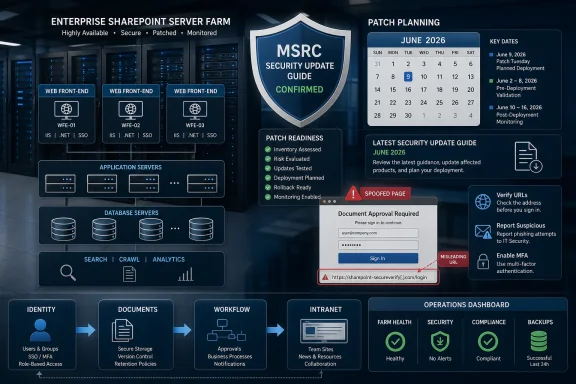
Microsoft’s Acknowledgement Moves This From Rumor to Patch Queue
The most useful fact about CVE-2026-45453 is also the least dramatic: Microsoft has assigned it a Security Update Guide entry. That sounds bureaucratic, but in vulnerability management it is the line between a vague industry warning and a vendor-recognized defect with operational consequences.
The user-supplied metric text is describing report confidence, the CVSS idea that not every vulnerability disclosure carries the same evidentiary weight. Some flaws are reported from third-party research with thin public detail. Some are inferred from crash behavior, exploit traces, or partial reverse engineering. Others are confirmed by the vendor that owns the affected code.
CVE-2026-45453 belongs in that latter administrative bucket because Microsoft’s own update guide is the source being referenced. That does not mean every technical detail is public, and it does not mean exploit code exists. It means defenders should treat the vulnerability as real, track the affected SharePoint Server builds, and move it into normal patch governance rather than waiting for a proof-of-concept blog post.
That distinction matters in SharePoint because the platform is rarely a single box that can be casually rebooted over lunch. It is usually a farm, a database dependency, a search service, a set of customizations, and a collection of business owners who remember the last time a cumulative update broke a workflow.
“Spoofing” Is the Word That Makes People Underreact
Microsoft’s taxonomy often labels vulnerabilities by impact: remote code execution, elevation of privilege, information disclosure, denial of service, spoofing. In boardroom risk conversations, “spoofing” tends to land with less force than “RCE.” That is understandable, but it can also be misleading.
Spoofing in a collaboration platform is not merely cosmetic. SharePoint mediates trust: who authored a document, which URL a user believes they are visiting, which identity a workflow thinks it is handling, which site or file a user is being asked to trust. A spoofing flaw can undermine the signals people and systems rely on before taking the next action.
That does not automatically make CVE-2026-45453 catastrophic. Without public technical detail, defenders should avoid inventing an exploit chain. But they should also avoid the opposite error: assuming that anything short of code execution can wait indefinitely.
SharePoint has a long history of being used as an internal trust amplifier. A convincing page, document prompt, workflow notification, or identity-adjacent deception inside SharePoint can carry more credibility than the same lure arriving from the open Internet. The attacker does not always need to own the server outright if the platform can be made to help sell the lie.
The Confidence Metric Is Really About Attacker Knowledge
The metric text supplied with the advisory gets at a subtle point that patch teams often miss. Report confidence is not only about whether defenders believe the bug exists. It is also about how much technical certainty may be available to attackers.
When a vendor acknowledges a vulnerability, the uncertainty shrinks. Attackers can compare patched and unpatched binaries, inspect changed assemblies, review request-handling differences, and hunt for the bug class even when Microsoft withholds exploit detail. The public advisory may be sparse, but the patch itself can become a map.
That is why “no public exploit” should not be confused with “low urgency.” In mature adversary ecosystems, Patch Tuesday starts a race. Defenders test and deploy updates; attackers diff patches and look for laggards. The question is not whether every criminal crew can weaponize the issue immediately. The question is how long exposed or poorly governed SharePoint farms will remain behind once the fix is available.
This is especially relevant for on-premises SharePoint, where Microsoft does not patch the customer’s server farm directly. SharePoint Online customers live inside Microsoft’s service boundary. SharePoint Server customers own the maintenance window, regression testing, backup posture, and rollback plan.
SharePoint Server Remains the Enterprise Exception to the Cloud Rule
It is tempting to treat on-premises SharePoint as yesterday’s problem. Microsoft 365 has absorbed much of the collaboration story, and SharePoint Online is the version most end users experience whether they know it or not. Yet SharePoint Server persists for reasons that are not always irrational.
Some organizations keep SharePoint on-premises because of data residency, disconnected environments, legacy customizations, regulated workflows, or integration with line-of-business systems that were never rebuilt for the cloud. Others simply have too much organizational gravity invested in old farms to migrate quickly. Those environments are exactly where patching is slowest and risk acceptance becomes normalized.
Microsoft’s own servicing model reinforces the reality that SharePoint Server is still a living product. SharePoint Server Subscription Edition receives regular public updates, and Microsoft’s update documentation emphasizes that SharePoint updates are cumulative. For current farms, the practical advice is usually not to chase one tiny fix in isolation but to understand the latest supported update level and the farm’s distance from it.
That is both good and bad news. Cumulative updates simplify the destination because the newest update includes prior security fixes. They complicate the journey because a farm far behind may need more careful testing, schema updates, and application validation before administrators are comfortable moving production.
Patch Tuesday Is a Calendar Event; SharePoint Patching Is a Change Program
Windows endpoints can often absorb security updates through rings, telemetry, and automated rollback strategies. SharePoint farms demand a different rhythm. The update touches web front ends, application servers, databases, service applications, custom solutions, and sometimes third-party add-ons that have not been touched in years.
That is why CVE-2026-45453 should be treated less like a single line in a spreadsheet and more like a trigger for a readiness check. Administrators need to know which SharePoint versions are deployed, what build levels they are running, whether the farm is in support, and whether the organization has rehearsed its patch process recently.
The worst SharePoint security posture is not “unpatched for a few days.” It is “nobody is sure who owns the farm.” Many enterprises have inherited SharePoint deployments that remain business-critical but organizationally orphaned. The servers are monitored enough to stay online, but not owned enough to be updated with confidence.
CVE-2026-45453 is therefore a useful forcing function. If the farm cannot be patched promptly because no one can predict the impact, that is not merely a vulnerability-management issue. It is a platform-governance failure.
Sparse Advisories Are a Feature, Not a Courtesy
Security teams often complain that Microsoft advisories do not provide enough exploit detail. The complaint is fair from a defender’s perspective, especially for teams trying to prioritize dozens of CVEs with limited maintenance windows. But sparse disclosure is not accidental.
Vendors walk a line between informing defenders and handing attackers a recipe. For a spoofing vulnerability, the missing detail may include the affected component, the precise validation failure, the kind of user interaction required, or the conditions under which the spoof becomes meaningful. Those omissions can be frustrating, but they are part of the coordinated disclosure model.
The operational answer is to read the advisory for what it can reliably tell you and avoid pretending it says more than it does. Microsoft’s acknowledgement supports confidence that the flaw exists. The title supports the impact class and affected product family. Any severity score, exploitability assessment, affected build list, and remediation guidance should be taken from the live Security Update Guide and update packages, not from guesswork.
That last point matters because security teams are awash in scraped CVE mirrors, AI-generated summaries, and vendor-neutral vulnerability portals. Those can be useful for aggregation, but they can also lag, flatten nuance, or hallucinate context. For Microsoft server products, the authoritative chain still begins with MSRC and the relevant update documentation.
The Real Risk Is the Farm That Cannot Be Quickly Understood
For many WindowsForum readers, the practical question is not “what is spoofing?” It is “what should I do before the ticket lands?” The answer starts with inventory.
An administrator should be able to say which SharePoint Server editions exist in the environment, which farms are production, which are exposed beyond the internal network, which service accounts are privileged, which custom solutions are deployed, and which update level each farm is running. If that information takes days to assemble, the organization has already found its first security problem.
The next issue is exposure. A SharePoint farm reachable from the Internet deserves more urgent attention than a tightly segmented internal farm, but internal-only does not mean safe. Phishing, compromised VPN accounts, malicious insiders, and lateral movement all turn internal collaboration platforms into attractive targets.
Then comes authentication and monitoring. Spoofing vulnerabilities often intersect with trust boundaries, user perception, or identity-adjacent behavior. Even when the ultimate fix is a patch, defenders should review logging, anomalous access patterns, unexpected page behavior, suspicious file prompts, and authentication events around SharePoint workflows.
This is where mature environments separate themselves. They do not wait for a perfect exploit narrative before checking whether their controls would show them something strange.
SharePoint’s 2025 Hangover Still Shapes 2026 Risk
The broader SharePoint security context is hard to ignore. In 2025, on-premises SharePoint vulnerabilities drew emergency attention after active exploitation against customer environments. Those incidents reinforced a lesson that had already been visible for years: collaboration servers are high-value targets because they sit at the intersection of documents, identity, and business process.
That history does not prove CVE-2026-45453 is being exploited. It does mean administrators should resist treating SharePoint advisories as routine background noise. Attackers have repeatedly shown interest in enterprise edge and collaboration systems precisely because those systems are trusted, complex, and inconsistently patched.
The phrase “on-premises” is doing a lot of work here. Microsoft can harden its cloud service centrally. It cannot remotely normalize every customer’s SharePoint farm, remove every legacy customization, or schedule every maintenance window. The customer’s operational maturity becomes part of the security boundary.
That is why a medium-seeming issue in a poorly maintained SharePoint deployment may deserve more attention than a scarier-sounding CVE in a well-managed, auto-updating client fleet. Risk is not only severity. It is severity multiplied by exposure, exploitability, business role, and patch friction.
Administrators Should Patch the Platform, Not Just the CVE
The most common mistake after a named CVE is to ask for a one-off fix. SharePoint rarely rewards that mindset. Microsoft’s update model is cumulative, and farms often require a coherent update path rather than a surgical patch.
Before applying updates, administrators should confirm backups, document farm topology, verify database health, and test representative workflows. They should also check whether language packs, Office server components, and related dependencies need matching attention. SharePoint patching failures are often caused not by the security fix itself but by an incomplete understanding of the farm.
After updating, the job is not finished until the configuration wizard or equivalent post-update steps are complete across the farm. A server that has binaries updated but farm configuration left unfinished can create its own operational trouble. Security patching that leaves the platform half-updated is not a win.
The right posture is boring but effective: maintain a tested patch cadence before the emergency. The organizations that suffer most during urgent CVE cycles are usually not unlucky. They are discovering, under pressure, that they let routine maintenance become exceptional.
The CVSS Line Item Cannot Carry the Whole Decision
CVSS is useful, but it is not a substitute for judgment. A spoofing vulnerability’s numeric score may not fully capture the sensitivity of the SharePoint sites involved, the trust users place in internal pages, or the downstream actions a successful deception could trigger. A farm hosting lunch menus and HR PDFs is not the same risk as a farm hosting legal approvals, engineering documents, or privileged operations runbooks.
Report confidence adds one more dimension. If a vulnerability is vendor-confirmed, the probability that it is a real defect is high enough for operational planning. If technical details are limited, the probability that defenders can write perfect compensating controls is low. That combination usually argues for patching rather than prolonged debate.
The right prioritization question is therefore concrete: what would an attacker gain if they could successfully spoof something in this SharePoint environment? If the answer is “users might disclose credentials,” “approvers might trust the wrong workflow,” “documents might appear to come from a trusted location,” or “the flaw could assist a broader chain,” then the risk is not abstract.
Security teams should also be careful with exception language. “We are not Internet-facing” is relevant. “We are behind VPN” is relevant. “Nobody uses that old farm” is often false, and it has been false in enough post-incident reviews to deserve skepticism.
Microsoft’s Server Customers Still Own the Last Mile
One quiet consequence of Microsoft’s cloud transition is that on-premises server customers now operate in a harsher contrast. Cloud customers increasingly expect invisible remediation. Server customers still live with maintenance windows, dependency maps, and the occasional Saturday spent watching upgrade logs.
That is not a criticism of organizations that still need SharePoint Server. It is a recognition of the bargain. Running collaboration infrastructure yourself can preserve control, but it also preserves responsibility. The more sensitive the content and workflows, the less acceptable it is to let patching depend on heroic manual effort.
CVE-2026-45453 is a reminder that “legacy” and “critical” often describe the same system. The farm may not be strategic in the CIO’s modernization slide deck, but it may still be where employees go to approve contracts, retrieve templates, collaborate on regulated documents, or follow operational procedures.
Security debt accumulates quietly in those systems. A vendor-confirmed spoofing vulnerability simply makes the debt visible for a moment.
The June SharePoint Advisory Leaves Little Room for Comfortable Ambiguity
The practical lessons from CVE-2026-45453 are not exotic, but they are specific. Treat the MSRC entry as a real vendor-confirmed vulnerability, resist downgrading it solely because it is labeled spoofing, and use the patch cycle to validate whether SharePoint Server is still governed like the critical platform it often remains.
- Microsoft’s Security Update Guide entry is enough to move CVE-2026-45453 into patch planning, even if public technical detail remains limited.
- The spoofing label should not be read as harmless, because SharePoint’s value comes from brokering trust among users, documents, sites, and workflows.
- SharePoint Online and SharePoint Server create different operational realities, and on-premises customers remain responsible for deploying server updates.
- A farm that cannot be inventoried, tested, backed up, and patched on a predictable schedule is already carrying security risk beyond this single CVE.
- CVSS report confidence is a useful reminder that vendor acknowledgement reduces uncertainty for defenders and may also sharpen the target for attackers.
The sensible response to CVE-2026-45453 is not panic; it is disciplined maintenance with less tolerance for ambiguity. SharePoint Server will remain in many enterprises long after cloud-first strategy documents suggest otherwise, and every new advisory tests whether those environments are being actively managed or merely kept alive. The organizations that come out ahead will be the ones that treat this as another reason to modernize their patch process, not another isolated line item to defer until the next emergency.