

Microsoft has published CVE-2026-47634 as a Microsoft SharePoint Server spoofing vulnerability in the Security Update Guide, and the key signal in the advisory is not just the spoofing label but Microsoft’s confidence that the vulnerability exists and has credible technical grounding. That makes this more than a database entry for compliance teams to file away. It is another reminder that SharePoint’s risk profile is shaped as much by exposed collaboration workflows and authentication assumptions as by headline-grabbing remote-code-execution bugs. For administrators, the practical question is no longer whether SharePoint belongs in the emergency-patching queue; it is how quickly the organization can turn a sparse advisory into a defensible operational response.
The phrase “spoofing vulnerability” can sound almost gentle in a world conditioned to panic at “remote code execution.” That is a mistake. In Microsoft’s security taxonomy, spoofing is often where trust boundaries begin to fray: an attacker may not immediately own the server, but they may be able to make a system, user, service, or workflow believe something false.
CVE-2026-47634 lands in a particularly sensitive product category. SharePoint Server is not a consumer app sitting at the edge of personal convenience; it is often a document hub, intranet platform, workflow engine, forms backend, records store, and authentication-integrated business portal. A spoofing weakness in that context can become a staging point for credential theft, session confusion, phishing inside trusted collaboration spaces, or chained exploitation.
The advisory language highlighted by Microsoft’s metric is about confidence. It measures how certain the vendor and ecosystem are that the vulnerability is real and how much credible technical detail is known. That matters because vulnerability management is not merely a severity-score exercise. It is an exercise in allocating scarce attention under uncertainty.
When Microsoft acknowledges a flaw in SharePoint Server, the uncertainty narrows. The advisory may not hand defenders a full exploit narrative, and it may not publish root-cause details. But the acknowledgement itself changes the risk calculus: the vulnerability has moved from rumor or external hypothesis into vendor-confirmed security debt.
That progression matters because attackers and defenders read the same signals. A confirmed vulnerability gives defenders a reason to prioritize patching, but it also tells offensive researchers that there is something real to reverse-engineer. Even when Microsoft withholds technical details, a security update can become a roadmap: compare patched and unpatched binaries, inspect changed files, map code paths, and test assumptions.
This is the paradox of responsible disclosure at enterprise scale. The vendor must tell customers enough to act without giving attackers a turnkey exploit. But in the SharePoint world, the mere presence of a confirmed server-side vulnerability can trigger immediate interest because the target population is valuable and historically unevenly patched.
A low-detail advisory does not mean low risk. It often means Microsoft is managing disclosure carefully, especially if the affected component sits close to authentication, request handling, content rendering, or federation logic. For administrators, the absence of a public proof of concept should be treated as breathing room, not absolution.
That is why SharePoint vulnerabilities often have an impact beyond the affected CVE description. A flaw in one request path may touch document libraries, workflows, user profiles, search, or custom forms. A spoofing bug may not sound catastrophic in isolation, but SharePoint’s job is to broker trust among users, documents, sites, permissions, and identity providers.
The on-premises distinction is also crucial. SharePoint Online customers benefit from Microsoft operating the service and absorbing much of the patching burden. SharePoint Server customers own the farm, the update cadence, the outage window, the compatibility testing, and the painful edge cases. That ownership is powerful when an organization needs control; it is punishing when attackers move faster than change boards.
For WindowsForum’s audience, this is the familiar bargain of on-prem infrastructure. You get sovereignty, integration flexibility, and local control. You also inherit the blast radius when a collaboration platform becomes part of the attack surface.
What matters is the trust model. SharePoint is deeply tied to identity: Windows authentication, claims, OAuth-style integrations, service applications, external sharing patterns, and role-based permissions. If a vulnerability lets an attacker manipulate what SharePoint thinks it is seeing, or what a user thinks SharePoint is presenting, the impact can ripple through more than one control plane.
In practical terms, spoofing vulnerabilities can support social engineering because the malicious action appears to come from a trusted system. They can also support technical chaining because trust confusion may open the door to token misuse, request forgery, or privilege-adjacent behavior. Not every spoofing bug becomes a breach, but in a high-value server product the defensive posture has to assume adversaries will test whether it can.
This is where security teams need discipline. Do not invent exploit details that Microsoft has not published. Do not ignore the bug because the impact label is not RCE. The right posture is controlled urgency: patch, verify exposure, monitor suspicious activity, and watch for advisory revisions.
The advantage often belongs to whoever can automate the boring work. Attackers can scan for exposed SharePoint servers at internet scale and prioritize targets by version, banner, response behavior, and known deployment patterns. Defenders frequently have to start by asking a more embarrassing question: where are all our SharePoint servers?
That inventory problem remains one of the defining failures of enterprise security. It is not enough to know about the main farm documented in the CMDB. Organizations also need to find abandoned test farms, disaster recovery systems, lab environments, extranet portals, and acquisitions running their own infrastructure. SharePoint’s business value made it easy to deploy; its operational complexity makes it hard to retire.
CVE-2026-47634 should therefore be treated as an inventory test as much as a patching task. If the organization cannot quickly answer which SharePoint Server versions are deployed, which are internet-facing, which have custom authentication, and which are behind compensating controls, then the vulnerability has already exposed a process gap.
But that same confidence metric is useful to attackers. It tells them the target is not speculative. If the advisory is paired with a software update, it tells them there is code to compare. If the vulnerability affects supported SharePoint Server editions, it tells them the installed base is likely concentrated in government, education, healthcare, manufacturing, legal, and other document-heavy environments.
This is why organizations should separate exploit maturity from report confidence. A vulnerability can be confirmed even if there is no known public exploit. Conversely, a low-detail flaw can become exploitable quickly once patches ship and researchers begin reverse engineering. Waiting for weaponized exploit code before acting is a strategy that has failed repeatedly across Microsoft server products.
The stronger play is to use report confidence as a trigger for early action. Confirmed existence should start the clock. Public exploit availability should not be the starting gun; by then, the race may already be lost.
That history changes how CVE-2026-47634 should be read. A spoofing vulnerability in SharePoint Server does not need to be another “ToolShell” moment to deserve priority. It arrives in an ecosystem where defenders have already seen how quickly initial advisories can evolve and how often the real-world risk depends on deployment exposure.
Microsoft’s own handling of SharePoint vulnerabilities has also shown that advisory details can change. CVSS scores, authentication requirements, exploitability assessments, and known exploitation status may be updated as new evidence appears. Administrators who snapshot an advisory once and never return to it are effectively betting that day-one information is complete.
That is not a safe bet. The better process is to revisit the advisory, track update history, monitor CISA and sector-specific alerts, and keep an eye on security vendors who may publish detection logic or indicators after Microsoft’s first disclosure.
SharePoint patching is not always a one-click exercise. Farms may require careful sequencing, configuration wizard runs, service validation, and post-update checks. That operational friction is real, but it should not become an excuse for paralysis. The answer is to maintain a tested SharePoint update process before the emergency, not to rediscover it during one.
Exposure matters. An internet-facing SharePoint deployment should be treated differently from a tightly segmented internal farm, though internal-only systems are not safe by default. Phished credentials, VPN access, compromised endpoints, and lateral movement routinely turn “internal” vulnerabilities into reachable ones.
Security teams should also review authentication flows and logs. For a spoofing vulnerability, look for anomalies around unusual user-agent strings, unexpected referrers, suspicious redirects, authentication failures followed by success, odd document access patterns, and requests to rarely used SharePoint endpoints. The exact indicators will depend on the final technical details, but the logging posture can be improved before those details arrive.
Old SharePoint environments often survive because they are politically difficult to change. A department depends on a workflow. A retired application stores reports there. A vendor integration uses an ancient authentication pattern. A business unit has a custom portal no one wants to rewrite. The result is a platform that remains critical without receiving the architectural attention given to newer cloud services.
That mismatch is the security problem. SharePoint Server is frequently treated like legacy plumbing until a vulnerability makes it front-page infrastructure. Then everyone remembers that the plumbing carries sensitive documents, privileged workflows, and identity-integrated access.
A mature response to CVE-2026-47634 should therefore include architectural questions. Can the farm be segmented more aggressively? Can external access be reduced? Can unsupported customizations be retired? Can sensitive document libraries be moved or protected with stronger conditional access around adjacent systems? The patch fixes the known flaw; the review reduces the next blast radius.
Microsoft’s exploitability and confidence fields add nuance, but they are still inputs rather than verdicts. Administrators should read them alongside product exposure, business criticality, authentication requirements, and available mitigations. A medium-severity spoofing bug on a public-facing collaboration platform may deserve faster handling than a higher-scored flaw buried in a rarely used internal component.
The important distinction is between vendor severity and organizational risk. Microsoft can describe the vulnerability in general terms. Only the organization can decide how much trust it has concentrated in its SharePoint deployment.
This is also where security teams should resist alert fatigue. Not every CVE deserves an all-hands emergency. But SharePoint Server is one of those products where confirmed vulnerabilities deserve a faster triage path because the product’s role is so central and because adversaries have repeatedly shown interest in it.
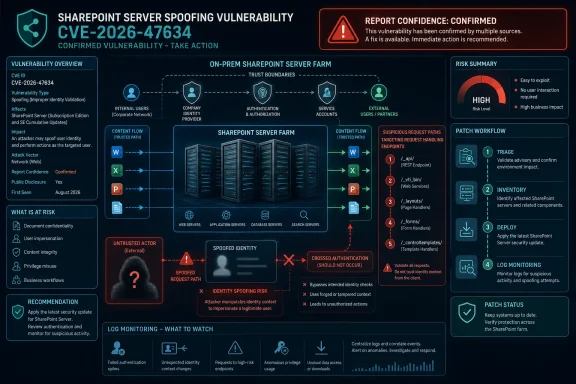 Microsoft’s Quiet Signal Is the Story
The phrase “spoofing vulnerability” can sound almost gentle in a world conditioned to panic at “remote code execution.” That is a mistake. In Microsoft’s security taxonomy, spoofing is often where trust boundaries begin to fray: an attacker may not immediately own the server, but they may be able to make a system, user, service, or workflow believe something false.CVE-2026-47634 lands in a particularly sensitive product category. SharePoint Server is not a consumer app sitting at the edge of personal convenience; it is often a document hub, intranet platform, workflow engine, forms backend, records store, and authentication-integrated business portal. A spoofing weakness in that context can become a staging point for credential theft, session confusion, phishing inside trusted collaboration spaces, or chained exploitation.
The advisory language highlighted by Microsoft’s metric is about confidence. It measures how certain the vendor and ecosystem are that the vulnerability is real and how much credible technical detail is known. That matters because vulnerability management is not merely a severity-score exercise. It is an exercise in allocating scarce attention under uncertainty.
When Microsoft acknowledges a flaw in SharePoint Server, the uncertainty narrows. The advisory may not hand defenders a full exploit narrative, and it may not publish root-cause details. But the acknowledgement itself changes the risk calculus: the vulnerability has moved from rumor or external hypothesis into vendor-confirmed security debt.
Report Confidence Turns a Sparse Advisory into an Operational Event
The metric described in Microsoft’s guidance is essentially a confidence gauge. At one end are cases where only the existence of a vulnerability is rumored or loosely publicized. In the middle are cases where independent research or partial evidence suggests where the flaw lies. At the strongest end are cases confirmed by the vendor or author of the affected technology.That progression matters because attackers and defenders read the same signals. A confirmed vulnerability gives defenders a reason to prioritize patching, but it also tells offensive researchers that there is something real to reverse-engineer. Even when Microsoft withholds technical details, a security update can become a roadmap: compare patched and unpatched binaries, inspect changed files, map code paths, and test assumptions.
This is the paradox of responsible disclosure at enterprise scale. The vendor must tell customers enough to act without giving attackers a turnkey exploit. But in the SharePoint world, the mere presence of a confirmed server-side vulnerability can trigger immediate interest because the target population is valuable and historically unevenly patched.
A low-detail advisory does not mean low risk. It often means Microsoft is managing disclosure carefully, especially if the affected component sits close to authentication, request handling, content rendering, or federation logic. For administrators, the absence of a public proof of concept should be treated as breathing room, not absolution.
SharePoint Is Not Just Another Server in the Rack
SharePoint Server occupies a strange place in enterprise IT. It is old enough to carry legacy assumptions, central enough to be trusted, and customizable enough to be messy. Many deployments have accumulated years of web parts, farm solutions, custom authentication plumbing, third-party integrations, service accounts, and permissions exceptions that outlived the people who created them.That is why SharePoint vulnerabilities often have an impact beyond the affected CVE description. A flaw in one request path may touch document libraries, workflows, user profiles, search, or custom forms. A spoofing bug may not sound catastrophic in isolation, but SharePoint’s job is to broker trust among users, documents, sites, permissions, and identity providers.
The on-premises distinction is also crucial. SharePoint Online customers benefit from Microsoft operating the service and absorbing much of the patching burden. SharePoint Server customers own the farm, the update cadence, the outage window, the compatibility testing, and the painful edge cases. That ownership is powerful when an organization needs control; it is punishing when attackers move faster than change boards.
For WindowsForum’s audience, this is the familiar bargain of on-prem infrastructure. You get sovereignty, integration flexibility, and local control. You also inherit the blast radius when a collaboration platform becomes part of the attack surface.
Spoofing Bugs Exploit Trust Before They Exploit Code
The term spoofing covers a wide range of security failures, and that range is why administrators should resist treating the category as second-tier. Spoofing can mean impersonating a user interface, forging a request context, misleading a victim about a resource, confusing origin or identity checks, or causing a server to trust data it should not trust. The exact mechanism for CVE-2026-47634 should not be assumed from the category alone.What matters is the trust model. SharePoint is deeply tied to identity: Windows authentication, claims, OAuth-style integrations, service applications, external sharing patterns, and role-based permissions. If a vulnerability lets an attacker manipulate what SharePoint thinks it is seeing, or what a user thinks SharePoint is presenting, the impact can ripple through more than one control plane.
In practical terms, spoofing vulnerabilities can support social engineering because the malicious action appears to come from a trusted system. They can also support technical chaining because trust confusion may open the door to token misuse, request forgery, or privilege-adjacent behavior. Not every spoofing bug becomes a breach, but in a high-value server product the defensive posture has to assume adversaries will test whether it can.
This is where security teams need discipline. Do not invent exploit details that Microsoft has not published. Do not ignore the bug because the impact label is not RCE. The right posture is controlled urgency: patch, verify exposure, monitor suspicious activity, and watch for advisory revisions.
The Patch Tuesday Era Now Belongs to Reverse Engineers
Modern Microsoft vulnerability response exists in a race between two groups of specialists. On one side are administrators trying to read advisories, test updates, sequence deployments, avoid outages, and prove compliance. On the other are researchers, brokers, and criminal operators diffing patches to discover exactly what changed.The advantage often belongs to whoever can automate the boring work. Attackers can scan for exposed SharePoint servers at internet scale and prioritize targets by version, banner, response behavior, and known deployment patterns. Defenders frequently have to start by asking a more embarrassing question: where are all our SharePoint servers?
That inventory problem remains one of the defining failures of enterprise security. It is not enough to know about the main farm documented in the CMDB. Organizations also need to find abandoned test farms, disaster recovery systems, lab environments, extranet portals, and acquisitions running their own infrastructure. SharePoint’s business value made it easy to deploy; its operational complexity makes it hard to retire.
CVE-2026-47634 should therefore be treated as an inventory test as much as a patching task. If the organization cannot quickly answer which SharePoint Server versions are deployed, which are internet-facing, which have custom authentication, and which are behind compensating controls, then the vulnerability has already exposed a process gap.
Microsoft’s Confidence Metric Cuts Both Ways
Microsoft’s confidence language helps administrators decide how seriously to take a vulnerability when public details are limited. A confirmed report should reduce internal debate. Security teams should not have to spend days arguing whether a vendor-confirmed SharePoint Server vulnerability is “real enough” to enter the patch pipeline.But that same confidence metric is useful to attackers. It tells them the target is not speculative. If the advisory is paired with a software update, it tells them there is code to compare. If the vulnerability affects supported SharePoint Server editions, it tells them the installed base is likely concentrated in government, education, healthcare, manufacturing, legal, and other document-heavy environments.
This is why organizations should separate exploit maturity from report confidence. A vulnerability can be confirmed even if there is no known public exploit. Conversely, a low-detail flaw can become exploitable quickly once patches ship and researchers begin reverse engineering. Waiting for weaponized exploit code before acting is a strategy that has failed repeatedly across Microsoft server products.
The stronger play is to use report confidence as a trigger for early action. Confirmed existence should start the clock. Public exploit availability should not be the starting gun; by then, the race may already be lost.
The 2025 SharePoint Lessons Still Apply
The SharePoint security story of the last year has been unusually blunt. On-premises SharePoint flaws have been exploited, revisited, chained, and reclassified in ways that punished slow patching and vague asset ownership. The recurring pattern is not that every SharePoint bug is catastrophic. The pattern is that SharePoint servers are valuable enough that serious actors pay attention quickly.That history changes how CVE-2026-47634 should be read. A spoofing vulnerability in SharePoint Server does not need to be another “ToolShell” moment to deserve priority. It arrives in an ecosystem where defenders have already seen how quickly initial advisories can evolve and how often the real-world risk depends on deployment exposure.
Microsoft’s own handling of SharePoint vulnerabilities has also shown that advisory details can change. CVSS scores, authentication requirements, exploitability assessments, and known exploitation status may be updated as new evidence appears. Administrators who snapshot an advisory once and never return to it are effectively betting that day-one information is complete.
That is not a safe bet. The better process is to revisit the advisory, track update history, monitor CISA and sector-specific alerts, and keep an eye on security vendors who may publish detection logic or indicators after Microsoft’s first disclosure.
Where Administrators Should Spend Their First Hour
The first hour after a SharePoint Server CVE enters the queue should not be spent drafting a meeting invite. It should be spent reducing uncertainty. The organization needs to know whether it runs affected SharePoint Server editions, whether those systems are externally reachable, and whether the relevant security update is available and compatible with the current farm state.SharePoint patching is not always a one-click exercise. Farms may require careful sequencing, configuration wizard runs, service validation, and post-update checks. That operational friction is real, but it should not become an excuse for paralysis. The answer is to maintain a tested SharePoint update process before the emergency, not to rediscover it during one.
Exposure matters. An internet-facing SharePoint deployment should be treated differently from a tightly segmented internal farm, though internal-only systems are not safe by default. Phished credentials, VPN access, compromised endpoints, and lateral movement routinely turn “internal” vulnerabilities into reachable ones.
Security teams should also review authentication flows and logs. For a spoofing vulnerability, look for anomalies around unusual user-agent strings, unexpected referrers, suspicious redirects, authentication failures followed by success, odd document access patterns, and requests to rarely used SharePoint endpoints. The exact indicators will depend on the final technical details, but the logging posture can be improved before those details arrive.
The Compliance Checkbox Will Miss the Point
Many organizations will process CVE-2026-47634 as a ticket: identify affected hosts, deploy update, close finding. That is necessary but incomplete. A SharePoint vulnerability should also force a review of why the server is exposed, who owns it, and whether its trust relationships still make sense.Old SharePoint environments often survive because they are politically difficult to change. A department depends on a workflow. A retired application stores reports there. A vendor integration uses an ancient authentication pattern. A business unit has a custom portal no one wants to rewrite. The result is a platform that remains critical without receiving the architectural attention given to newer cloud services.
That mismatch is the security problem. SharePoint Server is frequently treated like legacy plumbing until a vulnerability makes it front-page infrastructure. Then everyone remembers that the plumbing carries sensitive documents, privileged workflows, and identity-integrated access.
A mature response to CVE-2026-47634 should therefore include architectural questions. Can the farm be segmented more aggressively? Can external access be reduced? Can unsupported customizations be retired? Can sensitive document libraries be moved or protected with stronger conditional access around adjacent systems? The patch fixes the known flaw; the review reduces the next blast radius.
Defenders Need to Watch the Advisory, Not Just the Score
CVSS remains useful, but it is a blunt instrument. A numeric score cannot fully capture whether a SharePoint farm is internet-facing, whether it hosts regulated data, whether it has custom claims providers, or whether its patch process takes three weeks. The same vulnerability can be tolerable in one environment and urgent in another.Microsoft’s exploitability and confidence fields add nuance, but they are still inputs rather than verdicts. Administrators should read them alongside product exposure, business criticality, authentication requirements, and available mitigations. A medium-severity spoofing bug on a public-facing collaboration platform may deserve faster handling than a higher-scored flaw buried in a rarely used internal component.
The important distinction is between vendor severity and organizational risk. Microsoft can describe the vulnerability in general terms. Only the organization can decide how much trust it has concentrated in its SharePoint deployment.
This is also where security teams should resist alert fatigue. Not every CVE deserves an all-hands emergency. But SharePoint Server is one of those products where confirmed vulnerabilities deserve a faster triage path because the product’s role is so central and because adversaries have repeatedly shown interest in it.
The SharePoint Farm Is Now a Risk Register
The concrete response to CVE-2026-47634 is not mysterious. The hard part is execution under pressure, especially in organizations where SharePoint ownership is split across infrastructure, collaboration, security, and application teams.- Organizations should treat Microsoft’s confirmation of CVE-2026-47634 as enough evidence to begin triage, even if public exploit details remain limited.
- Administrators should identify every SharePoint Server deployment, including test, disaster recovery, extranet, and inherited environments that may not be in the primary asset inventory.
- Internet-facing SharePoint systems should move to the front of the patching and validation queue because exposure changes the practical risk of even non-RCE flaws.
- Security teams should monitor for advisory updates, because Microsoft vulnerability records can change as exploitation evidence, authentication requirements, or technical understanding evolves.
- Patching should be paired with log review, authentication-flow scrutiny, and a reassessment of whether the farm still needs the level of exposure and trust it currently has.
- The absence of public exploit code should be treated as temporary uncertainty, not as a reason to delay remediation.
References
- Primary source: MSRC
Published: 2026-06-09T07:00:00-07:00
Security Update Guide - Microsoft Security Response Center
 msrc.microsoft.com
- Official source: microsoft.com
Disrupting active exploitation of on-premises SharePoint vulnerabilities | Microsoft Security Blog
Microsoft has observed two named Chinese nation-state actors, Linen Typhoon and Violet Typhoon, exploiting vulnerabilities targeting internet-facing SharePoint servers. In addition, we have observed another China-based threat actor, tracked as Storm-2603, exploiting these vulnerabilities...www.microsoft.com - Related coverage: techradar.com
Microsoft releases urgent SharePoint security flaw patches - here's what you need to know, and how to update | TechRadar
Patches for a critical severity SharePoint bug are now availablewww.techradar.com - Related coverage: tomshardware.com
Microsoft says China-based hackers exploiting critical SharePoint vulnerabilities to deploy Warlock ransomware — three China-affiliated threat actors seen taking advantage | Tom's Hardware
The company has attributed these attacks to a group it calls Storm-2603.www.tomshardware.com - Related coverage: windowscentral.com
Microsoft issues emergency SharePoint patches for ToolShell | Windows Central
Microsoft has issued emergency patches for two zero-day vulnerabilities.www.windowscentral.com - Related coverage: pcgamer.com
Microsoft warns of 'active attacks' on its government and business server tech, with one cybersecurity expert claiming that they should 'assume that you have been compromised' | PC Gamer
There are a bunch of security agencies on the case, though.www.pcgamer.com
- Related coverage: itpro.com
SharePoint flaw: Microsoft says hackers deploying ransomware | IT Pro
Fallout from the serious zero-day SharePoint vulnerability continues with Microsoft warning about ransomware attackswww.itpro.com - Related coverage: caloes.ca.gov
</rdf:Alt> </dc:title> <dc:description> <rdf:Alt> <rdf:li xml:lang="x-default"/> </rdf:Alt> </dc:description> <dc:creator> <rdf:Seq> <rdf:li>(Contra
</rdf:Alt> </dc:description> <dc:creator> <rdf:Seq> <rdf:li>(Contractor) Melanie, Barlow@CalOESwww.caloes.ca.gov
- Related coverage: beaconlab.us
- Related coverage: cyxcel.com
CyXcel: Get Expert Cyber Legal Advice and Incident Response | Weightmans
We combine specialist legal expertise with curated technical, cybersecurity and digital transformation partnerships, ensuring you always have the right experts. www.cyxcel.com
- Official source: learn.microsoft.com
- Related coverage: runzero.com
SharePoint Server RCE vulnerability: Find impacted assets
The Microsoft SharePoint RCE (CVE-2026-20963) now has a critical 9.8 CVSS and is being exploited in the wild. Here’s how to find affected assets.www.runzero.com - Related coverage: strobes.co
Sharepoint Vulnerabilities - CVE List & Security Advisories | Strobes VI | Strobes VI
Complete list of Sharepoint security vulnerabilities and CVEs. View CVSS scores, exploit availability, patches, and prioritization data for Sharepoint products.strobes.co
- Related coverage: deepwiki.com
MSRC API Reference | microsoft/MSRC-Microsoft-Security-Updates-API | DeepWiki
This document provides technical reference information for the Microsoft Security Response Center (MSRC) CVRF API that underlies the MsrcSecurityUpdates PowerShell module. This covers the REST API enddeepwiki.com - Related coverage: sra.io
