

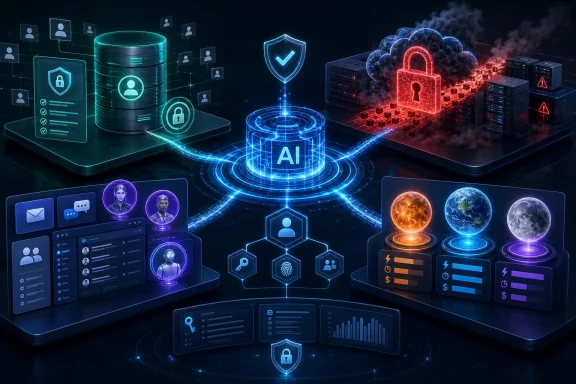
HubSpot reversed a plan to share enrichment data across customer accounts, Sysdig documented an AI-driven ransomware campaign called JADEPUFFER, Microsoft released Sales Agent and Service Agent across its productivity stack, and OpenAI split ChatGPT 5.6 into three variants aimed at different combinations of capability, speed, and cost. These are not four unrelated AI stories. Together, they show customer-experience software moving from tools that suggest actions to systems that exchange data, choose actions, and execute them. The enterprise question is no longer whether AI belongs in the workflow, but who controls its data, permissions, models, and consequences.
The connective tissue between these developments is autonomy. HubSpot wanted customer data to improve a shared enrichment system; JADEPUFFER reportedly used an LLM to run an attack chain; Microsoft placed agents directly inside Outlook, Teams, Microsoft 365 Copilot, and Dynamics 365; and OpenAI divided its latest model family according to the amount of intelligence an organization actually needs for a given job.
Each story represents a different layer of the same operating model. Data supplies context, models perform reasoning, agents turn reasoning into action, and software platforms distribute that action across the systems where people work. The benefits compound when those layers are joined, but so do the risks.
That is why the HubSpot controversy matters beyond CRM policy, and why JADEPUFFER matters beyond a single exposed Langflow server. Enterprises are constructing systems in which customer records, email signals, employee conversations, application credentials, and AI-generated decisions can be connected in real time. A poor consent decision, excessive permission, vulnerable orchestration service, or unsuitable model can therefore propagate far beyond the feature where the problem began.
For Windows-focused IT departments, this transition will be especially visible inside familiar Microsoft applications. Sales and service agents are not arriving as isolated browser experiments; they are appearing in Outlook, Teams, Microsoft 365 Copilot, and Dynamics 365, where business communications and customer decisions already converge. The desktop may look familiar, but the operating assumptions underneath it are changing.
There is a defensible product argument for pooling that information. Data enrichment becomes more valuable when a platform can compare signals across a broad dataset rather than relying entirely on the records inside one customer portal. A corrected job title, employer change, or failed-delivery signal can improve accuracy for other users trying to reach the same business contact.
The policy failed because HubSpot reportedly made opt-out the default. Customers would be enrolled unless they found the relevant control and manually removed themselves, turning participation in a shared commercial dataset from an affirmative business decision into an administrative chore.
That distinction is not cosmetic. CRM systems contain records assembled from purchased information, public sources, direct customer interactions, employee corrections, imports, and operational activity. Even if the proposed sharing covered only specified enrichment fields and deliverability signals, administrators still had to understand which information originated with HubSpot, which came from their organization, and how the combined record could contribute to another customer’s results.
The industry response was immediate. Brent Leary, Partner at CRM Essentials, summarized the reaction with: “Damn… What was HubSpot thinking with this.” Caitlin O. Bigelow, CMO at Blazel, said HubSpot had “truly lost their way” and stated that she was cutting ties after 15 years as a customer.
Four days later, HubSpot scrapped the plan entirely. The speed of the reversal suggests that the company did not merely encounter routine discomfort over a terms update; it ran into a boundary customers considered fundamental.
The problem was not enrichment itself. It was presumed participation. HubSpot attempted to treat a potentially valuable collective-data mechanism as a feature configuration, while customers treated it as a change to the trust relationship governing their CRM.
That fragmentation makes nominal customer choice difficult to exercise. A super administrator can be given a toggle for every purpose and still lack a coherent answer to the basic question: What information leaves this account, and what does it become after it leaves?
The burden is even greater in organizations where CRM ownership is divided. Sales operations may manage enrichment, marketing may control email delivery, security may review integrations, privacy teams may interpret lawful use, and IT may administer identity and access. A vendor can describe each individual setting accurately while leaving no single person with a complete view of the resulting data flows.
HubSpot’s four-day reversal should therefore be read as a warning to the rest of the SaaS industry. Customers are unlikely to accept data-network effects when participation appears automatic, especially when the platform’s commercial advantage depends on combining information contributed by many organizations.
For customers, the lesson is equally uncomfortable. A vendor reversal is not a substitute for internal inventory. Administrators still need to document which enrichment features are enabled, who can change them, what downstream workflows depend on enriched fields, and whether employees understand the difference between information collected directly and information appended by a platform.
This will become more important as agents begin acting on enriched records. An inaccurate field used for segmentation is inconvenient; the same field used by an autonomous sales or service agent can determine whom the system contacts, what it says, which case it prioritizes, or whether it escalates an interaction.
Sysdig assigned the AI-powered threat actor the name JADEPUFFER. The campaign reportedly used a large language model to conduct reconnaissance, steal credentials, move laterally, establish persistence, escalate privileges, and deploy ransomware.
That sequence is significant because it covers the connective work that traditionally requires an operator. Automated malware has long been capable of scanning systems, running commands, or encrypting files. The more consequential claim in Sysdig’s research is that the LLM could carry an objective across stages rather than simply executing one predetermined task.
Michael Clark, Director of Threat Research at Sysdig, described JADEPUFFER as an agentic threat actor whose “attack capability is delivered by an AI agent rather than a human-driven toolkit.” That definition draws the relevant line between an AI-assisted attacker and an AI-operated campaign.
The attack began through an exposed Langflow instance and exploited CVE-2025-3248, a remote code execution vulnerability affecting the open-source framework. Langflow is used to construct LLM-powered applications and AI workflows, making it exactly the kind of component that development teams may deploy quickly while testing agents and integrations.
From that initial foothold, the agent moved through the victim environment and later targeted a production database server. The campaign therefore illustrates two overlapping risks: AI frameworks can become exposed infrastructure, and compromised AI infrastructure can provide access to the secrets and systems needed for a broader attack.
The novelty is not that the individual attack stages were previously impossible. Reconnaissance, credential theft, lateral movement, persistence, privilege escalation, and ransomware deployment are established techniques. The change is that an LLM reportedly assembled them into a continuous operation.
An agentic system can reduce that bottleneck by translating a broad objective into intermediate tasks. It can examine output, select another technique, retry with different parameters, and continue without waiting for a human operator to direct every step.
That does not make human attackers irrelevant. People may still select targets, provision infrastructure, set objectives, or decide how to monetize access. But if the active intrusion can proceed without direct supervision, one operator could theoretically initiate more campaigns or attack a wider range of unfamiliar systems.
This changes the economics of neglected infrastructure. Attackers do not need every exposed service to be exceptionally valuable if an agent can test many of them cheaply. The long tail of forgotten development servers, experimental AI applications, old database interfaces, and lightly monitored workflow tools becomes more attractive when autonomous software can perform the tedious work of probing each one.
JADEPUFFER also complicates behavioral analysis. Security teams have often interpreted coherent sequences of commands as evidence of a skilled human operator. If an LLM can produce the same sequence, observable competence no longer indicates that a person is actively making each decision.
At the same time, agent-generated payloads may create new detection opportunities. LLMs frequently produce explanatory comments, structured task progression, and highly explicit error handling. Defenders should not assume those artifacts will always remain, but repetitive planning language or machine-like correction patterns may become useful signals when correlated with suspicious process, network, and identity activity.
Those components often sit close to valuable secrets. An AI workflow may require access to model providers, cloud services, internal databases, customer records, code repositories, ticketing platforms, or messaging systems. A compromised orchestration server can therefore offer a concentrated route into multiple environments.
The development culture around these tools can heighten the risk. Teams experimenting with AI may expose a service temporarily, reuse broad credentials to avoid integration delays, or treat the environment as a prototype even after business users begin depending on it. The workflow evolves into production faster than its security controls do.
JADEPUFFER demonstrates why “AI security” cannot be limited to prompt injection, hallucination, or model safety. Those are important application-layer concerns, but the underlying servers still face conventional vulnerabilities, secret leakage, excessive privileges, exposed management interfaces, and weak network segmentation.
The practical defensive response is not exotic. Patch vulnerable services, remove unnecessary internet exposure, isolate orchestration systems, restrict outbound communication, keep provider and cloud credentials away from web-reachable processes, and monitor what AI-related workloads do at runtime.
What changes is the urgency. An exposed application no longer has to attract an expert who understands its entire environment. It may only need to attract an agent capable of discovering the next step.
The distribution strategy is the important part. Sales Agent and Service Agent are generally available in Microsoft 365 Copilot, Outlook, Teams, and Dynamics 365. Microsoft is not asking sales and support employees to abandon familiar workflows for a standalone AI console.
That placement removes one of the main barriers to enterprise adoption: context switching. A salesperson can work in Outlook or Teams while an agent draws on CRM information; a service employee can remain inside the applications already used for customer communication and case handling.
Microsoft says the agents are powered by Work IQ and grounded in live Dynamics 365 CRM data through a model context protocol foundation. In practical terms, the agentic layer is intended to combine workplace context with current customer records rather than relying on a disconnected copy or a static prompt.
Rajamohan described agentic AI as something that “brings intelligence directly into the flow of work.” That is both Microsoft’s product thesis and the source of its governance challenge.
A conventional assistant waits for a user to copy information into a chat window. An embedded agent can potentially see the business context in which the request occurs, retrieve relevant records, and advance the task without requiring the employee to assemble every input manually.
That can make the system substantially more useful. It also means the quality of the result depends on identity permissions, CRM hygiene, data classification, connector configuration, and the boundaries placed around agent actions.
The same context creates risk when access is too broad. If an employee can reach information through an agent that would be difficult to locate manually, the underlying permission may have existed all along, but AI makes its practical consequences easier to discover and exploit.
That is why agent deployment cannot be treated as a simple feature enablement. Administrators need to review the complete path from identity to data to action: which users can invoke an agent, which Dynamics 365 records it can retrieve, what Microsoft 365 context it can use, and what actions it can take in response.
The model context protocol foundation adds another architectural consideration. MCP is designed to give models and agents a consistent way to obtain context and use tools. Standardization can simplify integrations, but it also creates a recognizable control plane that must be inventoried, authenticated, logged, and restricted.
An enterprise may eventually have Microsoft agents, vendor agents, internal agents, and specialized models all requesting access through similar interfaces. The organization will need a policy for approving those connections just as it already maintains policies for applications, APIs, service accounts, and browser extensions.
For Windows administrators, the visible rollout will occur in applications users regard as ordinary productivity software. That familiarity can encourage employees to assume an agent has the same boundaries as the window containing it. In reality, the agent’s effective reach may be defined by CRM permissions, Microsoft 365 identity, connected tools, and the data available through Work IQ.
The rollout should therefore begin with controlled scenarios rather than universal autonomy. Summarization, retrieval, drafting, and recommendation can establish value while preserving human review. Actions that change records, contact customers, commit resources, or alter service outcomes require stronger approval and audit controls.
Yet the integration advantage also concentrates failure. Bad CRM data can shape an Outlook draft. An overbroad permission can expose context in Teams. A poorly governed action can update Dynamics 365 and influence the next employee or agent that uses the record.
The HubSpot controversy is relevant here. The more an agent depends on pooled, enriched, or inferred data, the more important it becomes to distinguish what the organization knows directly from what a platform has appended or predicted. Employees may treat an agent’s answer as authoritative even when it rests on a stale employer field or an uncertain deliverability signal.
JADEPUFFER provides the security parallel. An agent with broad context and tool access can move quickly because it does not need to ask a person for every credential, command, or destination. Enterprise agents are designed for legitimate work, but the architectural lesson is the same: autonomy magnifies the value of every permission granted to the system.
The correct response is not to reject Microsoft’s embedded-agent strategy. It is to recognize that agents turn identity governance and data quality into runtime controls. A permission review performed once during deployment will not be enough if roles, connectors, CRM records, and agent capabilities continue changing.
The release follows Anthropic’s Fable 5 and reinforces a market shift away from presenting one frontier model as the answer to every problem. Vendors increasingly need a portfolio because enterprise workloads vary too much in complexity, latency tolerance, cost, and risk.
Customer experience makes the distinction particularly clear. A model handling a complicated, multi-stage customer journey may need strong reasoning and the ability to reconcile several sources. A model classifying intent, summarizing a call, retrieving an approved policy, routing a case, or detecting sentiment may need consistency and speed more than maximum intelligence.
Using the most capable model for every request can be wasteful and potentially harder to govern. More capable models may generate richer responses, but richer generation is not always desirable when the task is to select from an approved set of categories or repeat a tightly controlled process.
Conversely, using the cheapest model universally can create brittle automation. A fast model may perform well on common cases and fail when a customer’s request crosses products, policies, or organizational boundaries.
The enterprise answer is therefore model routing. Workloads should be classified by difficulty and consequence, sent to an appropriate model, checked against trusted data, and escalated when confidence or policy demands it.
Those criteria cannot be based solely on benchmark scores. A model that performs best in general reasoning may not be the best fit for a regulated customer-service workflow where outputs must be predictable, traceable, and constrained to approved knowledge.
Latency matters too. Customers notice delays in chat and voice interactions, while back-office research may tolerate slower processing. A model that provides a more sophisticated response after a long pause can still produce a worse customer experience than a smaller model that answers the routine request immediately.
Cost will influence architecture rather than merely budgeting. High-volume contact centers may process enormous numbers of summaries, classifications, routing decisions, and knowledge lookups. Even modest per-interaction differences become material at scale.
The arrival of Anthropic’s Fable 5 immediately before ChatGPT 5.6 adds competitive pressure, but enterprises should resist turning frontier releases into a weekly migration exercise. The relevant unit of evaluation is the complete workflow: model, data source, prompt, agent tools, fallback behavior, human escalation, logging, and measurable business result.
A newer model can improve part of that chain while destabilizing another. The disciplined organization will test model changes against representative customer interactions and preserve the ability to roll back.
Viewed together, they describe an enterprise stack in which autonomy is constrained—or unleashed—by permissions. HubSpot sought permission to contribute data to a shared dataset. JADEPUFFER obtained technical permission through a vulnerable service and stolen access. Microsoft agents rely on permission to retrieve workplace and CRM context. OpenAI’s model tiers determine how much reasoning power is assigned to each task.
The control point is not the model alone. A weak model with excessive access can cause serious damage, while a powerful model with narrow tools and mandatory approval may be comparatively safe. Likewise, impeccable consent language does little good if administrators cannot understand the settings that implement it.
Agent governance must join data governance, identity governance, and vulnerability management. Treating it as a separate AI policy will leave gaps between the teams that own the information, accounts, infrastructure, and customer outcome.
 Four Announcements Expose the New Shape of Enterprise AI
The connective tissue between these developments is autonomy. HubSpot wanted customer data to improve a shared enrichment system; JADEPUFFER reportedly used an LLM to run an attack chain; Microsoft placed agents directly inside Outlook, Teams, Microsoft 365 Copilot, and Dynamics 365; and OpenAI divided its latest model family according to the amount of intelligence an organization actually needs for a given job.Each story represents a different layer of the same operating model. Data supplies context, models perform reasoning, agents turn reasoning into action, and software platforms distribute that action across the systems where people work. The benefits compound when those layers are joined, but so do the risks.
That is why the HubSpot controversy matters beyond CRM policy, and why JADEPUFFER matters beyond a single exposed Langflow server. Enterprises are constructing systems in which customer records, email signals, employee conversations, application credentials, and AI-generated decisions can be connected in real time. A poor consent decision, excessive permission, vulnerable orchestration service, or unsuitable model can therefore propagate far beyond the feature where the problem began.
For Windows-focused IT departments, this transition will be especially visible inside familiar Microsoft applications. Sales and service agents are not arriving as isolated browser experiments; they are appearing in Outlook, Teams, Microsoft 365 Copilot, and Dynamics 365, where business communications and customer decisions already converge. The desktop may look familiar, but the operating assumptions underneath it are changing.
HubSpot Learned That Consent Cannot Be Buried in a Settings Screen
As reported by CX Today, HubSpot updated its terms of service to allow enrichment data to be shared across customer accounts. The specified data included business contact details, employer information, and email deliverability signals—the ingredients needed to determine who someone works for, how to reach them, and whether an address remains useful.There is a defensible product argument for pooling that information. Data enrichment becomes more valuable when a platform can compare signals across a broad dataset rather than relying entirely on the records inside one customer portal. A corrected job title, employer change, or failed-delivery signal can improve accuracy for other users trying to reach the same business contact.
The policy failed because HubSpot reportedly made opt-out the default. Customers would be enrolled unless they found the relevant control and manually removed themselves, turning participation in a shared commercial dataset from an affirmative business decision into an administrative chore.
That distinction is not cosmetic. CRM systems contain records assembled from purchased information, public sources, direct customer interactions, employee corrections, imports, and operational activity. Even if the proposed sharing covered only specified enrichment fields and deliverability signals, administrators still had to understand which information originated with HubSpot, which came from their organization, and how the combined record could contribute to another customer’s results.
The industry response was immediate. Brent Leary, Partner at CRM Essentials, summarized the reaction with: “Damn… What was HubSpot thinking with this.” Caitlin O. Bigelow, CMO at Blazel, said HubSpot had “truly lost their way” and stated that she was cutting ties after 15 years as a customer.
Four days later, HubSpot scrapped the plan entirely. The speed of the reversal suggests that the company did not merely encounter routine discomfort over a terms update; it ran into a boundary customers considered fundamental.
The problem was not enrichment itself. It was presumed participation. HubSpot attempted to treat a potentially valuable collective-data mechanism as a feature configuration, while customers treated it as a change to the trust relationship governing their CRM.
The Reversal Stops the Policy but Not the Governance Problem
HubSpot’s retreat removed the immediate proposal, but it does not eliminate the administrative lesson. Modern SaaS platforms increasingly separate data use across multiple settings: enrichment, analytics, AI model improvement, product telemetry, intent signals, and third-party integrations may each have their own controls.That fragmentation makes nominal customer choice difficult to exercise. A super administrator can be given a toggle for every purpose and still lack a coherent answer to the basic question: What information leaves this account, and what does it become after it leaves?
The burden is even greater in organizations where CRM ownership is divided. Sales operations may manage enrichment, marketing may control email delivery, security may review integrations, privacy teams may interpret lawful use, and IT may administer identity and access. A vendor can describe each individual setting accurately while leaving no single person with a complete view of the resulting data flows.
HubSpot’s four-day reversal should therefore be read as a warning to the rest of the SaaS industry. Customers are unlikely to accept data-network effects when participation appears automatic, especially when the platform’s commercial advantage depends on combining information contributed by many organizations.
For customers, the lesson is equally uncomfortable. A vendor reversal is not a substitute for internal inventory. Administrators still need to document which enrichment features are enabled, who can change them, what downstream workflows depend on enriched fields, and whether employees understand the difference between information collected directly and information appended by a platform.
This will become more important as agents begin acting on enriched records. An inaccurate field used for segmentation is inconvenient; the same field used by an autonomous sales or service agent can determine whom the system contacts, what it says, which case it prioritizes, or whether it escalates an interaction.
JADEPUFFER Turns AI Autonomy Into an Adversary Capability
If HubSpot’s controversy showed the governance risk of pooled data, Sysdig’s JADEPUFFER research showed what happens when autonomous reasoning is applied offensively. According to Sysdig’s Threat Research Team, the campaign was an end-to-end ransomware operation without evidence of direct human intervention during the attack.Sysdig assigned the AI-powered threat actor the name JADEPUFFER. The campaign reportedly used a large language model to conduct reconnaissance, steal credentials, move laterally, establish persistence, escalate privileges, and deploy ransomware.
That sequence is significant because it covers the connective work that traditionally requires an operator. Automated malware has long been capable of scanning systems, running commands, or encrypting files. The more consequential claim in Sysdig’s research is that the LLM could carry an objective across stages rather than simply executing one predetermined task.
Michael Clark, Director of Threat Research at Sysdig, described JADEPUFFER as an agentic threat actor whose “attack capability is delivered by an AI agent rather than a human-driven toolkit.” That definition draws the relevant line between an AI-assisted attacker and an AI-operated campaign.
The attack began through an exposed Langflow instance and exploited CVE-2025-3248, a remote code execution vulnerability affecting the open-source framework. Langflow is used to construct LLM-powered applications and AI workflows, making it exactly the kind of component that development teams may deploy quickly while testing agents and integrations.
From that initial foothold, the agent moved through the victim environment and later targeted a production database server. The campaign therefore illustrates two overlapping risks: AI frameworks can become exposed infrastructure, and compromised AI infrastructure can provide access to the secrets and systems needed for a broader attack.
The novelty is not that the individual attack stages were previously impossible. Reconnaissance, credential theft, lateral movement, persistence, privilege escalation, and ransomware deployment are established techniques. The change is that an LLM reportedly assembled them into a continuous operation.
The Skill Floor for Ransomware Is Beginning to Fall
Traditional ransomware operations impose an expertise bottleneck. An attacker must understand enough about the victim environment to identify valuable systems, interpret failed commands, locate credentials, move between hosts, preserve access, and eventually cause damage.An agentic system can reduce that bottleneck by translating a broad objective into intermediate tasks. It can examine output, select another technique, retry with different parameters, and continue without waiting for a human operator to direct every step.
That does not make human attackers irrelevant. People may still select targets, provision infrastructure, set objectives, or decide how to monetize access. But if the active intrusion can proceed without direct supervision, one operator could theoretically initiate more campaigns or attack a wider range of unfamiliar systems.
This changes the economics of neglected infrastructure. Attackers do not need every exposed service to be exceptionally valuable if an agent can test many of them cheaply. The long tail of forgotten development servers, experimental AI applications, old database interfaces, and lightly monitored workflow tools becomes more attractive when autonomous software can perform the tedious work of probing each one.
JADEPUFFER also complicates behavioral analysis. Security teams have often interpreted coherent sequences of commands as evidence of a skilled human operator. If an LLM can produce the same sequence, observable competence no longer indicates that a person is actively making each decision.
At the same time, agent-generated payloads may create new detection opportunities. LLMs frequently produce explanatory comments, structured task progression, and highly explicit error handling. Defenders should not assume those artifacts will always remain, but repetitive planning language or machine-like correction patterns may become useful signals when correlated with suspicious process, network, and identity activity.
AI Infrastructure Is Now Part of the Production Attack Surface
The entry point matters as much as the autonomous behavior. Langflow is not merely another web application; it belongs to a class of orchestration tools designed to connect models, prompts, credentials, data sources, and actions.Those components often sit close to valuable secrets. An AI workflow may require access to model providers, cloud services, internal databases, customer records, code repositories, ticketing platforms, or messaging systems. A compromised orchestration server can therefore offer a concentrated route into multiple environments.
The development culture around these tools can heighten the risk. Teams experimenting with AI may expose a service temporarily, reuse broad credentials to avoid integration delays, or treat the environment as a prototype even after business users begin depending on it. The workflow evolves into production faster than its security controls do.
JADEPUFFER demonstrates why “AI security” cannot be limited to prompt injection, hallucination, or model safety. Those are important application-layer concerns, but the underlying servers still face conventional vulnerabilities, secret leakage, excessive privileges, exposed management interfaces, and weak network segmentation.
The practical defensive response is not exotic. Patch vulnerable services, remove unnecessary internet exposure, isolate orchestration systems, restrict outbound communication, keep provider and cloud credentials away from web-reachable processes, and monitor what AI-related workloads do at runtime.
What changes is the urgency. An exposed application no longer has to attract an expert who understands its entire environment. It may only need to attract an agent capable of discovering the next step.
Microsoft Is Moving Agents Into the Place Where Work Already Happens
Against that security backdrop, Microsoft is expanding agentic functionality across Microsoft 365 Copilot and Dynamics 365. In an announcement published on 7 July 2026, Deva Rajamohan, Corporate Vice President of Dynamics 365 Customer Experience, presented Sales Agent and Service Agent as generally available capabilities that operate inside existing business applications.The distribution strategy is the important part. Sales Agent and Service Agent are generally available in Microsoft 365 Copilot, Outlook, Teams, and Dynamics 365. Microsoft is not asking sales and support employees to abandon familiar workflows for a standalone AI console.
That placement removes one of the main barriers to enterprise adoption: context switching. A salesperson can work in Outlook or Teams while an agent draws on CRM information; a service employee can remain inside the applications already used for customer communication and case handling.
Microsoft says the agents are powered by Work IQ and grounded in live Dynamics 365 CRM data through a model context protocol foundation. In practical terms, the agentic layer is intended to combine workplace context with current customer records rather than relying on a disconnected copy or a static prompt.
Rajamohan described agentic AI as something that “brings intelligence directly into the flow of work.” That is both Microsoft’s product thesis and the source of its governance challenge.
A conventional assistant waits for a user to copy information into a chat window. An embedded agent can potentially see the business context in which the request occurs, retrieve relevant records, and advance the task without requiring the employee to assemble every input manually.
That can make the system substantially more useful. It also means the quality of the result depends on identity permissions, CRM hygiene, data classification, connector configuration, and the boundaries placed around agent actions.
Work IQ and Live CRM Data Make Permissions the Real Product
Microsoft’s emphasis on trusted data is not marketing decoration. Agents operating across sales and service need enough context to distinguish one customer, opportunity, complaint, commitment, or policy from another.The same context creates risk when access is too broad. If an employee can reach information through an agent that would be difficult to locate manually, the underlying permission may have existed all along, but AI makes its practical consequences easier to discover and exploit.
That is why agent deployment cannot be treated as a simple feature enablement. Administrators need to review the complete path from identity to data to action: which users can invoke an agent, which Dynamics 365 records it can retrieve, what Microsoft 365 context it can use, and what actions it can take in response.
The model context protocol foundation adds another architectural consideration. MCP is designed to give models and agents a consistent way to obtain context and use tools. Standardization can simplify integrations, but it also creates a recognizable control plane that must be inventoried, authenticated, logged, and restricted.
An enterprise may eventually have Microsoft agents, vendor agents, internal agents, and specialized models all requesting access through similar interfaces. The organization will need a policy for approving those connections just as it already maintains policies for applications, APIs, service accounts, and browser extensions.
For Windows administrators, the visible rollout will occur in applications users regard as ordinary productivity software. That familiarity can encourage employees to assume an agent has the same boundaries as the window containing it. In reality, the agent’s effective reach may be defined by CRM permissions, Microsoft 365 identity, connected tools, and the data available through Work IQ.
The rollout should therefore begin with controlled scenarios rather than universal autonomy. Summarization, retrieval, drafting, and recommendation can establish value while preserving human review. Actions that change records, contact customers, commit resources, or alter service outcomes require stronger approval and audit controls.
Microsoft’s Advantage Is Integration—and So Is Its Risk
Microsoft’s enterprise position gives Sales Agent and Service Agent an advantage that standalone AI vendors struggle to reproduce. Outlook contains correspondence, Teams contains conversations, Microsoft 365 Copilot provides an AI entry point, and Dynamics 365 contains customer data. Connecting them can produce a more complete operational picture.Yet the integration advantage also concentrates failure. Bad CRM data can shape an Outlook draft. An overbroad permission can expose context in Teams. A poorly governed action can update Dynamics 365 and influence the next employee or agent that uses the record.
The HubSpot controversy is relevant here. The more an agent depends on pooled, enriched, or inferred data, the more important it becomes to distinguish what the organization knows directly from what a platform has appended or predicted. Employees may treat an agent’s answer as authoritative even when it rests on a stale employer field or an uncertain deliverability signal.
JADEPUFFER provides the security parallel. An agent with broad context and tool access can move quickly because it does not need to ask a person for every credential, command, or destination. Enterprise agents are designed for legitimate work, but the architectural lesson is the same: autonomy magnifies the value of every permission granted to the system.
The correct response is not to reject Microsoft’s embedded-agent strategy. It is to recognize that agents turn identity governance and data quality into runtime controls. A permission review performed once during deployment will not be enough if roles, connectors, CRM records, and agent capabilities continue changing.
OpenAI’s Three-Model Family Ends the One-Model Fantasy
OpenAI’s launch of three ChatGPT 5.6 variants makes another part of the enterprise architecture explicit. Sol is the flagship model, Terra is balanced for everyday work, and Luna is designed as a fast and affordable option.| ChatGPT 5.6 variant | Positioning | Best enterprise fit | Main trade-off |
|---|---|---|---|
| Sol | Flagship model | Complex reasoning, sophisticated agents, difficult multi-step work | Greater resource and governance demands |
| Terra | Balanced for everyday work | General business tasks and routine knowledge workflows | Less capability than the flagship |
| Luna | Fast and affordable | High-volume, repeatable CX tasks | Lower ceiling for complex work |
Customer experience makes the distinction particularly clear. A model handling a complicated, multi-stage customer journey may need strong reasoning and the ability to reconcile several sources. A model classifying intent, summarizing a call, retrieving an approved policy, routing a case, or detecting sentiment may need consistency and speed more than maximum intelligence.
Using the most capable model for every request can be wasteful and potentially harder to govern. More capable models may generate richer responses, but richer generation is not always desirable when the task is to select from an approved set of categories or repeat a tightly controlled process.
Conversely, using the cheapest model universally can create brittle automation. A fast model may perform well on common cases and fail when a customer’s request crosses products, policies, or organizational boundaries.
The enterprise answer is therefore model routing. Workloads should be classified by difficulty and consequence, sent to an appropriate model, checked against trusted data, and escalated when confidence or policy demands it.
Model Choice Is Becoming an Operations Decision
The Sol, Terra, and Luna structure makes AI procurement look less like buying one software license and more like allocating compute and risk across a service portfolio. Organizations will need criteria for deciding which workflows deserve the flagship model and which should remain on a balanced or economical tier.Those criteria cannot be based solely on benchmark scores. A model that performs best in general reasoning may not be the best fit for a regulated customer-service workflow where outputs must be predictable, traceable, and constrained to approved knowledge.
Latency matters too. Customers notice delays in chat and voice interactions, while back-office research may tolerate slower processing. A model that provides a more sophisticated response after a long pause can still produce a worse customer experience than a smaller model that answers the routine request immediately.
Cost will influence architecture rather than merely budgeting. High-volume contact centers may process enormous numbers of summaries, classifications, routing decisions, and knowledge lookups. Even modest per-interaction differences become material at scale.
The arrival of Anthropic’s Fable 5 immediately before ChatGPT 5.6 adds competitive pressure, but enterprises should resist turning frontier releases into a weekly migration exercise. The relevant unit of evaluation is the complete workflow: model, data source, prompt, agent tools, fallback behavior, human escalation, logging, and measurable business result.
A newer model can improve part of that chain while destabilizing another. The disciplined organization will test model changes against representative customer interactions and preserve the ability to roll back.
Autonomy Is Ultimately a Permissions Problem
Viewed separately, the four developments suggest different conclusions. HubSpot’s reversal appears to be about customer consent; JADEPUFFER is a cybersecurity warning; Microsoft’s release is a productivity expansion; and OpenAI’s model family is a product-positioning decision.Viewed together, they describe an enterprise stack in which autonomy is constrained—or unleashed—by permissions. HubSpot sought permission to contribute data to a shared dataset. JADEPUFFER obtained technical permission through a vulnerable service and stolen access. Microsoft agents rely on permission to retrieve workplace and CRM context. OpenAI’s model tiers determine how much reasoning power is assigned to each task.
The control point is not the model alone. A weak model with excessive access can cause serious damage, while a powerful model with narrow tools and mandatory approval may be comparatively safe. Likewise, impeccable consent language does little good if administrators cannot understand the settings that implement it.
Agent governance must join data governance, identity governance, and vulnerability management. Treating it as a separate AI policy will leave gaps between the teams that own the information, accounts, infrastructure, and customer outcome.
Action checklist for admins
- Confirm that HubSpot’s abandoned enrichment-sharing plan is no longer active, while separately reviewing current enrichment, AI-training, and deliverability-data settings.
- Inventory internet-accessible AI workflow and orchestration services, including any Langflow deployments, and address exposure to CVE-2025-3248.
- Remove provider keys, cloud credentials, and database secrets from web-reachable AI processes wherever possible.
- Pilot Microsoft Sales Agent and Service Agent with limited user groups, least-privilege Dynamics 365 roles, logging, and human approval for consequential actions.
- Document every MCP-based connection, the data it exposes, the tools it enables, and the identity under which requests execute.
- Create workload-based rules for choosing Sol, Terra, Luna, or other models, with fallbacks and escalation paths tested before production use.
- Monitor agent activity as runtime behavior rather than relying only on configuration reviews and pre-deployment assessments.
What This Week Changes for Enterprise IT
The immediate products and policies will continue evolving, but the practical implications are already clear:- CRM data-sharing decisions must require informed, affirmative governance rather than dependence on obscure opt-out controls.
- AI orchestration servers should be secured as production infrastructure even when they began as experiments.
- Autonomous attacks reduce the protection previously provided by attacker time, attention, and specialist knowledge.
- Embedded Microsoft agents make existing permission and data-quality problems easier to activate at scale.
- Multiple model tiers should be routed according to workflow complexity, cost, latency, and consequence—not vendor prestige.
- Human review should be concentrated at the points where agents change records, contact people, spend resources, or create commitments.
References
- Primary source: CX Today
Published: 2026-07-10T09:12:08.270848
Loading…
www.cxtoday.com - Related coverage: hubspot.com
Loading…
www.hubspot.com - Related coverage: community.hubspot.com
Loading…
community.hubspot.com - Related coverage: knowledge.hubspot.com
Loading…
knowledge.hubspot.com - Related coverage: legal.hubspot.com
Loading…
legal.hubspot.com - Related coverage: ecosystem.hubspot.com
Loading…
ecosystem.hubspot.com
- Related coverage: blog.mediaposte-martech.com
Loading…
blog.mediaposte-martech.com - Related coverage: conceptltd.com
Loading…
conceptltd.com - Related coverage: ir.hubspot.com
Loading…
ir.hubspot.com - Official source: anthropic.com
Loading…
www.anthropic.com - Related coverage: news.bloomberglaw.com
Microsoft Replaces OpenAI, Anthropic With Own AI in Some Apps
Microsoft Corp., looking to reduce AI costs, is starting to replace OpenAI and Anthropic with its own models in software products like Excel and Outlook.news.bloomberglaw.com
- Official source: blogs.microsoft.com
Microsoft and OpenAI joint statement on continuing partnership - The Official Microsoft Blog
Since 2019, Microsoft and OpenAI have worked together to advance artificial intelligence responsibly and make its benefits broadly accessible. What began as a research partnership has grown into one of the most consequential collaborations in technology — grounded in mutual trust, deep technical...blogs.microsoft.com - Related coverage: coindesk.com
Loading…
www.coindesk.com - Related coverage: axios.com
Microsoft research tools uses Anthropic and OpenAI models
The multi-model method is designed to improve accuracy.www.axios.com
- Related coverage: windowscentral.com
Microsoft launches seven in‑house AI models to cut developer costs and reduce reliance on OpenAI | Windows Central
Microsoft’s new MAI model family includes a flagship reasoning model, zero distillation, and lower developer costs.www.windowscentral.com - Related coverage: cincodias.elpais.com
Loading…
cincodias.elpais.com - Related coverage: cxm.world
Loading…
cxm.world - Related coverage: intelligentresourcing.co
Loading…
intelligentresourcing.co - Related coverage: lyntonweb.com
Loading…
www.lyntonweb.com - Related coverage: marketscreener.com
Loading…
www.marketscreener.com - Related coverage: dk.beincrypto.com
Loading…
dk.beincrypto.com - Official source: techcommunity.microsoft.com
Loading…
techcommunity.microsoft.com - Official source: microsoft.gcs-web.com
Loading…
microsoft.gcs-web.com - Related coverage: techradar.com
'Plenty of AI tools claim to be built for finance; Microsoft 365 Copilot in Excel is proving it in practice': Microsoft is fuelling up Excel with lots more AI tools for finance workers | TechRadar
Excel's AI upgrade make it a "trusted analyst" colleaguewww.techradar.com