

The Linux kernel bug tracked as CVE-2025-38261 is a narrow but important RISC‑V architecture issue that showed up during heavy stress testing: the kernel could fail to save and restore the RISC‑V supervisor user‑memory access flag (SR_SUM) across context switches. Microsoft’s public CVE entry currently attests that the Azure Linux distribution includes the affected code and is therefore in‑scope for the remediation, and Microsoft says it will update that attestation if additional Microsoft products are later found to include the same library. That phrasing is deliberate — it is an artifact‑level inventory statement, not a global assertion that no other Microsoft product could ever contain the vulnerable kernel code. For enterprise defenders, the upshot is straightforward: treat Microsoft’s attestation for Azure Linux as authoritative for those artifacts, but don’t assume other Microsoft‑branded images, kernels, or services are automatically out of scope until they are explicitly checked and attested.
CVE-2025-38261 was reported upstream in the Linux kernel and fixed by small, targeted changes in the RISC‑V architecture support. The root cause is a corner‑case interaction between user‑memory access helpers (for example, the put_user() macro), functions that may block or sleep, and the supervisor mode bit that controls whether kernel code may access user memory without explicit uaccess protection. When the kernel enabled user access to carry out a put_user() operation, the code sequence could call into a function that sleeps and — under some circumstances — leave the SR_SUM bit cleared on return. If execution continued and a context switch occurred while SR_SUM was in the wrong state, the kernel could later access user memory incorrectly and crash with an “Unable to handle kernel access to user memory without uaccess routines” Oops.
The immediate fix in the kernel was twofold: evaluate put_user() arguments before enabling user access, and ensure that the scheduler’s context switch code saves and restores the SR_SUM state so the bit cannot leak across threads. The patches are small, upstream, and have been pulled into stable trees.
While this is not a remotely exploitable arbitrary‑code execution flaw against commodity x86 or ARM hardware, it is nevertheless a reliability and availability risk for systems running RISC‑V kernels built from vulnerable upstream revisions — particularly on heavily loaded systems or testbeds using stress harnesses like syzbot/syzkaller which explore concurrent edges.
Important clarifications buried in that phrasing:
Longer explanation:
That phrasing should not be read as a blanket guarantee that no other Microsoft product could ever be affected. VEX/CSAF attestations are product‑level, artifact‑scoped signals intended to enable automation and authoritative triage. Defenders should therefore combine three things: (1) the vendor’s attestation data for the specific artifacts they run, (2) artifact‑level verification against kernel versions/commit mappings, and (3) pragmatic patching and isolation where RISC‑V kernels are present. Doing so delivers both accuracy and safety — it avoids false assurances while enabling focused remediation where it matters.
Source: MSRC Security Update Guide - Microsoft Security Response Center
 Background / Overview
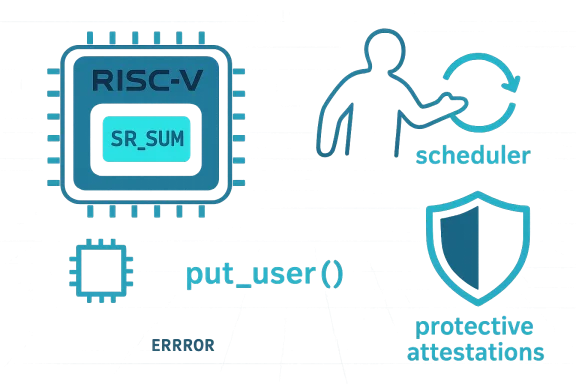
CVE-2025-38261 was reported upstream in the Linux kernel and fixed by small, targeted changes in the RISC‑V architecture support. The root cause is a corner‑case interaction between user‑memory access helpers (for example, the put_user() macro), functions that may block or sleep, and the supervisor mode bit that controls whether kernel code may access user memory without explicit uaccess protection. When the kernel enabled user access to carry out a put_user() operation, the code sequence could call into a function that sleeps and — under some circumstances — leave the SR_SUM bit cleared on return. If execution continued and a context switch occurred while SR_SUM was in the wrong state, the kernel could later access user memory incorrectly and crash with an “Unable to handle kernel access to user memory without uaccess routines” Oops.The immediate fix in the kernel was twofold: evaluate put_user() arguments before enabling user access, and ensure that the scheduler’s context switch code saves and restores the SR_SUM state so the bit cannot leak across threads. The patches are small, upstream, and have been pulled into stable trees.
While this is not a remotely exploitable arbitrary‑code execution flaw against commodity x86 or ARM hardware, it is nevertheless a reliability and availability risk for systems running RISC‑V kernels built from vulnerable upstream revisions — particularly on heavily loaded systems or testbeds using stress harnesses like syzbot/syzkaller which explore concurrent edges.
Technical deep dive: what went wrong and why it mattered
What SR_SUM actually is
- SR_SUM is the runtime status bit in the RISC‑V supervisor status register (sstatus) that controls whether supervisor code may access user memory without additional barrier/guarding instructions.
- Kernel memory access helpers (uaccess wrappers) dance around this bit: they enable user access when the kernel must copy to/from user space and disable it afterwards to preserve isolation.
- The Linux kernel uses these helpers widely (put_user(), get_user(), copy_from_user(), etc.). Those helpers assume the SR_SUM state is correctly preserved when they complete.
The failing sequence
- In the vulnerable code path the kernel used put_user() inside schedule_tail() while preparing a new task. The macro expanded into a sequence that enabled user access, invoked code to compute an argument (which could, in rare cases, block or call functions that clear SR_SUM), and then performed the user memory write.
- If the argument evaluation path temporarily cleared SR_SUM — for example because a called function slept and returned with the register changed — the kernel could then proceed with a put_user() in an inconsistent SR_SUM state.
- A subsequent context switch could then leave the next thread executing with an incorrect SR_SUM value. That thread might later access user memory without proper guarding and trigger a kernel OOPS or panic.
The upstream fixes
- Evaluate put_user() arguments outside the user‑enabled region so any functions called during argument evaluation cannot unintentionally interact with SR_SUM while user access is enabled.
- Save and restore SR_SUM across context switches (switch_to/schedule code) so that SR_SUM cannot “leak” between different execution contexts even if an earlier path left it in a surprising state.
What the Microsoft CVE entry actually says — and what it does not say
Microsoft’s public CVE FAQ repeated across several Linux kernel CVE pages answers the question “Is Azure Linux the only Microsoft product that includes this open‑source library and is therefore potentially affected?” with a clear policy response: Azure Linux (the Microsoft‑maintained distro) is the product Microsoft has inspected and attested, and Microsoft will publish machine‑readable attestations (CSAF/VEX) to indicate which of its products include the vulnerable library. If additional Microsoft products are identified as carrying the vulnerable code, Microsoft will update the CVE entry and distributed VEX attestations.Important clarifications buried in that phrasing:
- The Microsoft response is a product‑level attestation, not a guarantee of universal absence elsewhere. It affirms that the Azure Linux artifacts have been checked and are in scope.
- A VEX/CSAF attestation is an authoritative answer for the named product and artifact set; it is not a global scan of all Microsoft binaries, images, and services.
- Microsoft’s CSAF/VEX rollout started with Azure Linux. The company has indicated a phased approach to publish attestations for additional products over time.
Is Azure Linux the only Microsoft product that could be affected?
Short answer: No — but it is the only Microsoft product currently attested as affected.Longer explanation:
- The vulnerability is specific to the RISC‑V kernel code paths. Therefore, only systems running a RISC‑V build of the Linux kernel can manifest this bug.
- Microsoft’s Azure Linux attestation is authoritative: if you run Microsoft‑published Azure Linux images on RISC‑V hardware (or emulators), treat them as affected until you apply the vendor fixes.
- Microsoft runs and publishes many different Linux artifacts and kernel builds: Azure virtual machine images, marketplace images and appliances, container host images (AKS node images), the WSL2 kernel used on client Windows machines, and specialized kernels in some cloud services. Each artifact is built and maintained separately and may use different kernel versions or configuration flags.
- Many of Microsoft’s other Linux artifacts are built for x86_64 and ARM64 targets, not RISC‑V. If your environment does not have any RISC‑V hosts and does not run RISC‑V emulation, the operational risk from this CVE is effectively zero for those non‑RISC‑V artifacts.
- However, the only way to be certain whether a particular Microsoft artifact contains the vulnerable code is to check the artifact’s SBOM/SCA/CSAF attestation or compare the kernel version/commit mapping the vendor provides to upstream commit IDs for the fix.
Practical risk assessment for organizations
When this matters (high priority)
- You run production RISC‑V hosts (real hardware) running Linux server kernels compiled from upstream trees or vendor kernels that map to the vulnerable commits.
- You run RISC‑V emulation or QEMU RISC‑V hosts in CI/test infrastructures where syzkaller or equivalent fuzzing/stress harnesses run.
- You run multi‑tenant RISC‑V infrastructure where kernel stability is security‑critical (co‑located workloads, hypervisor thin stacks that rely on kernel behavior).
When this is lower risk
- Your infrastructure runs only x86_64 or ARM64 kernels (no RISC‑V).
- Your WSL2 / desktop Linux images were built and provided by Microsoft but targeted x86_64/ARM64 kernels, not RISC‑V.
- You only use Microsoft images that are explicitly attested not affected by this CVE in the Microsoft CSAF/VEX feed.
False‑comfort pitfall to avoid
- Don’t treat the absence of a product with a Microsoft VEX attestation as proof of safety across the vendor’s entire estate. VEX/CSAF attestation is per product/artifact; absence of an attestation may simply mean the vendor hasn’t finished inventory mapping for that artifact yet.
How to verify whether your Microsoft artifacts are affected
Follow a small set of verification steps tailored to the artifact type:- Identify the artifact(s) you run
- Azure VM image SKU, AKS node image/osSku, Marketplace image, WSL2 kernel version, or custom Marketplace appliance.
- Check Microsoft’s CSAF/VEX feed for product‑level attestations for CVE‑2025‑38261 (or the relevant CVE) to see if your artifact is listed as “Known Affected”, “Not Affected”, or “Under Investigation”.
- If no VEX attestation exists for your artifact, obtain the kernel version and, if possible, the kernel commit mapping (the vendor should provide a mapping from package version to upstream commit IDs).
- Compare the kernel package/version/commit against upstream commits that introduced the fix (or against stable tree releases that include the fix). If the artifact’s kernel predates the fix and is a RISC‑V build, treat it as in‑scope.
- If you control the image, rebuild or update the kernel with the patched upstream revision and re‑deploy.
- For managed services (AKS, Azure VM images etc.), consult Microsoft’s published advisories and VEX attestations; if in doubt open a support ticket to request artifact‑level verification.
Remediation, detection and mitigation guidance
Immediate remediation recommendations
- Apply vendor kernels that include the upstream fixes. For Linux distributions that ship kernel packages, update the kernel to the fixed package published by your distributor or apply the upstream patch and rebuild.
- Reboot as required to start using the updated kernel.
- For Microsoft‑published artifacts, rely on the vendor’s patched images or follow Microsoft instructions to update kernel packages in your images.
Temporary mitigations if patching is difficult
- If you cannot immediately apply the kernel fix, isolate RISC‑V hosts and avoid running untrusted workloads on them.
- Reduce attack surface by disabling interfaces that allow arbitrary code injection into user memory paths used by uaccess macros — though this is very situational and not a substitute for patching.
- Avoid running syzkaller or similarly aggressive stress/fuzzing on production systems.
Detection and monitoring
- Look for kernel OOPS traces that match “Unable to handle kernel access to user memory without uaccess routines” or schedule_tail backtraces that include references to put_user or syzkaller in reproduction logs.
- Monitor vendor security trackers and the Microsoft CSAF/VEX feed for updated attestations and patch publication.
What this means for Microsoft cloud customers specifically
- If you run Azure Linux images on RISC‑V infrastructure (or run RISC‑V emulation images), treat those images as in‑scope if MSRC has attested them for the CVE. Apply the Microsoft‑provided updates for Azure Linux promptly.
- For Azure services that present other Linux artifacts (AKS node images, Marketplace images, custom images in the Azure Marketplace), do not assume safety unless Microsoft has attested them. Use product‑level attestations or request artifact verification.
- WSL2 and other Microsoft‑distributed kernels are typically targeted to x86_64/ARM64; the RISC‑V nature of this CVE likely means most WSL2 users are not affected. Still, verify the kernel architecture and version if you have an unusual environment or a custom WSL kernel.
- Microsoft’s decision to publish CSAF/VEX attestations for Azure Linux first is an operational approach: it provides an authoritative signal for that product faster than trying to enumerate and attest every Microsoft image at once. Expect additional attestations to roll out over time.
Strengths and limitations of Microsoft’s CSAF/VEX approach in this context
Strengths
- Machine readable attestations (VEX/CSAF) let large organizations automate vulnerability triage at scale. When Microsoft marks an artifact “Known Affected” or “Not Affected,” defenders can programmatically ingest that signal.
- Starting with Azure Linux lets Microsoft create repeatable inventory and mapping processes before expanding to other product families.
- Publishing attestations is more useful and actionable than one‑off advisories: it gives customers concrete product‑by‑product answers instead of generic vendor statements.
Limitations and risks
- VEX/CSAF scopes are per product/artifact. A single attestation for Azure Linux does not cover all Microsoft artifacts — but some readers may misinterpret a single attestation as a global guarantee.
- The cadence of attestations depends on inventory automation and product mapping work. There will be a lag between upstream fixes and full vendor artifact attestations in some cases.
- VEX data is only as good as the inventory that feeds it. Complex supply chains and multiple build pipelines can cause omissions until the vendor completes artifact tracing.
Recommended actions for administrators and security teams
- Treat Microsoft’s Azure Linux attestation as authoritative for those artifacts. Patch Azure Linux images promptly.
- For every Microsoft‑provided image or service used in your environment, perform artifact‑level verification: check kernel architecture, version, and commit mapping against known upstream fixes.
- Automate VEX/CSAF ingestion into your vulnerability management pipeline so product‑level attestations are consumed in real time.
- Maintain an inventory of the CPU architectures you run (x86_64, ARM64, RISC‑V). Many organizations can immediately rule this CVE out simply because they do not run RISC‑V kernels.
- If you run RISC‑V systems, prioritize kernel updates and reproducers in staging so you can validate fixes and avoid regressions.
- When in doubt, open a support ticket with your vendor (Microsoft support for Azure images) and request an artifact‑level attestation or an explicit statement about the artifact you run.
Conclusion
CVE-2025-38261 is a focused RISC‑V kernel correctness bug that can trigger kernel OOPSes under heavy stress; the upstream fix is localized and has been merged. Microsoft has answered the predictable question about product exposure: Azure Linux is the Microsoft artifact that has been checked and is currently attested for this CVE, and Microsoft will update its CVE and VEX attestations if additional products are later found to include the vulnerable code.That phrasing should not be read as a blanket guarantee that no other Microsoft product could ever be affected. VEX/CSAF attestations are product‑level, artifact‑scoped signals intended to enable automation and authoritative triage. Defenders should therefore combine three things: (1) the vendor’s attestation data for the specific artifacts they run, (2) artifact‑level verification against kernel versions/commit mappings, and (3) pragmatic patching and isolation where RISC‑V kernels are present. Doing so delivers both accuracy and safety — it avoids false assurances while enabling focused remediation where it matters.
Source: MSRC Security Update Guide - Microsoft Security Response Center
