

Microsoft’s short public answer — that “Azure Linux includes this open‑source library and is therefore potentially affected” — is accurate for the product Microsoft has inventory‑checked, but it is not a categorical statement that no other Microsoft product could contain the same vulnerable code.
CVE‑2025‑38499 is a Linux kernel vulnerability in the mount/namespace code: the function clone_private_mnt did not verify that the caller held CAP_SYS_ADMIN in the user namespace that owns the mount, which can allow mounts to be cloned or exposed in ways the caller shouldn’t be able to undo. The defect is a kernel correctness/privilege‑check bug that was fixed upstream in the stable kernel trees. Public vulnerability trackers list the vulnerability and map it into distribution advisories. Microsoft’s MSRC statement quoted by many administrators and security teams makes two linked points: (1) Microsoft has published CSAF/VEX machine‑readable attestations starting with Azure Linux, and (2) their current attestation for this CVE lists Azure Linux as a product that “includes this open‑source library and is therefore potentially affected,” and Microsoft will update the CVE entry (and its VEX attestations) if additional Microsoft products are later found to ship the same upstream component. That phrasing is deliberate: it is a product‑scoped inventory attestation, not a company‑wide negative proof.
Appendix (quick references for triage automation)
Source: MSRC Security Update Guide - Microsoft Security Response Center
 Background / Overview
CVE‑2025‑38499 is a Linux kernel vulnerability in the mount/namespace code: the function clone_private_mnt did not verify that the caller held CAP_SYS_ADMIN in the user namespace that owns the mount, which can allow mounts to be cloned or exposed in ways the caller shouldn’t be able to undo. The defect is a kernel correctness/privilege‑check bug that was fixed upstream in the stable kernel trees. Public vulnerability trackers list the vulnerability and map it into distribution advisories. Microsoft’s MSRC statement quoted by many administrators and security teams makes two linked points: (1) Microsoft has published CSAF/VEX machine‑readable attestations starting with Azure Linux, and (2) their current attestation for this CVE lists Azure Linux as a product that “includes this open‑source library and is therefore potentially affected,” and Microsoft will update the CVE entry (and its VEX attestations) if additional Microsoft products are later found to ship the same upstream component. That phrasing is deliberate: it is a product‑scoped inventory attestation, not a company‑wide negative proof. Technical summary: what CVE‑2025‑38499 actually is
- The bug is in clone_private_mnt, part of the kernel mount/namespace code. The function assumes a capability check has already been enforced, but under certain mount API interactions it can miss verifying CAP_SYS_ADMIN in the user namespace that anchors the mount. That gap can allow an attacker with insufficient privileges in the caller’s userns to end up cloning or exposing a mount that they should not be able to manipulate.
- Impact class: primarily privilege‑validation / isolation correctness. In practice this class of bug leads to an integrity/authorization bypass for mount/namespace operations — which in multi‑tenant or containerized environments can have meaningful consequences. Most vendors characterize this as an important but local‑attack surface issue; distribution advisories and cloud vendors have assigned medium-to‑important severities and published fixed kernels.
- Exploitability: the issue is local or local‑adjacent (for example, from within a container or untrusted tenant workload where the process can invoke mount/clone paths). The concrete exploit scenario depends on whether the target kernel build includes the implicated code path and the runtime environment allows the needed mount/namespace operations. That is why artifact‑level verification matters.
What Microsoft said — and what that wording means operationally
Microsoft’s public posture for this and many similar kernel CVEs uses CSAF/VEX product attestations. In plain terms:- Microsoft has completed an inventory for the Azure Linux family (the CBL‑Mariner / Azure Linux lineage) and confirmed the upstream component that maps to CVE‑2025‑38499 is present in those images. Microsoft therefore marks Azure Linux as “potentially affected” and publishes that attestation in machine‑readable form so customers and automation tools can act.
- Microsoft also explicitly stated that they will update the CVE entry and their VEX/CSAF attestations if additional Microsoft products are later identified as shipping the same component. In short: Azure Linux is a confirmed “yes” in Microsoft’s attestation set; other Microsoft products are currently unattested (unknown) unless Microsoft later states otherwise.
Is Azure Linux the only Microsoft product that includes the library and is therefore potentially affected?
Short, direct answer:- As of the attestation Microsoft published, Azure Linux is the only Microsoft product Microsoft has publicly attested to include the implicated open‑source code and therefore be “potentially affected.” That is Microsoft’s published inventory state.
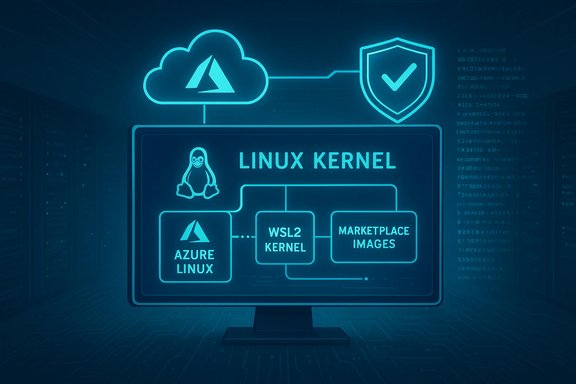
- No — Azure Linux is not necessarily the only Microsoft product that could include the same vulnerable kernel code. Microsoft ships and publishes multiple Linux kernel artifacts (for example, the WSL2 kernel, linux‑azure / azure‑tuned kernels used in some VM SKUs, curated Marketplace images, AKS node images, and other appliance images). Each of those is a separate artifact that may or may not include the same upstream source files, depending on kernel version, config flags (CONFIG_*), module selection, and whether a vendor backport was applied. Therefore the same upstream code can appear in multiple Microsoft artifacts even if only one product has been attested so far.
- Microsoft publishes the WSL2 kernel sources on GitHub (the microsoft/WSL2‑Linux‑Kernel repository), demonstrating Microsoft builds and ships a separate Linux kernel artifact as part of Windows/WSL. That artifact is independently versioned and configured and therefore requires a separate inventory check to determine whether it contains a vulnerable commit range or not.
- Major distribution and vendor trackers (NVD, Debian, Ubuntu, Oracle, Amazon, Red Hat) list CVE‑2025‑38499 and have mapped fixes into their kernel packages; those pages show how the upstream fix was propagated across vendor kernels and confirm the vulnerability is being treated as a kernel‑package issue across the Linux ecosystem. That mapping underscores the artifact‑level nature of exposure: a CVE maps to a kernel commit range and distributions publish which package versions are fixed.
How to triage and respond (practical checklist for WindowsForum readers)
- Inventory first: identify which Microsoft artifacts and images you actually run.
- Azure VMs using Microsoft‑published images (including Azure Linux).
- AKS node images or Marketplace images you use.
- Windows hosts running WSL2 (the WSL kernel is a Microsoft‑supplied kernel image).
- Any appliances or partner Marketplace VM images that may bundle Microsoft kernel binaries.
- For each artifact, determine the kernel build and version.
- On running Linux artifacts, capture uname -r and inspect /proc/config.gz or the kernel config shipped with the artifact to confirm which CONFIG flags are enabled.
- Map the kernel version and vendor package to vendor advisories (Ubuntu, Debian, Red Hat, Oracle, Amazon) to see whether the vendor lists the CVE and which package version contains the patch.
- Patch Azure Linux immediately where Microsoft attested the product as “potentially affected.”
- Use Microsoft’s published Azure Linux kernel updates or updated images; consume Microsoft’s CSAF/VEX files if you ingest those into automation for triage. Microsoft’s VEX rollout and documentation explain how to consume these attestations.
- If you run other Microsoft artifacts (WSL2, linux‑azure kernels, Marketplace images), either:
- Confirm their kernel package and vendor advisory status; OR
- Open a support request with Microsoft asking for a product‑level attestation or confirmation for the specific SKU you run (MSRC committed to update CVE attestations as inventory expands).
- Short‑term mitigations when patching is impractical:
- Restrict who can perform mount/namespace operations. Avoid giving CAP_SYS_ADMIN to untrusted users or containers.
- Avoid granting privileged capabilities (CAP_SYS_ADMIN) into containers or CI runners unless strictly required.
- Harden container runtimes (drop CAP_SYS_ADMIN, restrict privileged containers).
- Monitor kernel logs for mount/namespace related OOPSes or unusual mount activity.
- Automate and subscribe:
- Subscribe to MSRC updates and to your distribution security trackers so you receive timely notices when a product you use moves from “Known‑Affected” to “Fixed.”
- Ingest Microsoft’s CSAF/VEX feed if you run large fleets of Microsoft‑supplied artifacts; these files are machine readable and intended for automation.
Critical analysis: strengths and limitations of Microsoft’s VEX attestation model
Strengths- Deterministic signal for Azure Linux. Microsoft’s CSAF/VEX attestation for Azure Linux gives defenders a clean, machine‑actionable input for automation: a named product is “Known‑Affected” so triage decisions are unambiguous for that product family. That reduces noisy false positives and speeds remediation in clouds that consume those images.
- Phased rollout is pragmatic. Large vendors ship many distinct binary artifacts. A phased attestation approach (start with Azure Linux) is operationally sensible: it lets Microsoft validate tooling and processes before scaling the inventory to many more SKUs.
- Attestation ≠ exhaustive coverage. Microsoft’s statement that “Azure Linux includes this library” does not prove other Microsoft artifacts are unaffected. Missing attestations for other artifacts create unknowns that defenders must handle conservatively. Treat “not listed” as “unknown” and verify relevant artifacts yourself.
- Backport variability across vendors. Even when vendors publish “fixed” kernel packages, the underlying backport approach can vary (partial backports, different changelog wording, or diverging stable branch merges). Operators should confirm vendor changelogs reference the upstream commit or the CVE before assuming a package is fixed.
- Time lag and automation dependencies. Large‑scale inventorying and automated VEX consumption takes time. Until Microsoft publishes attestations for every relevant SKU, customers must rely on manual artifact checks or vendor support channels for verification. This creates an operational window where unknown artifacts may be left unverified.
Example scenarios that matter to WindowsForum readers
- WSL2 desktops and developer machines: WSL2 uses a Microsoft‑supplied kernel that is publicly hosted on GitHub (microsoft/WSL2‑Linux‑Kernel). If you run WSL2, check the WSL kernel version and whether the WSL kernel source at the shipped tag includes the commit that remediates CVE‑2025‑38499. If uncertain, apply the latest WSL kernel updates or follow Microsoft’s guidance for WSL updates.
- Azure VM images: Azure Marketplace and Azure VM images may include Microsoft‑maintained kernels (Azure Linux) or distro kernels (Ubuntu, Debian, RHEL). Microsoft’s attestation covers the Azure Linux family; other images must be validated against their vendor advisories or by Microsoft’s updated attestations. Inventory images you run and match kernel versions to vendor CVE mappings.
- Container hosts, CI/CD, and multi‑tenant services: these are high‑value targets because local or local‑adjacent actors (containers with privilege or misconfigured capabilities) can exercise mount/namespace APIs. Restrict CAP_SYS_ADMIN use and consider reducing the attack surface by disabling unprivileged namespaces where appropriate.
When a vendor says “we’ll update the CVE if other products are identified” — how teams should interpret that
- Interpret the phrase as a promise of future attestation for currently unknown artifacts, not as an assurance that those artifacts are already safe.
- Treat Microsoft’s attestation as a snapshot in time. Operational practice: act on the attestation where it exists, and for any other Microsoft artifacts that you run, perform artifact‑level checks (kernel version, config, vendor package changelog) or obtain a direct attestation/support confirmation from Microsoft.
Conclusion — what to tell your IT/security team now
- Microsoft’s public attestation is authoritative for Azure Linux: treat those images as in‑scope and apply Microsoft’s updated Azure Linux images or kernel packages.
- However, the attestation is product‑scoped: it is not a company‑wide guarantee that no other Microsoft product contains the same vulnerable kernel code. Other Microsoft artifacts (notably WSL2 kernels, linux‑azure kernels, Marketplace images, AKS node images) are plausible carriers until they are inventory‑checked and attested or independently verified. Do not assume “not listed yet” equals “not affected.”
- Operational checklist: inventory Microsoft artifacts you run, map kernel versions to vendor advisories (NVD/distribution trackers), patch Azure Linux immediately, restrict CAP_SYS_ADMIN and privileged container capabilities, and subscribe to Microsoft’s VEX/CSAF feed and vendor security trackers for updates.
Appendix (quick references for triage automation)
- Check NVD / distro security trackers for CVE‑2025‑38499 kernel mappings.
- Consult Microsoft’s VEX/CSAF documentation and the MSRC blog about the VEX rollout for guidance on consuming Microsoft attestations.
- Verify WSL2 kernel version and source if you run WSL2 desktops.
Source: MSRC Security Update Guide - Microsoft Security Response Center
