

A small, surgical fix in the Linux kernel’s CoreSight TRBE driver has been assigned CVE‑2025‑40060 after maintainers corrected an error‑handling mismatch that could otherwise produce a kernel panic on affected systems.
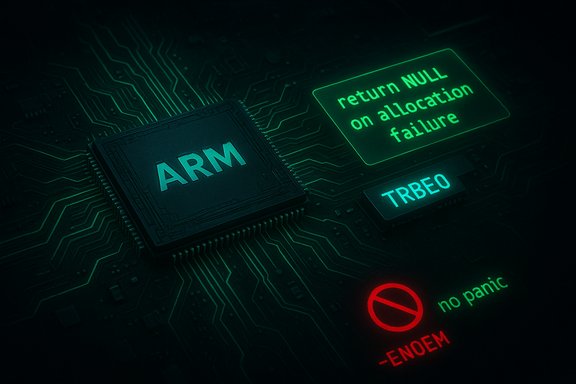
The vulnerability lives in the Linux kernel CoreSight stack’s TRBE (Trace Buffer Extension) driver — the per‑CPU trace buffer implementation used as a sink for certain ARM trace sources. TRBE captures CPU trace data in system memory and integrates with the CoreSight/ETE tracing framework; TRBE devices appear under the coresight bus (for example, /sys/bus/coresight/devices/trbe0). CVE‑2025‑40060 is not a memory‑corruption exploit or remote code execution primitive. Instead it is a classical null/error‑value handling bug: the TRBE allocation routine returned a negative error code in some failure paths while the caller only tested for a NULL return. That mismatch allowed an error case to be misinterpreted as a valid pointer, letting the caller continue and eventually trigger a kernel panic. The flaw was reported, upstream maintainers pushed a tiny defensive patch to return NULL on allocation failure, and the issue was recorded in public vulnerability trackers on October 28, 2025.
Source: MSRC Security Update Guide - Microsoft Security Response Center
 Background / Overview
The vulnerability lives in the Linux kernel CoreSight stack’s TRBE (Trace Buffer Extension) driver — the per‑CPU trace buffer implementation used as a sink for certain ARM trace sources. TRBE captures CPU trace data in system memory and integrates with the CoreSight/ETE tracing framework; TRBE devices appear under the coresight bus (for example, /sys/bus/coresight/devices/trbe0). CVE‑2025‑40060 is not a memory‑corruption exploit or remote code execution primitive. Instead it is a classical null/error‑value handling bug: the TRBE allocation routine returned a negative error code in some failure paths while the caller only tested for a NULL return. That mismatch allowed an error case to be misinterpreted as a valid pointer, letting the caller continue and eventually trigger a kernel panic. The flaw was reported, upstream maintainers pushed a tiny defensive patch to return NULL on allocation failure, and the issue was recorded in public vulnerability trackers on October 28, 2025. What exactly went wrong: technical anatomy
The code contract mismatch
At the heart of the problem are two cooperating functions in the TRBE/CoreSight path:- A TRBE helper that attempts to allocate a buffer (arm_trbe_alloc_buffer or similar).
- A caller (etm_setup_aux or etm_setup_aux that expects the helper to return either a valid pointer or NULL to indicate allocation failure.
Why this is severe in kernel context
A NULL or invalid pointer dereference in user space typically isolates a single process; in kernel space it most often yields an oops or panic that destabilizes the entire host or at least the affected kernel subsystem. For tracing and debug drivers that operate at privileged levels and during device initialization or teardown, such faults can cause immediate service interruptions or require reboots to restore normal operation. That makes even a one‑line defensive omission operationally important.Scope — who is affected
- Any Linux kernel build that includes the coresight‑trbe driver (CONFIG_CORESIGHT_TRBE or module) and the vulnerable code paths is potentially affected. The TRBE driver is present in ARM/ARM64 trees where the hardware supports Trace Buffer Extension and where the feature is enabled in kernel config.
- Distribution kernels that include the upstream commit prior to the stable‑tree fix are at risk until they backport the fix into their packaged kernels. Public trackers and OSV imports show Debian and several stable branches enumerated as containing affected packages.
- Embedded devices, vendor kernels (Android OEM kernels), SoC images, and appliances that ship custom kernel trees are the most likely real‑world exposure because vendor update cycles are often slower and may lag upstream fixes. Administrators of embedded fleets should treat vendor‑supplied kernels as a prioritized inventory item to verify.
Severity and exploitability
- Attack vector: Local. The code path is exercised on the host; there is no realistic unauthenticated remote attack path described in the public records.
- Privileges: Low (in some configurations an unprivileged local user may be able to exercise the traces or related sysfs interfaces), but the attacker must be local or supply code that runs locally.
- Primary impact: Availability (Denial‑of‑Service) — kernel panic/oops, not confidentiality or integrity compromise. Public CVSS interpretations cluster in the medium range (CVSS v3 ≈ 5.5) reflecting the local vector and high availability impact.
Patch and upstream response
Upstream maintainers merged a focused, minimal patch into the stable kernel trees: the allocator function was changed to return a NULL pointer when a buffer allocation failed, so that callers which only check for NULL will correctly see the failure and not proceed to dereference an error value. The change is intentionally small to minimize regression risk and ease backporting for distributions/vendors. The patch traces and stable‑tree emails show the two‑to‑six line edits typical of this defensive class of fix. Why this fix is safe and correct:- It preserves normal behavior in successful allocation paths (no functional change when memory is available).
- It restores the expected contract between allocator and caller (either return a valid pointer or NULL to indicate failure, not an errno‑encoded pointer).
- Because the fix is small and constrained, it is easy for distributors and vendors to backport without upsetting unrelated subsystems.
How to detect if you're affected
Administrators and incident responders should use the following checks and telemetry searches.Quick inventory checks
- Check for TRBE devices in sysfs: look for /sys/bus/coresight/devices/trbe* on ARM/ARM64 systems. The TRBE kernel documentation documents these device entries and their attributes.
- Check kernel configuration or module presence:
- uname -r to identify the running kernel.
- grep CONFIG_CORESIGHT_TRBE /boot/config-$(uname -r) or check lsmod | grep coresight_trbe to see if the driver is built/loaded.
- Cross‑reference your kernel package version against your distribution’s CVE advisory or the OSV/debian imports that map CVE‑2025‑40060 to specific package ranges.
Log and SIEM hunting queries
- Search kernel logs for oops/panic entries mentioning coresight, trbe, or trace‑related stack frames. Typical indicators include kernel panics, “NULL pointer dereference”, and trace driver symbols in the stack. Add dmesg, journalctl, and /var/log/kern.log queries for those markers.
- Look for recent reboots correlated with trace device use or device probe/teardown — repeated reboots tied to trace attach/detach events can point to this class of bug.
Recommended remediation steps (operational playbook)
- Identify: inventory hosts that expose TRBE devices or have the coresight‑trbe driver enabled. Use the sysfs paths and kernel config checks listed above.
- Patch: apply vendor/distribution kernel updates that include the upstream stable commit which implements the NULL return on allocation failure. For mainstream distributions, install the updated kernel packages when they become available and plan a reboot. The upstream fix is merged into stable trees and distributed via distro backports.
- Reboot: kernel fixes require running the updated kernel — schedule reboots or staged rollouts per your change management.
- Validate: after upgrading, reproduce attach/detach or trace setup sequences on representative hardware to confirm no oopses occur; inspect dmesg/journal for lingering errors.
- Vendor follow‑up for embedded devices: for devices using vendor‑custom kernels (Android phones, SoC images, appliances), contact the vendor for a patched image or backport. If the vendor does not supply a fix promptly, consider network/physical controls to reduce local attack surface (restrict untrusted local code execution, isolate devices).
- Restrict access to machines that allow untrusted local users to load trace devices or interact with coresight sysfs entries.
- Isolate vulnerable devices from multi‑tenant or untrusted networks where possible.
- Increase monitoring of kernel logs and set alerts for repeated trace‑related oopses.
Practical risk analysis for common environments
- Multi‑tenant/cloud hosts: medium‑high priority. Even though the attack vector is local, guests or untrusted tenants that can influence trace setup might produce host instability; such hosts should be patched quickly.
- Development and shared build hosts: medium priority. These environments commonly enable tracing and may permit non‑privileged users to interact with tracing infrastructure; restrictions or rapid patching are sensible.
- Embedded fleets / OEM devices: highest real‑world exposure. Vendors may take longer to push updates; these devices need explicit vendor QA and remediation timelines.
- Single‑user desktop or tightly controlled server: lower immediate risk if local users are trusted and trace features are not exposed, but the correct operational posture remains to patch when updates arrive.
What the upstream commits and trackers say
Multiple independent trackers ingested the same upstream message and patch metadata: the NVD and OSV entries summarize the bug as a return‑value mismatch in the TRBE allocation path and list the upstream commits that implement the change; distribution trackers such as Debian’s security tracker already map affected package ranges against the fix. The stable‑tree patch messages and stable update mailings describe the fix as returning NULL on allocation failure so callers detect the failure correctly. Cross‑referencing the kernel‑side documentation and the stable patch corroborates that TRBE is a per‑CPU trace sink and that the kernel code handling buffer allocation must follow strict return‑value contracts to avoid kernel faults — a small oversight in that contract is what led to CVE‑2025‑40060.Developer and engineering takeaways
- Defensive coding in privileged code paths is essential: always make the return‑value contract between an allocator and its caller explicit and consistent (either NULL or ERR_PTR conventions but not mixed semantics). This bug is a textbook case where inconsistent conventions produce high‑impact behavior.
- Small, surgical fixes are often the right corrective action for these classes of bugs. They reduce the chance of regressions and make backports simpler for distributors and OEMs. The upstream patch for CVE‑2025‑40060 is intentionally minimal for that reason.
- Fuzzing and negative‑path testing of kernel drivers that parse or manage hardware descriptors and buffer lifecycles can catch these problems earlier. Focused tests that simulate allocation failure, partial initialization, and teardown races are high‑value for tracing and driver subsystems.
Detection and incident response checklist
- If you see kernel oops/panic logs with trace‑related symbols (trbe, coresight, etm_setup_aux) treat the host as high priority for patching and investigation.
- Preserve dmesg/kern.log output for forensic analysis and to correlate whether the panic was caused by this TRBE path versus unrelated kernel subsystems.
- Isolate affected hosts and collect runtime artifact (kernel crash dumps, /proc/last_kmsg on embedded devices) before rebooting for an initial triage.
- After patching, re-run the scenario that previously reproduced the crash in a controlled testbed to confirm the remediation.
Caveats and unverifiable claims
- There is no public evidence at disclosure that CVE‑2025‑40060 has been exploited in the wild; trackers and advisories list it as a robustness/DoS fix. That absence of evidence is not proof of absence — defenders should treat the vulnerability as a credible availability risk and patch accordingly. This claim is based on current public trackers and the lack of reported PoC or exploited incidents at time of disclosure.
- Specific vendor‑impact assertions (which models of phones, SoCs, or appliances are affected) require vendor confirmation. Embedded products often have vendor forks with custom kernel versions; verify patch availability and backport status directly with vendors. Treat any statement about a particular device family as tentative until you see a vendor advisory.
Conclusion and final recommendations
CVE‑2025‑40060 is a prototypical kernel robustness issue: a minor error‑handling mismatch that can crash a host. The functional fix is small and upstream, and most mainstream distributions and kernel stable branches will absorb the patch quickly. Still, the practical exposure is biggest for embedded and vendor kernels that lag upstream. Administrators should:- Inventory systems for TRBE/coressight presence and locate vulnerable kernel packages.
- Apply vendor or distribution kernel updates that contain the stable‑tree fix and reboot as required.
- Harden local access and monitoring for devices that cannot be patched immediately, and escalate to vendors for embedded devices lacking a timely update.
Source: MSRC Security Update Guide - Microsoft Security Response Center
