

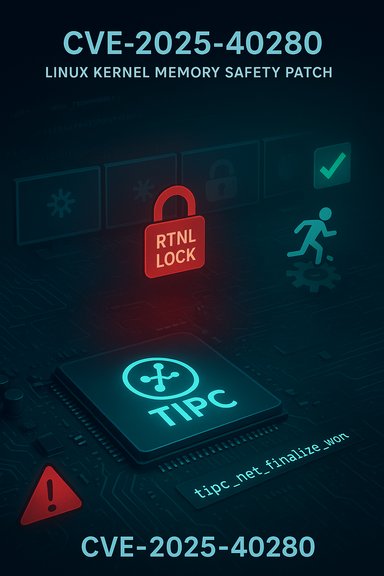
The Linux kernel recently received a targeted patch addressing a use‑after‑free in the Transparent Inter‑Process Communication (TIPC) subsystem: CVE‑2025‑40280 — “tipc: Fix use‑after‑free in tipc_mon_reinit_self”. The bug, reported by syzbot and flagged by KASAN traces, arises because tipc_mon_reinit_self iterates the per‑net monitor array without holding the RTNL (networking) lock, exposing a narrow race that can let code touch freed monitor entries. Upstream maintainers closed the window by ensuring the RTNL is held in the work context that previously ran unlocked, and the change was merged into the stable kernel trees and propagated into downstream advisories.
TIPC is a Linux kernel networking family designed for cluster and intra‑host message passing. Its monitor subsystem keeps per‑network namespace monitor structures in an array (tipc_net(net)->monitors[]). That array is normally protected by the RTNL lock, which serializes a number of network configuration and teardown operations. A syzbot‑generated KASAN report showed a slab use‑after‑free originating from tipc_mon_reinit_self when invoked from tipc_net_finalize_work, a workqueue context that historically did not take RTNL. The immediate symptom is a KASAN slab‑use‑after‑free trace and a kernel oops; the underlying defect is a classic synchronization omission that allows a reader to traverse freed entries. This is a local kernel memory safety bug: it does not present as a straightforward unauthenticated network attack against remote hosts, because exploitation requires inducing the specific tipc workload and timing the reinit/finalize sequence. Nonetheless, kernel use‑after‑free defects are high‑value primitives for advanced attackers on multi‑tenant infrastructure, so maintainers treated the issue as important and applied a surgical fix that preserves semantics while closing the race.
Source: MSRC Security Update Guide - Microsoft Security Response Center
 Background / Overview
TIPC is a Linux kernel networking family designed for cluster and intra‑host message passing. Its monitor subsystem keeps per‑network namespace monitor structures in an array (tipc_net(net)->monitors[]). That array is normally protected by the RTNL lock, which serializes a number of network configuration and teardown operations. A syzbot‑generated KASAN report showed a slab use‑after‑free originating from tipc_mon_reinit_self when invoked from tipc_net_finalize_work, a workqueue context that historically did not take RTNL. The immediate symptom is a KASAN slab‑use‑after‑free trace and a kernel oops; the underlying defect is a classic synchronization omission that allows a reader to traverse freed entries. This is a local kernel memory safety bug: it does not present as a straightforward unauthenticated network attack against remote hosts, because exploitation requires inducing the specific tipc workload and timing the reinit/finalize sequence. Nonetheless, kernel use‑after‑free defects are high‑value primitives for advanced attackers on multi‑tenant infrastructure, so maintainers treated the issue as important and applied a surgical fix that preserves semantics while closing the race. Technical anatomy: what went wrong
The data structures and locking model
TIPC stores per‑net state in tipc_net(net), which includes an array of monitor pointers (monitors[]). Access to that array and related monitor lifecycle operations are expected to be serialized by the RTNL lock. When protectors such as RTNL are relied upon, any code that reads or mutates those shared structures must either:- hold RTNL (or other appropriate locks) while accessing them, or
- use safe concurrent accessors (RCU, refcounts, explicit checks) that guarantee lifetime semantics.
How the bug was discovered
Syzbot, the kernel fuzzing/hardening harness used by many kernel maintainers, produced a KASAN trace showing an illegal read in a spinlock acquisition site triggered by tipc_net_finalize_work. The backtrace in the report pointed to tipc_mon_reinit_self walking monitors[] without RTNL held; KASAN flagged accesses into freed memory. The concrete logs include the workqueue context, the stack trace, and the kernel addresses involved — a smoking gun for the maintainers.The upstream fix: minimal, defensive, and targeted
The kernel patch for this CVE follows the maintainers’ common pattern: prefer small, local ordering or locking changes that restore the intended synchronization without redesigning the subsystem.- The core change is to ensure that the work path (tipc_net_finalize_work) grabs RTNL before calling tipc_mon_reinit_self, eliminating the code path where the array is iterated without the expected lock. In short: hold RTNL in the worker context.
- Some patch variants add defensive NULL checks around per‑monitor fields to avoid dereferencing absent substructures during reinit (for example, checking mon->self before touching subfields), but the primary safety guarantee comes from consistent locking.
Affected scope and distribution mapping
- Affected code: the vulnerability lives in the in‑tree Linux kernel TIPC monitor code (net/tipc/monitor.c), across trees that include the vulnerable commit(s) before the upstream fix.
- Attack vector: local (AV:L). The workqueue context and kernel internals involved mean that an unprivileged local process — or a tenant in a VM/container with the ability to touch TIPC or trigger certain network namespace teardown flows — could trigger the condition.
- Distributions and vendors: the CVE has been recorded in major trackers and mirrored by OSV/NVD entries; maintainers and distribution security teams have referenced upstream commits and prepared backports. Operators should consult their vendor’s kernel changelog to map the upstream commit to the packaged kernel build.
Severity, exploitability and practical risk
What the bug enables (technical):
- Use‑After‑Free (UAF): a worker thread can traverse freed monitor pointers, possibly reading or writing memory that has been reclaimed. The immediate observable impacts are kernel WARNs, KASAN reports, and potential kernel oops/panic.
Likelihood of remote exploitation:
- Low for unauthenticated remote attacks. The vector requires local interactions with the kernel TIPC paths and precise timing. However, on multi‑tenant hosts, containers, or VMs where untrusted code runs, the exposure is broader because the attacker need not be a privileged user to manipulate local networking or namespaces.
Typical impact profile:
- Primary impact: availability. Kernel oopses and panics cause service interruptions, reboots, or data-plane failures.
- Secondary impact: integrity. In theory, UAFs can be escalated into memory corruption primitives, and determined attackers sometimes chain such primitives to achieve privilege escalation. As of disclosure, there is no widely published PoC demonstrating a stable escalation chain from this specific defect. Treat escalation potential as theoretical but non‑trivial.
Prior examples and context
Kernel networking subsystems are frequent targets for syzbot and KASAN. The TIPC tree has seen multiple defensive fixes in 2024–2025 to harden lifetimes and refcounting. Those prior fixes shared the same pattern: small, clearly scoped changes (lock ordering, check insertion, RCU/hold rework) to eliminate narrow windows that produced UAFs. This CVE follows that established pattern.Detection, hunting and forensic guidance
Short, actionable guidance for operators and incident responders:- Check kernel logs for KASAN or WARN traces referencing tipc_mon_reinit_self, tipc_net_finalize_work, or monitor.c. These traces often include the exact callstack produced by KASAN and are high signal. Use journalctl -k or dmesg to search for suspicious oopses.
- If you collect vmcores (kdump), preserve them for offline analysis: kernel oopses triggered by UAFs often require the vmcore to reconstruct the heap and allocator state for any meaningful investigation. Ensure kdump is enabled on critical infrastructure.
- Correlate any TIPC‑specific activity (netlink calls touching TIPCs, ip link or netlink events) with kernel oopses. The syzbot traces that reported this issue included netlink‑driven flows that ultimately scheduled the problematic work item.
- Hunting primitives: search for repeated or correlated OOPS events in a narrow time window, stack traces mentioning tipc_*, workqueue processing, or RTNL warnings. Centralized log aggregation helps preserve traces that are often lost during reboots.
Immediate mitigation and remediation steps
- Install vendor‑supplied kernel updates that reference the upstream fix (apply package updates and reboot). The upstream commits have been merged into stable trees; distributions have begun shipping backports. Confirm the package changelog explicitly mentions the CVE or the corresponding commit IDs.
- If patching is delayed, reduce the attack surface:
- Restrict or remove access to TIPC where possible. If TIPC isn’t used, consider blacklisting the module or compiling kernels without it for endpoints where space permits.
- Limit which users/processes can manipulate network namespaces and netlink interfaces (least privilege).
- Harden container and VM isolation so untrusted tenants cannot interact with host TIPC or trigger the kernel paths that lead to finalize work.
- For appliance and embedded device operators:
- Contact the vendor if their images or appliance kernels lag upstream; insist on backports or updated firmware images. Vendor kernels often require coordination and may not follow the same release cadence as mainstream distributions.
- Verify remediation:
- After applying updates, confirm the system runs the patched kernel (uname -r and package manager checks) and inspect the vendor changelog for reference to the CVE or upstream commit. If you maintain custom kernels, merge the upstream stable commit into your branch and rebuild.
Why this patch matters — strengths of the fix
- Correctness over workaround: The upstream maintainers fixed the synchronization invariant rather than band‑aiding per‑access checks. Ensuring RTNL is held in the worker path restores the original locking contract and prevents similar races anywhere the contract is assumed. That approach is robust and reduces the chance of regressions.
- Surgical changes minimize regression risk: The patch is small, localized, and easy to backport — characteristics kernel maintainers favor when addressing memory‑safety regressions in stable branches. Small fixes are more likely to be accepted quickly and tested broadly.
- Community verification: Multiple independent trackers (NVD, OSV, distributor advisories) and the upstream patchwork chatter documented the fix, showing a coordinated response across the kernel community and distros. That cross‑validation reduces ambiguity about what changed and how to verify it.
Potential risks and caveats
- Backporting and vendor coverage vary. Different distributions backport fixes into different kernel branches at different times. Operators must verify vendor package changelogs rather than assuming every host with a version number greater than X is safe. Rely on the vendor’s package notes or check for the upstream commit ID in the package changelog, not just kernel version numbers.
- Detection gaps on non‑KASAN systems. KASAN detections are powerful in testing and fuzzing environments, but production kernels typically do not run with KASAN enabled. That means a system may exhibit kernel oops or panics without the rich diagnostic traces seen in syzbot reports, and intermittent races could be missed until they cause a crash. Centralized logging and vmcore collection are therefore essential.
- Operational tradeoffs of module unloads. Disabling TIPC (or removing modules) can be a valid short‑term mitigation, but for hosts that legitimately use TIPC for cluster or management planes, unloading the module may be disruptive. Evaluate impact and coordinate maintenance windows if kernel updates or module removals are performed.
- No public PoC (yet) ≠ no risk. While there may be no widely published exploit chain, kernel UAFs are by definition memory‑safety holes that could be parts of future privilege‑escalation chains. Treat this as an important stability and potential security fix.
Practical checklist for Windows‑centric administrators who run Linux guests, containers or appliances
- Inventory: enumerate VMs, containers, and appliances that include Linux kernels with TIPC enabled. Check for presence of net/tipc in kernel config or the TIPC module.
- Patch: coordinate with cloud/image vendors and apply updated images or kernel packages promptly. Reboot VMs/hosts into patched kernels.
- Monitor: centralize dmesg/journalctl -k logs for early detection of oopses mentioning tipc_mon_reinit_self or tipc_net_finalize_work. Preserve vmcores for post‑mortem.
- Isolate tenants: on multi‑tenant infrastructure, consider additional network and capability restrictions for untrusted tenants to reduce the chance of privilege‑escalation attempts being staged locally.
Broader takeaways for kernel security and operations
- Small races matter: many kernel defects arise from subtle locking assumptions being violated in a rarely exercised path (workqueue, teardown, or async callback). Ensuring invariants are explicit and enforced (e.g., always hold RTNL when accessing monitors[]) is far more maintainable than sprinkling per‑access checks.
- Fuzzing and KASAN continue to pay dividends: syzbot and KASAN traces repeatedly find narrow races that escape traditional code review. Operators benefit when upstream fixes propagate quickly to downstream packages.
- Operational hygiene reduces blast radius: centralized logging, crash capture (kdump), least privilege for device and netlink access, and rapid image updates materially reduce the operational impact of kernel memory defects.
Conclusion
CVE‑2025‑40280 is a narrowly scoped but meaningful Linux kernel fix: a use‑after‑free in the TIPC monitor reinitialization path caused by iterating a RTNL‑protected array without the lock under a particular workqueue context. The upstream remedy — ensuring RTNL is held where required — is small, safe, and effective. Administrators should treat this as an availability‑first risk: immediately verify vendor kernel package updates, apply patches, and reboot hosts into patched kernels. For environments where rapid patching is difficult, reduce exposure by tightening access to TIPC, hardening tenant isolation, and preserving kernel logging and vmcores for forensic analysis. The fix exemplifies the kernel community’s approach to memory‑safety regressions: surgical, defensive changes that restore intended invariants and make future races less likely.Source: MSRC Security Update Guide - Microsoft Security Response Center
