

Microsoft’s Security Response Guide lists CVE-2025-49752 as an Elevation of Privilege vulnerability affecting Azure Bastion, and administrators should treat it as a high-priority cloud-management risk while they confirm vendor guidance and deploy the vendor-recommended mitigations.
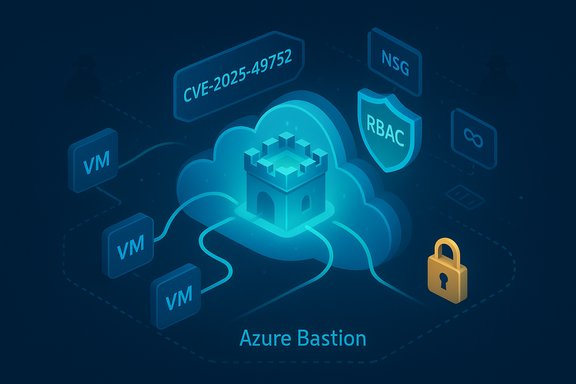
Azure Bastion is a managed platform service that provides secure and seamless RDP/SSH connectivity to virtual machines in Azure without exposing management ports to the public Internet. It sits in a virtual network, proxies session traffic, and integrates with Azure RBAC and network controls; because of that privileged role it functions as a critical control point — and conversely, a high-value target for attackers seeking to escalate access from a compromised session or local foothold to broader cloud or tenant-level privileges.
CVE-2025-49752 is cataloged on Microsoft’s Security Update Guide as an elevation-of-privilege issue tied to Azure Bastion. The vendor entry includes a confidence metric description that explains how Microsoft (and the security community) measure the degree of certainty around a vulnerability’s existence and technical detail; this metric matters because it signals whether the issue is fully verified, tentatively identified, or conjecture pending further research.
Because cloud-service advisories can be intentionally terse pending mitigations, defenders must combine vendor guidance with aggressive operational controls and behavior-based detection. Where additional independent technical analysis appears, map those findings back to Microsoft’s KB and test patches in a pilot ring before wide deployment. In the absence of public exploitation evidence, prioritize containment and least-privilege hardening for your management plane and treat Bastion hosts as crown-jewel infrastructure that deserves accelerated patching and continuous monitoring.
Source: MSRC Security Update Guide - Microsoft Security Response Center
 Background
Azure Bastion is a managed platform service that provides secure and seamless RDP/SSH connectivity to virtual machines in Azure without exposing management ports to the public Internet. It sits in a virtual network, proxies session traffic, and integrates with Azure RBAC and network controls; because of that privileged role it functions as a critical control point — and conversely, a high-value target for attackers seeking to escalate access from a compromised session or local foothold to broader cloud or tenant-level privileges.CVE-2025-49752 is cataloged on Microsoft’s Security Update Guide as an elevation-of-privilege issue tied to Azure Bastion. The vendor entry includes a confidence metric description that explains how Microsoft (and the security community) measure the degree of certainty around a vulnerability’s existence and technical detail; this metric matters because it signals whether the issue is fully verified, tentatively identified, or conjecture pending further research.
What Microsoft’s advisory says (summary)
- The CVE is registered in Microsoft’s Update Guide as a privilege-elevation vulnerability in Azure Bastion.
- The advisory text includes a description of the confidence metric — used to communicate how certain Microsoft is about both the existence and technical specifics of the reported flaw.
Why Azure Bastion vulnerabilities are operationally significant
Azure Bastion controls how administrators and operators reach VM consoles without opening RDP/SSH ports. A successful elevation-of-privilege against Bastion or its surrounding management plane can have outsized impact:- Trusted-management pivot — Bastion acts as a privileged proxy for RDP/SSH sessions; compromise can let an attacker escalate from user-level access to administrative access on target VMs or on the management plane that creates and assigns session tokens.
- Token and identity amplification — Local or service-level compromise can allow access to machine-assigned identities or token endpoints, enabling abuse of Azure Resource Manager (ARM) APIs and cross-resource actions.
- Audit and detection gaps — Because Bastion proxies legitimate admin sessions, malicious activity may look like normal administrative behavior unless investigators correlate network or control-plane anomalies across logs and telemetry.
- Blast radius — In multi-tenant or large-scale enterprise subscriptions, Bastion is frequently fronted against many VMs and can therefore magnify lateral movement or post‑compromise persistence. Community and vendor write-ups on similar Azure agent/extension elevation-of-privilege flaws show how a local EoP can be chained into management-plane access.
Technical analysis — what could be happening (reasonable, cautious inferences)
Microsoft’s Update Guide entry for CVE-2025-49752 supplies the vulnerability classification (elevation of privilege) and the explicit vendor confidence metric language but—at the time of publication—does not necessarily disclose the low-level exploit primitive. When vendor details are limited, security teams should reason from common patterns observed in other Azure management-plane and agent/extension CVEs:- Common root causes for Azure elevation-of-privilege flaws include improper access control, missing authorization checks in service APIs, untrusted input passed to privileged code paths, and local IPC/metadata endpoint abuse (HIMDS-style endpoints). Any of these could plausibly affect Bastion components that handle session orchestration, token exchange, or portal-driven troubleshooting flows.
- An attacker with the ability to trick a Bastion control-plane function into performing privileged operations (for example, by abusing an unauthenticated or insufficiently validated API) can escalate capability beyond their expected RBAC. Similar Azure agent issues have allowed on-host privilege escalation that then leveraged machine-assigned tokens to call ARM APIs.
- If the vulnerability is in a path that bridges portal UI actions to backend resource orchestration (for example, a connection troubleshooting export or an extension install flow), exploitation could be low‑interaction for a remote attacker under certain conditions. However, without a published PoC or vendor technical note, this remains a plausible scenario to be tested — not a confirmed exploit chain.
Verification and cross-checking (what we confirmed and what remains unverified)
Verified:- The CVE identifier exists in Microsoft’s Security Update Guide entry for CVE-2025-49752 and is associated with Azure Bastion in the vendor catalog. That entry includes Microsoft’s confidence-metric description for vulnerability reporting.
- Independent, high-quality vulnerability aggregators and public NVD-type mirrors did not at the time of research provide a full technical write-up or corroborating PoC for CVE-2025-49752 (no NVD entry with exploit details was found that expands on Microsoft’s note). Where external trackers do list Azure-related CVEs, they often rely on vendor advisories and may lag the vendor’s page. Because of that lag and because cloud-service advisories sometimes withhold in-depth technical details, additional corroboration could be limited to vendor-provided KBs or subsequent third-party technical analyses. If you require confirmed exploit mechanics for threat hunting signatures, continue to monitor MSRC and established vulnerability databases for updates.
Immediate actions for administrators (operational playbook)
- Confirm vendor guidance
- Visit the Microsoft Security Update Guide entry for CVE‑2025‑49752 and note any KB, fixed build, or rollout schedule listed. Apply vendor-provided patches or mitigations as directed.
- Inventory Bastion deployments
- Enumerate all Azure Bastion hosts and associated subnets, check which subscriptions and resource groups use Bastion, and identify any Bastion hosts that are internet-exposed via misconfigured NSGs or peered networks.
- Prioritize high-value assets
- Patch and validate Bastion deployments that secure jump boxes, administrative host pools, CI/CD runners, or domain-joined management VMs first; these hosts have the largest operational blast radius.
- Apply immediate compensating controls until patched
- Restrict network access: limit allowed management IP ranges and enforce just‑in‑time access patterns where possible.
- Harden RBAC: reduce long‑lived management privileges, enable Privileged Identity Management (PIM) for bastion‑related roles, and remove unnecessary owner-level rights on subscription or resource group scopes.
- Monitor metadata & token calls: alert on unexpected requests to local metadata endpoints or unusual token requests from non-admin processes.
- Validate and test
- After applying recommended updates or configuration changes, validate by reviewing Bastion logs, Azure Activity logs, and any EDR alerts for anomalous session creation or token usage.
- Post‑patch validation and hardening
- Re-audit Bastion configuration and keep Bastion agents and extensions up to date. Map CVE → KB → installed build rather than relying solely on CVE strings in automation.
Detection and hunting guidance
- Prioritize searches for:
- Unexpected privilege escalations in Bastion service logs or Azure Activity logs (role assignment changes, unusual service principal operations).
- Non-standard calls to local metadata endpoints or token requests initiated by Bastion-related processes.
- Windows/Linux host telemetry showing local privilege escalation attempts around sessions proxied by Bastion.
- Build detection rules focused on behavior rather than fragile memory signatures: monitor for suspicious process ancestry (for example, non‑admin processes spawning admin shells after Bastion session initiation), and for changes to extension/agent configuration. Similar Azure agent advisories emphasize behavioral hunting over early exploit-specific signatures.
Risk assessment — what exploitation would enable and how bad could it be?
If an attacker were to successfully exploit an elevation-of-privilege bug in Azure Bastion the potential consequences include:- Unauthorized administrative access to VM consoles and the ability to execute commands, harvest credentials, or move laterally.
- Abuse of machine or service identities to call ARM APIs, modify resources, or install persistent extensions and agents.
- Suppression or manipulation of logs and audit trails if the attacker achieves sufficiently high privilege on management hosts.
- Supply‑chain-style or tenant-scale abuse if Bastion orchestration is integrated with provisioning pipelines, automation or central management tooling.
Strengths of Microsoft’s disclosure and areas of concern
Strengths:- Publishing the CVE and a vulnerability entry in the Microsoft Security Update Guide demonstrates transparency and gives operators a canonical reference for remediation and tracking. The vendor’s addition of a confidence metric helps consumers interpret how definitive the technical details are.
- Microsoft has a track record of rolling out mitigations and platform-side fixes for Azure control-plane issues; prior Bastion incidents were mitigated at scale by the vendor with no customer action required in some cases.
- Cloud-service advisories sometimes omit exploit mechanics and PoCs until fixes are available, which is sensible defensively but leaves defenders needing to make high‑consequence patch decisions with limited technical context.
- Vulnerability tracking feeds and third-party aggregators can fragment CVE → patch mappings for Azure components, creating operational confusion if automation relies solely on CVE strings. Establish a process to map MSRC advisory text to exact KB/agent versions and test before deployment.
Longer-term mitigations and defense-in-depth for bastion-style architectures
- Reduce attack surface
- Avoid exposing management planes directly to broad networks; use restricted IP ranges, VPNs, or private links.
- Enforce least privilege
- Use granular RBAC, PIM, and short-lived credentials for both human and machine identities associated with Bastion.
- Harden on-host controls
- Ensure bastion-proxied VMs are configured with application control, EDR, and strict local-account policies to reduce the chance that a local EoP becomes a full tenant compromise.
- Segmentation and micro-perimeters
- Segment management and production networks; place Bastion hosts in tightly controlled management VNETs with strict NSGs and firewall policies.
- Continuous validation
- Regularly scan and validate Bastion-related resource configurations in IaC templates and pipelines; treat management-agent updates as first-class patch items in your change-management cadence.
What to watch next
- Microsoft Update Guide updates for the CVE entry: check for added KB references, fixed build numbers, or platform-side mitigations and mapped agent versions.
- Trusted third‑party technical write-ups from established security vendors (for example, major endpoint/cloud security vendors and well-known independent researchers) that provide PoC analysis, exploit mechanics, and detection artifacts.
- CVE and NVD entries that expand the vector string and CVSS scoring, which informs prioritization and automated gating in enterprise patch pipelines.
Conclusion
CVE‑2025‑49752 is an Azure Bastion elevation‑of‑privilege entry in Microsoft’s Security Update Guide and should be treated as a serious operational concern for organizations that rely on Bastion for administrative access. Microsoft’s advisory system and its confidence metric are the authoritative starting points for verification and remediation, but the practical response for defenders remains the same: inventory, prioritize high‑value Bastion deployments, apply vendor fixes quickly, and use compensating network/RBAC controls while awaiting patches.Because cloud-service advisories can be intentionally terse pending mitigations, defenders must combine vendor guidance with aggressive operational controls and behavior-based detection. Where additional independent technical analysis appears, map those findings back to Microsoft’s KB and test patches in a pilot ring before wide deployment. In the absence of public exploitation evidence, prioritize containment and least-privilege hardening for your management plane and treat Bastion hosts as crown-jewel infrastructure that deserves accelerated patching and continuous monitoring.
Source: MSRC Security Update Guide - Microsoft Security Response Center
