

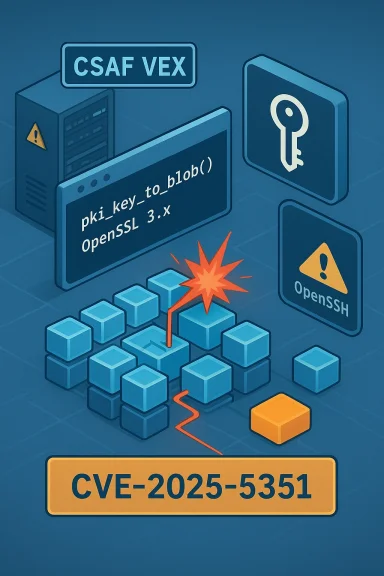
The newly assigned CVE‑2025‑5351 exposes a double‑free bug in libssh’s key export path — a subtle memory‑management defect in the library’s pki_key_to_blob() routine that can corrupt the heap during error handling and, under constrained conditions, crash or destabilize applications that perform key export operations. Microsoft’s public advisory calls out Azure Linux as a confirmed carrier of the implicated open‑source component and pledges to expand its machine‑readable CSAF/VEX attestations as further product inventories are completed; however, that product‑level attestation is not a proof that no other Microsoft product can or does ship the vulnerable libssh binary. This article unpacks the technical details of CVE‑2025‑5351, verifies the public record, analyses what Microsoft’s wording actually means for enterprise defenders, and provides an operational roadmap for discovery, mitigation, and longer‑term supply‑chain hygiene.
CVE‑2025‑5351 describes a memory management issue in libssh’s key export functions, specifically an error‑path double free rooted in pki_key_to_blob(). When an internal memory structure (commonly referenced as params) is freed during error cleanup but not nulled afterwards, a subsequent error path that attempts to free the same pointer again can trigger a double free, with consequences ranging from application crashes to heap corruption in low‑memory conditions. This is a reliability‑class vulnerability with possible security ramifications depending on how an application uses the exported data and its memory model.
Multiple independent vulnerability trackers and distribution security pages describe the flaw in the same terms and map it to downstream packages and advisories. Ubuntu’s security page, Amazon Linux’s ALAS advisory summary, and NVD entries all converge on the same technical description and risk characterization, which establishes a consistent upstream narrative for defenders.
Microsoft’s short FAQ line on its Security Update Guide — the phrasing many operators have quoted — reads in effect that “Azure Linux includes this open‑source library and is therefore potentially affected,” and the company states it began publishing CSAF/VEX attestations in October 2025 and will update CVE entries if further impact is found. That phrasing is intentionally scoped and procedural: it signals a product‑level inventory result for Azure Linux rather than a universal claim that only Azure Linux might include libssh.
Why that distinction matters technically:
Your defensible posture is therefore threefold:
Source: MSRC Security Update Guide - Microsoft Security Response Center
 Background / Overview
CVE‑2025‑5351 describes a memory management issue in libssh’s key export functions, specifically an error‑path double free rooted in pki_key_to_blob(). When an internal memory structure (commonly referenced as params) is freed during error cleanup but not nulled afterwards, a subsequent error path that attempts to free the same pointer again can trigger a double free, with consequences ranging from application crashes to heap corruption in low‑memory conditions. This is a reliability‑class vulnerability with possible security ramifications depending on how an application uses the exported data and its memory model.Multiple independent vulnerability trackers and distribution security pages describe the flaw in the same terms and map it to downstream packages and advisories. Ubuntu’s security page, Amazon Linux’s ALAS advisory summary, and NVD entries all converge on the same technical description and risk characterization, which establishes a consistent upstream narrative for defenders.
Microsoft’s short FAQ line on its Security Update Guide — the phrasing many operators have quoted — reads in effect that “Azure Linux includes this open‑source library and is therefore potentially affected,” and the company states it began publishing CSAF/VEX attestations in October 2025 and will update CVE entries if further impact is found. That phrasing is intentionally scoped and procedural: it signals a product‑level inventory result for Azure Linux rather than a universal claim that only Azure Linux might include libssh.
Technical anatomy of CVE‑2025‑5351
What fails and why it matters
At the heart of this flaw is a classic resource life‑cycle mistake: free without clear, then free again. The function pki_key_to_blob() performs serialization/conversion of cryptographic key structures into blob formats used by libssh and its callers. On certain failure paths — especially when downstream crypto backends such as OpenSSL 3.0 report allocation or parameter errors — the code frees an allocation pointed to by params but does not reset the pointer to NULL. If a later cleanup path assumes params is still valid and calls the same free routine a second time, the runtime ends up double‑freeing the same heap object. The immediate practical results are undefined behavior: heap corruption and application instability are the most likely outcomes, while exploitation to gain control of code flow is significantly harder but not categorically impossible depending on the environment and allocator details.Interaction with crypto backends (OpenSSL >= 3.0)
Several downstream advisories flag that the bug’s practical footprint increases when libssh is built against OpenSSL 3.0 or later. OpenSSL‑3’s parameter handling and OSSL_PARAM semantics are implicated in the typical failure scenarios described by vendors: when allocation of an internal string or parameter structure fails, libssh’s cleanup sequence calls OSSL_PARAM_free() (or equivalent) with the same pointer argument that was already freed, producing the double free. Put simply, the vulnerability is most likely to surface in builds where libssh relies on OpenSSL 3.x parameter APIs. This nuance matters operationally because not all libssh binaries are identical: packaging, build flags, and the choice of crypto backend determine whether a specific libssh instance is actually vulnerable.Affected versions and exposure profile
Public trackers and distributor advisories list the issue as present in libssh releases that predate the upstream fix (the specific fixed tag varies by project and distributor). Some trackers classify the vulnerability as Low–Medium for general deployments because it typically requires particular error conditions (low memory or allocation failures) and — in many real‑world deployments — the exposing call paths are not invoked frequently. Still, the vulnerability’s presence inside a widely used SSH library elevates the operational priority: many disparate packages and toolchains use libssh, and the risk is multiplicative when images or static binaries vendor older libssh code.Microsoft’s statement: reading the attestation line correctly
The literal text and its operational interpretation
Microsoft’s Security Update Guide entry for CVE‑2025‑5351 contains a short FAQ‑style clarifying sentence: Azure Linux “includes this open‑source library and is therefore potentially affected,” followed by a transparency pledge about CSAF/VEX and a promise to update CVE records if additional products are discovered to ship the component. That statement is authoritative for Azure Linux — Microsoft inspected the Azure Linux build outputs and identified the implicated upstream library — but the sentence does not assert exclusivity. Microsoft’s VEX/CSAF rollout is phased, and the company has repeatedly said it will expand attestations as inventories complete. Expect product‑by‑product updates rather than an immediate all‑products sweep.Why defenders often mistake the wording for “only”
There are two reasons this one‑line is commonly misread as an exclusivity claim:- Brevity breeds overreach: short machine‑readable lines fit automation but lose nuance; a busy admin or a scripted SIEM query may interpret “Azure Linux includes…” as “only Azure Linux includes…”.
- The product‑by‑product nature of VEX/CSAF: when a vendor begins publishing attestations for a single product family, that product becomes visible first; the rest of the portfolio remains in the dark until the inventory work is completed, which operators can mistake for “not affected.” Both assumptions are dangerous in security practice.
What Microsoft’s phrasing does and doesn’t do for you
What it does:- Gives you an authoritative remediation target: if you operate Azure Linux images, they are in‑scope and should be patched according to Microsoft’s guidance.
- Provides a mechanism for future transparency: Microsoft’s CSAF/VEX promise means more product‑level attestations will appear over time.
- Prove that other Microsoft products are unaffected. Absence of a product name on MSRC is absence of attestation, not evidence the product is clean.
- Substitute for artifact‑level discovery in your estate. Images, containers, Marketplace appliances, WSL kernels, and statically‑linked binaries distributed by Microsoft or third parties must still be scanned and verified.
Is Azure Linux the only Microsoft product that includes libssh and is therefore potentially affected?
Short, precise answer: No — not necessarily. Azure Linux is the only Microsoft product Microsoft has publicly attested as including the vulnerable libssh library for CVE‑2025‑5351 at the time of the advisory, and that makes Azure Linux a confirmed remediation priority. However, the attestation is product‑scoped; other Microsoft artifacts could include libssh depending on how they were built, packaged, or vendored. Until Microsoft publishes attestations for those artifacts or you verify them locally, they remain unverified rather than proven clean.Why that distinction matters technically:
- The presence of vulnerable code is an artifact property: it depends on the exact package version, build flags, enabled modules, and whether the library was statically vendored into a binary.
- Microsoft ships many Linux‑adjacent artifacts where libssh could be present: Azure VM images, Marketplace appliances, container base images, WSL distributions/kernels, and various management or telemetry images. Any one of these can carry a vulnerable libssh instance until inventoried or patched.
Cross‑checking the claim: independent verification
To avoid relying on a single source, I cross‑checked the libssh technical description and Microsoft attestation across multiple independent records:- NVD and distribution trackers (NVD/Ubuntu/Red Hat) contain the same pki_key_to_blob double‑free description, corroborating the flaw’s technical specifics and the affected call path.
- Amazon Linux (ALAS) summarizes the same failure mode and links the practical exposure to builds using OpenSSL 3.0 or newer.
- Debian and other distro trackers list CVE‑2025‑5351 and map the fix into distro packages, showing how downstream vendors are addressing the problem.
- Microsoft’s MSRC wording and CSAF/VEX rollout promise are observable in the company’s update guide UX (the text is dynamically rendered), and multiple third‑party analyses and community threads interpret that same language consistently: Azure Linux is explicitly attested; other Microsoft products remain to be inventoried.
Practical recommendations for administrators and security teams
If you manage environments that consume Microsoft artifacts (Azure, WSL, Marketplace images) or any Linux distributions in general, follow this prioritized checklist:- Immediate triage — confirm known‑affected assets (minutes to hours)
- Search your estate for libssh packages and binaries. Look for package metadata (libssh package versions) and run binary checks (strings, ldd, or package managers) across VMs, containers, and images.
- For Azure Linux images, follow Microsoft’s published patch guidance and apply the package or image updates Microsoft provides — treat Azure Linux as Known Affected.
- Short‑term mitigations (hours)
- Where feasible, disable or avoid invoking key export functionality in services that use libssh until patched.
- Limit exposure: restrict services that perform remote key export to trusted networks and authenticated clients; adjust monitoring/alerting for unexpected crashes in services that use libssh.
- Patch and rebuild (days)
- Upgrade libssh to the fixed upstream/release versions provided by your distro or vendor and rebuild any images that vendor or statically link libssh.
- For containers and immutable images, rebuild base images with patched packages and redeploy. Distributors (Ubuntu, Debian, Amazon Linux, etc.) will publish fixed packages — use those as your authoritative remediation artifacts.
- Artifact‑level discovery and SBOMs (days to weeks)
- Generate SBOMs for your images and CI pipelines to identify where libssh is present and which versions are used.
- Enforce dependency pinning, static analysis, and dependency scanning in CI to catch vendored or statically linked vulnerable libraries before they reach production.
- Longer‑term supply‑chain hardening (weeks to months)
- Require machine‑readable attestations (VEX/CSAF) from vendors where available, but do not rely solely on vendor attestation for coverage. Use attestation as a complement to your own scanning and SBOMs.
- Automate remediation workflows: trigger image rebuilds, container redeploys, or package upgrades automatically when a critical library is updated in the SBOM.
- Maintain runtime detection to spot abnormal termination or crashes that may be symptomatic of heap corruption, particularly in services performing key export or crypto operations.
Risk and exploitability assessment
CVE‑2025‑5351 is primarily a stability/availability vulnerability with a low‑to‑medium exploitation profile in many real‑world settings. The most important factors in determining practical risk are:- Whether your libssh instance is built against OpenSSL 3.x (increasing the likelihood the problematic code path executes).
- Whether the vulnerable code path is exercised in production (many deployments will never call key‑export functions in a way that triggers the error cleanup path).
- Whether the environment uses static linking or vendors older libssh versions into immutable images (containers, appliances), which raises the blast radius because remediation requires rebuilding artifacts.
What to tell leadership and customers
- Azure Linux: Microsoft has confirmed Azure Linux images include the implicated libssh code and should be patched as a priority. Follow Microsoft’s Azure Linux advisories.
- Other Microsoft artifacts: do not assume “no mention” equals “not vulnerable.” If you consume other Microsoft images (Marketplace, WSL, container bases) or run Microsoft‑provided agent binaries, treat them as potentially affected until you verify via SBOMs, vendor attestations, or local scans.
- Business risk: the immediate business impact is service reliability and potential availability loss; remediation is straightforward in most package‑managed environments but can be time‑consuming for immutable artifacts or statically vendored binaries.
Where the record is still incomplete — and what to watch for
- Microsoft’s VEX/CSAF feed is rolling out product attestations progressively. Watch Microsoft’s CSAF/VEX outputs and the MSRC update notice for CVE‑2025‑5351 for any expansion of the product mapping beyond Azure Linux. Until Microsoft publishes additional attestations, other products are simply unverified.
- If you run custom Marketplace images, third‑party appliances, or BYO images in Azure, they are not covered by Microsoft’s Azure Linux attestation unless the vendor explicitly states so — these must be scanned by your team.
- For WSL distributions and other Microsoft‑published kernel/artifact trees (for example, WSL2 kernels on GitHub), check the build provenance and whether libssh is present in the packaged userland. Published attestations for Azure Linux do not automatically apply to WSL or Windows in‑box components.
Conclusion — the defensible operational posture
CVE‑2025‑5351 is a real, documented double‑free in libssh’s key export path that distros have cataloged and are patching. Microsoft’s statement that Azure Linux includes this open‑source library and is therefore potentially affected is an authoritative, product‑scoped attestation that makes Azure Linux a confirmed remediation priority — but it is not a claim that Azure Linux is the only Microsoft product that could contain the vulnerable libssh binary. Treat Microsoft’s attestation as a starting point, not an exhaustive sweep.Your defensible posture is therefore threefold:
- Patch Azure Linux images immediately if you run them.
- Conduct artifact‑level discovery (SBOMs, package scans, image rebuilds) for all Microsoft‑provided and third‑party artifacts you consume.
- Use vendor attestations (CSAF/VEX) when available as a trusted input, but maintain your own scanning and SBOM‑driven controls as the authoritative source for what is running in your environment.
Source: MSRC Security Update Guide - Microsoft Security Response Center
