

CVE-2026-0968 is a low-severity libssh SFTP client flaw, disclosed in early 2026 and tracked by Microsoft’s Security Update Guide, that lets a malicious SFTP server crash vulnerable client applications by sending a malformed
The important part is not that libssh has a denial-of-service bug. Mature C libraries that parse network protocols will continue to have memory-safety defects, and SFTP is not magically exempt because it rides inside SSH. The important part is that Microsoft is now part of the visibility chain for an open-source library issue whose practical blast radius depends less on Windows Update than on where libssh has been embedded, packaged, vendored, or forgotten.
On paper, CVE-2026-0968 is modest. The affected component is the SFTP client side of libssh, and the failure mode is an out-of-bounds heap read caused by missing validation when parsing a server-provided
That attack shape matters. This is not an arbitrary attacker hurling packets at an exposed SSH daemon and taking over a system. The attacker needs to control or impersonate an SFTP server that the victim client connects to, or otherwise place themselves in the trust path of the file-transfer workflow. That is why the CVSS vector includes high attack complexity and required user interaction, and why the final score lands at 3.1, in the low range.
But “low” does not mean “irrelevant.” In enterprise environments, SFTP is one of those technologies that disappears into the plumbing: nightly file drops, backup jobs, vendor data exchanges, CI/CD artifact movement, industrial systems, reporting pipelines, and managed transfer appliances. If one of those workflows relies on a vulnerable libssh build, a crash can still interrupt a business process at the exact moment the business assumes the process is boring and dependable.
The result is a vulnerability that is boring in the exploit database but potentially irritating in the real world. No CISO should cancel a weekend over CVE-2026-0968. No admin should ignore it simply because the score starts with a three.
For WindowsForum readers, the practical reading is this: do not treat the MSRC page as proof that your Windows desktop is inherently vulnerable. Treat it as proof that Microsoft believes the issue is relevant enough to surface in its vulnerability ecosystem. The next step is product-specific investigation, not panic.
That distinction is increasingly important because modern Windows environments are layered with software that did not originate in Redmond. Windows Subsystem for Linux, container images, Git clients, third-party backup tools, IDEs, remote administration products, security appliances, and vendor agents can all bring their own SSH or SFTP implementations. Some use OpenSSH. Some use libssh. Some statically link libraries in a way that hides them from ordinary package inventory tools.
The Microsoft angle, then, is less “Windows has a libssh bug” than “Windows shops now need Linux-style dependency awareness.” That is a cultural shift many organizations still have not completed. The operating system patch level is necessary evidence, but it is no longer sufficient evidence.
That is why the user-provided MSRC language about conditions beyond the attacker’s control is not boilerplate trivia. It is the core of the risk model. A successful attack depends on the victim’s client initiating the SFTP interaction and reaching a server that can feed it malformed protocol data.
Still, the “required user interaction” metric can understate risk in automated environments. A human may not be clicking “connect” in a GUI client; a scheduled job may be doing the interaction every hour. If an organization has a script that pulls reports from a vendor SFTP endpoint, the “user” is effectively the automation framework, and the crash may repeat reliably until someone notices.
That is the awkward middle ground for this CVE. It is not remotely exploitable at will against arbitrary hosts, but it can be triggered in the exact workflows where humans are least likely to be watching. Availability bugs love unattended systems.
The
SFTP’s file-listing behavior carries some historical baggage. The
CVE-2026-0968 appears in that seam between expected structure and hostile input. The vulnerable libssh code path could read beyond the allocated heap buffer when a malformed
That difference matters for prioritization. A heap read beyond bounds sounds scary because similar primitives can sometimes be chained into information disclosure or memory-corruption exploitation. But the published scoring and vendor descriptions frame this one as an availability issue with no confidentiality or integrity impact. Unless new research changes the picture, defenders should resist the scanner-driven urge to treat it like a critical compromise path.
The more useful lesson is architectural. Protocol parsers should assume that every byte from the other side is adversarial, even when the other side is “just” a file server. SFTP is often trusted because SSH is trusted, but encryption authenticates and protects the channel; it does not make the peer’s application behavior safe.
Most organizations do not live in that clean upstream world. They consume libssh through distributions, appliances, commercial applications, language bindings, or embedded products. That creates a patching map with several roads: update the OS package, update the application that bundles libssh, wait for a vendor firmware release, rebuild a container image, or replace a statically linked binary.
Linux distributions have taken their usual varied approaches. Some mark the issue fixed in updated packages. Some classify it as minor and postpone stable-release action. Some backport patches without changing the apparent upstream version number, which can confuse scanners that rely on version strings alone.
That scanner confusion is not a side issue. A tool that flags “libssh 0.10.6” as vulnerable may be correct for one system and wrong for another if a distribution has backported the patch. Conversely, a vendor appliance might report a friendly product version while hiding an older bundled library. Security teams need evidence from package changelogs, vendor advisories, or binary composition analysis rather than blind faith in version comparisons.
For Windows administrators, the same logic applies with different tooling. If a third-party Windows application ships
Consider a finance team that pulls reconciliation files from a vendor. Consider a hospital system exchanging data with a partner. Consider a backup product that retrieves or indexes remote directories over SFTP. If the remote endpoint is compromised, replaced, or malicious by design, a vulnerable client could be crashed during the listing stage before the expected files are collected.
A crash is not catastrophic in the way credential theft or ransomware is catastrophic. But a failed file transfer can cascade. Reports do not arrive, downstream jobs process stale data, alerts fire late, and support teams burn time chasing a “network problem” that is actually a parser crash. Availability bugs become business bugs when they sit inside workflows nobody has touched in years.
This is also why verifying server identity is not a ceremonial workaround. The libssh advisory recommends properly verifying the identity of SFTP servers before proceeding, and that advice is especially relevant here. If clients accept changed host keys without scrutiny, ignore host-key validation, or connect through brittle scripts that suppress warnings, an attacker’s job becomes easier.
Host-key hygiene is not glamorous security work. It rarely makes dashboards glow green. But in a vulnerability where the malicious actor has to become the server the client trusts, the integrity of that trust decision is the defense line that matters before the patch lands.
KDE’s SFTP integration, Cockpit, Git hosting infrastructure, backup products, file-transfer utilities, and embedded management stacks are all examples of the kind of software universe in which libssh has historically appeared. The point is not that every such product is vulnerable today. The point is that libssh is a library, and libraries travel.
That makes SBOMs more than procurement theater. A software bill of materials is useful only if someone can ask, “Where do we run libssh, and which build is it?” and get an answer faster than the attacker or outage does. CVE-2026-0968 is a low-stakes test of that capability.
If the answer requires three teams, a vendor ticket, and a spreadsheet named “final-final-v2,” the problem is not CVE-2026-0968. The problem is dependency opacity. Low-severity CVEs are often where organizations discover whether their inventory process works before a high-severity issue forces the same discovery under pressure.
Windows administrators should pay particular attention to three places: developer workstations, file-transfer automation, and security or infrastructure appliances managed from Windows consoles. Those are the environments where cross-platform libraries show up without anyone thinking of them as part of the Windows estate.
But CVSS is not a scheduling system. It describes technical characteristics, not business dependency. A low-severity denial-of-service bug in an SFTP client used once a month for a noncritical archive is background noise. The same bug in an automated exchange that gates payroll, claims processing, manufacturing orders, or regulatory submissions deserves faster attention.
That is where risk-based vulnerability management either proves itself or becomes a slogan. The right question is not “What is the CVSS score?” The right question is “Where do we use libssh as an SFTP client against servers we do not fully control, and what breaks if that client crashes?”
The answer may still be “not much.” That is acceptable. Security teams do not need to inflate every issue into a crisis to justify their existence. But they do need to know why they are deferring a patch, and they need to document that rationale before the next scanner report turns the same CVE into a recurring meeting.
That is the supply chain working. Not perfectly, not instantly everywhere, and not in a way that eliminates downstream labor. But the upstream project produced fixed versions, and the advisory is clear enough for competent operators to act.
The hard part begins after disclosure. Organizations must translate “libssh before 0.11.4 or before 0.12.0” into their own reality. Is the library dynamically linked or statically embedded? Is it patched by the distribution despite an older version string? Is it inside a container base image? Is it bundled in a commercial product whose vendor uses a private fork?
None of those questions are specific to libssh. They are the same questions that appear after OpenSSL, zlib, libxml2, curl, SQLite, and countless other components ship fixes. CVE-2026-0968 is merely a gentler reminder than most that the modern software stack is a dependency stack.
For administrators, the response should be more structured. Start by identifying systems and applications that use libssh, then determine whether they use it as an SFTP client. Server-only exposure is less relevant to this specific CVE than client behavior, though mixed client-server tools may have both roles.
Next, map trust boundaries. A vulnerable client that connects only to an internally managed, locked-down SFTP server presents a different risk from one that connects to dozens of external partner endpoints. The more external and automated the workflow, the higher the practical priority.
Then patch through the right channel. On Linux, that usually means vendor packages rather than hand-built upstream tarballs. In containers, it means rebuilding and redeploying images, not merely patching the host. On Windows, it means updating the specific application or component that bundles libssh, because the operating system itself may not be the owner of the vulnerable library.
Finally, test the workflow after patching. File-transfer systems are notorious for brittle assumptions about ciphers, host keys, directory listings, filenames, and remote server behavior. A security update that fixes one parser edge case should not break normal operations, but production SFTP jobs deserve verification because they often sit at the intersection of old vendors and older scripts.
A good triage note for this CVE should answer a few concrete questions. Is libssh present? Is it an affected version or an older version with a vendor backport? Is the affected code path reachable through SFTP client operations? Does the system connect to untrusted or external SFTP servers? Is the application supervised in a way that restarts cleanly after a crash, and would a crash cause data loss or missed processing?
Those questions turn a generic CVE into an operational decision. They also prevent the two failure modes that plague vulnerability management: overreacting to every scanner line item and underreacting to anything with a low base score.
The most mature response may be to patch during the next normal maintenance window and tighten host-key verification in the meantime. The least mature response is to mark the finding as “low” and close it without knowing whether it sits inside a revenue-critical transfer job.
These controls are often treated as annoyances because they interrupt automation. But the interruption is the point. If a client cannot tell the difference between the expected SFTP server and a malicious replacement, the client is already in a weakened position before any parsing bug enters the story.
This does not mean host-key verification eliminates the need to patch. A compromised legitimate server can still send malicious data, and a trusted endpoint can become hostile after a breach. But identity verification narrows the attack surface, especially for scenarios involving impersonation or man-in-the-middle positioning.
The broader lesson is that encrypted protocols are not self-validating. SSH gives administrators strong tools for authentication and confidentiality, but operational shortcuts can reduce those tools to decorative locks on an unlocked door.
The concrete takeaways are narrow but important:
SSH_FXP_NAME file-listing message with a bad longname field. The bug is not a Windows kernel emergency, not a wormable network service flaw, and not the kind of headline-grabbing remote code execution issue that sends admins sprinting. But it is exactly the sort of dependency vulnerability that quietly tests whether an organization really knows what software it runs.The important part is not that libssh has a denial-of-service bug. Mature C libraries that parse network protocols will continue to have memory-safety defects, and SFTP is not magically exempt because it rides inside SSH. The important part is that Microsoft is now part of the visibility chain for an open-source library issue whose practical blast radius depends less on Windows Update than on where libssh has been embedded, packaged, vendored, or forgotten.
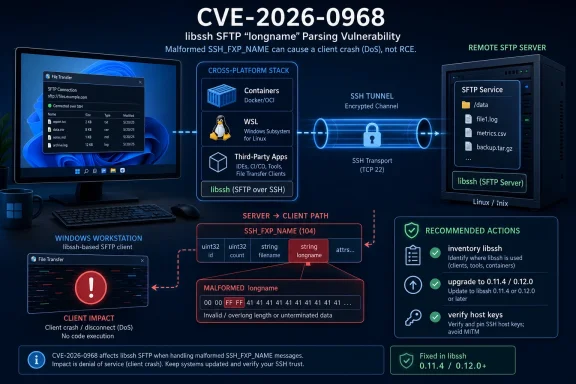 A Small SFTP Crash Exposes a Bigger Inventory Problem
On paper, CVE-2026-0968 is modest. The affected component is the SFTP client side of libssh, and the failure mode is an out-of-bounds heap read caused by missing validation when parsing a server-provided longname field during a directory listing. In ordinary English: a client asks an SFTP server for a list of files, the server sends back a deliberately malformed response, and the client-side application using libssh may crash.That attack shape matters. This is not an arbitrary attacker hurling packets at an exposed SSH daemon and taking over a system. The attacker needs to control or impersonate an SFTP server that the victim client connects to, or otherwise place themselves in the trust path of the file-transfer workflow. That is why the CVSS vector includes high attack complexity and required user interaction, and why the final score lands at 3.1, in the low range.
But “low” does not mean “irrelevant.” In enterprise environments, SFTP is one of those technologies that disappears into the plumbing: nightly file drops, backup jobs, vendor data exchanges, CI/CD artifact movement, industrial systems, reporting pipelines, and managed transfer appliances. If one of those workflows relies on a vulnerable libssh build, a crash can still interrupt a business process at the exact moment the business assumes the process is boring and dependable.
The result is a vulnerability that is boring in the exploit database but potentially irritating in the real world. No CISO should cancel a weekend over CVE-2026-0968. No admin should ignore it simply because the score starts with a three.
Microsoft’s Listing Is a Signal, Not a Patch Tuesday Siren
The presence of CVE-2026-0968 in Microsoft’s Security Update Guide may make some Windows readers assume there is a direct Microsoft patch to chase. That assumption can be misleading. MSRC frequently tracks vulnerabilities that affect Microsoft products, bundled components, open-source dependencies, cloud services, developer tools, or ecosystem software, and the Update Guide entry is often a routing signal rather than a simple “install this cumulative update and move on” story.For WindowsForum readers, the practical reading is this: do not treat the MSRC page as proof that your Windows desktop is inherently vulnerable. Treat it as proof that Microsoft believes the issue is relevant enough to surface in its vulnerability ecosystem. The next step is product-specific investigation, not panic.
That distinction is increasingly important because modern Windows environments are layered with software that did not originate in Redmond. Windows Subsystem for Linux, container images, Git clients, third-party backup tools, IDEs, remote administration products, security appliances, and vendor agents can all bring their own SSH or SFTP implementations. Some use OpenSSH. Some use libssh. Some statically link libraries in a way that hides them from ordinary package inventory tools.
The Microsoft angle, then, is less “Windows has a libssh bug” than “Windows shops now need Linux-style dependency awareness.” That is a cultural shift many organizations still have not completed. The operating system patch level is necessary evidence, but it is no longer sufficient evidence.
The Attack Requires a Bad Server and a Willing Client
The exploit path for CVE-2026-0968 is constrained in ways that make it less dangerous than a typical unauthenticated server-side vulnerability. A vulnerable application must act as an SFTP client and process a malicious file-listing response. The attacker must be in a position to serve that response, which usually means running the SFTP server the victim connects to, compromising a legitimate destination server, or manipulating the connection path in a way that defeats the victim’s trust decisions.That is why the user-provided MSRC language about conditions beyond the attacker’s control is not boilerplate trivia. It is the core of the risk model. A successful attack depends on the victim’s client initiating the SFTP interaction and reaching a server that can feed it malformed protocol data.
Still, the “required user interaction” metric can understate risk in automated environments. A human may not be clicking “connect” in a GUI client; a scheduled job may be doing the interaction every hour. If an organization has a script that pulls reports from a vendor SFTP endpoint, the “user” is effectively the automation framework, and the crash may repeat reliably until someone notices.
That is the awkward middle ground for this CVE. It is not remotely exploitable at will against arbitrary hosts, but it can be triggered in the exact workflows where humans are least likely to be watching. Availability bugs love unattended systems.
The longname Field Is Legacy Baggage With Security Consequences
SFTP’s file-listing behavior carries some historical baggage. The SSH_FXP_NAME response can include filenames and attributes, and implementations have long had to deal with a longname representation that behaves like a formatted listing string rather than a clean modern data structure. That kind of protocol surface is fertile ground for parser assumptions.CVE-2026-0968 appears in that seam between expected structure and hostile input. The vulnerable libssh code path could read beyond the allocated heap buffer when a malformed
longname was encountered, because a necessary null check was missing. The likely visible consequence is a crash, not data theft or command execution.That difference matters for prioritization. A heap read beyond bounds sounds scary because similar primitives can sometimes be chained into information disclosure or memory-corruption exploitation. But the published scoring and vendor descriptions frame this one as an availability issue with no confidentiality or integrity impact. Unless new research changes the picture, defenders should resist the scanner-driven urge to treat it like a critical compromise path.
The more useful lesson is architectural. Protocol parsers should assume that every byte from the other side is adversarial, even when the other side is “just” a file server. SFTP is often trusted because SSH is trusted, but encryption authenticates and protects the channel; it does not make the peer’s application behavior safe.
The Fix Exists Upstream, but the Real World Runs Downstream
The libssh project addressed the issue in its 0.11.4 and 0.12.0 security releases. Those releases fixed CVE-2026-0968 alongside several other security issues, including additional denial-of-service and path-handling problems. For administrators running software directly against upstream libssh, the answer is straightforward: upgrade to a fixed release or apply the relevant vendor patch.Most organizations do not live in that clean upstream world. They consume libssh through distributions, appliances, commercial applications, language bindings, or embedded products. That creates a patching map with several roads: update the OS package, update the application that bundles libssh, wait for a vendor firmware release, rebuild a container image, or replace a statically linked binary.
Linux distributions have taken their usual varied approaches. Some mark the issue fixed in updated packages. Some classify it as minor and postpone stable-release action. Some backport patches without changing the apparent upstream version number, which can confuse scanners that rely on version strings alone.
That scanner confusion is not a side issue. A tool that flags “libssh 0.10.6” as vulnerable may be correct for one system and wrong for another if a distribution has backported the patch. Conversely, a vendor appliance might report a friendly product version while hiding an older bundled library. Security teams need evidence from package changelogs, vendor advisories, or binary composition analysis rather than blind faith in version comparisons.
For Windows administrators, the same logic applies with different tooling. If a third-party Windows application ships
libssh.dll, a system-wide Windows Update is unlikely to help. If a developer tool statically links libssh, there may be no obvious DLL to inspect. If the vulnerable component lives inside a WSL distribution or container image, the fix path goes through that environment’s package manager or image rebuild process, not through Settings.The Quiet Risk Lives in Automation, Not Desktops
It is tempting to imagine CVE-2026-0968 as a user sitting at a graphical SFTP client and connecting to a malicious server. That scenario is possible, but it is probably not the most operationally interesting one. The more realistic risk lives in automated transfers that connect to fixed endpoints on a schedule.Consider a finance team that pulls reconciliation files from a vendor. Consider a hospital system exchanging data with a partner. Consider a backup product that retrieves or indexes remote directories over SFTP. If the remote endpoint is compromised, replaced, or malicious by design, a vulnerable client could be crashed during the listing stage before the expected files are collected.
A crash is not catastrophic in the way credential theft or ransomware is catastrophic. But a failed file transfer can cascade. Reports do not arrive, downstream jobs process stale data, alerts fire late, and support teams burn time chasing a “network problem” that is actually a parser crash. Availability bugs become business bugs when they sit inside workflows nobody has touched in years.
This is also why verifying server identity is not a ceremonial workaround. The libssh advisory recommends properly verifying the identity of SFTP servers before proceeding, and that advice is especially relevant here. If clients accept changed host keys without scrutiny, ignore host-key validation, or connect through brittle scripts that suppress warnings, an attacker’s job becomes easier.
Host-key hygiene is not glamorous security work. It rarely makes dashboards glow green. But in a vulnerability where the malicious actor has to become the server the client trusts, the integrity of that trust decision is the defense line that matters before the patch lands.
Windows Shops Cannot Outsource This to Linux Teams
Because libssh is most visibly associated with Unix-like systems, Windows-heavy organizations may be inclined to throw this over the wall to the Linux team. That would miss how cross-platform the SSH ecosystem has become. Windows endpoints, build agents, and servers routinely run software that speaks SFTP without using Microsoft’s own OpenSSH client.KDE’s SFTP integration, Cockpit, Git hosting infrastructure, backup products, file-transfer utilities, and embedded management stacks are all examples of the kind of software universe in which libssh has historically appeared. The point is not that every such product is vulnerable today. The point is that libssh is a library, and libraries travel.
That makes SBOMs more than procurement theater. A software bill of materials is useful only if someone can ask, “Where do we run libssh, and which build is it?” and get an answer faster than the attacker or outage does. CVE-2026-0968 is a low-stakes test of that capability.
If the answer requires three teams, a vendor ticket, and a spreadsheet named “final-final-v2,” the problem is not CVE-2026-0968. The problem is dependency opacity. Low-severity CVEs are often where organizations discover whether their inventory process works before a high-severity issue forces the same discovery under pressure.
Windows administrators should pay particular attention to three places: developer workstations, file-transfer automation, and security or infrastructure appliances managed from Windows consoles. Those are the environments where cross-platform libraries show up without anyone thinking of them as part of the Windows estate.
CVSS Gets the Severity Right and the Urgency Only Half Right
The CVSS 3.1 score of 3.1 is defensible. Network attack vector, high attack complexity, no privileges required, required user interaction, unchanged scope, no confidentiality impact, no integrity impact, and low availability impact tell a coherent story. This is not a critical vulnerability wearing a false mustache.But CVSS is not a scheduling system. It describes technical characteristics, not business dependency. A low-severity denial-of-service bug in an SFTP client used once a month for a noncritical archive is background noise. The same bug in an automated exchange that gates payroll, claims processing, manufacturing orders, or regulatory submissions deserves faster attention.
That is where risk-based vulnerability management either proves itself or becomes a slogan. The right question is not “What is the CVSS score?” The right question is “Where do we use libssh as an SFTP client against servers we do not fully control, and what breaks if that client crashes?”
The answer may still be “not much.” That is acceptable. Security teams do not need to inflate every issue into a crisis to justify their existence. But they do need to know why they are deferring a patch, and they need to document that rationale before the next scanner report turns the same CVE into a recurring meeting.
The Open-Source Supply Chain Did Its Job, Then Handed You the Clipboard
There is a tendency to frame every open-source vulnerability as proof that open source is uniquely risky. CVE-2026-0968 argues the opposite more convincingly. The flaw was identified, assigned a CVE, documented by the project, fixed in security releases, tracked by distributions, surfaced by national databases, and picked up by Microsoft’s security ecosystem.That is the supply chain working. Not perfectly, not instantly everywhere, and not in a way that eliminates downstream labor. But the upstream project produced fixed versions, and the advisory is clear enough for competent operators to act.
The hard part begins after disclosure. Organizations must translate “libssh before 0.11.4 or before 0.12.0” into their own reality. Is the library dynamically linked or statically embedded? Is it patched by the distribution despite an older version string? Is it inside a container base image? Is it bundled in a commercial product whose vendor uses a private fork?
None of those questions are specific to libssh. They are the same questions that appear after OpenSSL, zlib, libxml2, curl, SQLite, and countless other components ship fixes. CVE-2026-0968 is merely a gentler reminder than most that the modern software stack is a dependency stack.
The Practical Response Is Boring, Which Is Why It Might Work
For individual users, the advice is simple: keep your distribution packages and SFTP-capable applications current, and be cautious about connecting to unfamiliar SFTP servers. If an application vendor ships an update mentioning libssh, SFTP, or SSH library fixes, take it. If a tool complains that a server host key changed unexpectedly, do not click through reflexively.For administrators, the response should be more structured. Start by identifying systems and applications that use libssh, then determine whether they use it as an SFTP client. Server-only exposure is less relevant to this specific CVE than client behavior, though mixed client-server tools may have both roles.
Next, map trust boundaries. A vulnerable client that connects only to an internally managed, locked-down SFTP server presents a different risk from one that connects to dozens of external partner endpoints. The more external and automated the workflow, the higher the practical priority.
Then patch through the right channel. On Linux, that usually means vendor packages rather than hand-built upstream tarballs. In containers, it means rebuilding and redeploying images, not merely patching the host. On Windows, it means updating the specific application or component that bundles libssh, because the operating system itself may not be the owner of the vulnerable library.
Finally, test the workflow after patching. File-transfer systems are notorious for brittle assumptions about ciphers, host keys, directory listings, filenames, and remote server behavior. A security update that fixes one parser edge case should not break normal operations, but production SFTP jobs deserve verification because they often sit at the intersection of old vendors and older scripts.
The Scanner Alert Should Start a Conversation, Not End One
Many organizations will first encounter CVE-2026-0968 as a vulnerability scanner finding. That finding may be useful, noisy, incomplete, or wrong, depending on how the scanner detects libssh and whether it understands backported fixes. Treat it as a lead.A good triage note for this CVE should answer a few concrete questions. Is libssh present? Is it an affected version or an older version with a vendor backport? Is the affected code path reachable through SFTP client operations? Does the system connect to untrusted or external SFTP servers? Is the application supervised in a way that restarts cleanly after a crash, and would a crash cause data loss or missed processing?
Those questions turn a generic CVE into an operational decision. They also prevent the two failure modes that plague vulnerability management: overreacting to every scanner line item and underreacting to anything with a low base score.
The most mature response may be to patch during the next normal maintenance window and tighten host-key verification in the meantime. The least mature response is to mark the finding as “low” and close it without knowing whether it sits inside a revenue-critical transfer job.
The Patch Is Not a Substitute for Trust Hygiene
Because the workaround centers on verifying SFTP server identity, CVE-2026-0968 should prompt a quick audit of SSH trust habits. Do clients pin known host keys? Are host-key changes investigated? Do scripts disable strict checking for convenience? Are partner server keys documented, rotated, and validated through an out-of-band process?These controls are often treated as annoyances because they interrupt automation. But the interruption is the point. If a client cannot tell the difference between the expected SFTP server and a malicious replacement, the client is already in a weakened position before any parsing bug enters the story.
This does not mean host-key verification eliminates the need to patch. A compromised legitimate server can still send malicious data, and a trusted endpoint can become hostile after a breach. But identity verification narrows the attack surface, especially for scenarios involving impersonation or man-in-the-middle positioning.
The broader lesson is that encrypted protocols are not self-validating. SSH gives administrators strong tools for authentication and confidentiality, but operational shortcuts can reduce those tools to decorative locks on an unlocked door.
This Low-Severity Libssh Bug Draws the Map for the Next High-Severity One
The useful way to handle CVE-2026-0968 is to treat it as a rehearsal. It is low enough that teams can respond carefully, but real enough that the exercise is not theoretical. If your organization cannot locate libssh today, it will not magically locate a more urgent vulnerable dependency tomorrow.The concrete takeaways are narrow but important:
- CVE-2026-0968 affects libssh SFTP client parsing, not every SSH server exposed to the internet.
- The fixed upstream releases are libssh 0.11.4 and 0.12.0, though downstream vendors may backport fixes into older-looking package versions.
- Exploitation requires a vulnerable client to process a malicious SFTP server response during a file-listing operation.
- The most relevant Windows exposure is likely through third-party applications, developer tools, WSL environments, containers, or appliances rather than the base operating system alone.
- Host-key verification and trusted SFTP endpoint management reduce practical risk but do not replace patching.
- Low CVSS severity should guide prioritization, not excuse organizations from inventory and workflow impact analysis.
References
- Primary source: MSRC
Published: 2026-05-22T01:38:24-07:00
Security Update Guide - Microsoft Security Response Center
 msrc.microsoft.com
- Related coverage: sentinelone.com
CVE-2026-0968: libssh SFTP DoS Vulnerability Explained
CVE-2026-0968 is a denial of service vulnerability in libssh SFTP. Learn about its impact, affected versions, and mitigation methods to protect systems.www.sentinelone.com
- Related coverage: armosec.io
CVE-2026-0968: The libssh Heap Read That Isn't as Scary as Scanners Say - ARMO
CVE-2026-0968 in libssh sounds critical, but real-world risk is low. Learn why scanners overrate it, how exploitation actually works, and what security teams should prioritize.www.armosec.io - Related coverage: service.securitm.ru
CVE-2026-0968 - CVE уязвимости - SECURITM
Libssh: libssh: denial of service due to malformed sftp messageservice.securitm.ru
- Related coverage: thehackerwire.com
CVE-2026-0968 - Low Vulnerability
CVE-2026-0968 is a Low severity vulnerability (CVSS 3.1). A flaw was found in libssh in which a malicious SFTP (SSH File Transfer Protocol) server can exploit this by...www.thehackerwire.com
