

Microsoft has recorded CVE-2025-59507 — an elevation‑of‑privilege (EoP) vulnerability in the Windows Speech runtime — and published an update that vendors and administrators should treat as a high‑priority local remediation item. This flaw, described as a race condition (concurrent execution using a shared resource with improper synchronization) in the Windows Speech component, allows an authenticated local account to potentially escalate privileges on affected machines; public vulnerability trackers and vendor mirrors list the issue with a High severity (CVSS v3.1 base ≈ 7.0) and Microsoft has issued security updates to address it.
Windows has long run a family of speech-related components — the Windows Speech runtime, speech recognition services, and brokered speech APIs — to support dictation, accessibility features, and voice interfaces. Those components process untrusted user data and often participate in cross-process brokered operations or IPC, which makes them a recurring source of local privilege‑escalation findings when bugs arise. Microsoft recorded CVE-2025-59507 in its Security Update Guide and mapped fixes into the November 2025 update wave; public aggregators mirrored Microsoft’s advisory and assigned a CVSS v3.1 score of 7.0 with a vector that indicates a local attack vector and high impact to confidentiality, integrity, and availability. The vendor’s summary for CVE-2025-59507 is intentionally concise: it identifies the vulnerable component (Windows Speech runtime), the defect class (race condition / improper synchronization — CWE‑362), and the likely impact (local elevation of privilege). That style of disclosure is common: it confirms the vulnerability and the availability of a patch while withholding low‑level internals to reduce immediate weaponization risk. Administrators must therefore rely on Microsoft’s Update Guide to map which KBs and builds contain the fix for their environment.
Recommended remediation playbook
CVE‑2025‑59507 underlines a recurring security lesson: inbox platform services that mediate privileged operations and process untrusted inputs deserve aggressive inventory, rapid patching, and layered mitigations. The vendor confirmation and available updates provide enterprise defenders with the necessary tools to close the window of exposure — the operational challenge now is disciplined, prioritized deployment and focused telemetry to detect any attempted exploitation during the rollout.
Source: MSRC Security Update Guide - Microsoft Security Response Center
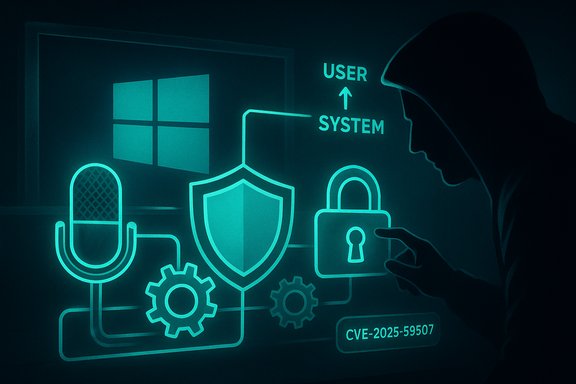 Background / Overview
Windows has long run a family of speech-related components — the Windows Speech runtime, speech recognition services, and brokered speech APIs — to support dictation, accessibility features, and voice interfaces. Those components process untrusted user data and often participate in cross-process brokered operations or IPC, which makes them a recurring source of local privilege‑escalation findings when bugs arise. Microsoft recorded CVE-2025-59507 in its Security Update Guide and mapped fixes into the November 2025 update wave; public aggregators mirrored Microsoft’s advisory and assigned a CVSS v3.1 score of 7.0 with a vector that indicates a local attack vector and high impact to confidentiality, integrity, and availability. The vendor’s summary for CVE-2025-59507 is intentionally concise: it identifies the vulnerable component (Windows Speech runtime), the defect class (race condition / improper synchronization — CWE‑362), and the likely impact (local elevation of privilege). That style of disclosure is common: it confirms the vulnerability and the availability of a patch while withholding low‑level internals to reduce immediate weaponization risk. Administrators must therefore rely on Microsoft’s Update Guide to map which KBs and builds contain the fix for their environment. What CVE‑2025‑59507 is (technical summary)
- Vulnerability class: Race condition / improper synchronization (CWE‑362).
- Affected component: Windows Speech runtime / Speech Recognition-related components.
- Attack vector: Local — an attacker must be able to run code or trigger the speech subsystem on the host (AV:L).
- Privileges required: Low — a standard/authorized local account may be sufficient to reach the vulnerable code path (PR:L).
- Impact: Elevation of Privilege — successful exploitation could result in SYSTEM-level privileges (C:H / I:H / A:H).
- CVSS v3.1 (published vector): approximately 7.0 (High) — vendor metadata shows AV:L/AC:H/PR:L/UI:N/S:U/C:H/I:H/A:H.
Confidence and corroboration
Vendor confirmation matters; Microsoft’s Update Guide entry confirms the vulnerability and the availability of patched updates. Independent aggregators — OpenCVE, CVE Details, and other vulnerability databases — mirror Microsoft’s classification and scoring, increasing confidence that the published facts are accurate and that the issue has been fixed in the November security release cycle. However, the technical mechanics (function names, exploit proof‑of‑concept, or public exploit code) were not published with the vendor advisory at the time of record, and no widely indexed PoC or in‑the‑wild exploitation had been established publicly when these sources were checked. Treat any early third‑party technical reconstructions as analyst inferences until corroborated by vendor diffs or multiple reputable researchers.Why this is operationally important
Local EoP primitives are often the missing piece in real-world attack chains. An attacker who gains initial local code execution — through phishing, a malicious installer, a misconfigured remote access tool, or another flaw — can use a local privilege escalation to obtain SYSTEM privileges, disable defenses, access credentials, and move laterally. Systems that are particularly at risk include:- Developer workstations and test environments where arbitrary binaries are executed.
- Multi‑user hosts (VDI, RDS, Terminal Servers) where one user escalating privileges can affect other sessions.
- Privileged administrative workstations and jump boxes.
- Build servers, CI/CD runners, and systems that process untrusted artifacts.
Technical analysis — exploitation model and practical considerations
How race conditions become privilege chains
Race conditions in privileged services can present several practical exploitation avenues:- Time‑of‑Check/Time‑of‑Use (TOCTOU): an attacker replaces or tampers with a handle, file, or object between the check and the privileged use.
- Token or handle swapping: if privileged code temporarily validates a resource and later acts on it without re‑validating ownership, an attacker can redirect privileged behavior.
- Shared memory/IPC manipulation: brokered speech services often marshal structures between processes; non-atomic state changes or improper synchronization can result in privileged paths processing attacker-controlled data.
Preconditions and complexity
- Preconditions: local code execution or the ability to invoke the speech runtime (often just the ability to run an application as a standard user).
- Exploitation complexity: moderate for race-based memory-safety primitives; lower for pure authorization/logic failures.
- User interaction: not required beyond running the hostile code in most plausible attack paths.
- Remote exploitation: not indicated. Public records and the vendor vector specify Local only.
Likely post‑exploit consequences
If exploited, the adversary could:- Spawn SYSTEM processes and execute arbitrary code at the highest privilege.
- Modify critical system settings or security controls.
- Install persistent backdoors or create privileged accounts.
- Harvest credentials and tokens for lateral movement.
Patch, mitigation, and deployment guidance
Microsoft published security updates mapped to the CVE in the November 2025 update set; administrators should use the Microsoft Security Update Guide (MSRC) and the Microsoft Update Catalog to derive the exact KBs for their installed OS builds and servicing channels. Because MSRC pages sometimes render dynamically and omit low‑level detail, confirm KB‑to‑build mappings in your patch-management tools (WSUS, SCCM/MECM, Intune) before automating deployments.Recommended remediation playbook
- Inventory:
- Query your patch management system for machines that match the affected Windows builds and identify the exact KB numbers that MSRC lists for CVE‑2025‑59507.
- Validate:
- Test the relevant KB(s) in a representative staging ring to check for application compatibility and regressions.
- Prioritize:
- Patch admin workstations, domain controllers (if applicable), RDS/VDI hosts, developer machines, and build servers first.
- Deploy:
- Staged rollout: pilot → broader deployment → enterprise completion. Ensure reboots are coordinated and tracked.
- Mitigations (temporary, if patching must be deferred):
- Restrict microphone access and revoke unnecessary audio permissions for untrusted apps.
- Where feasible, disable legacy or unused speech features and services on servers and multi‑user hosts.
- Enforce application allow‑listing (WDAC/AppLocker) to reduce untrusted code execution.
- Monitor and hunt:
- Increase telemetry for service crashes, token impersonation, unexpected process creation, and suspicious handle/IPC activity.
Detection and telemetry: what to look for
Because the vulnerability is local and may be exploited without network signatures, focus detection on endpoint and OS behavior:- Unexpected elevation chains: parent process that is non-admin spawning or duplicating SYSTEM processes.
- Token duplication/impersonation API usage spikes.
- Repeated or anomalous calls to speech‑related services or brokered COM endpoints from user processes.
- Service crashes and rapid restarts in speech or audio‑broker services.
- New or modified scheduled tasks and persistence artifacts following suspicious local activity.
Strengths in Microsoft’s response — and operational gaps
Notable strengths
- Vendor acknowledgement and fixes: Microsoft published the Update Guide entry and released updates in the November security cycle, which moves the issue from “unverified report” to an actionable remediation task. That vendor confirmation is the authoritative decision point for enterprises.
- Appropriate high‑level disclosure: Microsoft limited technical details in the initial advisory, which reduces near‑term mass weaponization risks while administrators can patch.
Potential risks and operational gaps
- Sparse technical detail: The lack of low‑level information (function names, PoC, exploit primitives) makes it harder for defenders to craft precise detection rules or to assess whether specific peripherals (microphone/speaker) or configurations materially affect exploitability. Analysts must therefore treat many reconstructions as inferred rather than verified.
- CVE‑to‑KB mapping friction: Public feeds sometimes list CVEs without consistent KB mappings for all SKUs; automated patching systems must validate KB IDs from MSRC or Update Catalog rather than relying solely on CVE strings. This is an operational friction point that can delay correct remediation.
- Chaining risk: Because local EoP primitives are useful building blocks, environments that tolerate untrusted code execution or that host multi‑user workloads have elevated exposure; these environments must prioritize patching and containment controls.
Risk scoring and prioritization guidance
Given the published CVSS v3.1 base of around 7.0 (High) and the local-only vector, prioritize CVE‑2025‑59507 as follows:- Critical: Admin workstations, build servers, VDI/RDS and multi‑user hosts, jump boxes — patch within 24–72 hours after successful staging and validation.
- High: Domain‑adjacent servers and developer machines that run untrusted code — patch within the first 7 days where possible.
- Medium: Standard user desktops in tightly controlled environments where application control prevents untrusted binaries — still patch but after higher‑risk tiers.
How defenders should communicate this internally
- Convey the vendor-confirmed facts concisely: CVE‑2025‑59507 is a vendor‑acknowledged local EoP in Windows Speech, patched in the November 2025 updates; MSRC is the authoritative source for KBs.
- Provide a short remediation timeline and assign ownership for inventory, test, and deployment phases.
- Warn stakeholders that technical PoCs were not public at disclosure (so detection may need to be behavior‑based), but that weaponization risk increases after details leak or patch diffs are published.
- Include a brief runbook for incident response in case of detection: isolate the host, collect EDR telemetry, preserve crash dumps, and check for persistence artifacts.
What remains uncertain and what to watch for
- Exact exploitation mechanics: The vendor advisory did not publish low‑level details; any claim about precise internal failure modes should be treated as speculative until corroborated by Microsoft or independent researchers. If such technical writeups or proof‑of‑concepts appear, defenders must quickly translate those findings into detection signatures and patch validation tests.
- SKUs and KB mapping variety: Public trackers sometimes show fragmented KB mappings; organizations must verify the precise KBs for their builds in the MSRC Update Guide or Update Catalog before rolling out automated patches.
- Exploit publication timeline: Historically, once details or patch diffs are public, exploit code or practical weaponization can follow quickly; monitor security research feeds and threat intel for PoC publications that dramatically raise urgency.
Final assessment and recommended checklist
CVE‑2025‑59507 is a legitimate, vendor‑acknowledged local elevation‑of‑privilege vulnerability in the Windows Speech runtime that carries a High CVSS v3.1 score and was addressed in Microsoft’s November 2025 security updates. Although the vendor withheld deep technical specifics in the initial advisory — a reasonable trade‑off to limit rapid weaponization — independent vulnerability databases and community advisories corroborate Microsoft’s summary and scoring. Administrators should act immediately: inventory, validate KB mapping, stage the update, prioritize high‑risk hosts, deploy patches, and expand endpoint telemetry for token and process anomalies. Practical checklist (condensed)- Query MSRC for the CVE → KB mapping for each Windows build in your estate.
- Stage and validate the relevant KB(s) in a representative test ring within 24–48 hours.
- Patch high‑risk hosts first (admin workstations, VDI/RDS, developer build machines).
- If you cannot patch immediately, restrict microphone/audio access and enforce application allow‑listing.
- Harden telemetry and hunt for token impersonation, unexpected SYSTEM process creation, and speech‑service crashes.
CVE‑2025‑59507 underlines a recurring security lesson: inbox platform services that mediate privileged operations and process untrusted inputs deserve aggressive inventory, rapid patching, and layered mitigations. The vendor confirmation and available updates provide enterprise defenders with the necessary tools to close the window of exposure — the operational challenge now is disciplined, prioritized deployment and focused telemetry to detect any attempted exploitation during the rollout.
Source: MSRC Security Update Guide - Microsoft Security Response Center
