

Microsoft’s Security Update Guide lists CVE‑2025‑59509 as an information‑disclosure vulnerability affecting Windows Speech Recognition, but the public record remains intentionally sparse: the vendor acknowledgement exists, yet low‑level technical details, exploit code, and independent write‑ups are either absent or not widely indexed — a situation that demands a conservative, defense‑first posture for administrators and security teams.
Windows Speech Recognition and the Windows Speech Runtime are long‑standing platform components that mediate voice‑to‑text, dictation, and voice command capabilities across Windows desktop and some server workloads. These components run in privileged or semi‑privileged contexts, process untrusted input (audio data, encoded streams, or IPC from user apps), and therefore carry non‑trivial attack surface when bugs are present. Historically, vulnerabilities in the speech stack have ranged from local elevation‑of‑privilege flaws to memory‑safety defects that lead to information leaks or even code execution. For context, recent October disclosures included a cluster of Windows Speech Runtime CVEs (for example, CVE‑2025‑58715 and CVE‑2025‑58716) whose published advisories and vendor‑mapped updates provide useful analogues for understanding the likely operational model of CVE‑2025‑59509.
Why this matters in practice:
(Operational checklist recap)
Source: MSRC Security Update Guide - Microsoft Security Response Center
 Background
Windows Speech Recognition and the Windows Speech Runtime are long‑standing platform components that mediate voice‑to‑text, dictation, and voice command capabilities across Windows desktop and some server workloads. These components run in privileged or semi‑privileged contexts, process untrusted input (audio data, encoded streams, or IPC from user apps), and therefore carry non‑trivial attack surface when bugs are present. Historically, vulnerabilities in the speech stack have ranged from local elevation‑of‑privilege flaws to memory‑safety defects that lead to information leaks or even code execution. For context, recent October disclosures included a cluster of Windows Speech Runtime CVEs (for example, CVE‑2025‑58715 and CVE‑2025‑58716) whose published advisories and vendor‑mapped updates provide useful analogues for understanding the likely operational model of CVE‑2025‑59509. Why vendor confirmation matters
When Microsoft records a CVE in its Security Update Guide, that entry is the authoritative start point for remediation. However, Microsoft’s initial advisories commonly omit low‑level implementation details (function names, IOCTL IDs, memory offsets) to reduce immediate weaponization risk. That practice increases operational uncertainty while the patch is distributed, which is why defenders must emphasize patch validation, asset mapping, and mitigations before chasing technical root causes in public feeds.What we can verify right now
- Microsoft has an Update Guide entry for CVE‑2025‑59509 identifying it as an information‑disclosure issue in the Windows Speech components; the vendor acknowledgement confirms the vulnerability is real and that remediation is managed via Microsoft updates.
- Public, indexed technical analysis (detailed post‑mortems, proof‑of‑concept exploits, or independent researchers’ writeups) referencing CVE‑2025‑59509 were not discoverable at the time of writing; analogous speech runtime CVEs from the same release cycle show that vendor updates are available for the speech component family, but the precise root cause for 59509 is not publicly enumerated.
- Because public technical detail is limited, confidently answering “how” the bug works is impossible without vendor patch diffs or third‑party reverse engineering. This absence of public detail is a deliberate vendor practice and should be treated as a confidence signal that more concrete analysis may appear only after patches propagate.
The report‑confidence dimension: what it means for defenders
A practical triage rubric — used by many security teams — separates vulnerability signals into discrete confidence levels. That rubric ranges from unverified reports to vendor‑confirmed and independently corroborated exploitation. For CVEs like CVE‑2025‑59509, where the vendor has recorded the issue but technical details are limited, the classification typically sits at an intermediate confidence level: vendor‑listed, patch available, but technical mechanics unverified. Treat this as a Level‑1 or Level‑2 event on an operational confidence scale: real and actionable, but lacking third‑party technical corroboration.Why this matters in practice:
- A vendor‑listed CVE pushes the issue from “rumor” to “response required.” Inventories must be updated and remediation windows planned.
- Limited public detail increases the risk that defenders will miss nuance (for example, whether only specific SKUs are affected or whether additional prerequisites are required).
- Attackers may attempt to weaponize patch diffs once updates are published — which increases the urgency to patch early, but to do so carefully in production environments.
Likely technical classes and exploitation model (defensible inferences)
Because Microsoft’s initial advisory style for kernel and runtime issues is intentionally terse, defenders should base short‑term assumptions on historically recurring defect classes in the Windows speech/voice stack:- Uninitialized buffers or stale memory returned to user mode: privileged services sometimes copy more bytes than they initialize and return stale kernel or process memory to a caller, enabling local reads of sensitive data. This is a very common pattern for information‑disclosure bugs in Windows subsystems.
- Improper input validation or marshalling: user inputs (audio payloads, metadata, or IPC parameters) passed to privileged speech components may lack robust length or type checks. That can permit out‑of‑bounds reads or controlled leaks via crafted requests. Similar recent speech runtime CVEs explicitly referenced improper input validation in their advisories.
- Brokered‑service logic errors: the speech runtime frequently brokers requests between user apps, system services, and hardware codecs. Errors in access checks or handle marshalling can cause privileged paths to disclose internal handles, tokens, or pointers that leak layout or secrets.
- Attacker achieves a local foothold (low‑privilege user process, a malicious app, or a sandbox escape).
- The attacker repeatedly triggers the vulnerable interface (an API, a COM call, or an internal D‑COM/IPC path).
- Returned buffers are dumped and scanned for recognizable artifacts (kernel pointers, token fragments, GUIDs, or credentials).
- The leaked fragments are used to defeat exploit mitigations (e.g., KASLR) or to craft follow‑on local privilege‑escalation chains.
Cross‑checking related evidence (what we used to corroborate)
Because CVE‑2025‑59509’s public technical footprint is limited, this analysis cross‑references the vendor Update Guide entry with independent trackers and recent, closely related Windows Speech CVEs published in the same patch wave (October 2025). Those comparisons help establish probable impact patterns and remediation expectations:- Microsoft Security Update Guide entry for CVE‑2025‑59509 (vendor acknowledgement and update mapping).
- NVD and CVE aggregators for adjacent Windows Speech CVEs (for example, CVE‑2025‑58715 and CVE‑2025‑58716) which were published on the same update cycle and are documented as integer‑overflow / improper‑input‑validation issues in the speech runtime; those entries show vendor KB mappings and CVSS scoring used for operational prioritization.
- Industry posts summarizing the October patch wave and flagging speech runtime fixes as high‑priority for local privilege escalations and AppContainer escape scenarios; these posts help translate vendor CVE metadata into realistic operational threat models.
- There is no widely indexed proof‑of‑concept exploit for CVE‑2025‑59509 at the time of writing.
- No public third‑party technical write‑up (detailed root cause or patch diff analysis) for CVE‑2025‑59509 was located; therefore any claim about exact function names, offsets, or exploit payloads must be treated as unverified.
Operational guidance — immediate actions (0–72 hours)
When a Microsoft CVE appears in the Update Guide but public technical details are limited, a practical emergency playbook balances speed with safety:- Map and inventory (first 0–6 hours)
- Query software inventory and endpoint management tools for hosts that have Windows Speech components installed or that run speech‑enabled apps.
- Prioritize shared and multi‑user systems (VDI, Terminal Servers, developer build machines, CI runners) because local vulnerability requirements are easier to satisfy on those targets.
- Retrieve authoritative KB mapping (0–12 hours)
- Use Microsoft’s Security Update Guide entry for CVE‑2025‑59509 to obtain the exact KB numbers and per‑SKU update artifacts. The Update Guide is the canonical mapping between CVE and the required security rollups. Apply the correct update matching each OS build.
- Patch test ring (12–24 hours)
- Apply the vendor update to a small, representative test ring. Validate application compatibility (voice drivers, enterprise dictation tools, unified communications software).
- Check for known interdependencies (SSU/LCU or servicing stacks) documented in the KB.
- Staged rollout (24–72 hours)
- Roll the update across the estate according to normal change control, accelerating high‑priority pods based on exposure and criticality.
- For systems that cannot be updated immediately, apply compensating controls (see next section).
- Compensating controls (if immediate patching is infeasible)
- Restrict local execution of untrusted binaries via application control policies (AppLocker, WDAC).
- Tighten local privilege levels and reduce the number of users with install rights.
- Temporarily disable speech features on high‑risk endpoints if business impact allows (note: this is blunt and may not be feasible for all orgs).
- Telemetry and hunting (continuous)
- Tune EDR/SIEM rules to look for repeated calls to speech‑related APIs, unusual COM/IPC activity from low‑privilege processes, or attempts to access privileged speech broker services.
- Search for anomalous process behaviors coinciding with service crashes and restarts in the System/Application event logs.
Detection recipes and indicators of compromise
Because information‑disclosure primitives are frequently leveraged as reconnaissance, early detection focuses on behavioral and artifact patterns rather than a single signature:- Repeated user‑mode processes invoking speech APIs in tight loops and dumping returned buffers (potential automated scanners).
- Unexpected crashes or exceptions in speech service hosts (Service Control Manager events) followed by suspicious child process creation.
- EDR detections of token‑manipulation, Handle duplication, or local credential access attempts after observed speech‑service anomalies.
- Outbound telemetry indicating attempts to exfiltrate short secrets or GUID fragments to nearby infrastructure — these leaks are often harvested and then used offline; correlate small, frequent outbound connections post‑anomaly.
Risk analysis: who should move fastest?
Prioritize remediation for the following classes of hosts:- Administrative and privileged workstations: a local leak here can yield tokens and keys that unlock broad lateral access.
- Shared multi‑user hosts (RDS, VDI, classroom machines): local low‑privilege processes are common here, raising exploitability.
- Developer workstations and CI/build servers: untrusted code runs frequently; an information leak can expose signing keys or build tokens.
- Laptops and mobile devices in mixed‑trust environments: physical access plus a local leak increases the attack surface for offline exploitation.
Strengths and limitations of the current public record
Strengths:- Vendor acknowledgement in Microsoft’s Update Guide is definitive and moves this issue into the “patch now” category for defenders.
- Comparable speech runtime CVEs in the same release set give defenders an operational template for remediation and hunting.
- Lack of public technical detail reduces the ability to write precise detection signatures; defenders must rely more heavily on behavioral telemetry and patching.
- The vendor’s intentional terseness is a double‑edged sword: it reduces immediate exploitability but delays the community’s ability to provide independent verification and large‑scale detection content.
- If attackers reverse‑engineer the patch or obtain details through other channels, weaponization risk increases quickly — making timely patch rollout critical.
Longer‑term recommendations
- Harden host configurations: reduce local attack surface via application control (AppLocker/WDAC), least‑privilege user policies, and removal of unnecessary local services.
- Improve telemetry coverage: ensure EDR captures IPC/COM calls and local API usage around privileged components; correlate service instability with token operations.
- Maintain a CVE confidence registry: integrate the confidence rubric described earlier into your vulnerability management workflow so that vendor‑listed but technically opaque CVEs get immediate inventory and patch planning while lower‑confidence reports are triaged differently.
- Require test‑ring validation for all security rollups to spot regressions in voice/RTC software stacks, which are often sensitive to driver and codec interactions.
Conclusion
CVE‑2025‑59509 is a vendor‑recorded information‑disclosure vulnerability in Windows Speech Recognition; the Microsoft Security Update Guide entry is the authoritative source for remediation. However, the public technical footprint remains limited, creating an operational tension between the need to patch quickly and the lack of community technical detail to support targeted detection. The defensible course of action is clear: map affected assets now, retrieve the authoritative KB for your OS builds from Microsoft, validate and deploy updates in a staged manner, and tune telemetry to detect the reconnaissance patterns that typically accompany kernel/runtime leaks. Use the published patterns from closely related speech CVEs as an operational guide while treating any low‑level exploit claims as unverified until corroborated by Microsoft or trusted researchers.(Operational checklist recap)
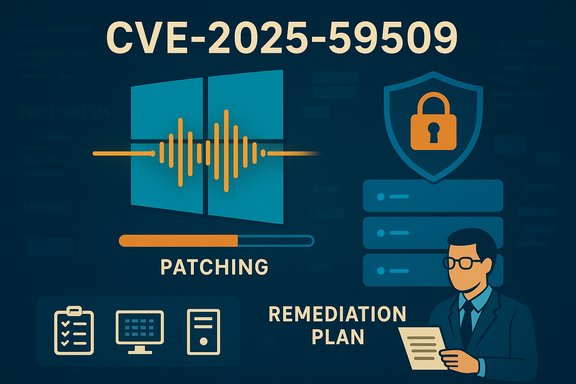
- Query MSRC for CVE‑2025‑59509 and record the KB mapping.
- Patch test ring, validate speech/voice applications.
- Roll updates to critical and shared hosts first.
- Tighten controls on local execution and monitor EDR for speech‑service anomalies.
- Treat precise exploit mechanics as unverified until independent technical analysis appears; prioritize rapid patching over speculative containment.
Source: MSRC Security Update Guide - Microsoft Security Response Center
