

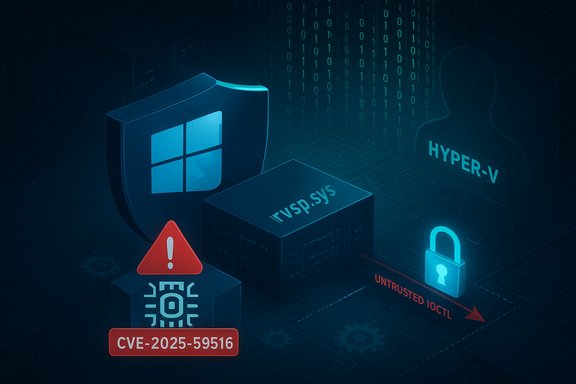
Microsoft has recorded a new kernel‑level vulnerability, CVE‑2025‑59516, in the Windows Storage Virtualization Service Provider (VSP) driver that can allow a local, authorized attacker to escalate privileges on affected hosts by invoking a missing authentication path in the driver—Microsoft’s advisory is the canonical reference for remediation and other vendor metadata. This is a high‑severity elevation‑of‑privilege issue (CVSS v3.1 base score 7.8) that affects Hyper‑V host storage plumbing and therefore has outsized operational impact for virtualized environments; independent vulnerability trackers confirm the high score and technical summary.
Background / Overview
The Storage VSP driver (storvsp.sys) runs in the Hyper‑V root partition and implements host‑side storage virtualization services that guest partitions rely on for VHD/VHDX access and other virtual disk operations. Because VSP drivers execute in kernel mode with SYSTEM privileges, any logic or authentication error can be converted by an attacker with local access into a powerful post‑compromise primitive. Microsoft’s public advisory for CVE‑2025‑59516 (and vendor summaries used by third‑party trackers) characterizes the defect as “missing authentication for a critical function” in the Windows Storage VSP Driver that permits an authorized local attacker to elevate privileges. This class of vulnerability matters because it turns an already‑present local foothold (for example, a malicious process running in a guest VM or a compromised low‑privilege user on the host) into host‑level control, with the ability to install persistent implants, manipulate other VMs, or disable defenses—outcomes that are particularly severe in multi‑tenant or production hypervisor hosts. Prior StorVSP and related VSP/VSC driver defects have produced both denial‑of‑service and privilege‑elevation outcomes, underscoring the practical urgency of this CVE for organizations running Hyper‑V.What we know right now
- Core issue: Missing authentication for a critical function in the Windows Storage VSP driver (storvsp.sys), enabling local elevation of privilege when triggered.
- Vendor advisory: Microsoft lists CVE‑2025‑59516 in its Security Update Guide; administrators should treat the MSRC entry as the authoritative remediation mapping.
- Severity: CVSS v3.1 base score 7.8 (High) as reported by vulnerability aggregators.
- Attack vector: Local / authorized — an attacker must be able to run code or otherwise interact locally with the virtualization storage provider. The vulnerability is not described as remotely exploitable from the network without prior access.
- Affected components: storvsp.sys (Windows Storage VSP driver) on Hyper‑V host/root partitions (specific SKUs/builds are enumerated in the Microsoft Update Guide and vendor advisories—administrators must map CVE→KB→build carefully before rolling updates).
Technical anatomy — how this class of VSP defect becomes dangerous
Kernel privileges + exposed interfaces = high leverage
VSPs operate inside the root partition with kernel privileges and process inputs that may originate in lower‑privileged contexts (guests, admin tools, or user processes). A missing authentication check for a critical function means the driver may accept or act on requests it should deny, letting an attacker manipulate storage operations or swap in attacker‑controlled data structures. That missing check can be a direct gate to:- token manipulation or process creation under SYSTEM,
- unauthorized DeviceIoControl / IOCTL paths that reach privileged routines,
- or other logic flows that alter kernel objects.
Likely exploitation model (realistic, high‑level)
- Attacker obtains local code execution or an ability to perform privileged I/O calls from a guest VM or a non‑privileged host process.
- Attacker crafts requests that exercise the unauthenticated function (for example, malformed or semantically‑special IOCTLs, VHD/VHDX descriptor manipulations, or storage attach requests).
- Driver accepts the operation without proper authentication or authorization checks and performs privileged actions in kernel context.
- Attacker escalates privileges (token theft, spawn SYSTEM processes) or destabilizes host operations.
Affected systems and scope: what to check in your estate
- Hyper‑V hosts (root partition) running storvsp.sys. Confirm exact OS builds and SKUs via your inventory tools (the Microsoft Update Guide / KB mapping lists the versions that require the update).
- Hosts that accept untrusted VHD/VHDX images, guest‑provided storage descriptors, or third‑party VM tooling without strong validation. Multi‑tenant or cloud hosts are especially at risk.
- Administrative jump boxes and management servers that have Hyper‑V roles installed—these should be prioritized in patch windows.
Mitigation and immediate action checklist (0–72 hours)
- 1. Query Microsoft’s Security Update Guide for CVE‑2025‑59516 and identify the exact KB(s) for every Windows build in your environment. Apply the KB mappings to inventory tools.
- 2. Test the vendor update in a representative pilot ring that includes Hyper‑V hosts, cluster members, VDI hosts, and management jump boxes. Validate VM stability, live migration, replication and backup jobs.
- 3. Prioritize deployment to production Hyper‑V hosts and management systems in a staged rollout after pilot verification—schedule reboots during maintenance windows.
- 4. If immediate patching is not possible, apply compensating controls: restrict local (interactive) logons to host systems, restrict who can attach or mount VHD/VHDX images, and reduce the set of accounts permitted to perform storage attach/management operations.
- 5. Harden configuration: enable virtualization‑based security / Memory Integrity (HVCI) where hardware supports it, enforce driver signing and vulnerable driver block lists, and segment management networks.
- 6. Update detection/prevention stacks (EDR/IDS/IPS/NGFW) and apply vendor protections: Check Point and other security vendors have released protections or IPS signatures tied to the advisory—ensure those signatures are applied and tuned to reduce false positives.
Detection, hunting and indicators of compromise
Because public advisories typically omit exploit mechanics for kernel bugs, defenders should hunt for behavioural and artifact patterns rather than rely on straight IOCs.- Primary signals to monitor:
- Sudden host crashes or BSODs referencing storvsp.sys or storage VSP components.
- Unexpected process elevation to SYSTEM originating from userland processes or from guests.
- Unusual DeviceIoControl/IOCTL activity toward virtualization storage device objects, especially shortly before crashes or host instability.
- Attempts to attach or mount untrusted VHD/VHDX images, or unexpected virtual disk descriptor parsing failures.
- Forensic captures if exploitation is suspected:
- Capture memory images and WER minidumps, preserve Windows Event logs, and collect driver lists (driverquery) and recent device attach logs. Avoid additional reboots until forensic captures are complete because volatile kernel state is valuable.
- Detection playbook items:
- Tune EDR to alert on process token duplication, creation of SYSTEM processes from non‑privileged parent processes, and kernel‑related exceptions pointing to storvsp.sys.
- Validate test harnesses in a controlled environment to reproduce non‑exploit crash behaviour and reduce false positives.
Operational impact and enterprise priorities
A storvsp.sys vulnerability is an operational urgency because kernel‑mode failures can:- Cause hostwide availability issues (BSODs, VM outages) and require emergency patching and reboots.
- Permit post‑compromise persistence and lateral movement if privilege escalation succeeds.
- Amplify risk in multi‑tenant or hosting environments where a single compromised guest or tenant can target the host.
- Hyper‑V hosts and management/jump boxes (highest).
- VDI clusters and multi‑tenant hosts.
- Development/test hosts and isolated lab machines.
- Standalone desktop or non‑virtualization hosts (lower priority unless they host Hyper‑V roles).
Vendor communication and investigative limitations — a critical read
Microsoft’s public advisory model for kernel bugs commonly omits low‑level exploit mechanics to limit short‑term weaponization; that means defenders are often asked to act on concise textual descriptions and KB→build mappings rather than exploit code. This practice reduces immediate mass‑exploitation risk but also forces security teams to operate with incomplete technical detail while attackers may perform private weaponization. Treat the vendor bulletin as authoritative for remediation, but plan to augment with independent research and vendor threat telemetry as it becomes available. Independent trackers (vulnerability databases and security vendors) are useful for context—CVSS scoring and product lists from reputable vendors like Check Point, Rapid7, Kaspersky and others corroborate severity and offer protections or signatures—but always cross‑check KB identifiers against Microsoft’s update catalog prior to deployment to avoid mismatches. Flagged uncertainties and cautionary notes:- There is no authoritative, public proof‑of‑concept exploit published in the vendor advisory at disclosure; absence of a public PoC does not mean an exploit does not exist in private. Treat that claim carefully and monitor telemetry closely.
- Vendor pages are intentionally concise; forensic and exploit detail should come from validated independent research or vendor follow‑ups. Until such follow‑ups appear, avoid speculative technical claims about exploit primitives beyond the vendor’s description.
Recommended step‑by‑step response for Windows / Hyper‑V admins
- Inventory: Run an inventory of Hyper‑V hosts and collect Windows build numbers and storvsp.sys file versions.
- Identify update: Query Microsoft Update Guide for CVE‑2025‑59516 and retrieve the exact KB package(s) that apply to each build.
- Pilot: Apply the security update to a pilot ring of non‑production Hyper‑V hosts (include a replica of your most sensitive workloads). Validate VM migrations, storage replication, and backup/restore functionality.
- Deploy: Schedule a phased production rollout, prioritizing hosts by exposure and business impact. Coordinate reboots and maintenance windows.
- Compensate: Where patching is delayed, restrict local host access, enforce least privilege, and prevent untrusted VM disk attachments.
- Monitor & Hunt: Tune EDR, IDS/IPS and SIEM for the signals described earlier; apply vendor IPS signatures (for example, Check Point protections) as an immediate temporary layer.
- Forensic readiness: Prepare forensic capture playbooks (memory, WER dumps) in case a suspected compromise or crash event requires triage.
Broader analysis — why this matters beyond the immediate fix
- Kernel drivers remain a recurring source of dangerous EoP primitives because they operate with high privilege and often accept complex, user‑visible inputs. The Windows Storage VSP is a textbook example: the convenience of attaching virtual disks and handling guest‑to‑host I/O expands the attack surface.
- Multi‑stage attacks are a key risk: local vulnerabilities like CVE‑2025‑59516 are often used as the “second stage” to convert footholds into complete host compromise. This is a realistic attack progression—phishing or guest compromise followed by a local kernel escalation.
- Operational complexity: kernel patches often force reboots and compatibility checks; organizations that defer patching to avoid operational disruption can inadvertently widen their exposure window. The practical security trade‑off is short‑term disruption for long‑term containment.
Final verdict — strengths and risks
Strengths:- Microsoft has recorded CVE‑2025‑59516 in its Security Update Guide and provided KBs for remediation—this gives defenders the authoritative path to mitigate risk.
- Multiple independent vendors (Check Point, vulnerability aggregators) have corroborated the severity and offered detection/protection signatures that can be deployed quickly as interim controls.
- Public technical detail is limited by design, which reduces short‑term weaponization risk but leaves defenders relying on behavioural detection and vendor KB mapping.
- The initial attack vector is local and may be low‑barrier in multi‑tenant or development environments; if a foothold already exists, the practical danger is materially higher.
- Forensic and remediation complexity is real—kernel patches require careful testing, and emergency reboots can have business impact. Plan and communicate across operations early.
Bottom line and closing guidance
CVE‑2025‑59516 is a serious, high‑severity kernel driver vulnerability in storvsp.sys that demands immediate attention from organizations running Hyper‑V or hosting virtual machines. Administrators should:- Prioritize identification of affected hosts and apply Microsoft’s vendor KB updates after pilot testing.
- Implement compensating controls (restrict local access, prevent untrusted disk attachments) while rolling out patches.
- Deploy vendor IPS/EDR protections and tune telemetry to detect suspicious DeviceIoControl/IOCTL patterns, unexpected storvsp.sys crashes, and sudden SYSTEM elevations.
Source: MSRC Security Update Guide - Microsoft Security Response Center
