

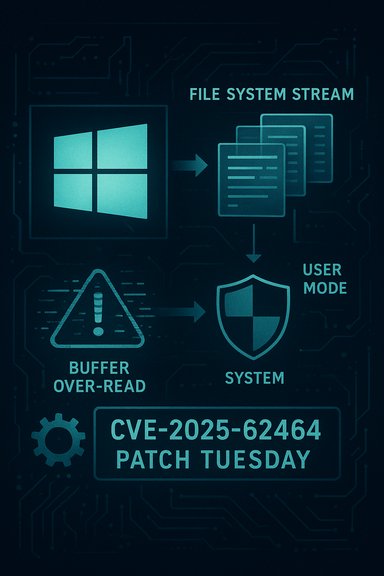
Microsoft has published a new high‑severity local Elevation‑of‑Privilege advisory: CVE‑2025‑62464, a buffer over‑read in the Windows Projected File System (ProjFS) that can allow an authorized local attacker to escalate to higher privileges on affected hosts. Public trackers assign a CVSS v3.1 base score of 7.8 (High) and vendor guidance points administrators to Microsoft’s Security Update Guide for KB mappings and remediation steps.
The Windows Projected File System (ProjFS) is a Microsoft user‑mode and kernel‑assisted facility that lets a provider application “project” remote or virtualized data into the Windows file system namespace so files and directories appear local to applications. ProjFS is used by virtualization helpers and source‑control integrations (for example, VFS for Git), and it is an optional component beginning with Windows 10, version 1809. The design intentionally bridges user‑mode provider code with kernel‑level I/O interception, which increases the attack surface for bugs that cross the user/kernel boundary. CVE‑2025‑62464 is reported as a buffer over‑read within the Projected File System implementation. The vendor‑level metadata and multiple vulnerability trackers characterize the impact as local Elevation‑of‑Privilege (EoP): a malicious or compromised low‑privilege process that can interact with ProjFS provider interfaces or projected file operations may be able to force kernel logic to read out‑of‑bounds memory and derive information or corrupt state in a way that yields privilege escalation. Published trackers list the vulnerability as not remotely exploitable (local attack vector only) but still high priority because kernel file‑system code executes in a privileged context and can be converted into full SYSTEM control in post‑compromise chains.
The disclosure of CVE‑2025‑62464 is a timely reminder that virtualization and projection technologies, while powerful and convenient for modern workflows, widen the kernel–user attack surface. The most effective immediate defense is disciplined patching mapped precisely to your builds, combined with hardening and focused telemetry to detect any misuse before it blossoms into a full compromise.
Source: MSRC Security Update Guide - Microsoft Security Response Center
 Background / Overview
The Windows Projected File System (ProjFS) is a Microsoft user‑mode and kernel‑assisted facility that lets a provider application “project” remote or virtualized data into the Windows file system namespace so files and directories appear local to applications. ProjFS is used by virtualization helpers and source‑control integrations (for example, VFS for Git), and it is an optional component beginning with Windows 10, version 1809. The design intentionally bridges user‑mode provider code with kernel‑level I/O interception, which increases the attack surface for bugs that cross the user/kernel boundary. CVE‑2025‑62464 is reported as a buffer over‑read within the Projected File System implementation. The vendor‑level metadata and multiple vulnerability trackers characterize the impact as local Elevation‑of‑Privilege (EoP): a malicious or compromised low‑privilege process that can interact with ProjFS provider interfaces or projected file operations may be able to force kernel logic to read out‑of‑bounds memory and derive information or corrupt state in a way that yields privilege escalation. Published trackers list the vulnerability as not remotely exploitable (local attack vector only) but still high priority because kernel file‑system code executes in a privileged context and can be converted into full SYSTEM control in post‑compromise chains. Why this matters: ProjFS as a high‑value target
ProjFS’s primary purpose—making remote or virtual content appear local—requires a close collaboration between user‑mode providers and kernel interfaces. That collaboration creates several risk amplifiers:- Kernel execution context: Any logic that runs in kernel mode can bypass userland isolation if exploited.
- Complex inputs: ProjFS accepts directory/file metadata, provider callbacks, and reparse-style behaviors that are inherently complex to validate.
- Wide deployment: ProjFS is used by developer tools and cloud sync/virtualization solutions; even if not ubiquitous on every desktop, the component is present in many enterprise fleets and development workstations.
What the public record says now
- Vulnerability ID: CVE‑2025‑62464.
- Classification: Buffer over‑read in Windows Projected File System.
- Impact: Elevation of Privilege (local) — attacker with the ability to make Projected File System‑related calls can leverage the flaw to obtain elevated privileges.
- CVSS v3.1 base: 7.8 (High) in public trackers.
- Exploitability: Local only; no authoritative public proof‑of‑concept was widely published at the time of disclosure. Administrators should treat PoCs as sensitive: a public PoC or patch diff can rapidly enable weaponization.
Technical anatomy (concise, non‑exploitative)
The public summary indicates a buffer over‑read condition — classified under CWE‑126 — inside code paths that parse or validate Projected File System structures or provider inputs. A buffer over‑read differs from a write‑corruption bug in that it reads past intended memory bounds; that read can either leak sensitive kernel memory (confidentiality impact) or lead to undefined control flow and crashes that attackers can toolbox into more powerful primitives (integrity/availability impacts). The vendor metadata and trackers place confidentiality, integrity, and availability impacts as high where exploit succeeds, while noting that exploitation requires local access and precise interaction with ProjFS interfaces. Key points about the internals and exploitation model:- Attack vector is local: attacker needs the ability to run code or to coerce a user/process into interacting with a ProjFS virtualization root.
- Likely trigger surface: provider callbacks, directory enumeration, or file metadata operations that ProjFS forwards from user‑mode providers into kernel context.
- Typical exploitation chain: local foothold → crafted ProjFS operations (or malicious provider) → controlled buffer over‑read → escalate to SYSTEM via information disclosure, type confusion, or use with additional memory primitives.
- Practical complexity: moderate. A read‑only flaw often requires additional conditions to turn into a reliable code‑execution primitive, but history shows attackers can weaponize such bugs as part of multi‑stage local escalation chains.
Vendor status and patch availability
Public vulnerability trackers list CVE‑2025‑62464 in the December 2025 Patch Tuesday release set; Microsoft’s Security Update Guide contains the advisory entry and the KB mapping steps administrators must use to find the correct updates for their Windows builds. Operators must not assume a single KB covers all SKUs — always confirm the KB→build mapping before mass deployment. Operational guidance from security practitioners emphasizes: map, pilot, roll. Validate the update in a representative lab, verify that the patch installs and that ProjFS functionality remains intact for required workloads, then schedule staged deployment across production rings. When Microsoft publishes VEX/CSAF artifacts or product attestations, use them to accelerate prioritization — but always verify on local image builds because bespoke or OEM images may ship different component sets.Immediate operational checklist (0–72 hours)
- Map applicability: consult Microsoft’s Security Update Guide and your patch management tool to identify the KB(s) that correspond to CVE‑2025‑62464 for each Windows build in your estate. Confirm via vendor KB text before applying broadly.
- Pilot patch: select a small, representative set of endpoints (developer workstations, VDI images, servers that run projected file providers) and apply the update. Verify functionality (mounts, provider behavior) and watch for regressions.
- Prioritize rollout: prioritize systems where ProjFS is in use or where local code execution is plausible (developer machines, VDI pools, build agents, image processing hosts). If you host multi‑tenant or shared systems where low‑privileged users can interact with file projections, elevate priority.
- Compensating controls while patching:
- Remove local admin rights from non‑trusted accounts; enforce least privilege.
- Restrict who can register or launch ProjFS providers where possible.
- Use application allow‑listing (WDAC/AppLocker) to limit untrusted binaries from running on sensitive hosts.
- For managed environments, consider temporarily disabling optional ProjFS providers or limiting virtualization roots to trusted administrators if the business use allows.
Detection and hunting recommendations
Because the attack path is local and ProjFS is a component that sees filesystem operations, detection should focus on anomalous local activity and kernel component failures:- EDR / SIEM hunting rules: look for unexpected process behavior that interacts with ProjFS providers, sudden escalations to SYSTEM from non‑privileged processes, and creation of new services or scheduled tasks immediately after ProjFS‑related activity.
- Kernel telemetry: monitor for driver or kernel crash traces that reference ProjFS stack frames, unexpected IRP failures, or warnings logged in the event log that correlate with user sessions. Kernel oopses and minifilter crashes are high‑value telemetry.
- Event logs: search Windows Event Log for Service Control Manager events around driver reloads, or for crashes of provider helper processes. Capture memory dumps if a crash occurs for vendor triage.
- Baseline known providers: identify the ProjFS providers in your environment (for example, developer tools or vendor extensions) and track unusual file I/O patterns to or from their processes.
- Investigate post‑patch diffs: once a patch is released, defenders should treat public patch diffs and community PoCs as actionable indicators to hunt for pre‑patch exploitation attempts; attackers often build exploits rapidly after diffing.
Risk analysis — exploitation likelihood and business impact
- Exploitation likelihood (short term): Moderate for attackers with local access. The exploit requires interaction with ProjFS interfaces and may require detailed local reconnaissance or user‑assistance. Public PoCs were not widely propagated at disclosure time, which reduces immediate mass exploitation risk — but patch diffs and private PoCs can quickly change that calculus.
- Business impact (if exploited): High. A successful local escalation to SYSTEM enables disabling of security controls, credential theft, persistence mechanisms (services, scheduled tasks), and lateral movement — the standard “second stage” outcomes that make EoP kernel bugs so attractive. Prior incidents involving kernel minifilters and CLFS show attackers converting local faults into domain‑wide compromises in enterprise environments.
- Blast radius considerations: multi‑tenant hosts, shared build runners, and virtualization hosts that mount or process untrusted images are the most at risk because a single exploited host can compromise multiple tenants or CI pipelines. Desktop endpoints used by developers are a second priority because they are common vectors for post‑phishing lateral movement.
Mitigations and hardening (practical)
- Patch promptly and validate: deploy vendor updates following standard test/pilot/rollout processes; confirm KB application on each build.
- Least privilege enforcement: restrict local admin rights, enforce just‑in‑time admin models, and reduce the number of accounts that can install or register ProjFS providers.
- Application allow‑listing: use Windows Defender Application Control (WDAC) or AppLocker to prevent unauthorized binaries from running on sensitive hosts.
- Limit provider registration: where operationally feasible, restrict who can register ProjFS providers or run provider installers; treat provider installation as an administrative operation.
- Monitor and collect telemetry: ensure kernel crash dumps, process creation events, and security event logs are centralized and retained to support post‑compromise investigations. Capture memory snapshots before remediation if you suspect exploitation.
What defenders should not assume
- Don’t assume “local only” means “low priority.” Local EoP bugs have a long track record of being weaponized after initial footholds. In enterprise environments the local actor may already be an attacker who just needs an escalation primitive.
- Don’t trust third‑party CVE aggregators alone. Automated systems sometimes mismap CVEs to KBs or to product SKUs. Always confirm KB mappings against Microsoft’s Security Update Guide and the Microsoft Update Catalog for each build.
Recommended timeline and priorities
- Within 24 hours: inventory systems that use or ship ProjFS providers (developer tooling, virtualization aids, cloud sync clients). Identify business‑critical hosts and any multi‑tenant platforms.
- Within 48–72 hours: pilot and validate the official vendor updates on representative images; tune detection rules for ProjFS telemetry.
- Within 7 days: full staged deployment to high‑priority hosts (VDI pools, build servers, developer machines, shared infrastructure). Apply compensating controls where patching must be delayed.
- Ongoing: review patch status, collect forensic artifacts for any suspected incident, and refine policies to limit who can install or register new ProjFS providers.
Final assessment — strengths, gaps, and residual risk
Strengths- The vendor published a tracked CVE and the security update guide entry, which means administrators can map their builds to KBs and remediate using standard channels. Public trackers provide CVSS scoring and an initial exploitability assessment to help prioritize action.
- Public advisories intentionally omit low‑level exploit mechanics for kernel bugs; while responsible, that obscures immediate hunt indicators and places more burden on operators to rely on telemetry and vendor KB mapping.
- If a public PoC appears or patch diffs are reverse‑engineered, weaponization can proceed quickly; defenders must assume the vulnerability is high risk the moment patch diffs are visible.
- Long‑tail systems (OEM images, embedded appliances, or air‑gapped nodes that are not regularly updated) may lag in receiving vendor fixes. These hosts often represent the most enduring risk and should be inventoried and isolated where possible.
Quick checklist for WindowsForum readers
- Confirm whether ProjFS is used in your environment (developer tools, VFS for Git, or third‑party providers).
- Map CVE‑2025‑62464 to the correct Microsoft KB for each Windows build using the Security Update Guide.
- Pilot, validate, and stage patch deployment; prioritize multi‑tenant and developer machines.
- Harden endpoints with least‑privilege, application allow‑listing, and EDR rules tuned for unexpected SYSTEM process creation.
- Tune telemetry to capture kernel dumps and ProjFS‑related anomalies; preserve evidence before remediating suspected compromises.
The disclosure of CVE‑2025‑62464 is a timely reminder that virtualization and projection technologies, while powerful and convenient for modern workflows, widen the kernel–user attack surface. The most effective immediate defense is disciplined patching mapped precisely to your builds, combined with hardening and focused telemetry to detect any misuse before it blossoms into a full compromise.
Source: MSRC Security Update Guide - Microsoft Security Response Center
