

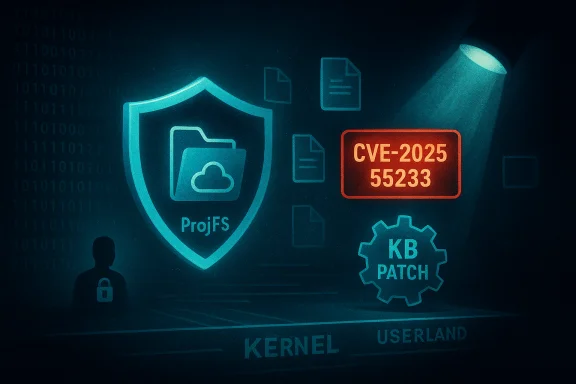
Microsoft’s December 9 Patch Tuesday closed out the year with another kernel-area elevation‑of‑privilege that targets the Windows Projected File System (ProjFS): CVE‑2025‑55233 is an out‑of‑bounds read in ProjFS that Microsoft has recorded in its Security Update Guide and which third‑party trackers are scoring as High (CVSS 3.1 = 7.8); the flaw allows an authorized local attacker to escalate privileges on an affected host.
Windows’ Projected File System — commonly known as ProjFS — is a kernel/userland collaboration that lets file system providers present placeholder files to user processes while the actual file content is supplied on demand by a usermode provider. That design enables cloud sync clients, virtualization tools, and other storage integrations to show full file trees while minimizing local storage. Because ProjFS bridges user and kernel contexts, bugs in its parsing, boundary checking, or provider interfaces can turn into powerful local escalation primitives. Recent Patch Tuesday cycles have repeatedly highlighted filesystem and mini‑filter components as high‑value targets for attackers, and CVE‑2025‑55233 joins a sequence of ProjFS / file‑system related fixes shipped this month. This article summarizes what is verifiably known about CVE‑2025‑55233, explains the technical implications for defenders and administrators, and provides a prioritized, practical remediation and detection playbook for Windows teams. Where vendor or technical details remain sparse or dynamically rendered (MSRC pages often are), the reporting below highlights what’s confirmed, and flags items that require operator verification (for example, precise KB → SKU mappings).
(If you manage patch orchestration: confirm the MSRC Update Guide KB mapping for each Windows build in use before scheduling the update; the vendor page is the canonical source for those mappings.
Source: MSRC Security Update Guide - Microsoft Security Response Center
 Overview
Windows’ Projected File System — commonly known as ProjFS — is a kernel/userland collaboration that lets file system providers present placeholder files to user processes while the actual file content is supplied on demand by a usermode provider. That design enables cloud sync clients, virtualization tools, and other storage integrations to show full file trees while minimizing local storage. Because ProjFS bridges user and kernel contexts, bugs in its parsing, boundary checking, or provider interfaces can turn into powerful local escalation primitives. Recent Patch Tuesday cycles have repeatedly highlighted filesystem and mini‑filter components as high‑value targets for attackers, and CVE‑2025‑55233 joins a sequence of ProjFS / file‑system related fixes shipped this month. This article summarizes what is verifiably known about CVE‑2025‑55233, explains the technical implications for defenders and administrators, and provides a prioritized, practical remediation and detection playbook for Windows teams. Where vendor or technical details remain sparse or dynamically rendered (MSRC pages often are), the reporting below highlights what’s confirmed, and flags items that require operator verification (for example, precise KB → SKU mappings).What we know (confirmed facts)
- The vulnerability identifier is CVE‑2025‑55233 and it was added to public trackers on December 9, 2025.
- Public records characterize the root cause as an out‑of‑bounds read (CWE‑125) in the Windows Projected File System; the class of weakness is consistent with reading past a buffer or structure boundary in a privileged code path.
- The community and public trackers list the CVSS v3.1 base score as 7.8 (High), with a vector consistent with a local attack that requires low privileges and no user interaction in the canonical exploit model.
- Public entries indicate remote exploitation is not applicable — this is a local escalation primitive, not a network‑facing RCE.
- Microsoft’s Security Update Guide includes a vendor entry for CVE‑2025‑55233 (the MSRC page is the canonical KB mapping source for your specific build), although the Update Guide’s pages are dynamically rendered and often require the vendor’s mapping lookup to translate CVE → KB for each Windows SKU. Third‑party trackers mirror the vendor entry. Administrators must map the CVE to the exact KB for their builds before patching.
Why this matters: threat model and operational impact
A local out‑of‑bounds read in a kernel‑proximate component like ProjFS is noteworthy because of how easily such memory‑safety faults can be escalated or chained in real‑world attacks.- Kernel privilege and surface area: ProjFS code executes in privileged contexts or proxies privileged file operations; a bug there can expose kernel memory or create conditions for more severe memory corruption primitives such as info‑leaks, improper pointer use, or use‑after‑free exploitation chains. Those chains can convert a low‑privileged foothold into SYSTEM.
- Common exploitation path: the most realistic chain begins with a local foothold (malicious binary, compromised user session, or coerced user action). From there an attacker crafts filesystem provider inputs or operations that exercise ProjFS code paths and trigger the out‑of‑bounds read. Depending on the surrounding memory layout and additional vulnerabilities, attackers can escalate to SYSTEM. Public history shows filesystem / mini‑filter flaws are frequently repurposed as local escalation primitives.
- Enterprise risk amplification: although the vector is local, modern enterprise environments often host shared platforms (VDI, virtualization hosts, CI runners, developer machines) where a single local compromise can be amplified. That means administrators should treat unpatched hosts as high priority.
Technical anatomy (what the public descriptions imply)
The public descriptor “out‑of‑bounds read” points to a class of issues where code reads past an intended boundary in a buffer or object. In kernel components this often yields two practical outcomes:- Crash or denial‑of‑service: a simple out‑of‑bounds read may cause a kernel fault that crashes the system — disruptive but not necessarily exploitable for code execution.
- Information disclosure or exploitation primitive: if the overread can be controlled so it leaks kernel or adjacent memory into a user‑accessible context, attackers can gain intelligence to bypass ASLR or craft subsequent heap manipulations that convert the primitive into more powerful corruption (write‑what‑where, function pointer overwrite, token theft).
- Provider callbacks that deliver metadata or reparse data to the kernel; if a length field is mishandled, a read beyond a buffer could occur.
- Path or name parsing routines that treat provider‑supplied strings or structures as NUL‑terminated without bounds checking.
- IOCTL or device interface handlers used by providers; malformed request buffers or incorrectly validated lengths may be the trigger vector.
Verification notes and uncertainty
- Canonical source: Microsoft’s Security Update Guide entry for CVE‑2025‑55233 is the authoritative record for the CVE and the mapping to KBs. However, that page is dynamically rendered and sometimes not fully viewable without JavaScript in automated scrapers; operators should use the MSRC Update Guide or Microsoft Update Catalog to map CVE → KB for each Windows build. This is standard practice for Microsoft kernel CVEs.
- Public scoring: third‑party aggregators (the ones mirrored by vulnerability databases) list the CVSS v3.1 base score as 7.8 with vector elements consistent with a local elevation‑of‑privilege (AV:L/AC:L/PR:L/UI:N/S:U/C:H/I:H/A:H). Administrators should verify scoring in the NVD/NIST and their vulnerability management systems as those trackers may update or normalize vector fields later.
- Exploitation observed? As of publication there are no authoritative public reports of active exploitation specific to CVE‑2025‑55233. That status can change quickly; continue to monitor telemetry and vendor advisories.
Immediate operational guidance (what to do now — prioritized)
- Inventory and prioritize
- Identify endpoints and servers that use or integrate with Projected File System providers: cloud sync clients, file‑virtualization products, developer host tools, and any usermode provider implementations. These will be your highest priority to patch and test.
- Confirm presence of any inbox or third‑party ProjFS providers that could be in use in your environment.
- Patch promptly (primary remediation)
- Use Microsoft Update, Windows Update for Business, or the Microsoft Update Catalog to obtain and install the security update(s) that remediate CVE‑2025‑55233 for your exact Windows builds.
- Always confirm the KB number(s) for your SKU and OS build in Microsoft’s Update Guide before mass deployment. The Update Guide is canonical for CVE→KB mapping — verify against it.
- Apply compensating controls if immediate patching is infeasible
- Reduce local attack surface: remove or limit local admin privileges where possible (apply least privilege), enforce Just‑In‑Time / Just‑Enough‑Admin controls for administrative operations, and restrict the set of users who can install or run untrusted software.
- Application allow‑listing: enforce WDAC/AppLocker policies to block untrusted or unknown binaries from executing.
- Temporary restriction of ProjFS usage: where feasible and safe, temporarily disable or restrict non‑essential ProjFS providers (vendor documentation will vary — do not remove system components blindly).
- Network segmentation: ensure that endpoints with elevated risk (developer machines, jump boxes) are isolated from high‑value or domain admin assets until patched.
- Verify patch deployment
- After installing the vendor updates, validate patch presence using configuration management tools and by checking installed KBs and OS build numbers. Do not assume successful deployment without verification and reboot where required.
- Increase detection and hunting
- Hunt for sudden kernel OOMs, bluescreens, or crashes correlated with user activity that manipulates provider files or placeholders.
- Monitor for unusual DeviceIoControl/IOCTL activity against ProjFS device objects or for processes invoking ProjFS provider APIs in abnormal contexts.
- Look for suspicious child process creation from user processes that interact with cloud sync or file‑virtualization providers.
- Deploy EDR hunts for token manipulation, DuplicateToken, CreateProcessAsUser, or other API use that indicates privilege escalation attempts. Use kernel crash dumps to capture stack traces referencing ProjFS modules if crashes occur.
- Post‑patch hardening
- Harden provider implementations: vendors and in‑house code that implement ProjFS providers should be audited for proper bounds checking, strict length validation, and robust error handling. Ensure secure coding practices around provider callbacks and input parsing.
Detection signals and forensic indicators
- Kernel crash signatures referencing ProjFS or related driver names; collect and analyze crash dumps for stack frames in Projected File System modules.
- Elevated failures or repeated blue screen events on hosts that use cloud sync or projected file providers; correlate with user operations involving file placeholders.
- Abnormal IOCTL patterns: repeated or malformed DeviceIoControl calls to projected file device interfaces from non‑trusted processes.
- Post‑compromise behaviors after a local exploit: sudden SYSTEM‑level process creation, new services installed as SYSTEM, suspicious persistence objects in system locations.
Why ProjFS and filesystem drivers keep recurring in advisories
Filesystem bridging components such as ProjFS, Cloud Files mini‑filters, and other kernel‑space modules are repeatedly targeted because:- They execute in privileged context while handling user‑supplied or untrusted inputs (metadata, reparse points, provider buffers).
- The parsing code is frequently complex and has to mediate many edge cases — increasing the chance of boundary errors (overflows, overreads, UAFs).
- A successful local escalation via a filesystem primitive provides a straightforward path to SYSTEM and persistence.
Risk analysis: who should worry most?
- High‑value administrators and jump hosts: machines used by IT staff or that store administrative credentials are high‑impact targets; compromise there can allow domain‑level escalation.
- Developer and CI hosts: systems that mount images, run untrusted builds, or accept artifacts from third parties are high‑risk because an attacker can trick those environments into mounting or processing crafted inputs.
- Virtualization hosts and shared platforms: the local vector can be amplified on multi‑tenant platforms where one compromised workload can affect co‑tenants or the hypervisor host if the vulnerability can be triggered from guest contexts.
Recommended checklist for IT teams (step‑by‑step)
- Immediately identify all Windows SKUs and builds in your estate. Export a list and map to MSRC KBs for CVE‑2025‑55233.
- Prioritize patching for:
- Administrative workstations and jump boxes
- Servers that mount cloud or virtualized file providers
- Developer machines and CI runners
- Stage patches in a test environment; validate that critical workloads function after the update and that reboots complete successfully.
- Roll out updates in waves, verifying installation with configuration management and ensuring reboots are scheduled.
- If you cannot patch immediately:
- Remove unnecessary local admin rights
- Harden endpoints with allow‑listing and EDR policies
- Temporarily suspend or restrict non‑essential ProjFS providers where vendor guidance permits
- Perform EDR hunts for kernel crashes, IOCTL anomalies, and token manipulation indicators.
- Document findings and prepare incident response playbooks tied to this CVE in case exploitation is observed.
Long‑term recommendations
- Reduce the number of privileged kernel components exposed to userland inputs where possible. When a provider must exist, enforce strong input validation at the boundary layers and adopt memory‑safe patterns where feasible.
- Vet third‑party ProjFS providers and cloud sync clients for security posture and timely patching practices.
- Maintain rigorous asset tagging and patch‑management processes that map CVEs to KBs automatically, but always include a manual verification step against the vendor update guide for kernel / driver patches.
Final assessment and conclusion
CVE‑2025‑55233 is a high‑impact, local elevation‑of‑privilege vulnerability in the Windows Projected File System that the industry is treating seriously because it targets the privileged kernel/userland boundary. The public record shows an out‑of‑bounds read root cause and a CVSS v3.1 base score of 7.8, and Microsoft has recorded the CVE in its Security Update Guide; third‑party trackers and Patch Tuesday summaries list it among December’s important Windows EoP fixes. Operational urgency should be judged by your exposure profile. Environments with shared hosts, developer machines, or administrative jump hosts should prioritize rapid patch deployment and post‑patch verification. Where immediate patching is impossible, apply strict least‑privilege controls, application allow‑listing, and aggressive EDR hunting for the detection signals listed above. The definitive remediation is vendor patching mapped precisely to your Windows SKUs via the MSRC Update Guide; administrators must confirm KB mappings before mass deployments. This advisory fits the recurring pattern of kernel adapter / filesystem fixes: weaponizable local primitives that demand quick action and careful validation. Treat CVE‑2025‑55233 as an urgent Windows patching item, verify your KB mappings, and prioritize hosts where a local escalation would have the widest impact.(If you manage patch orchestration: confirm the MSRC Update Guide KB mapping for each Windows build in use before scheduling the update; the vendor page is the canonical source for those mappings.
Source: MSRC Security Update Guide - Microsoft Security Response Center
