

Microsoft's security advisory for a newly cataloged Routing and Remote Access Service (RRAS) vulnerability, tracked as CVE-2025-62473, describes a network‑accessible information‑disclosure flaw in the Windows RRAS stack; independent trackers assign it a CVSS v3.1 base score of 6.5, and vendor materials indicate a buffer over‑read class (CWE‑126) affecting RRAS protocol handling.
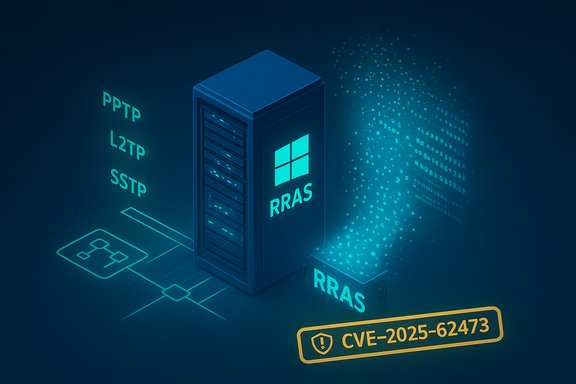
Routing and Remote Access Service (RRAS) is a long‑running Windows role used for VPN termination (PPTP, L2TP/IPsec, SSTP), site‑to‑site routing, NAT and legacy remote access functions. Because RRAS frequently processes untrusted network input and normally runs with elevated privileges, any flaw that leaks memory or other sensitive data from RRAS is materially useful to attackers performing reconnaissance or later exploitation. The 2025 RRAS vulnerability cluster — multiple CVEs disclosed across mid‑ to late‑2025 — has already attracted heavy operational attention from defenders and incident responders.
CVE‑2025‑62473 is described in vendor and aggregator summaries as a buffer over‑read (information disclosure) in the RRAS code path. Public trackers list the vulnerability as network‑facing with significant confidentiality impact, though authoritative vendor text for the MSRC entry requires a full browser render (JavaScript) for the update guide page to display details directly. Administrators should treat the MSRC advisory as the final authority for mapping the CVE to the exact KB and update packages for their builds.
Note on verification: the MSRC update guide page for this CVE requires a full browser render to display the advisory content; if any public feed or third‑party mirror provides conflicting KB mappings or exploitability semantics, prioritize the MSRC page and the Microsoft Update Catalog as the authoritative sources and treat conflicting third‑party entries as needing confirmation.
Source: MSRC Security Update Guide - Microsoft Security Response Center
 Background / Overview
Routing and Remote Access Service (RRAS) is a long‑running Windows role used for VPN termination (PPTP, L2TP/IPsec, SSTP), site‑to‑site routing, NAT and legacy remote access functions. Because RRAS frequently processes untrusted network input and normally runs with elevated privileges, any flaw that leaks memory or other sensitive data from RRAS is materially useful to attackers performing reconnaissance or later exploitation. The 2025 RRAS vulnerability cluster — multiple CVEs disclosed across mid‑ to late‑2025 — has already attracted heavy operational attention from defenders and incident responders.CVE‑2025‑62473 is described in vendor and aggregator summaries as a buffer over‑read (information disclosure) in the RRAS code path. Public trackers list the vulnerability as network‑facing with significant confidentiality impact, though authoritative vendor text for the MSRC entry requires a full browser render (JavaScript) for the update guide page to display details directly. Administrators should treat the MSRC advisory as the final authority for mapping the CVE to the exact KB and update packages for their builds.
What the advisory says (concise technical summary)
- Vulnerability class: Buffer over‑read / information disclosure (CWE‑126 reported by public trackers).
- Affected component: Windows Routing and Remote Access Service (RemoteAccess/RRAS) when the role/service is installed and running.
- Attack vector: Network (attackers can induce RRAS to return more data than intended by sending crafted protocol messages).
- Privileges required: Public feeds vary but the reported vector indicates low or no authentication required in many deployment models; practical exploitation depends on protocol reachability and the RRAS listener configuration.
- Impact: Confidentiality loss — disclosure of memory contents or protocol state that might include sensitive tokens, internal configuration, or heap/stack fragments. Public scoring places confidentiality impact high while integrity and availability are not the primary failure modes.
Why this matters operationally
RRAS commonly terminates VPN sessions and sits at network boundaries. An information‑disclosure primitive in RRAS can be weaponized in several practical ways:- Leak authentication material or session tokens that permit lateral movement or replay attacks.
- Reveal memory layouts and pointers that facilitate subsequent exploitation of separate memory‑corruption bugs (heap grooming, bypassing ASLR/CFG).
- Provide reconnaissance data for crafting targeted exploits against privileged services.
Evidence, verification and confidence
- Vendor advisory: The Microsoft Security Update Guide lists an entry for CVE‑2025‑62473; however, that web page requires a full browser session to render its JavaScript‑driven UI, which can impede automated scraping. Administrators should open the MSRC entry in a browser to obtain the authoritative KB mapping and installation instructions.
- Independent trackers: CVE aggregators such as CVEFeed (and similar databases) have cataloged CVE‑2025‑62473 as a buffer over‑read with a CVSS v3.1 score of 6.5, supporting the risk profile described above. These trackers reflect the public MSRC entry and summarize the vulnerability at a high level.
- Community/operational writeups: Forum and incident‑response summaries assembled during the 2025 RRAS advisory wave provide practical mitigation and detection guidance (inventory commands, port lists, and hardening steps). These community playbooks largely converge on the same core tactical steps: patch promptly, inventory RRAS, block RRAS protocol ports where possible, and increase logging and capture of PCAPs and memory if exploitation is suspected.
Technical analysis — how a buffer over‑read in RRAS can be exploited
A buffer over‑read occurs when a component reads past the intended bounds of an allocated buffer. In RRAS protocol handling, the likely practical outcomes are:- The service responds with extra memory contents (heap/stack fragments) in response to a malformed negotiation or packet, producing an information leak chain.
- Leaked memory can reveal pointer values, object layouts, or cryptographic artifacts that an attacker can use to defeat difficult mitigations (ASLR, heap hardening) in separate bugs.
- When combined with other memory‑corruption primitives (use‑after‑free, heap overflow), this information can dramatically lower the difficulty of achieving code execution.
Who should care and how to prioritize
- Highest priority: Internet‑facing RRAS servers (VPN gateways, DMZ concentrators) that accept negotiated VPN flows or protocol endpoints. These should be patched immediately or taken offline until patched.
- High priority: Systems reachable from less‑trusted internal segments, or servers where unprivileged code execution is possible (terminal servers, developer machines). A local foothold plus an RRAS information leak can be chained to achieve full compromise.
- Medium priority: Non‑exposed servers with RRAS installed — validate whether the role is required; if not, remove it and harden the host. Inventory gaps are common and frequently responsible for lingering exposure.
Immediate mitigation and remediation (0–72 hours)
- Patch first — map CVE to KB and apply updates
- Confirm the exact KB(s) that remediate CVE‑2025‑62473 for each Windows build in your estate using the Microsoft Security Update Guide or Microsoft Update Catalog. MSRC is authoritative; DO NOT rely solely on third‑party mirrors for KB→build mapping.
- If patching cannot be immediate, apply containment controls
- Block RRAS/VPN ports at the perimeter: TCP 1723 (PPTP), GRE (IP protocol 47), UDP 1701 (L2TP), UDP 500/4500 (IKE/IPsec), TCP 443 (SSTP).
- Stop and disable the RemoteAccess service on non‑critical hosts:
- Stop-Service -Name RemoteAccess -Force
- Set-Service -Name RemoteAccess -StartupType Disabled
- Uninstall the RRAS role if not required: Uninstall‑WindowsFeature -Name RemoteAccess -IncludeManagementTools.
- Harden authentication and session state
- Enforce certificate‑based authentication and MFA for VPN endpoints where possible; rotate keys/certificates and expire long‑lived sessions if RRAS endpoints were exposed pre‑patch.
- Increase detection and telemetry
- Forward RRAS logs (Applications and Services Logs → Microsoft → Windows → RemoteAccess and RasMan) to your SIEM.
- Deploy IDS/IPS rules to flag malformed RRAS packets and repeated negotiation attempts; tune Suricata/Snort signatures for RRAS flows.
- Prepare for forensic capture
- If you suspect exploitation, isolate the host, capture volatile memory (process dump of RemoteAccess), preserve PCAPs of RRAS traffic, and coordinate with IR teams for controlled acquisition.
Detection and hunting guidance
- Network signals to watch:
- Unusual spikes of traffic to RRAS ports (TCP 1723, GRE 47, UDP 1701, UDP 500/4500, TCP 443).
- Repeated negotiation failures or malformed negotiation sequences from single IPs (indicating scanning or exploitation attempts).
- Host signals to watch:
- RRAS/RemoteAccess service crashes, abnormal restarts, or unexpected error codes in Application and Services logs → RemoteAccess / RasMan.
- Unexpected creation of reparse points or symlink/junction activity in RRAS configuration directories (for RRAS vulnerabilities that involve filesystem link handling).
- Practical hunting steps:
- Inventory installations:
- Get-Service -Name RemoteAccess
- Get-WindowsFeature | Where-Object { $.Name -match "RemoteAccess" -or $.Name -match "Routing" }
- Search SIEM for the above network and host indicators and correlate with authentication events and new administrative sessions.
Operational playbook — a prioritized rollout
- Identify all RRAS instances and classify by exposure (internet‑facing, partner‑accessible, internal).
- Create a test ring and apply the vendor update to representative hosts.
- Patch internet‑facing RRAS servers next, validate functionality, and monitor logs.
- Roll updates to internal RRAS hosts in staged rings.
- For hosts that cannot be patched immediately, apply host firewall restrictions and stop RemoteAccess until update windows are available.
Risk analysis — strengths and potential weaknesses
Strengths- Microsoft published a security advisory for the CVE and the update guide is the authoritative mechanism to locate per‑build KBs; organizations with disciplined patch governance can eliminate exposure quickly.
- Community playbooks and detection recipes for RRAS issues matured during 2025, providing practical templates for containment, telemetry tuning and forensics.
- CVE→KB mapping confusion has appeared repeatedly for RRAS advisories in 2025; relying on third‑party mirrors can result in patching the wrong package for a build. Always verify in MSRC or Microsoft Update Catalog before mass deployment.
- Inventory gaps: RRAS is an optional role and sometimes exists on unmanaged cloud images or legacy systems; unknown RRAS instances are the most common source of post‑patch incidents.
- Disclosure vs exploitation: an information‑disclosure primitive may seem lower severity than RCE, but leaked memory and layout artifacts are a force multiplier for adversaries and can rapidly lead to exploit chains. Treat information‑disclosure CVEs with urgency when they affect privileged network services.
Cross‑referencing the public record
- The Microsoft Security Update Guide contains the vendor entry for CVE‑2025‑62473; administrators should use that entry to obtain KB mappings and update packages. Note that MSRC pages often require a fully rendered browser to view the detailed advisory text.
- Independent aggregators and vulnerability feeds have indexed CVE‑2025‑62473 and summarized it as a buffer over‑read with a moderate CVSS score (6.5). These independent records corroborate the vendor‑acknowledged existence of the issue but may omit per‑build KB mappings or the full technical triggers.
- Broader threat context: RRAS CVEs were part of a cluster disclosed across 2025 and were included in vendor monthly security updates (Patch Tuesday) — defenders should not treat this CVE in isolation but as part of an active family of RRAS advisories. Patch rollouts in November 2025, for example, included multiple RRAS fixes that were prioritized by security teams.
Practical checklist (copy/paste for operators)
- Inventory RRAS presence:
- Get-Service -Name RemoteAccess
- Get-WindowsFeature | Where-Object { $.Name -match "RemoteAccess" -or $.Name -match "Routing" }
- Emergency mitigations if you cannot patch immediately:
- Stop and disable RRAS:
- Stop-Service -Name RemoteAccess -Force
- Set-Service -Name RemoteAccess -StartupType Disabled
- Block RRAS ports at perimeter: TCP 1723, GRE (47), UDP 1701, UDP 500, UDP 4500, TCP 443.
- Post‑patch validation:
- Confirm the KB/hotfix is installed (Get-HotFix or Windows Update history).
- Reboot where required and test representative VPN client connections.
- Monitor RRAS logs and SIEM for errant errors or service restarts in the first 72 hours.
Final assessment and recommended stance
CVE‑2025‑62473 is a credible, vendor‑acknowledged information‑disclosure vulnerability in Windows RRAS that merits rapid operational attention. The practical risk is elevated when RRAS is network‑exposed or when hosts permit local untrusted execution. The single best protective action is to map the CVE to the exact KB for each Windows build and deploy the vendor update promptly; where immediate patching is impossible, remove exposure by disabling RRAS and blocking protocol ports, harden authentication and rotate affected session material, and increase telemetry to detect scanning or exploitation attempts. Administrators should treat RRAS advisories as high‑priority in patch cycles, verify KB mappings in the Microsoft Security Update Guide, and follow the defensive playbook above to contain risk until updates can be applied. The community playbooks and detection recipes compiled during the 2025 RRAS advisory wave provide practical, operational guidance that can be implemented quickly to reduce exposure while patches are staged.Note on verification: the MSRC update guide page for this CVE requires a full browser render to display the advisory content; if any public feed or third‑party mirror provides conflicting KB mappings or exploitability semantics, prioritize the MSRC page and the Microsoft Update Catalog as the authoritative sources and treat conflicting third‑party entries as needing confirmation.
Source: MSRC Security Update Guide - Microsoft Security Response Center
