

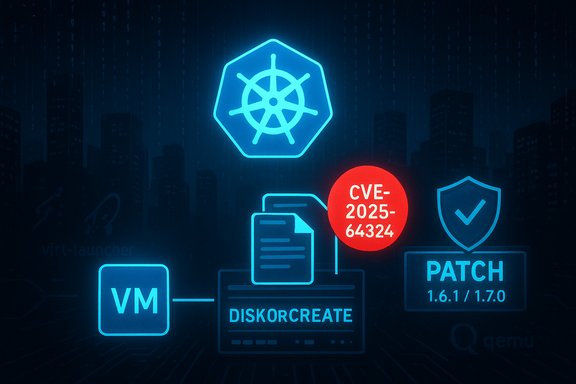
KubeVirt contains a logic flaw in its hostDisk handling that can allow a VM to cause the node to read or be forced to write arbitrary host files — a high-severity host-file access bug tracked as CVE-2025-64324 and patched in the 1.6.1 and 1.7.0 releases.
Background / Overview
KubeVirt is an open‑source project that brings full virtual machines into Kubernetes by pairing a tiny per‑VM helper pod (virt-launcher) with libvirt/qemu; operators can expose host files or directories into a VM using the hostDisk feature. The narrowly scoped but powerful DiskOrCreate option — which instructs KubeVirt to create a backing file on the host when the VM boots if it does not already exist — is at the center of CVE-2025-64324. Multiple public vulnerability trackers and the upstream GitHub advisory describe the issue and map the fix to specific commits and patched releases. At a high level, the bug is a logic error in virt-handler’s host-disk preparation code: when DiskOrCreate is used the code that prepares or creates the backing file can change ownership or otherwise manipulate files without correctly validating whether the targeted file is an intended, newly created file. The result: a VM operator (or an attacker who can submit a VMI manifest in an insufficiently controlled environment) can cause virt-handler to operate on host files it should never touch, enabling both read and write access to files normally owned by more privileged host users. This has been scored as High severity by several aggregators (CVSS v4 8.5 / CVSS v3 7.7 in various listings).What the advisory and patches say
Affected code paths and the fix
- The vulnerability arises in the pkg/host-disk/host-disk.go code paths inside virt-handler when the HostDisk feature gate is enabled and a Volume uses the DiskOrCreate behavior.
- The problematic flow is: virt-handler prepares a host-backed file for attachment, and the helper functions that create or prepare a sparse RAW file did not properly distinguish between newly created files and existing host files before changing ownership to the runtime UID used by qemu (UID 107). That logic allowed ownership changes and subsequent attach operations to be applied to attacker‑controlled targets on disk. The upstream fix restricts ownership/chown changes to newly created files and adds explicit checks to refuse manipulations on existing host files that are not allowed.
Affected versions and patched releases
- Affected: KubeVirt releases before 1.6.1 and certain pre‑1.7.0 lines where DiskOrCreate handling was present.
- Patched in: 1.6.1 and the 1.7.0 release candidates (1.7.0-rc.0 / 1.7.0). Public advisories and the GitHub advisory list these versions as containing the fix.
Technical analysis — how exploitation works
Core weakness
The bug is best characterized as a logic and ownership-check error (CWE classes mapped in trackers include information disclosure and improper access modification), not a kernel memory corruption. It emerges from three interacting facts:- HostDisk/DiskOrCreate semantics: administrators can instruct KubeVirt to mount a host file or directory into a VM. When DiskOrCreate is used, the controller creates a backing file if absent.
- Ownership normalization for QEMU: for qemu to read raw files presented as block devices, those files are commonly adjusted to be owned by the unprivileged qemu runtime account (UID 107) used inside virt-launcher.
- Insufficient validation: the code that performs creation and ownership changes did not adequately verify whether the target path referenced an already‑existing, privileged host file; it applied ownership changes in a way that could affect existing files that should not be touched.
Exploitation prerequisites and threat model
- The exploit is local to the cluster in the sense that it requires the ability to request creation or attachment of a hostDisk resource (or to otherwise influence virt-handler’s host-disk preparation).
- In practical multi‑tenant clusters or environments where non‑trusted users can create VirtualMachine manifests or supply host disk references, the attacker need not first compromise the host — the attacker abuses legitimate KubeVirt functionality and the buggy logic.
- If Kubernetes RBAC and admission controls prevent untrusted users from creating VM specs with hostDisk or DiskOrCreate semantics, the practical risk is substantially lower.
- The public trackers and advisories note a relatively low exploitation complexity when the feature gate is enabled and policy controls are permissive — which is why operators are urged to treat this as a high‑impact item on multi‑tenant platforms.
Real‑world impact scenarios
- Sensitive-file disclosure: An attacker could cause a VM to expose host configuration files (for example, /etc/passwd, SSH keys that are world‑readable in misconfigured systems, or other host files reachable via the DiskOrCreate path) by forcing virt-handler to present the host file as a disk to the guest.
- Integrity compromise: The attacker can modify host files by inducing the ownership change to UID 107 and then writing to the file from within a guest or by using the attaching workflow to replace contents.
- Chained escalation: Exfiltrated secrets obtained through file reads may enable credential pivoting to other cluster components; modified host files could be used to alter startup configuration or service behavior and facilitate further compromise.
- Provider/CI risk: Shared CI runners, multi‑tenant clusters, and managed-hosting environments where tenants can provision VM specs or writable volumes are the highest risk. Service providers should treat hostDisk as a privileged capability and restrict access aggressively.
Detection, hunting and indicators
The vulnerability produces several high‑signal indicators defenders can hunt for; many of these are recommended in upstream advisories and incident-response guidance.- Look for host files suddenly owned by UID 107 (qemu). A simple host check:
- find / -uid 107 -ls
- Inspect virt-handler and kubelet logs for mount/attach errors or unusual warnings during VMI startup; virt-handler may log path resolution or chown failures.
- Audit the Kubernetes API server audit trail for VMI creation events that include hostDisk volumes or DiskOrCreate semantics, especially when those calls come from unprivileged principals.
- Scan PVCs and any user-supplied volume content that will be attached to VMs for symlinks or unexpected entries — symlink‑based or path-based tricks have been an adjacent class exploited in other KubeVirt advisories.
- On a Linux node: find / -uid 107 -ls
- Tail virt-handler logs (namespace commonly kubevirt): kubectl -n kubevirt logs -l kubevirt.io=virt-handler --tail=500
- Kubernetes audit: filter for creation of VirtualMachine or VirtualMachineInstance objects that include hostDisk volumes in their spec.
Remediation and mitigations
The single best fix: upgrade
- Upgrade KubeVirt to 1.6.1 or 1.7.0 (or later) as soon as operationally feasible. The upstream GitHub advisory and commit history show the targeted fixes and hardened ownership checks that close the attack vector.
Compensating controls if you cannot patch immediately
- Disable the HostDisk feature gate if your workloads do not require direct host file mounts. This removes the attack surface entirely.
- Tighten RBAC and admission policies so that only trusted administrators can create VM specs that reference hostDisk or DiskOrCreate. Use admission controllers (Gatekeeper/OPA, Kyverno) to reject VirtualMachine manifests containing hostDisk entries unless they are created by an approved principal.
- Scan and quarantine volumes: prevent user‑writable volumes or PVCs from being attached to VMs without verification; scan for symlinks or suspicious files.
- Harden node controls: where acceptable, disable unprivileged user namespaces and remove unnecessary hostPath privileges for pods that touch virt-launcher components (note: disabling userns may impact legitimate workloads — test first).
Operational rollout checklist (recommended sequence)
- Inventory: enumerate clusters running KubeVirt and list installed versions.
- Test: upgrade a staging cluster to the patched release and validate VM lifecycle and device attach behavior.
- Patch: roll out the upgrade to production during a maintenance window, monitoring VM state and node stability.
- Post‑patch validation: scan nodes for unexpected UID 107 ownership findings and validate admission controls.
- If incident suspected: preserve logs, cordon and drain suspect nodes, collect file metadata and auditd logs, rotate credentials and service account tokens if a compromise is confirmed.
Risk analysis for different deployment models
- Single‑tenant, operator‑managed clusters — Lower practical risk if the operator maintains strict controls over who can create VM specs and manages all PVCs. Patch in a normal maintenance cadence, but still treat this as a high‑priority security update.
- Multi‑tenant and self-service platforms — High risk. If tenants can create VMs or upload files/PVCs that get attached to VMs, the vulnerability is an effective data-exfiltration and host‑file corruption vector. Prioritize immediate patching and RBAC lockdowns.
- Managed providers / CI runners / build hosts — Very high risk. These systems often accept untrusted workloads and are frequently multi‑tenant by design. Apply patches and implement strict volume/manifest admission controls immediately.
Why Windows administrators and mixed‑environment operators should care
Even though KubeVirt runs on Linux nodes, the vulnerability affects any environment where Linux Kubernetes nodes host VM workloads that may serve Windows workloads under test, CI, or production. Windows operations teams that integrate with or manage Kubernetes clusters (for monitoring, backups, CI, or orchestration) must ensure platform teams have prioritized KubeVirt patching. Treat KubeVirt components like you would a hypervisor: they’re high‑value attack surface for tenants and supply‑chain compromise. The community guidance explicitly recommends including KubeVirt in standard vulnerability scanning, patching pipelines, and incident response playbooks.What remains uncertain and cautionary notes
- Public exploitation evidence: at disclosure time public trackers do not document widespread in‑the‑wild campaigns specifically abusing CVE-2025-64324. Absence of public incidents does not mean the problem is theoretical; the attack primitive (DiskOrCreate + ownership change) is straightforward in permissive environments, and proof‑of‑concept detail is present in commit diffs and advisory text. Treat the window to weaponization as real once advisories and patches circulate.
- Environment-specific exposure: whether an attacker can exploit this in a given cluster depends heavily on RBAC, admission policies, and whether HostDisk or DiskOrCreate is enabled. Operators must map their cluster-specific control plane policy to determine urgency beyond the baseline recommendation to patch. Uploaded operational guidance underscores that multi‑tenant clusters and CI runners are the highest priority to remediate.
Practical checklist — immediate action (quick reference)
- Patch: upgrade KubeVirt to 1.6.1 or 1.7.0 (rc or later) as the definitive remediation.
- If you cannot patch in the next 24–72 hours:
- Disable the HostDisk feature gate.
- Prevent non‑trusted principals from creating VM manifests that reference hostDisk/DiskOrCreate.
- Use admission controllers to block or require human review for hostDisk volume usage.
- Scan nodes for files owned by UID 107 and investigate unusual ownership changes.
- Audit: enable and analyze Kubernetes API audit logs for suspicious VMI creation events and track virt-handler log anomalies.
- Harden: tighten RBAC, block unprivileged PVC writes in namespaces that run VMs, and treat any long‑lived virt-handler tokens as sensitive — rotate them if compromise is suspected.
Conclusion
CVE-2025-64324 is a meaningful reminder that cloud‑native virtualization blends legacy hypervisor semantics with Kubernetes storage constructs in ways that can produce surprising host‑level exposure. The vulnerability’s root cause is a straightforward logic error in ownership and file‑creation handling for hostDisk/DiskOrCreate, but the impact — arbitrary host file read and write — is severe in multi‑tenant and self‑service environments. The remediation is clear and available: upgrade to the patched releases (1.6.1 / 1.7.0) and, where practical, reduce surface area by disabling HostDisk or limiting who can create hostDisk‑backed VMs. Operators should also apply the detection and hardening steps described above while treating platform RBAC and admission controls as first‑line defenses against similar future bugs.Source: MSRC Security Update Guide - Microsoft Security Response Center
