

A newly assigned CVE, CVE-2025-68229, documents a Linux kernel defect in the SCSI target loop driver (tcm_loop) that can cause a kernel crash: a NULL-pointer dereference in tcm_loop_tpg_address_show when tl_hba->sh was not successfully allocated during driver probe. The upstream maintainers have committed small, surgical fixes into the stable kernel trees; operators running kernels that include the vulnerable commits should prioritize mapping upstream commits to their vendor kernel packages and deploying updates to remove the availability risk.
The Linux SCSI target modules provide in-kernel target functionality used by local storage export tests, lab setups, and some appliances. The tcm_loop driver implements a loopback SCSI target used for testing and lightweight target setups. The recent CVE describes a straightforward lifecycle bug: if the driver’s probe path fails to allocate or initialize the expected scsi_host structure (tl_hba->sh), a later information-display helper—tcm_loop_tpg_address_show—may dereference that pointer unguarded and trigger a kernel oops (NULL-pointer dereference). The failure mode is classic: a missing defensive check against an uninitialized pointer in a sysfs/configfs or show routine. This is an availability-first vulnerability. The observable result is a kernel oops or panic and a crash of the affected host or virtual machine. There is no immediate, public evidence that the bug allows code execution or privilege escalation by itself; however, kernel oopses and memory-safety issues sometimes form part of more complex exploit chains, so availability defects in kernel subsystems deserve prompt remediation in multi-tenant or production environments.
Source: MSRC Security Update Guide - Microsoft Security Response Center
 Background / Overview
The Linux SCSI target modules provide in-kernel target functionality used by local storage export tests, lab setups, and some appliances. The tcm_loop driver implements a loopback SCSI target used for testing and lightweight target setups. The recent CVE describes a straightforward lifecycle bug: if the driver’s probe path fails to allocate or initialize the expected scsi_host structure (tl_hba->sh), a later information-display helper—tcm_loop_tpg_address_show—may dereference that pointer unguarded and trigger a kernel oops (NULL-pointer dereference). The failure mode is classic: a missing defensive check against an uninitialized pointer in a sysfs/configfs or show routine. This is an availability-first vulnerability. The observable result is a kernel oops or panic and a crash of the affected host or virtual machine. There is no immediate, public evidence that the bug allows code execution or privilege escalation by itself; however, kernel oopses and memory-safety issues sometimes form part of more complex exploit chains, so availability defects in kernel subsystems deserve prompt remediation in multi-tenant or production environments. What went wrong — technical anatomy
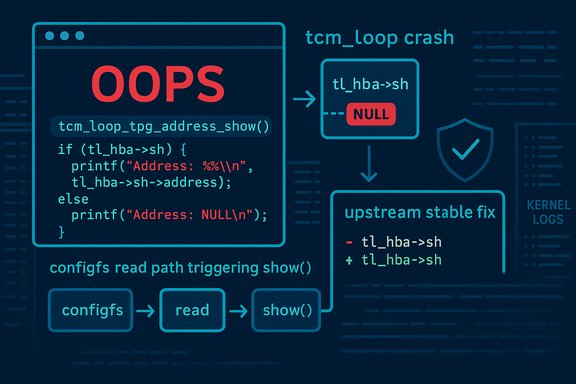
At a high level the defect is trivial to explain and trivial to fix, but the operational impact can be costly if left unpatched.- During tcm_loop_driver_probe, the driver allocates and initializes various per-HBA (host bus adapter) structures, including a pointer stored as tl_hba->sh that references the allocated scsi_host.
- If that allocation fails (e.g., memory pressure, resource exhaustion, or an unexpected runtime condition), tl_hba->sh remains NULL.
- A configfs or sysfs show function—tcm_loop_tpg_address_show—assumes tl_hba->sh exists and dereferences it to format and return a string for userspace. That unchecked dereference produces a kernel NULL-pointer dereference and an oops when tcm_loop_tpg_address_show is invoked (for example via a read of the corresponding configfs entry).
Example symptom (field trace)
The public CVE descriptions include a representative oops trace that demonstrates the NULL dereference: an OOPS with RIP pointing into tcm_loop_tpg_address_show and a call chain that includes configfs read helpers (configfs_read_iter → vfs_read → ksys_read), which is exactly the I/O path that triggers a show callback from userspace. That trace is the smoking gun: a userspace read of a configfs entry caused the kernel to dereference a NULL pointer that should have been validated.Affected versions and commit mapping
Multiple vulnerability databases and trackers list the same upstream commit identifiers and ranges that introduced/fixed the issue in the kernel Git history. OSV’s package mapping shows the vulnerable range and lists several stable commit IDs that implement the fix; public CVE mirrors repeat the same commit hashes as the “fixed” events. This is significant because vendor kernel packages will often backport just the small stable fix rather than bumping the entire kernel version. Administrators must map the upstream commit IDs to their distribution’s kernel package changelogs before declaring hosts remediated. Key operational facts to verify:- The CVE was published and recorded in NVD and OSV on 16 December 2025.
- Public trackers list the stable commit hashes that close the defect (these commit IDs appear in OSV and other mirrors). Use your distribution’s kernel changelog or package metadata to confirm those commits (or an explicit CVE mention) were included in the supplied kernel package.
- the vendor changelog/changelog entry naming CVE-2025-68229 or the upstream commit ID, or
- the kernel source included in the vendor package contains the stable patch that performs the tl_hba->sh NULL check. Several operational advisories emphasize this mapping requirement for Linux kernel fixes.
Exploitability and risk profile
- Attack vector: local. A local user or process (or an untrusted guest on a hypervisor host) that can read the configfs entry or otherwise invoke the show helper can trigger the NULL dereference.
- Privileges required: often low in practical setups. Reading certain configfs or sysfs attributes may be allowed to unprivileged users depending on system configuration; multi-tenant hosts, developer machines, CI runners, and testbeds are higher-risk.
- Primary impact: availability (kernel oops, panic, host crash). There is no authoritative public evidence at disclosure of this bug being weaponized for remote code execution or privilege escalation. However, because kernel oopses can lead to unexpected service outages and because availability problems are straightforward to weaponize in multi-tenant infrastructure, patching should be prioritized.
- A container or unprivileged user on a Linux host reads the tcm_loop configfs entry repeatedly to stress the show path and produce repeated oopses, causing service instability.
- An automated test harness or misconfigured monitoring read could accidentally trigger the bug during normal operations, producing a production outage.
Detection, hunting, and forensics
This class of kernel defect is detectable via kernel logs and crash traces. Key signals and steps:- Look for kernel log lines with “NULL pointer dereference”, “kernel BUG”, or backtraces that mention tcm_loop_tpg_address_show. The representative trace published in trackers includes an RIP pointing into tcm_loop_tpg_address_show plus the configfs → vfs_read call sites.
- Search centralized logs and crash archives for repeated oopses referencing tcm_loop or for sudden, unexplained kernel reboots correlated with configfs reads.
- Enable and collect vmcore/kdump images on systems where the tcm_loop driver is loaded. Preserving a vmcore is often essential for offline analysis and mapping a crash to a specific CVE.
- If you manage a fleet, add log-based alerts for kernel oopses containing “tcm_loop” or the specific function name so you can triage affected hosts quickly.
- journalctl -k | egrep -i 'tcm_loop|tcm_loop_tpg_address_show|NULL pointer'
- dmesg | tail -n 200 | egrep -i 'Oops|BUG|tcm_loop'
- If you capture a vmcore, preserve it and upload to vendor support when requesting triage.
Remediation and mitigation
Definitive remediation is simple: install a vendor-supplied kernel package that contains the upstream stable patch(s) fixing tcm_loop_tpg_address_show and reboot into the patched kernel. The patch is intentionally low-risk and small, which makes vendor backports straightforward and the package upgrades unlikely to introduce functional regressions. Confirm remediation by validating the vendor changelog or the kernel package metadata includes CVE-2025-68229 or the upstream commit IDs listed in OSV/NVD records. If you cannot patch immediately, consider these interim mitigations:- Unload or blacklist the tcm_loop module where feasible (modprobe -r tcm_loop or add to kernel module blacklist) to eliminate the vulnerable code path on hosts that do not require it.
- Restrict access to configfs/sysfs control interfaces so that untrusted users cannot trigger show helpers. Tighten permissions or use container/hypervisor isolation to prevent unprivileged reads of target-related interfaces.
- For hypervisor hosts, avoid exposing the tcm_loop target to guests or move untrusted guests to patched hosts.
- 1. Inventory hosts where the tcm_loop module is present: lsmod | grep tcm_loop
- 2. Check whether the vendor kernel package references CVE-2025-68229 in the changelog or security advisory (package-specific mapping is authoritative).
- 3. Plan a staged kernel update and reboot window for affected hosts.
- 4. After patching, monitor kernel logs for recurrence for at least 7–14 days.
Why the patch is low-risk — and why you should still act quickly
Kernel maintainers preferred a minimal defensive fix: validate tl_hba->sh before using it. That approach is low-risk because it preserves existing behavior for correctly-initialized HBAs and touches only the error/edge path. These surgical fixes are easier to backport and test, which is why they tend to appear rapidly in stable update trees. However, the risk here is operational, not technical: a single kernel oops on an infrastructure host can cascade into time-consuming recovery steps, failed orchestrator health checks, and tenant outages. Multi-tenant providers, CI infrastructure, and storage appliance operators should therefore treat the fix as urgent. Several publicly available kernel CVE write-ups emphasize that availability defects—while not RCEs—are often weaponized in real attacks or cause significant business disruption, especially in shared environments.Practical recommendations for Windows-centric admins and mixed estates
Many Windows administrators run mixed estates that include Linux VMs, hypervisors, containers, network appliances, or Windows Subsystem for Linux (WSL). The following advice translates the CVE’s risk into actionable steps for those environments:- Hyper-V and virtualization hosts: If you host Linux guests on hypervisors, determine whether any guests run the tcm_loop driver or expose configfs entries for storage targets. Patch host kernels where tcm_loop is loaded, and consider isolating untrusted guests until hosts are updated. The representative oops trace reported in public trackers showed a crash on a Hyper-V virtual machine in one example, underscoring that virtualized infrastructure is in-scope.
- WSL and developer machines: WSL distributions typically run a pared-down kernel on Windows; verify whether your WSL/kernel distribution includes tcm_loop (rare on default WSL installations). However, developers who run full Linux VMs locally or use test images should check those images. If the module is unnecessary, remove/blacklist it in images used by build agents.
- Storage appliances and SAN gateways: These often run vendor-supplied kernels with different backport timelines. Contact vendors for explicit CVE mapping and patch schedules; avoid blind assumptions that upstream fixes are included. The general pattern—map upstream commits to vendor packages before declaring remediation—is standard for kernel CVEs.
- Patch orchestration: Treat this as a kernel-package update and plan staggered reboots. Use staged rollouts with health checks for storage and I/O-critical hosts.
Critical analysis — strengths, limitations, and residual risks
Strengths- The upstream fix is tiny and scoped to the error path, which reduces the risk of regressions and makes backports easier for vendors.
- Multiple independent vulnerability trackers (NVD, OSV, CVE mirrors) have recorded the issue and list the stable commit IDs—this redundancy aids operators in mapping fixes to vendor kernels.
- The attack surface is local, giving defenders time to plan patch windows and mitigations, and the defect is straightforward to verify via logs if an OOPS occurred.
- Long-tail systems (embedded appliances, custom vendor kernels, and older images) can remain vulnerable for months if vendors do not release backports; operational teams must inventory and chase these devices proactively. This is a recurring problem with kernel fixes and vendor timelines.
- Although the immediate impact is availability, availability defects are valuable to attackers in multi-tenant contexts. A determined adversary may chain availability bugs with other primitives; treat denial-of-service primitives seriously in high-value environments.
- Detection is sometimes reactive: kernel oopses can be transient and lost on reboot. Centralized logging and crash capture are essential to correlate incidents to CVE-2025-68229.
- There are no public, reliable reports at the time of disclosure of this CVE being used to achieve privilege escalation or remote code execution. Any claim that the defect yields RCE without additional context remains unverified and speculative. Treat such claims cautiously until a reproducible public exploit or detailed technical write-up demonstrates an escalation chain.
Recommended playbook (concise)
- Inventory: Identify hosts with tcm_loop present. (lsmod | grep tcm_loop; check /sys/module/tcm_loop)
- Map: Check your vendor’s kernel changelog for CVE-2025-68229 or the upstream commit IDs listed in OSV/NVD. Do not rely only on kernel version numbers.
- Patch: Apply vendor-supplied kernel updates that include the fix and perform staged reboots.
- Contain: If immediate patching is impossible, unload or blacklist tcm_loop and restrict access to configfs/sysfs attributes that expose tcm_loop control points.
- Monitor: Enable centralized kernel logging and crash capture; search for traces mentioning tcm_loop_tpg_address_show or NULL-pointer dereferences.
- Validate: Confirm after reboot that the running kernel includes the patch by checking package changelogs or by inspecting the kernel source shipped with the package.
Conclusion
CVE-2025-68229 is a compact but meaningful reminder that small lifecycle mistakes in kernel drivers can cause outsized operational damage. The technical fix is straightforward—check tl_hba->sh before dereferencing it—but the practical work is not just code: it’s mapping upstream commits to vendor packages, orchestrating kernel updates and reboots, and ensuring long-tail devices are accounted for. Use the published NVD and OSV entries to identify the upstream commit IDs and then verify your vendor packages include those changes. Until hosts are patched or the tcm_loop module is removed from production images, treat exposure as an availability-risk issue and prioritize updates for multi-tenant and storage-critical infrastructure.Source: MSRC Security Update Guide - Microsoft Security Response Center
