

Libssh contains a memory‑exhaustion defect in its key‑exchange handling (CVE‑2025‑8277) that can, under repeated rekeying attempts with incorrect KEX guesses, leak ephemeral key material and gradually exhaust client memory — a low‑severity but practical availability risk for any software that embeds affected libssh releases.
A defect disclosed in September 2025 affects libssh’s key‑exchange (KEX) paths: when a party repeatedly performs (or causes) rekey attempts with incorrect KEX guesses, libssh allocates new ephemeral key material without reliably freeing prior allocations, accumulating memory tied to the session and potentially causing crashes or process instability on the client side. The problem has been publicly assigned CVE‑2025‑8277 and has been tracked by multiple distributors and security trackers. The vulnerability is classified as an availability (Denial‑of‑Service / resource exhaustion) issue rather than a confidentiality or code‑execution fault. Vendors and distro trackers give it a low severity rating (CVSS v3.1 ≈ 3.1) while warning the practical impact can be meaningful for high‑throughput clients, embedded devices, or long‑running agents. This advisory explains the technical root cause, affected versions and patches, realistic exploitability, detection signals, and a prioritized remediation playbook for system administrators and developers — with actionable guidance for Windows and mixed‑platform estates that run libssh‑using agents or client tooling.
Source: MSRC Security Update Guide - Microsoft Security Response Center
 Background / Overview
A defect disclosed in September 2025 affects libssh’s key‑exchange (KEX) paths: when a party repeatedly performs (or causes) rekey attempts with incorrect KEX guesses, libssh allocates new ephemeral key material without reliably freeing prior allocations, accumulating memory tied to the session and potentially causing crashes or process instability on the client side. The problem has been publicly assigned CVE‑2025‑8277 and has been tracked by multiple distributors and security trackers. The vulnerability is classified as an availability (Denial‑of‑Service / resource exhaustion) issue rather than a confidentiality or code‑execution fault. Vendors and distro trackers give it a low severity rating (CVSS v3.1 ≈ 3.1) while warning the practical impact can be meaningful for high‑throughput clients, embedded devices, or long‑running agents. This advisory explains the technical root cause, affected versions and patches, realistic exploitability, detection signals, and a prioritized remediation playbook for system administrators and developers — with actionable guidance for Windows and mixed‑platform estates that run libssh‑using agents or client tooling.Technical analysis: what fails and why
The root cause (in plain terms)
During SSH key exchange, libssh creates ephemeral key pairs and keeps session state for the current and next cryptographic parameters. When a KEX guess is made and rekeying is triggered repeatedly with incorrect guesses, the library’s code path that constructs the next cryptographic state (session->nextcrypto or equivalent) allocates a new ephemeral key pair but does not always free the previously allocated structure. Repeating this sequence accumulates memory until process memory pressure increases or the client process crashes. This is fundamentally a resource‑management bug (memory leak) in the KEX lifecycle.Which KEX algorithms / backends are implicated
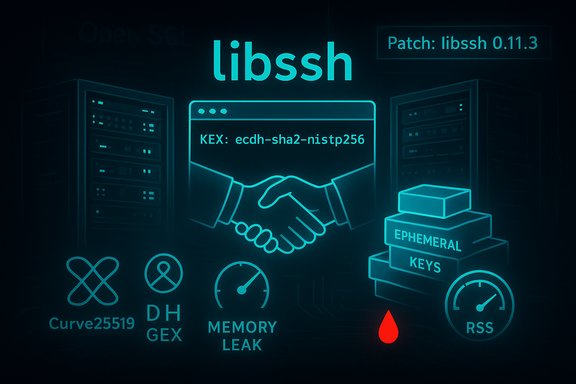
Public analyses show the leak can manifest across multiple KEX algorithms and crypto backends: Curve25519/ECDH families, DH‑GEX, and modern hybrid groups that libssh supports — and it has been observed to interact with different crypto backends such as libgcrypt and OpenSSL. That cross‑backend effect is because the leak occurs at the libssh session/state management level rather than in a single cipher implementation.Why this matters operationally
Leaks that arise during handshake/rekey processing are particularly problematic for long‑lived clients and embedded agents. A server or a malicious peer that can repeatedly force rekey attempts — or a misbehaving network appliance that provokes repeated KEX negotiations — can cause an otherwise healthy client to slowly consume more memory across many sessions or rekey cycles. While the defect does not appear to leak secret key material off‑host or enable remote code execution, availability of client processes and services that rely on libssh is the clear operational impact.Affected versions and patch status
- Upstream libssh developers and major distributions have cataloged the flaw and released fixes. Public advisories indicate that the problem is fixed in libssh 0.11.3 and later downstream package builds that incorporate that upstream change. Administrators should confirm the exact fixed package or build they deploy.
- Distribution trackers (Debian, Ubuntu, SUSE) have published package mappings showing which stable or security‑patched packages include the remediation; Debian, for example, lists fixed package versions for affected suites. Because many appliances and vendor products embed libssh statically, operators must also coordinate with vendors for firmware/agent updates.
- Mitigation timelines vary by vendor and distribution. Where package maintainers have rebuilt with the upstream fix, upgrades are available; where vendors ship static or embedded copies, firmware or vendor patches may be required. Treat the upstream 0.11.3 fix as canonical and map that to your package or firmware build numbers before declaring remediation complete.
Exploitability and realistic threat model
Attack vector and prerequisites
- Attack vector: Network — the vulnerability can be triggered remotely in typical client contexts because the memory allocation sequence occurs during the KEX exchange with a peer that can send or provoke repeated incorrect KEX guesses. The CVE is therefore reachable over the network in scenarios where an untrusted peer can interact with a libssh client.
- Privileges required: Low — no authentication or high privileges are necessary to cause repeated rekey sequences in many client‑server interactions; however, practical exploitation often depends on the ability to cause many KEX cycles in a short time (attack complexity is non‑trivial in some deployments).
- Attack complexity: Moderate — constructing repeated incorrect first‑KEX guesses or otherwise forcing rekey churn is straightforward for a protocol‑aware peer, but the attacker’s ability to cause many rekeys and measure success depends on network conditions and the victim’s KEX policy.
Magnitude of risk
- The published CVSS scores and vendor advisories place this as a low‑severity availability issue (CVSS ≈ 3.1), reflecting limited impact on confidentiality and integrity and moderate exploit complexity in many environments. That said, the operational risk is higher for devices or clients that run unattended for long periods (IoT nodes, edge agents, backups, remote management agents) because the leak can accumulate over time and eventually crash the process.
- Telemetry and exploit probability indicators (EPSS) reported by some trackers are low, suggesting broad, opportunistic exploitation is unlikely at publication; however, targeted attackers or operators of large fleets should not rely on low EPSS as safety — the leak is straightforward enough that weaponization could follow, especially in constrained environments. Flag these claims as time‑sensitive: absence of observed exploitation today is not a guarantee against future or targeted abuse.
Detection, monitoring, and forensic signals
Practical signals defenders can add to SIEMs and monitoring stacks:- Process memory growth correlated to libssh‑using client processes or agents — steady upward trends in RSS or heap size without corresponding workload increases. Alert on processes that cross expected memory thresholds.
- Repeated or unusually frequent rekey/KEX sequences in SSH session logs. Increase logging around KEX events (rekey start/finish) and create alerts for a high rate of KEX operations from a single peer or toward a single client.
- Elevated crash/restart counts or OOM events for services that embed libssh. Persistent restarts or OOM kill history tied to update intervals or KEX timing windows are high‑signal indicators.
- Network captures (PCAP): repeated ClientHello/KEX packets or malformed/guessing KEX patterns in traffic towards client endpoints can be a hunting indicator — capture and retain representative PCAPs when you suspect probing.
Mitigation & remediation: prioritized playbook
Apply controls in the order below; each step reduces exposure while you track vendor fixes and deploy patches.- Immediate (hours)
- Inventory all software that ships or links libssh (binaries, agents, SDKs, vendor appliances). Use SBOMs, package scanners, and binary string searches for libssh identifiers to locate instances. Prioritize long‑running clients (agents, embedded devices) and devices with remote management capabilities.
- If you control the software, update to the patched libssh release (upstream 0.11.3 or the vendor package that contains that upstream fix) and rebuild/redeploy clients and agents. Verify the binary reports the patched version on startup or via package metadata.
- Short‑term compensating controls (days)
- Apply network‑level rate limits and connection caps that reduce the ability of a remote peer to cause repeated KEX churn against a client. Rate‑limit handshake/rekey frequency at perimeter devices or service proxies where feasible.
- Where possible, isolate critical management/agent traffic to trusted networks (VPN, management VLANs) to prevent untrusted peers from interacting directly with libssh clients.
- Harden clients to limit resource use: run libssh‑using clients under resource controls (job objects, cgroups, Windows service‑level memory limits) so a single misbehaving peer cannot consume all host memory.
- Medium term (weeks)
- For third‑party appliances that embed libssh statically, open vendor support cases and demand timelines for firmware or package updates that include the fix. Maintain a tracking spreadsheet to ensure devices are scheduled for remediation.
- Add unit and integration tests for rekey sequences to CI pipelines so regressions are detected early if libssh or consumers are modified.
- Validation and post‑patch checks
- After patching, simulate high‑frequency rekey attempts in an isolated test environment to validate that memory does not grow unbounded and that clients remain stable.
- Re‑run detection queries and ensure alerts no longer trigger for the same KEX patterns you observed pre‑patch.
Practical recommendations for WindowsForum readers and operators
- Desktop tools and backup/agent clients that depend on libssh are common on Windows and mixed estates. For packaged Windows applications, confirm whether libssh is embedded or supplied by the OS distribution; statically linked copies shipped by vendors require vendor updates rather than OS updates. Track both package and vendor advisory channels.
- For Windows servers running agent workloads (backup clients, orchestration agents, remote management tools), prioritize updating the agent package and then enforce process memory constraints (Windows Job Objects, service limits) and EDR monitoring to detect anomalous memory growth.
- Where corporate build pipelines produce container images or Windows installers that bundle libssh, rebuild those artifacts with the fixed libssh and reissue signed installers/images to endpoint fleets. Source‑only changes are insufficient — binaries must be rebuilt to incorporate the fix.
- Add KEX/rekey monitoring to central log aggregation and create alerts for clients that perform or receive an unusually high rate of KEX negotiation attempts; this yields early warning of probing or misconfiguration.
Broader context and comparisons
CVE‑2025‑8277 is part of a recurring vulnerability class where protocol parsing or handshake complexity produces resource exhaustion. Similar handshaking and parsing‑related denial‑of‑service problems have affected TLS stacks and other libraries in recent months; defenders should treat these as a pattern rather than isolated incidents. The same class of defects has shown up in TLS keyshare parsing and PSK binder handling in other projects, underlining that handshake validation and strict freeing of ephemeral state are recurring engineering pain points. That pattern matters because the remediation story is often multi‑stage: upstream fixes are merged quickly, but downstream packaging, firmware, and appliance updates can lag, leaving a long tail of vulnerable devices that require vendor coordination. Inventory discipline and vendor follow‑up remain the decisive operational controls.Strengths, limitations, and remaining uncertainties
Strengths- The defect is well scoped: it is an availability/resource leak, not an RCE or key‑exfiltration bug, making the fix targeted and low‑risk to deploy in most codebases. Multiple vendors and upstream maintainers have published fixes and package mappings.
- The remediation approach (explicitly free prior ephemeral key state or avoid double‑allocating session->nextcrypto) is straightforward and backportable to stable release branches, enabling distributions and vendors to ship updates quickly.
- The operational impact of a memory leak can be outsized in long‑running clients or resource‑constrained devices; these contexts should be prioritized despite the CVSS low rating.
- Downstream appliance and firmware updates are the long pole: many embedded devices embed libssh, and until vendors ship patched firmware the exposure persists. Inventory and vendor coordination are therefore central to true remediation.
- Public telemetry shows low EPSS and few confirmed in‑the‑wild exploit reports at time of publication, but that is a snapshot. Any public claim about active exploitation should be treated cautiously and rechecked against threat‑intelligence feeds and vendor advisories when triaging high‑value assets.
Quick checklist (operational checklist you can act on now)
- Inventory: locate all libssh instances (binaries, agents, vendor appliances). Prioritize long‑running clients and embedded devices.
- Patch: upgrade to libssh builds that include the upstream 0.11.3 fix; rebuild and redeploy binaries and installers.
- Compensate: apply rate limits on KEX/handshake frequency and isolate management traffic to trusted networks.
- Harden: apply resource limits for critical clients/agents and enable monitoring for memory growth and repeated KEX events.
- Vendor follow‑up: track firmware/package updates for appliances that ship libssh statically — require vendor SLAs for remediation on internet‑facing devices.
Conclusion
CVE‑2025‑8277 is a concrete reminder that protocol‑level complexity (rekeying and ephemeral state management) produces real operational risk when memory allocation lifecycles are not managed defensively. The vulnerability’s technical fix is straightforward and available in upstream libssh 0.11.3, but the practical work for organisations is inventory, rebuild/redeploy, and remediation of embedded appliances. Prioritise client agents, long‑running services, and devices that are exposed to untrusted peers; apply rate limits and resource constraints while patching, and validate via testing that memory no longer grows under repeated KEX attempts. Monitor threat‑intelligence channels for changes to exploitation evidence and treat any claim of in‑the‑wild weaponization as time‑sensitive.Source: MSRC Security Update Guide - Microsoft Security Response Center
