

A silent boundary-check mistake in a widely used networking library has resurfaced a familiar security lesson: small parsing errors in C can still bite large ecosystems. In September 2025 the curl project disclosed CVE-2025-9086, an out-of-bounds read in cookie path handling inside libcurl that can cause crashes and — under very particular conditions — let an insecure HTTP endpoint override a cookie that was previously marked as secure. The flaw was fixed upstream in curl 8.16.0; however, because libcurl is embedded in countless products and distributions, the practical risk picture for administrators and Windows users requires careful, concrete mitigation and validation.
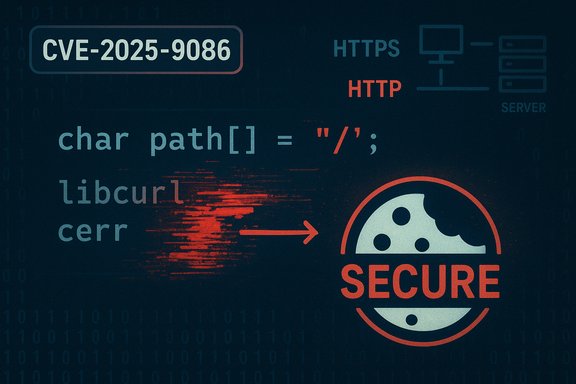
libcurl is the C library that powers the curl family of tools and is embedded into countless client applications, SDKs, and operating system packages. In August 2025 a researcher reported a logic bug in the cookie path comparison routine that was introduced in an earlier commit. The bug manifests when an HTTPS-hosted cookie that was set with the secure attribute is followed — through redirection or scheduling — by an HTTP connection to the same hostname that attempts to set the same cookie name with a path of “/”. A mistake in the path comparison reads beyond a heap buffer boundary, which can yield a crash (denial-of-service) or an incorrect comparison result that may allow the insecure site to override a secure cookie value.
The curl project published a security advisory and released curl 8.16.0 to remediate the issue. The advisory classifies the flaw as an out-of-bounds read (CWE-125) and notes the exploitability is constrained by a number of factors: the attacker must either control the non-secure HTTP host at the same name or be positioned as a network man-in-the-middle (MITM); the out-of-bounds read reads memory adjacent to a one-byte allocation (the cookie path), so an attacker has little deterministic control over what is read; and the operation is fragile and environmental. The security team observed no active exploitation at the time of disclosure.
Remediation: update the client to an upstream build that uses libcurl 8.16.0, or patch and recompile.
Remediation: update the agent vendor package; as interim, disable automatic HTTP redirects for update flows.
Remediation: patch the OS via vendor updates, but also inventory applications that carry their own libcurl.
Source: MSRC Security Update Guide - Microsoft Security Response Center
 Background
libcurl is the C library that powers the curl family of tools and is embedded into countless client applications, SDKs, and operating system packages. In August 2025 a researcher reported a logic bug in the cookie path comparison routine that was introduced in an earlier commit. The bug manifests when an HTTPS-hosted cookie that was set with the secure attribute is followed — through redirection or scheduling — by an HTTP connection to the same hostname that attempts to set the same cookie name with a path of “/”. A mistake in the path comparison reads beyond a heap buffer boundary, which can yield a crash (denial-of-service) or an incorrect comparison result that may allow the insecure site to override a secure cookie value.The curl project published a security advisory and released curl 8.16.0 to remediate the issue. The advisory classifies the flaw as an out-of-bounds read (CWE-125) and notes the exploitability is constrained by a number of factors: the attacker must either control the non-secure HTTP host at the same name or be positioned as a network man-in-the-middle (MITM); the out-of-bounds read reads memory adjacent to a one-byte allocation (the cookie path), so an attacker has little deterministic control over what is read; and the operation is fragile and environmental. The security team observed no active exploitation at the time of disclosure.
Technical overview
What exactly goes wrong?
At a high level, the bug is a logic error in path comparison that causes a read past the end of a heap buffer. The sequence required to trigger it:- A server sets a cookie over HTTPS and marks it Secure (so it should be sent only to HTTPS endpoints).
- The client (using libcurl) later follows a redirect or otherwise opens a connection to HTTP (same hostname).
- The HTTP response sets a cookie with the same name and a path of
"/". - During libcurl’s internal cookie path comparison, an off-by-one / mis-bound check leads the code to read memory past the path buffer.
- Cause a crash (segfault / abort) — leading to denial-of-service for the process that embeds libcurl; or
- Produce a false comparison result and accept the insecure cookie set by the HTTP endpoint, overwriting the prior secure cookie stored in memory.
Attack complexity and realistic impact
- Attacker control: An attacker needs the ability to serve or intercept the HTTP request to the same hostname. That means either control of
[url="http://example.com"]Example Domain[/url]for the same host and port, or MITM capability (e.g., on a compromised network or via DNS poisoning). - Reliability: The out-of-bounds read accesses heap memory immediately after a tiny allocation (the one-byte path buffer for
"/"). An attacker cannot reliably control that memory content making deterministic exploitation difficult. - Outcomes: The most straightforward outcome is a crash, which is trivial to trigger but limited to denial-of-service against the process. The more impactful outcome — silently overriding a secure cookie — is theoretically possible but depends on unpredictable heap contents and timing, so practical exploitation is fragile.
Affected versions and patch status
Upstream, distro, and platform scope
- Affected upstream libcurl versions: 7.31.0 through 8.15.0 (inclusive).
- Fixed in upstream: curl 8.16.0, with the fix applied to the official curl tree.
- The bug was introduced in a prior commit in the 7.x/8.x history and subsequently corrected by a specific patch in the maintenance branches; the upstream changelog and advisory identify both the introducing and fixing commits.
Practical implications for environments
- Systems that ship libcurl and consume HTTP(S) flows potentially are impacted. That includes many Linux distributions, container images, server-side agents, developer tools, and myriad applications that vendor libcurl.
- The curl command-line tool itself is not considered vulnerable in the same sense; the advisory notes the tool can be tricked into a behavior that would override a cookie but that this does not constitute a vulnerability for the stand-alone tool. The real risk is for embedded libcurl inside applications that manage cookies programmatically — servers, automation agents, language bindings, or third-party clients.
- For Windows users, the practical exposure depends on whether installed software bundles a vulnerable libcurl or invokes an OS-supplied
curl.exe/ libcurl binary built from the vulnerable upstream versions. Administrators should not assume the OS-supplied copy is patched — many vendors and distributions ship patched builds on their own schedule.
Why Windows users should care
Many Windows users assume this is a Linux problem. That assumption is risky.- Modern Windows releases include a version of
curl.exein system folders; even where the OS-supplied version is updated, many Windows applications ship their own bundled curl/libcurl builds (e.g., Git for Windows, package managers, SDKs, backup agents, and some vendor clients). - Third-party services and agent software running on Windows servers — especially those integrating HTTP clients or automated update handlers — frequently use libcurl under the hood.
- A vulnerable library embedded into a long-running service (agent, updater, synchronization client) can be abused to trigger crashes or to confuse cookie-based authentication flows, possibly enabling session tampering in constrained scenarios.
Detection and verification
How to discover whether you are impacted
- For command-line: Run
curl --versionin a shell. The output includes the curl version string and a list of supported protocols and features. If it reports a version between 7.31.0 and 8.15.0 inclusive, that copy is potentially affected. - For system packages and vendor bundles:
- Check installed packages in your package manager or application inventory tool.
- Search for libcurl.dll / curl.dll / libcurl.so files in application install folders and inspect their version information.
- For Windows binaries, check file properties on the DLL/executable or use tools that extract embedded version metadata.
- For developers and CI:
- Inspect build logs and link flags to see which libcurl revision is compiled into builds.
- For containers and images, inspect package versions or run the same
curl --versioninside the image. - For enterprise fleets:
- Use endpoint asset management, software inventory, or EDR queries to locate processes that load libcurl and report their file version metadata.
- Search software bill-of-materials (SBOM) outputs where available.
Practical commands and checks (Windows and cross-platform)
- Run:
curl --versionwhere curl(Windows) orwhich curl(Unix) to find the path(s) being used- Examine binary file properties (Windows Explorer -> Properties) for the LIBCURL or curl binary.
- For applications, search installation directories for
libcurl.*and extract version metadata with standard tools or a quick script that calls the binary with--version.
Remediation and mitigation
Immediate, effective steps
- Upgrade to curl 8.16.0 or later wherever libcurl is installed or bundled. This is the canonical remediation.
- Apply patches distributed by OS vendors. Many mainstream distributions and vendors backported fixes into their packaged libcurl builds; ensure your systems are updated with vendor-provided security updates.
- Rebuild any in-house applications that statically link libcurl with an updated libcurl version and redeploy.
- Replace or update third-party applications: check vendor advisories; apply vendor-provided updates where libcurl is bundled and ensure they include the fixed libcurl.
Short-term mitigations when an immediate upgrade is infeasible
- Avoid following redirects from HTTPS to HTTP when using custom curl-based logic. Configure clients to refuse insecure redirects or filter redirect targets.
- Disable cookie handling in high-risk contexts if your workflow permits: in libcurl, control cookie acceptance explicitly (e.g., do not load or persist cookies where not needed).
- Network-level controls: block or harden traffic that could be manipulated by an attacker using traditional MITM methods. Use network segmentation, enforce HTTPS-only policies for critical services, and restrict untrusted networks.
- Monitoring: increase logging and alerting on HTTP-to-HTTPS redirect sequences and on unexpected cookie changes for sensitive endpoints.
Long-term fixes and supply-chain hygiene
- Treat libraries like libcurl as first-class citizens in your patching program. Maintain a regular inventory and enforce patch windows for embedded third-party components.
- Require SBOMs for externally sourced binaries and vendors so you can quickly identify which releases incorporate a patched libcurl.
- For CI/CD pipelines, include dependency scanning against known CVEs and enforce policy gates that prevent shipping builds with vulnerable third-party libraries.
Practical scenarios and concrete examples
Scenario 1 — Desktop app with embedded libcurl
A productivity client embeds libcurl 8.14.0 for HTTP/HTTPS synchronization of user data. An attacker that can control a same-named HTTP endpoint could attempt the sequence that triggers the bug. The most likely outcome is a crash when the client syncs — interrupting service for the user. In fragile configurations it’s possible for the insecure cookie to supplant a secure cookie, which might enable session hijacking if the rest of the application trusts cookie precedence and doesn’t revalidate sessions.Remediation: update the client to an upstream build that uses libcurl 8.16.0, or patch and recompile.
Scenario 2 — Automation agent on a server
A long-running agent uses libcurl for automated updates and relays cookies across multiple backends. Remote attackers on the same network could perform a MITM and try to induce the faulty path comparison via redirected HTTP responses. A remote crash would be disruptive; silent cookie corruption could break auth logic or lead to unexpected behavior for downstream services.Remediation: update the agent vendor package; as interim, disable automatic HTTP redirects for update flows.
Scenario 3 — Windows included curl.exe
If the systemcurl.exe is old, a simple curl --version check will reveal it. For many end users the included system curl is updated through OS updates; for enterprise-managed desktops confirm via management tooling whether the OS-distributed copy is current. Even if the system copy is patched, vendor-supplied apps that bundle their own libcurl may still be vulnerable.Remediation: patch the OS via vendor updates, but also inventory applications that carry their own libcurl.
Detection, threat hunting and post-patch validation
- Hunt for processes that crash with stack traces involving libcurl cookie handling or path comparison routines. Crash logs that point into
libcurlcookie routines are a high-fidelity indicator. - Monitor network telemetry for unusual HTTPS-to-HTTP redirect patterns for hosts that should remain HTTPS-only.
- After patching, validate by running
curl --versionand ensuring the version is 8.16.0 or later, or by confirming vendor package updates were applied and binary checksums or version metadata changed. - Validate that services that were upgraded were restarted and that old DLLs are no longer loaded into memory.
Risk analysis and enterprise priorities
- The vulnerability is an illustrative case of fragile memory-safety in C code: a small mis-check can produce either a denial-of-service or subtle integrity issues.
- In pure risk terms, this CVE sits in a middle ground: it is easy to trigger denial-of-service but hard to weaponize reliably for confidentiality or integrity compromise across arbitrary environments.
- Prioritization guidance for enterprises:
- High priority: servers, agents, and services that run unattended and use libcurl for authentication workflows — these should be patched quickly.
- Medium priority: developer tools and desktop apps — patch according to normal update windows, but validate if they are part of critical workflows.
- Lower priority: ephemeral command-line users who run stand-alone
curlinteractively — still verifycurl --versionand update if necessary.
Broader lessons
- This CVE underlines enduring lessons that remain true in 2025: libraries embedded across ecosystems become a high-value attack surface; memory-safety issues in low-level C code continue to surface even in well-audited projects; and CVSS-style scores and vendor severity labels can diverge based on different risk models.
- Defensive engineering solutions — moving to memory-safe languages in critical parsing code, applying formal verification for tricky comparison logic, or at least adopting rigorous fuzzing and regression tests around cookie and header parsing — reduce the chance of similar regressions.
- Supply-chain visibility (SBOMs), automated dependency checking in CI, and patch telemetry are non-negotiable controls for modern operations.
Unverifiable or uncertain points (cautions)
- Public reporting at the time of disclosure indicated no known active exploitation. That status can change; organizations should not treat “no known exploit” as permanent assurance.
- Exact distributions and vendor timelines for patched packages vary; while upstream curl 8.16.0 contains the fix, when a given Linux distribution, Windows vendor, or third-party application receives and ships that fix is specific to each vendor. Validate with your vendor’s security advisories.
- Theoretical memory-overwrite paths are fragile by design; concrete, reliable remote exploitation that achieves silent cookie override across diverse heaps has not been demonstrated publicly. Treat such claims cautiously until reproducible exploit proof is published.
Checklist: what to do now
- Inventory:
- Find all copies of libcurl and curl on endpoints and servers.
- Identify applications that bundle their own libcurl.
- Verify:
- Run
curl --versionand binary version checks for embedded DLLs. - Patch:
- Apply vendor-supplied updates or upgrade to libcurl 8.16.0 or later.
- Rebuild and redeploy in-house applications that statically link libcurl.
- Mitigate:
- Disable insecure redirects in sensitive flows.
- Temporarily disable cookie persistence where acceptable.
- Monitor:
- Watch for process crashes referencing libcurl.
- Alert on unexpected HTTP-to-HTTPS redirect patterns.
- Validate:
- Confirm updated binaries in use at runtime; restart services if needed.
Conclusion
CVE-2025-9086 is a compact but meaningful reminder: parsing and comparison logic in ubiquitous networking libraries must be built and reviewed with extreme care. The fix is straightforward upstream and available in curl 8.16.0, but the real operational effort lies in locating every copy of libcurl across your estate — including bundled third-party binaries — and ensuring they receive an update. For Windows environments the salient steps are the same as for other platforms: inventory, verify, update, and validate. Where immediate updates aren’t possible, apply the conservative mitigations outlined above and monitor aggressively for crashes or unexpected cookie behavior. Small mistakes in C can have outsized effects; the best defense is disciplined supply-chain hygiene and fast, methodical patching.Source: MSRC Security Update Guide - Microsoft Security Response Center
