

CISA republished Hitachi Energy’s PROMOD V advisory on July 7, 2026, warning that versions 1.0.10 and earlier transmit some communications over HTTP rather than HTTPS, exposing energy-sector users worldwide to interception or manipulation of sensitive data in transit. The flaw, tracked as CVE-2026-10763, is not a cinematic zero-day so much as a reminder that industrial software security often fails at the seam between modern expectations and inherited components. Hitachi Energy’s fix is straightforward on paper: upgrade to PROMOD V 1.0.11 and enable HTTPS on the Digipede server. The harder part is operational, because in energy environments even a “simple” protocol fix has to pass through change windows, validation, segmentation rules, and the uncomfortable question of what may already have crossed the wire in clear text.
The core problem in the Hitachi Energy advisory is almost painfully familiar: PROMOD V relied on HTTP instead of HTTPS because of a third-party Digipede server component that lacked HTTPS support. In consumer software, that would be treated as an embarrassing regression. In industrial and energy planning environments, it becomes a risk-management event.
CISA’s republication frames the vulnerability as a high-severity issue, with CVSS 3.1 scoring of 7.1 and CVSS 4.0 scoring of 7.0. Those numbers matter less than the shape of the attack. The advisory describes a network-accessible, low-complexity weakness with no privileges required, but with user interaction required, and with confidentiality rated as highly impacted.
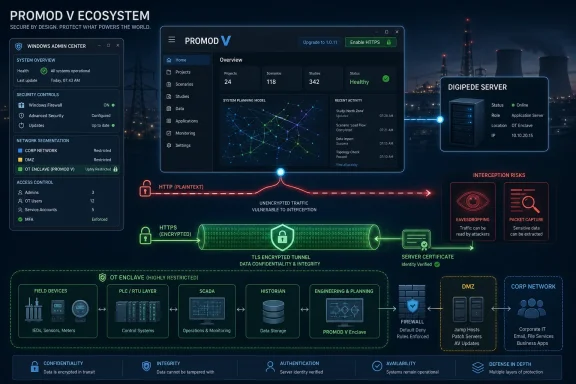
That is the sort of vulnerability that can be misunderstood if it is reduced to “not encrypted.” HTTP does not merely expose a password in some abstract textbook sense. It removes the cryptographic guarantee that the server is who it claims to be, that the client is speaking privately, and that the payload arriving at the other end is the payload that was sent.
For Windows admins and OT teams, the lesson is not that every plaintext flow is equally catastrophic. It is that unencrypted application traffic inside supposedly trusted networks is now a standing invitation to credential theft, session hijacking, traffic manipulation, and quiet reconnaissance. The modern enterprise perimeter has dissolved; many industrial networks still behave as if it merely moved inward.
That context changes the risk conversation. A flaw in planning software may not immediately trip a breaker or open a valve, but it can expose sensitive modeling data, authentication material, or job information used by analysts and engineers. In critical infrastructure, the distinction between “business data” and “operational data” has grown thinner as planning, market operations, engineering, and OT-adjacent platforms increasingly share networks, identities, and remote access paths.
The advisory does not allege active exploitation, and it does not claim that attackers can directly execute code or compromise a grid control system through this bug. That restraint is important. Some vulnerability databases have characterized the issue more aggressively, but the vendor and CISA description centers on insecure communication over HTTP, not a confirmed remote-code-execution pathway.
The real-world threat is therefore more prosaic and, in some ways, more believable. An attacker with a position on the relevant network path could observe traffic, collect sensitive material, or tamper with communications. That is not a Hollywood grid-collapse scenario. It is the kind of foothold and visibility that turns a minor network compromise into a larger intrusion campaign.
Software supply-chain risk is usually discussed in terms of malicious packages, poisoned updates, or vulnerable open-source libraries. This advisory is a quieter variation on the same theme. A product can be weakened not because a dependency is malicious, but because it cannot meet a baseline security expectation that the rest of the system now assumes.
For customers, the practical question is not whether Digipede or Hitachi Energy is more at fault. The question is whether the deployed system actually uses HTTPS after the update, and whether the organization can prove that through configuration review and network observation. “Upgrade available” is not the same as “risk removed.”
That distinction matters in industrial environments because updates often happen under pressure. Teams may install PROMOD V 1.0.11 but leave a server option unchanged, defer a certificate step, or preserve an old configuration for compatibility. The advisory’s remediation is explicit: upgrade and enable HTTPS on the Digipede server. Both halves matter.
That makes it easy to under-prioritize. Patch queues are crowded with actively exploited browser bugs, privilege-escalation flaws, VPN vulnerabilities, and remote-code-execution defects with public exploit code. A plaintext protocol issue in a specialized energy-planning product may not compete well on a dashboard unless asset owners understand where PROMOD V sits and who can reach it.
The CVSS vector also includes user interaction. That can lull teams into thinking exploitation requires a highly contrived scenario. In practice, user interaction in enterprise software often means normal use: an analyst launching a job, connecting to a service, or interacting with a workflow that causes the vulnerable communication to occur.
The most important part of the score is not the decimal. It is the network attack vector combined with low complexity and no required privileges. If an attacker is already positioned somewhere useful on the network path, HTTP gives them something to work with.
The initial public release was June 30, 2026, with CISA’s republication following on July 7, 2026. The CVE was reserved on June 3, according to public vulnerability records. That chronology suggests a conventional coordinated-disclosure process rather than a scramble around observed exploitation.
CISA’s recommended practices are the familiar ICS canon: minimize network exposure, keep control-system devices off the public internet, place systems behind firewalls, isolate control networks from business networks, use secure remote access methods, and perform impact analysis before deploying defensive measures. These recommendations can read like boilerplate because they appear in advisory after advisory. They keep appearing because asset inventories and network diagrams keep proving that the basics are still unevenly implemented.
There is also an important legal and operational subtext in CISA’s republication. The agency is amplifying the vendor’s notice to reach a wider critical-infrastructure audience. It is not certifying that every technical nuance has been independently tested, and it is not endorsing the product. For defenders, that means the vendor advisory and product documentation remain the authoritative path for remediation details.
HTTPS is not a single checkbox in the operational sense. Teams need server certificates, trust chains, hostname alignment, certificate renewal processes, and a rollback plan if legacy clients fail. If Digipede is deployed on Windows infrastructure, administrators may also need to consider service accounts, firewall rules, endpoint inspection, and whether existing monitoring tools recognize the encrypted flow.
The real risk is a partial deployment. A team may update PROMOD V but leave old HTTP endpoints alive for troubleshooting. A server may support HTTPS but allow HTTP fallback. A firewall rule may still permit plaintext traffic because nobody wants to break a production planning workflow during a busy operating period.
That is why verification should be treated as part of the fix. After upgrading, administrators should capture or inspect traffic at the relevant segment and confirm that PROMOD V communication to the Digipede server is encrypted. They should also look for lingering TCP/80 sessions, unexpected redirects, and clients still configured to use old endpoints.
CISA’s mitigation language emphasizes minimizing network exposure and isolating control-system networks from business networks. For energy companies, that is not merely generic advice. PROMOD V may sit in an analytical or planning environment rather than a real-time control zone, but those environments often have bridges to enterprise identity systems, file shares, remote access tools, and data sources that make lateral movement possible.
A sensible architecture treats the PROMOD V clients and Digipede server as a defined application enclave. Only approved clients should reach the server. Administrative access should be separately controlled. Remote access should pass through hardened, monitored paths rather than ad hoc VPN sprawl or jump-box shortcuts.
This is where Windows administrators have a central role. Many industrial software stacks still land on Windows servers and workstations, even when the business owner thinks of them as “engineering systems” rather than IT assets. Group Policy, Defender for Endpoint, certificate services, Windows Firewall, event forwarding, and privileged-access controls are not peripheral to OT security. They are often the practical tools that make the mitigation real.
Organizations should review where PROMOD V clients and Digipede servers live, which switches, routers, proxies, security tools, and remote-access appliances could observe the traffic, and whether packet capture or logging systems retained any sensitive content. In some environments, security monitoring tools may have captured payloads precisely because the traffic was unencrypted. That creates a secondary data-handling issue.
Credential hygiene is also relevant. If application credentials, session tokens, or reusable authentication material may have crossed the wire in plaintext, password rotation and token invalidation should be considered. The advisory language points to credential theft and session hijacking as plausible consequences, which is enough to justify a targeted review even absent public exploit reports.
The integrity side is harder to assess. If an attacker could manipulate traffic, teams may need to consider whether jobs, configurations, or outputs were altered. That does not require panic. It does require asking whether there are logs, checksums, approvals, or independent records that would reveal suspicious changes.
But the hard parts remain stubbornly human. Asset owners still have to know whether they run PROMOD V, which version is installed, where Digipede sits, whether the HTTPS setting has been enabled, and whether the affected traffic path crosses untrusted or shared network segments. A well-structured advisory cannot answer those questions from outside the environment.
This is particularly true in energy organizations with mergers, regional operating companies, contractor-managed systems, and long-lived engineering workstations. The official asset inventory may say one thing; the real estate of installed software may say another. A single affected application can be missed if it is owned by a planning group rather than centralized IT.
The better use of the advisory is as a trigger for a narrow hunt. Search software inventories for PROMOD V. Query endpoint management systems. Ask engineering and market-planning teams directly. Check network telemetry for Digipede-related traffic. Then validate the version and configuration rather than assuming the presence or absence of risk from procurement records.
The Digipede server detail makes certificate posture especially important. If the fix requires enabling HTTPS, then the Windows-side certificate lifecycle becomes part of the security boundary. Expired certificates, self-signed shortcuts, hostname mismatches, and trust exceptions can all undermine the intended protection.
Admins should also consider monitoring. A post-remediation environment should not silently permit PROMOD V clients to keep using HTTP. Windows Defender Firewall logs, network detection tools, proxy logs, and switch telemetry can help confirm whether plaintext communication has stopped. The goal is not to generate a compliance screenshot; it is to prove that the vulnerable behavior no longer occurs.
There is a broader policy lesson here as well. Internal HTTP should no longer be accepted merely because a system is “inside.” Exceptions may exist for legacy constraints, but they should be documented, segmented, monitored, and time-limited. Otherwise the exception becomes the architecture.
That ordinariness is the point. Critical infrastructure security is often discussed as if it were a world apart from mainstream enterprise IT, but its weaknesses increasingly rhyme with everyone else’s: dependency risk, stale components, insecure defaults, partial encryption, remote access exposure, and patch-management friction. The consequences differ, but the failure modes are familiar.
This should make defenders both more confident and more cautious. More confident because the mitigation playbook is not mysterious. More cautious because familiar problems can be underestimated when they appear inside specialized products with niche user bases.
Hitachi Energy deserves credit for publishing a clear remediation path, and CISA’s republication helps push the advisory beyond the vendor’s normal customer channels. But visibility is not remediation. The difference will be made by customers who verify versions, enable HTTPS, restrict network paths, and review whether sensitive information may already have been exposed.
 Plaintext Is Still a Security Boundary in 2026
The core problem in the Hitachi Energy advisory is almost painfully familiar: PROMOD V relied on HTTP instead of HTTPS because of a third-party Digipede server component that lacked HTTPS support. In consumer software, that would be treated as an embarrassing regression. In industrial and energy planning environments, it becomes a risk-management event.CISA’s republication frames the vulnerability as a high-severity issue, with CVSS 3.1 scoring of 7.1 and CVSS 4.0 scoring of 7.0. Those numbers matter less than the shape of the attack. The advisory describes a network-accessible, low-complexity weakness with no privileges required, but with user interaction required, and with confidentiality rated as highly impacted.
That is the sort of vulnerability that can be misunderstood if it is reduced to “not encrypted.” HTTP does not merely expose a password in some abstract textbook sense. It removes the cryptographic guarantee that the server is who it claims to be, that the client is speaking privately, and that the payload arriving at the other end is the payload that was sent.
For Windows admins and OT teams, the lesson is not that every plaintext flow is equally catastrophic. It is that unencrypted application traffic inside supposedly trusted networks is now a standing invitation to credential theft, session hijacking, traffic manipulation, and quiet reconnaissance. The modern enterprise perimeter has dissolved; many industrial networks still behave as if it merely moved inward.
PROMOD V Sits Where Planning Meets Operational Consequence
PROMOD is not a home router dashboard or a forgotten web app bolted to a printer. Hitachi Energy positions PROMOD as software used in power-market and system planning, the sort of analytical environment where energy models, assumptions, jobs, and workflows can carry operational and commercial value. CISA lists the affected critical infrastructure sector as Energy, with deployments worldwide and Hitachi Energy headquartered in Switzerland.That context changes the risk conversation. A flaw in planning software may not immediately trip a breaker or open a valve, but it can expose sensitive modeling data, authentication material, or job information used by analysts and engineers. In critical infrastructure, the distinction between “business data” and “operational data” has grown thinner as planning, market operations, engineering, and OT-adjacent platforms increasingly share networks, identities, and remote access paths.
The advisory does not allege active exploitation, and it does not claim that attackers can directly execute code or compromise a grid control system through this bug. That restraint is important. Some vulnerability databases have characterized the issue more aggressively, but the vendor and CISA description centers on insecure communication over HTTP, not a confirmed remote-code-execution pathway.
The real-world threat is therefore more prosaic and, in some ways, more believable. An attacker with a position on the relevant network path could observe traffic, collect sensitive material, or tamper with communications. That is not a Hollywood grid-collapse scenario. It is the kind of foothold and visibility that turns a minor network compromise into a larger intrusion campaign.
The Third-Party Component Is Not an Excuse
Hitachi Energy attributes the weakness to lack of HTTPS support from the third-party Digipede server. That detail is useful because it gives administrators somewhere specific to look. It is also uncomfortable because it shows how quickly a vendor’s security posture becomes dependent on a smaller component buried inside a larger platform.Software supply-chain risk is usually discussed in terms of malicious packages, poisoned updates, or vulnerable open-source libraries. This advisory is a quieter variation on the same theme. A product can be weakened not because a dependency is malicious, but because it cannot meet a baseline security expectation that the rest of the system now assumes.
For customers, the practical question is not whether Digipede or Hitachi Energy is more at fault. The question is whether the deployed system actually uses HTTPS after the update, and whether the organization can prove that through configuration review and network observation. “Upgrade available” is not the same as “risk removed.”
That distinction matters in industrial environments because updates often happen under pressure. Teams may install PROMOD V 1.0.11 but leave a server option unchanged, defer a certificate step, or preserve an old configuration for compatibility. The advisory’s remediation is explicit: upgrade and enable HTTPS on the Digipede server. Both halves matter.
CVSS Gets the Severity Right, but Not the Story
A 7.1 CVSS 3.1 score lands this issue in the high-severity bucket, which is appropriate. Confidentiality is the headline impact, integrity is lower but present, and availability is not scored as affected. This is not a vulnerability that shouts through an outage; it whispers through traffic captures.That makes it easy to under-prioritize. Patch queues are crowded with actively exploited browser bugs, privilege-escalation flaws, VPN vulnerabilities, and remote-code-execution defects with public exploit code. A plaintext protocol issue in a specialized energy-planning product may not compete well on a dashboard unless asset owners understand where PROMOD V sits and who can reach it.
The CVSS vector also includes user interaction. That can lull teams into thinking exploitation requires a highly contrived scenario. In practice, user interaction in enterprise software often means normal use: an analyst launching a job, connecting to a service, or interacting with a workflow that causes the vulnerable communication to occur.
The most important part of the score is not the decimal. It is the network attack vector combined with low complexity and no required privileges. If an attacker is already positioned somewhere useful on the network path, HTTP gives them something to work with.
CISA’s Republication Is a Visibility Mechanism, Not a New Discovery
CISA makes clear that this advisory is a republication of Hitachi Energy PSIRT advisory 8DBD000250 through the Common Security Advisory Framework pipeline. The agency’s note says the conversion is provided as-is for visibility, not as an independent editorial or technical rewrite. That distinction is worth preserving because it tells defenders where the authority begins and ends.The initial public release was June 30, 2026, with CISA’s republication following on July 7, 2026. The CVE was reserved on June 3, according to public vulnerability records. That chronology suggests a conventional coordinated-disclosure process rather than a scramble around observed exploitation.
CISA’s recommended practices are the familiar ICS canon: minimize network exposure, keep control-system devices off the public internet, place systems behind firewalls, isolate control networks from business networks, use secure remote access methods, and perform impact analysis before deploying defensive measures. These recommendations can read like boilerplate because they appear in advisory after advisory. They keep appearing because asset inventories and network diagrams keep proving that the basics are still unevenly implemented.
There is also an important legal and operational subtext in CISA’s republication. The agency is amplifying the vendor’s notice to reach a wider critical-infrastructure audience. It is not certifying that every technical nuance has been independently tested, and it is not endorsing the product. For defenders, that means the vendor advisory and product documentation remain the authoritative path for remediation details.
The Fix Is Simple Until Certificates Enter the Room
Hitachi Energy’s remediation points users to PROMOD V version 1.0.11 and instructs them to enable HTTPS on the Digipede server, with configuration guidance in the PROMOD V user guide and online help. That sounds modest compared with firmware replacement or emergency compensating controls. Anyone who has managed certificates in a mixed Windows and industrial environment knows it may not be.HTTPS is not a single checkbox in the operational sense. Teams need server certificates, trust chains, hostname alignment, certificate renewal processes, and a rollback plan if legacy clients fail. If Digipede is deployed on Windows infrastructure, administrators may also need to consider service accounts, firewall rules, endpoint inspection, and whether existing monitoring tools recognize the encrypted flow.
The real risk is a partial deployment. A team may update PROMOD V but leave old HTTP endpoints alive for troubleshooting. A server may support HTTPS but allow HTTP fallback. A firewall rule may still permit plaintext traffic because nobody wants to break a production planning workflow during a busy operating period.
That is why verification should be treated as part of the fix. After upgrading, administrators should capture or inspect traffic at the relevant segment and confirm that PROMOD V communication to the Digipede server is encrypted. They should also look for lingering TCP/80 sessions, unexpected redirects, and clients still configured to use old endpoints.
Segmentation Still Matters After Encryption
The right response to CVE-2026-10763 is not to say, “Once HTTPS is enabled, we’re done.” Encryption protects confidentiality and integrity in transit, but it does not turn a poorly segmented network into a resilient one. It narrows the attack surface; it does not erase it.CISA’s mitigation language emphasizes minimizing network exposure and isolating control-system networks from business networks. For energy companies, that is not merely generic advice. PROMOD V may sit in an analytical or planning environment rather than a real-time control zone, but those environments often have bridges to enterprise identity systems, file shares, remote access tools, and data sources that make lateral movement possible.
A sensible architecture treats the PROMOD V clients and Digipede server as a defined application enclave. Only approved clients should reach the server. Administrative access should be separately controlled. Remote access should pass through hardened, monitored paths rather than ad hoc VPN sprawl or jump-box shortcuts.
This is where Windows administrators have a central role. Many industrial software stacks still land on Windows servers and workstations, even when the business owner thinks of them as “engineering systems” rather than IT assets. Group Policy, Defender for Endpoint, certificate services, Windows Firewall, event forwarding, and privileged-access controls are not peripheral to OT security. They are often the practical tools that make the mitigation real.
The Quiet Risk Is What Was Already Exposed
Patching closes the obvious future path, but HTTP vulnerabilities leave behind a retrospective problem. If sensitive PROMOD V traffic has been traversing a network in clear text, defenders should ask who could have seen it. That does not mean assuming compromise. It means treating the network path as evidence.Organizations should review where PROMOD V clients and Digipede servers live, which switches, routers, proxies, security tools, and remote-access appliances could observe the traffic, and whether packet capture or logging systems retained any sensitive content. In some environments, security monitoring tools may have captured payloads precisely because the traffic was unencrypted. That creates a secondary data-handling issue.
Credential hygiene is also relevant. If application credentials, session tokens, or reusable authentication material may have crossed the wire in plaintext, password rotation and token invalidation should be considered. The advisory language points to credential theft and session hijacking as plausible consequences, which is enough to justify a targeted review even absent public exploit reports.
The integrity side is harder to assess. If an attacker could manipulate traffic, teams may need to consider whether jobs, configurations, or outputs were altered. That does not require panic. It does require asking whether there are logs, checksums, approvals, or independent records that would reveal suspicious changes.
Vendor Advisories Are Becoming Machine-Readable, but Not Self-Executing
This case also shows the promise and limitation of CSAF-based advisory distribution. Machine-readable advisories make it easier for CISA and other channels to republish vendor notices, and they help vulnerability-management platforms ingest product names, versions, CVEs, and remediation text. That is progress.But the hard parts remain stubbornly human. Asset owners still have to know whether they run PROMOD V, which version is installed, where Digipede sits, whether the HTTPS setting has been enabled, and whether the affected traffic path crosses untrusted or shared network segments. A well-structured advisory cannot answer those questions from outside the environment.
This is particularly true in energy organizations with mergers, regional operating companies, contractor-managed systems, and long-lived engineering workstations. The official asset inventory may say one thing; the real estate of installed software may say another. A single affected application can be missed if it is owned by a planning group rather than centralized IT.
The better use of the advisory is as a trigger for a narrow hunt. Search software inventories for PROMOD V. Query endpoint management systems. Ask engineering and market-planning teams directly. Check network telemetry for Digipede-related traffic. Then validate the version and configuration rather than assuming the presence or absence of risk from procurement records.
Windows Shops Should Treat This as an Application Trust Problem
For WindowsForum readers, the temptation is to file this under “industrial control systems” and move on. That would be a mistake. Many OT and energy-planning vulnerabilities are remediated not with exotic field gear, but with the same Windows administration disciplines used everywhere else: patch deployment, certificate management, firewall policy, endpoint hardening, and identity controls.The Digipede server detail makes certificate posture especially important. If the fix requires enabling HTTPS, then the Windows-side certificate lifecycle becomes part of the security boundary. Expired certificates, self-signed shortcuts, hostname mismatches, and trust exceptions can all undermine the intended protection.
Admins should also consider monitoring. A post-remediation environment should not silently permit PROMOD V clients to keep using HTTP. Windows Defender Firewall logs, network detection tools, proxy logs, and switch telemetry can help confirm whether plaintext communication has stopped. The goal is not to generate a compliance screenshot; it is to prove that the vulnerable behavior no longer occurs.
There is a broader policy lesson here as well. Internal HTTP should no longer be accepted merely because a system is “inside.” Exceptions may exist for legacy constraints, but they should be documented, segmented, monitored, and time-limited. Otherwise the exception becomes the architecture.
The Energy Sector’s Software Risk Is Increasingly Ordinary
The most striking thing about CVE-2026-10763 is how ordinary it is. No custom malware. No nation-state tradecraft. No obscure memory corruption. Just an application using HTTP where HTTPS is expected.That ordinariness is the point. Critical infrastructure security is often discussed as if it were a world apart from mainstream enterprise IT, but its weaknesses increasingly rhyme with everyone else’s: dependency risk, stale components, insecure defaults, partial encryption, remote access exposure, and patch-management friction. The consequences differ, but the failure modes are familiar.
This should make defenders both more confident and more cautious. More confident because the mitigation playbook is not mysterious. More cautious because familiar problems can be underestimated when they appear inside specialized products with niche user bases.
Hitachi Energy deserves credit for publishing a clear remediation path, and CISA’s republication helps push the advisory beyond the vendor’s normal customer channels. But visibility is not remediation. The difference will be made by customers who verify versions, enable HTTPS, restrict network paths, and review whether sensitive information may already have been exposed.
The PROMOD V Patch Is Really a Test of Operational Discipline
The concrete next steps are not complicated, which is precisely why organizations should move quickly and document what they find. The teams most likely to handle this well are the ones that treat the advisory as a configuration and architecture issue, not merely a patch ticket.- Organizations running PROMOD V versions 1.0.10 or earlier should upgrade to PROMOD V 1.0.11 and enable HTTPS on the Digipede server as directed by Hitachi Energy.
- Administrators should verify after the change that PROMOD V clients are no longer communicating with Digipede services over plaintext HTTP.
- Security teams should review whether credentials, session data, job metadata, or planning information may have traversed monitored or shared network paths in clear text.
- Network owners should restrict access to the Digipede server so only approved PROMOD V clients and administrators can reach it.
- Asset managers should confirm whether PROMOD V exists outside central IT visibility, especially on engineering, planning, or contractor-managed systems.
- Change boards should treat certificate lifecycle, renewal, hostname validation, and HTTP fallback behavior as part of the remediation, not as cleanup work.
References
- Primary source: CISA
Published: 2026-07-07T12:00:00+00:00
Loading…
www.cisa.gov - Related coverage: hitachi.com
hitachi-sec-2026-122: Multiple Vulnerabilities in Hitachi Command Suite, Hitachi Automation Director, Hitachi Configuration Manager, Hitachi Infrastructure Analytics Advisor and Hitachi Ops Center
Multiple vulnerabilities have been found in Hitachi Command Suite, Hitachi Automation Director, Hitachi Configuration Manager, Hitachi Infrastructure Analytics Advisor and Hitachi Ops Center.www.hitachi.com - Related coverage: hitachi.co.jp
Loading…
www.hitachi.co.jp - Related coverage: cve.org
Loading…
www.cve.org - Related coverage: cyber.gc.ca
Loading…
www.cyber.gc.ca