

Google published CVE-2026-11188 on June 4, 2026, describing a medium-severity use-after-free flaw in Chrome’s USB component on Android before version 149.0.7827.53 that could let a remote attacker attempt a sandbox escape through a crafted HTML page. The interesting part is not that Chrome has another memory-safety bug; Chrome always has another memory-safety bug. The interesting part is how this one exposes the gap between vendor language, NVD enrichment, mobile browser inventory, and the CPE machinery many vulnerability programs still treat as gospel. If your scanner is waiting for a perfectly shaped CPE record before it takes Chrome-on-Android seriously, the vulnerability is already telling you where your process is brittle.
CVE-2026-11188 is formally described as a use after free in USB in Google Chrome on Android before 149.0.7827.53. In plain English, that means Chrome may have mishandled memory tied to USB-related browser functionality after the program should no longer have been using that memory. The stated attack path is remote: a crafted HTML page, with user interaction required, could potentially lead to a sandbox escape.
That last phrase is doing a lot of work. A sandbox escape is not the same thing as arbitrary full-device compromise, and the public description does not claim a complete exploit chain. But in browser security, the sandbox is one of the major walls between a malicious web page and the rest of the system, so even a “medium” issue deserves more attention than the label might suggest.
Google’s own Chrome release note classifies the issue as medium severity and says it was reported by Google on April 15, 2026. The broader Chrome 149 stable release for desktop was announced on June 2, with 429 security fixes, and the CVE record landed shortly afterward. That chronology matters because it tells administrators this is part of a large Chrome security train, not an isolated boutique bug with a bespoke advisory.
The mismatch in framing is immediate. Chromium says medium. CISA’s ADP enrichment assigns a CVSS 3.1 score of 8.8, which lands in high territory. NVD, at the time reflected in the record, had not supplied its own CVSS vector. For security teams that still turn one score into one queue position, CVE-2026-11188 is exactly the sort of entry that creates argument in the patch meeting.
So, are we missing a CPE? Possibly, but not necessarily in the way the prompt implies. The record’s visible configuration appears to model Chrome as the application and Android as the platform. If a vulnerability scanner expects a standalone Chrome-for-Android CPE and does not understand the logical relationship between the application and operating-system CPEs, it may either over-report against non-Android Chrome assets or under-report against Android devices.
That is the old CPE problem in miniature. CPE was built to name products, but modern products are not cleanly bounded. Chrome is a browser, a mobile app, an embedded WebView-adjacent ecosystem participant, an enterprise-managed desktop application, and a dependency surface for countless workflows. A single CPE string is often less like a fingerprint and more like a mailing address: useful, but not sufficient proof that the right person opened the door.
In this case, the Android platform CPE should not be read as “Android itself is vulnerable.” The public description names Google Chrome on Android, not the Android OS. That distinction matters for remediation ownership, because the patch path is Chrome update hygiene, not waiting for an Android monthly security bulletin unless a downstream vendor has bundled Chrome in some unusual way.
CVE-2026-11188 illustrates why. The vendor says the issue is medium. CISA-ADP’s vector gives it network attack vector, low complexity, no privileges required, user interaction required, unchanged scope, and high confidentiality, integrity, and availability impact. That produces an 8.8 high score under CVSS 3.1, even though the Chromium label is lower.
Neither view is inherently absurd. Chromium severity reflects internal browser-security context, exploitability assumptions, sandboxing layers, and perhaps the narrowness of the affected component. CVSS is more mechanical: if a crafted page can plausibly get past a sandbox boundary and affect the triad at a high level, the math moves fast. The discrepancy is not a clerical failure; it is a reminder that severity systems answer different questions.
For administrators, the better question is not “Which score is right?” It is “What decision does this score support?” If the decision is whether to push Chrome 149.0.7827.53 or later to Android fleets, the answer is straightforward. If the decision is whether to interrupt production operations, notify executives, or hunt for exploitation, the public record does not currently justify the same urgency as an actively exploited zero-day.
Chrome’s release ecosystem is sprawling. Desktop stable releases, Android releases, Extended Stable, ChromeOS, WebView, and downstream Chromium packages do not always surface in a way that maps neatly to enterprise asset categories. A CVE can be listed in a desktop release note while its NVD description later narrows the product impact to Android. That is awkward for humans and worse for automation.
The practical risk is not that a sysadmin will read the wrong blog post. The practical risk is that a vulnerability-management platform imports the reference, sees a desktop advisory, matches desktop Chrome CPEs, and buries the mobile relevance where the mobile device management team never sees it. Conversely, a platform may flag Linux Chromium packages even when the upstream CVE text is Android-specific, because package ecosystems ingest CVEs aggressively and then sort out applicability later.
This is why mature shops increasingly treat browser vulnerabilities as product-family events first and platform-specific findings second. Chrome is not just “installed software.” It is an attack surface that ships frequently, autoupdates unevenly, and appears in places the central IT inventory may not fully see. CVE-2026-11188 is a small example of a large inventory problem.
That expansion is not inherently bad. WebUSB and adjacent device-access features exist because real users and real businesses want browser-based workflows to interact with hardware. Developers want configuration utilities without native installers. Enterprises want web apps that can talk to scanners, badges, lab equipment, point-of-sale devices, and field hardware.
But every new bridge becomes a place where the browser’s trust model has to be precise. A memory-safety flaw in a device-facing component is not just another crash bug; it is a bug in the machinery that decides how far a web page can reach into the local environment. Even if exploitation requires user interaction, attackers are very good at turning “click this” into “routine browsing.”
Android adds its own wrinkle. Mobile permission prompts, app sandboxing, and Play-managed updates create a different security envelope than desktop Chrome. That can reduce some classes of risk while complicating others, especially for organizations that have excellent Windows patch telemetry and comparatively vague mobile-browser visibility.
Chrome has invested heavily in mitigations, memory allocators, fuzzing, sandboxing, site isolation, and newer memory-safety work. Those layers matter. They are the reason many bugs that look scary in a CVE sentence do not become reliable, weaponized exploits overnight.
Yet the Chrome 149 security list is also a monument to the stubbornness of memory corruption. The release contains page after page of use-after-free, out-of-bounds access, type confusion, integer overflow, and uninitialized-use entries across browser subsystems. CVE-2026-11188 is one tile in that mosaic, but the pattern is unmistakable.
For WindowsForum readers, the lesson is broader than Android. Microsoft Edge, Google Chrome, Brave, Vivaldi, Opera, Electron apps, embedded Chromium runtimes, and WebView-based experiences all inherit pieces of the same security reality. Chromium’s engineering scale is enormous, but so is the attack surface.
That last condition is not guaranteed. Many enterprises still have strong compliance rituals around Windows endpoints and weak rituals around mobile browsers. They know the OS patch level of every laptop, but not the Chrome version on every personally owned Android phone that accesses company mail, SaaS dashboards, or identity portals.
CVE-2026-11188 is a good test case because it is not sensational. It is not publicly described as exploited in the wild. It does not appear to be the worst bug in Chrome 149. It is exactly the kind of vulnerability that can slip through process gaps because everyone assumes someone else’s automatic-update system will handle it.
That assumption is often true for consumer devices and often incomplete for enterprise risk. Autoupdate can be delayed, disabled, pinned, blocked by managed Play policies, slowed by regional rollout, or undermined by stale devices. A browser vulnerability does not care whether the device is corporate-owned, BYOD, or “just used for MFA and email.”
Edge’s Chromium base, Chrome’s dominance in enterprise web app testing, Electron’s ubiquity, and WebView2’s role in Windows application development have made browser engine security a platform concern. The specific CVE here names Chrome on Android, but the process lesson applies directly to Windows estates: do not let product naming and CPE matching become a substitute for understanding where Chromium-derived code runs.
The desktop Chrome 149 release itself fixed hundreds of vulnerabilities across Windows, macOS, and Linux. Even if CVE-2026-11188 is scoped to Android, the surrounding release train is a reminder that browser patch cadence is now closer to antivirus signatures than old-fashioned application updates. Delaying browser patches for “normal monthly maintenance” is increasingly hard to defend.
There is also a user-behavior angle. The same employee who runs fully managed Edge on a Windows 11 laptop may click the same phishing link on an unmanaged Android phone. Identity systems, session cookies, passkeys, and cloud consoles blur the line between endpoint categories. Attackers do not need your asset database to be tidy; they need one path that works.
But for a browser update, the operational decision is rarely subtle. If the fixed version exists and the application can update without breaking business-critical workflows, deploy it. The cost of staying behind on Chrome is cumulative: today’s medium issue becomes tomorrow’s exploit-chain ingredient, and the backlog grows faster than the justification for delay.
The more useful severity model is contextual. Is Chrome on Android allowed for corporate access? Are Android devices managed? Are app updates automatic and enforced? Are high-risk users exposed to hostile web content? Do administrators have telemetry proving version 149.0.7827.53 or later is present? Those questions matter more than whether the word beside the CVE says medium or high.
This is especially true for sandbox escapes. A sandbox escape often becomes dangerous when paired with another bug, such as a renderer compromise, script engine flaw, or logic issue that gets attacker-controlled code running in the first place. Security teams should resist judging such bugs in isolation simply because the public CVE description is short.
A better process treats CPE as evidence, not verdict. The evidence says Chrome before 149.0.7827.53 on Android is affected. The inventory question is whether your organization has Android devices running Chrome below that version. The remediation question is whether you can force or verify an update. The exception question is what access those devices retain if they cannot update.
Many scanners struggle here because mobile app inventory, browser version reporting, and CVE matching often live in separate systems. The MDM knows installed app versions. The vulnerability platform knows CVEs. The identity provider knows which devices are accessing corporate resources. The security team gets a dashboard that may not reconcile all three.
That is how a metadata imperfection becomes a governance failure. Nobody needs a perfect CPE ontology to know that outdated mobile browsers should not be trusted with privileged access. But without a reliable way to connect CVE, app version, device posture, and access policy, organizations end up debating database fields while users keep browsing.
The broader reading is more important. The vulnerability landed in a massive Chrome 149 security release, uses a desktop release note as a vendor reference, has incomplete NVD scoring from NIST, and depends on a CPE configuration that may not match how enterprises actually inventory Android Chrome. Every one of those details can create friction between disclosure and remediation.
For home users, friction is mostly solved by app updates. For IT shops, friction becomes a workflow problem. Someone has to know which mobile browsers exist, which versions they run, whether updates are enforced, and whether access controls respond when they are not.
That is where Chrome’s speed becomes both blessing and curse. Google can ship browser fixes quickly across a huge population. Enterprises can also lose track quickly if their governance model still treats browsers as ordinary applications rather than fast-moving security perimeters.
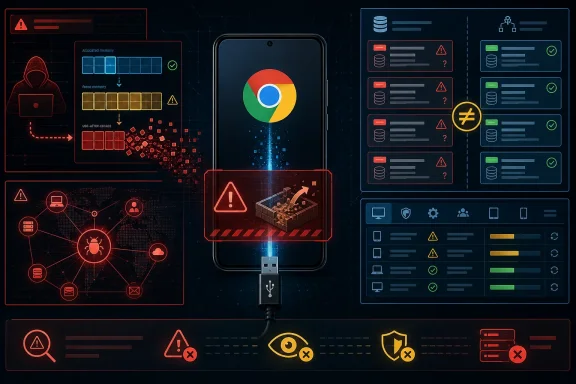 A Medium Chrome Bug Can Still Point at a High-Impact Failure Mode
CVE-2026-11188 is formally described as a use after free in USB in Google Chrome on Android before 149.0.7827.53. In plain English, that means Chrome may have mishandled memory tied to USB-related browser functionality after the program should no longer have been using that memory. The stated attack path is remote: a crafted HTML page, with user interaction required, could potentially lead to a sandbox escape.That last phrase is doing a lot of work. A sandbox escape is not the same thing as arbitrary full-device compromise, and the public description does not claim a complete exploit chain. But in browser security, the sandbox is one of the major walls between a malicious web page and the rest of the system, so even a “medium” issue deserves more attention than the label might suggest.
Google’s own Chrome release note classifies the issue as medium severity and says it was reported by Google on April 15, 2026. The broader Chrome 149 stable release for desktop was announced on June 2, with 429 security fixes, and the CVE record landed shortly afterward. That chronology matters because it tells administrators this is part of a large Chrome security train, not an isolated boutique bug with a bespoke advisory.
The mismatch in framing is immediate. Chromium says medium. CISA’s ADP enrichment assigns a CVSS 3.1 score of 8.8, which lands in high territory. NVD, at the time reflected in the record, had not supplied its own CVSS vector. For security teams that still turn one score into one queue position, CVE-2026-11188 is exactly the sort of entry that creates argument in the patch meeting.
The CPE Record Is Trying to Say “Chrome on Android,” Not “Android Is Broken”
The CPE configuration shown in the NVD change history is the most easily misunderstood part of the record. It combines a vulnerable Google Chrome application CPE up to but excluding 149.0.7827.53 with the Android operating system CPE. That is a common way to express a platform-constrained application vulnerability: the vulnerable product is Chrome, and the affected environment is Android.So, are we missing a CPE? Possibly, but not necessarily in the way the prompt implies. The record’s visible configuration appears to model Chrome as the application and Android as the platform. If a vulnerability scanner expects a standalone Chrome-for-Android CPE and does not understand the logical relationship between the application and operating-system CPEs, it may either over-report against non-Android Chrome assets or under-report against Android devices.
That is the old CPE problem in miniature. CPE was built to name products, but modern products are not cleanly bounded. Chrome is a browser, a mobile app, an embedded WebView-adjacent ecosystem participant, an enterprise-managed desktop application, and a dependency surface for countless workflows. A single CPE string is often less like a fingerprint and more like a mailing address: useful, but not sufficient proof that the right person opened the door.
In this case, the Android platform CPE should not be read as “Android itself is vulnerable.” The public description names Google Chrome on Android, not the Android OS. That distinction matters for remediation ownership, because the patch path is Chrome update hygiene, not waiting for an Android monthly security bulletin unless a downstream vendor has bundled Chrome in some unusual way.
NVD Enrichment Is a Starting Point, Not a Risk Decision
The NVD entry shows a familiar transitional state: the CVE exists, CISA-ADP has contributed CVSS and CWE information, and NIST’s own assessment is not yet complete. For years, many enterprise vulnerability workflows quietly assumed that an NVD record was the definitive structured truth. In 2026, that assumption is increasingly expensive.CVE-2026-11188 illustrates why. The vendor says the issue is medium. CISA-ADP’s vector gives it network attack vector, low complexity, no privileges required, user interaction required, unchanged scope, and high confidentiality, integrity, and availability impact. That produces an 8.8 high score under CVSS 3.1, even though the Chromium label is lower.
Neither view is inherently absurd. Chromium severity reflects internal browser-security context, exploitability assumptions, sandboxing layers, and perhaps the narrowness of the affected component. CVSS is more mechanical: if a crafted page can plausibly get past a sandbox boundary and affect the triad at a high level, the math moves fast. The discrepancy is not a clerical failure; it is a reminder that severity systems answer different questions.
For administrators, the better question is not “Which score is right?” It is “What decision does this score support?” If the decision is whether to push Chrome 149.0.7827.53 or later to Android fleets, the answer is straightforward. If the decision is whether to interrupt production operations, notify executives, or hunt for exploitation, the public record does not currently justify the same urgency as an actively exploited zero-day.
The Desktop Advisory Trail Makes the Mobile Signal Easier to Miss
There is another oddity: the cited Chrome release post is a desktop stable-channel update. The CVE text, however, says Chrome on Android before 149.0.7827.53. That mismatch does not mean the CVE is fabricated or irrelevant. It does mean security tooling that keys too literally off advisory titles may produce confusing results.Chrome’s release ecosystem is sprawling. Desktop stable releases, Android releases, Extended Stable, ChromeOS, WebView, and downstream Chromium packages do not always surface in a way that maps neatly to enterprise asset categories. A CVE can be listed in a desktop release note while its NVD description later narrows the product impact to Android. That is awkward for humans and worse for automation.
The practical risk is not that a sysadmin will read the wrong blog post. The practical risk is that a vulnerability-management platform imports the reference, sees a desktop advisory, matches desktop Chrome CPEs, and buries the mobile relevance where the mobile device management team never sees it. Conversely, a platform may flag Linux Chromium packages even when the upstream CVE text is Android-specific, because package ecosystems ingest CVEs aggressively and then sort out applicability later.
This is why mature shops increasingly treat browser vulnerabilities as product-family events first and platform-specific findings second. Chrome is not just “installed software.” It is an attack surface that ships frequently, autoupdates unevenly, and appears in places the central IT inventory may not fully see. CVE-2026-11188 is a small example of a large inventory problem.
USB in the Browser Is a Reminder That the Web Keeps Reaching Downward
The USB component matters because it sits at the boundary between web content and local hardware capability. Modern browsers are no longer document viewers with scripting engines bolted on. They mediate cameras, microphones, Bluetooth, USB, file pickers, identity providers, payment flows, passkeys, GPUs, machine-learning APIs, and local-device bridges that would have sounded reckless in the early web era.That expansion is not inherently bad. WebUSB and adjacent device-access features exist because real users and real businesses want browser-based workflows to interact with hardware. Developers want configuration utilities without native installers. Enterprises want web apps that can talk to scanners, badges, lab equipment, point-of-sale devices, and field hardware.
But every new bridge becomes a place where the browser’s trust model has to be precise. A memory-safety flaw in a device-facing component is not just another crash bug; it is a bug in the machinery that decides how far a web page can reach into the local environment. Even if exploitation requires user interaction, attackers are very good at turning “click this” into “routine browsing.”
Android adds its own wrinkle. Mobile permission prompts, app sandboxing, and Play-managed updates create a different security envelope than desktop Chrome. That can reduce some classes of risk while complicating others, especially for organizations that have excellent Windows patch telemetry and comparatively vague mobile-browser visibility.
Use-After-Free Bugs Are the Browser Industry’s Long Hangover
Use-after-free vulnerabilities have haunted C and C++ software for decades because they are simple to describe and painful to eradicate. A program frees memory, keeps a stale reference to it, and later uses that reference as if the object were still valid. Under the right conditions, an attacker may be able to shape what sits in that memory and turn a logic error into control over execution or data.Chrome has invested heavily in mitigations, memory allocators, fuzzing, sandboxing, site isolation, and newer memory-safety work. Those layers matter. They are the reason many bugs that look scary in a CVE sentence do not become reliable, weaponized exploits overnight.
Yet the Chrome 149 security list is also a monument to the stubbornness of memory corruption. The release contains page after page of use-after-free, out-of-bounds access, type confusion, integer overflow, and uninitialized-use entries across browser subsystems. CVE-2026-11188 is one tile in that mosaic, but the pattern is unmistakable.
For WindowsForum readers, the lesson is broader than Android. Microsoft Edge, Google Chrome, Brave, Vivaldi, Opera, Electron apps, embedded Chromium runtimes, and WebView-based experiences all inherit pieces of the same security reality. Chromium’s engineering scale is enormous, but so is the attack surface.
The Real Enterprise Exposure Is Patch Visibility, Not Patch Availability
For most individual users, the mitigation story is boring in the best possible way: update Chrome. On Android, that usually means the Play Store updates the browser, or the user opens the store and updates manually. In managed environments, the answer depends on MDM policy, app update controls, device ownership, and whether Android browsers are actually in the organization’s vulnerability scope.That last condition is not guaranteed. Many enterprises still have strong compliance rituals around Windows endpoints and weak rituals around mobile browsers. They know the OS patch level of every laptop, but not the Chrome version on every personally owned Android phone that accesses company mail, SaaS dashboards, or identity portals.
CVE-2026-11188 is a good test case because it is not sensational. It is not publicly described as exploited in the wild. It does not appear to be the worst bug in Chrome 149. It is exactly the kind of vulnerability that can slip through process gaps because everyone assumes someone else’s automatic-update system will handle it.
That assumption is often true for consumer devices and often incomplete for enterprise risk. Autoupdate can be delayed, disabled, pinned, blocked by managed Play policies, slowed by regional rollout, or undermined by stale devices. A browser vulnerability does not care whether the device is corporate-owned, BYOD, or “just used for MFA and email.”
Windows Admins Should Care Because Chromium Is Now Infrastructure
A Chrome-on-Android CVE might look like someone else’s problem to a Windows-heavy administrator. That would be a mistake. Chromium is now part of the operational fabric around Windows, even when the affected build is not a Windows build.Edge’s Chromium base, Chrome’s dominance in enterprise web app testing, Electron’s ubiquity, and WebView2’s role in Windows application development have made browser engine security a platform concern. The specific CVE here names Chrome on Android, but the process lesson applies directly to Windows estates: do not let product naming and CPE matching become a substitute for understanding where Chromium-derived code runs.
The desktop Chrome 149 release itself fixed hundreds of vulnerabilities across Windows, macOS, and Linux. Even if CVE-2026-11188 is scoped to Android, the surrounding release train is a reminder that browser patch cadence is now closer to antivirus signatures than old-fashioned application updates. Delaying browser patches for “normal monthly maintenance” is increasingly hard to defend.
There is also a user-behavior angle. The same employee who runs fully managed Edge on a Windows 11 laptop may click the same phishing link on an unmanaged Android phone. Identity systems, session cookies, passkeys, and cloud consoles blur the line between endpoint categories. Attackers do not need your asset database to be tidy; they need one path that works.
The Severity Debate Should Not Distract From the Fix
The CVSS-versus-Chromium-severity mismatch will attract attention because security teams are trained to argue over numbers. That argument has its place. A high CVSS score can drive SLAs, regulatory reporting, vulnerability dashboards, and exception processes. A medium vendor rating can temper panic and reflect exploit constraints the generic scoring system does not capture.But for a browser update, the operational decision is rarely subtle. If the fixed version exists and the application can update without breaking business-critical workflows, deploy it. The cost of staying behind on Chrome is cumulative: today’s medium issue becomes tomorrow’s exploit-chain ingredient, and the backlog grows faster than the justification for delay.
The more useful severity model is contextual. Is Chrome on Android allowed for corporate access? Are Android devices managed? Are app updates automatic and enforced? Are high-risk users exposed to hostile web content? Do administrators have telemetry proving version 149.0.7827.53 or later is present? Those questions matter more than whether the word beside the CVE says medium or high.
This is especially true for sandbox escapes. A sandbox escape often becomes dangerous when paired with another bug, such as a renderer compromise, script engine flaw, or logic issue that gets attacker-controlled code running in the first place. Security teams should resist judging such bugs in isolation simply because the public CVE description is short.
The CPE Gap Is a Governance Problem Wearing a Metadata Costume
The prompt asks whether a CPE is missing, and that is the right instinct in a narrow vulnerability-management sense. If the record does not map cleanly to the products in your environment, remediation status becomes fuzzy. But the deeper issue is that CPE correctness cannot be the only control.A better process treats CPE as evidence, not verdict. The evidence says Chrome before 149.0.7827.53 on Android is affected. The inventory question is whether your organization has Android devices running Chrome below that version. The remediation question is whether you can force or verify an update. The exception question is what access those devices retain if they cannot update.
Many scanners struggle here because mobile app inventory, browser version reporting, and CVE matching often live in separate systems. The MDM knows installed app versions. The vulnerability platform knows CVEs. The identity provider knows which devices are accessing corporate resources. The security team gets a dashboard that may not reconcile all three.
That is how a metadata imperfection becomes a governance failure. Nobody needs a perfect CPE ontology to know that outdated mobile browsers should not be trusted with privileged access. But without a reliable way to connect CVE, app version, device posture, and access policy, organizations end up debating database fields while users keep browsing.
The Practical Reading for CVE-2026-11188 Is Narrow but Not Small
The narrow reading is simple: Chrome on Android prior to 149.0.7827.53 has a USB use-after-free vulnerability that could potentially enable a sandbox escape through crafted HTML, and users should update. There is no public signal in the provided material that this specific CVE is being exploited in the wild. The bug is classified by Chromium as medium, while CISA-ADP scores it high under CVSS 3.1.The broader reading is more important. The vulnerability landed in a massive Chrome 149 security release, uses a desktop release note as a vendor reference, has incomplete NVD scoring from NIST, and depends on a CPE configuration that may not match how enterprises actually inventory Android Chrome. Every one of those details can create friction between disclosure and remediation.
For home users, friction is mostly solved by app updates. For IT shops, friction becomes a workflow problem. Someone has to know which mobile browsers exist, which versions they run, whether updates are enforced, and whether access controls respond when they are not.
That is where Chrome’s speed becomes both blessing and curse. Google can ship browser fixes quickly across a huge population. Enterprises can also lose track quickly if their governance model still treats browsers as ordinary applications rather than fast-moving security perimeters.
The Admin’s Readout From One Small USB Bug
CVE-2026-11188 is not the loudest Chrome vulnerability of June 2026, and that is precisely why it is useful. It shows the ordinary machinery of browser security: terse CVE text, restricted bug details, differing severity labels, partial enrichment, and platform-specific applicability. The work is to turn that ordinary machinery into action before it becomes noise.- Chrome on Android should be updated to 149.0.7827.53 or later wherever the browser is allowed to access personal, enterprise, or administrative services.
- The Android CPE in the NVD configuration should be interpreted as a platform constraint for the Chrome application, not as proof that the Android operating system itself is the vulnerable product.
- Vulnerability tools that rely only on desktop Chrome advisories or simplistic CPE matching may miss or misclassify mobile exposure.
- The Chromium medium rating and the CISA-ADP high CVSS score should be reconciled through asset context rather than treated as a contradiction that blocks action.
- Enterprises should verify mobile browser versions through MDM or device posture tooling instead of assuming Play Store autoupdate has completed everywhere.
- Security teams should treat sandbox-escape bugs as potential exploit-chain components, even when no public exploitation is reported for the individual CVE.
References
- Primary source: NVD / Chromium
Published: 2026-06-09T07:00:46-07:00
NVD - CVE-2026-11188
 nvd.nist.gov
- Security advisory: MSRC
Published: 2026-06-09T07:00:46-07:00
Original feed URL
Security Update Guide - Microsoft Security Response Center
 msrc.microsoft.com
- Related coverage: radar.offseq.com
CVE-2026-11188: Use after free in Google Chrome - Live Threat Intelligence - Threat Radar | OffSeq.com
Detailed information about CVE-2026-11188: Use after free in Google Chrome affecting Google Chrome. Get real-time updates, technical details, and mitigation strradar.offseq.com - Related coverage: security.snyk.io
Use After Free in chromium | CVE-2026-11188 | Snyk
Use After Free in chromium | CVE-2026-11188security.snyk.io - Related coverage: vuldb.com
CVE-2026-11188 Google Chrome USB use after free (ID 502959)
A security vulnerability has been detected in Google Chrome on Android. This vulnerability is traded as CVE-2026-11188. Upgrading the affected component is recommended.vuldb.com - Official source: nist.gov
National Vulnerability Database
NIST maintains the National Vulnerability Database (NVD), a repository of information on software and hardware flaws that can compromise computer security. This is a key piece of the nation’s cybersecurity infrastructure.www.nist.gov
- Related coverage: govcert.gov.hk
GovCERT.HK - Security Alert (A26-06-08): Multiple Vulnerabilities in Google Chrome
Security Alert (A26-06-08): Multiple Vulnerabilities in Google Chromewww.govcert.gov.hk
- Related coverage: labs.cloudsecurityalliance.org
NVD Enrichment Triage: Enterprise Vulnerability Programs Must Adapt
PDF documentlabs.cloudsecurityalliance.org
