

CVE-2026-11163 is a Chrome on Android use-after-free flaw in the browser’s Messages component, disclosed June 4, 2026, fixed before version 149.0.7827.53, and described as allowing a remote attacker to potentially escape the sandbox through a crafted HTML page. The oddity is not the memory bug itself; Chrome ships plenty of those. The interesting part is the mismatch between Google’s “Medium” Chromium severity, CISA-ADP’s critical CVSS score, and NVD’s configuration entry that ties the vulnerability to both Chrome and Android. That combination is exactly where vulnerability management stops being clerical work and becomes judgment.
Google’s Chrome release notes list CVE-2026-11163 as a Medium-severity use-after-free issue in Messages, reported internally by Google on April 13, 2026, and patched in the Chrome 149 stable release that began rolling out June 2, 2026. The NVD entry followed on June 4 and was modified on June 8 with CPE configuration data and CISA-ADP scoring. On paper, this looks routine: a browser memory-safety bug, a fixed version, a vendor advisory, and a restricted Chromium issue link.
But the description carries a phrase that should make administrators pause: sandbox escape. In Chrome security taxonomy, the browser sandbox is one of the major barriers between “a malicious page did something bad inside the renderer” and “the attacker now has a broader foothold.” A bug that potentially helps cross that boundary may sit in Google’s release notes as Medium because of internal exploitability assumptions, platform constraints, or chaining requirements, but defenders do not get to live inside Google’s internal risk model.
That is why CISA-ADP’s CVSS 3.1 score of 9.6 looks jarring but not irrational. The vector says network attack, low complexity, no privileges, required user interaction, changed scope, and high impact to confidentiality, integrity, and availability. In ordinary English: the victim still has to load something, but the attacker does not need an account, the attack can be delivered remotely, and a successful exploit could break out of the security boundary that was supposed to contain it.
The practical lesson is familiar but still underappreciated. Browser vendors often rate bugs by their position in a chain; vulnerability scanners often rate them by their theoretical consequence. Neither view is complete. For enterprise patching, the right answer is not to argue over whether “Medium” or “Critical” is the morally correct adjective. The right answer is to ask whether exposed Android Chrome clients can be brought to 149.0.7827.53 or later quickly, and whether your inventory actually knows which devices are in scope.
That distinction matters. CVE-2026-11163 is described as affecting Google Chrome on Android, not desktop Chrome on Windows, macOS, or Linux. Yet the reference used in the NVD record is Google’s “Stable Channel Update for Desktop,” because that Chrome 149 advisory is where Google published the long list of security fixes, including this Android-specific entry. The result is a slightly inelegant public record: a desktop release advisory carrying a mobile-only CVE, and an NVD CPE configuration that must represent both the application and the platform.
In CPE terms, the current entry is not obviously missing the core application CPE. It includes
Where it may still be incomplete is in the ecosystem around Chrome on Android. Android browsers can be represented differently across scanners, mobile device management tools, Google Play package identifiers, OEM builds, and WebView-related inventories. NVD CPEs are blunt instruments for mobile software, especially when the application is updated outside the OS image through Play services or an app store pipeline. A scanner looking only for desktop Chrome CPEs could overreport; a mobile inventory that does not map Chrome APK versions to CPE could underreport.
So the short answer is: the NVD entry does not look like it is missing the obvious Chrome CPE, but it may not be expressive enough for every real-world Android software inventory. The configuration is trying to say “Chrome before 149.0.7827.53 on Android.” If your tooling cannot interpret the AND relationship correctly, the problem may be less an absent CPE than a mismatch between CPE’s old-world product model and Android’s app-delivery reality.
That is precisely how bugs like this become operationally interesting. A single named vulnerability in a giant Chrome update is easy to miss if teams triage only by headline severity or only by desktop advisory summaries. The release note’s title says desktop, the CVE text says Android, the CPE says Chrome and Android, and the CVSS enrichment says critical. Every part is defensible; together they create room for bad assumptions.
For WindowsForum readers, the Windows angle is indirect but real. Many organizations manage Chrome as a cross-platform browser fleet, not as isolated Windows, macOS, Linux, Android, and iOS silos. The same security team may own Chrome policies on Windows endpoints and Android Enterprise devices. If the team’s dashboard says “Chrome 149 fixed,” it still needs to know which platform build that statement applies to.
There is also a timing issue. Chrome releases roll out over days or weeks, and mobile app updates depend on device policy, store availability, user behavior, battery state, network state, and sometimes OEM constraints. A Windows desktop can be forced through enterprise update policy with relatively predictable results. Android Chrome patching can be fast in well-managed fleets, but it can also vanish into the gray zone of personal devices, unmanaged contractors, shared tablets, and kiosk-style deployments.
That is why administrators should resist treating this as a mere vulnerability-feed cleanup item. CVE-2026-11163 is an example of the larger Chrome management problem: the browser is both an application and a platform, and on mobile it is tied to an operating environment that may or may not be visible to the same tools used for desktop patch compliance.
In a browser, this class of bug is especially troublesome because the attacker’s input surface is the web itself. HTML, JavaScript, CSS, media, graphics APIs, IPC mechanisms, permissions prompts, and platform integrations all interact in a browser process model designed to be fast, compatible, and secure at the same time. That is a brutal engineering tradeoff, and Chrome’s long security-fix lists are evidence not of negligence but of the scale of the target.
The “Messages” component name does not give outsiders much to work with. Google routinely restricts bug details until most users have received a fix, and the Chromium issue attached to this CVE is marked in a way that limits public visibility. That is normal behavior for browser vulnerabilities, particularly where exploit details could help attackers reproduce the bug before patch adoption catches up.
Still, the component name is enough to suggest why Android matters. Chrome on Android has platform-specific UI, permissions, intents, prompts, sharing flows, and messaging surfaces that differ from desktop Chrome. A bug in a mobile-only or mobile-relevant component may not map cleanly to desktop builds, even if the fix appears in the same global Chrome milestone.
The irony is that Chrome is already one of the industry’s strongest arguments for memory-safe rewrites and hardening. Site isolation, sandboxing, MiraclePtr-style mitigations, fuzzing, exploit rewards, and process separation all raise the cost of exploitation. Yet use-after-free bugs keep appearing because the browser remains a massive C++ codebase sitting at the center of everyday computing.
But the phrase also should not be waved away. A sandbox escape is the second half of many serious browser compromise chains. First, the attacker gets execution in a constrained context. Then, the attacker uses a separate vulnerability to escape containment and reach a more privileged process or broader device capability. The first bug gets attention because it is easier to explain; the second bug is what turns a browser crash into something more consequential.
CISA-ADP’s score reflects that broader reading. The “scope changed” portion of the vector is the giveaway: the vulnerable component’s failure can affect resources beyond its own security authority. For defenders, that is often more meaningful than whether Google labeled the bug Medium in the release note.
This is also where Android threat modeling diverges from desktop threat modeling. Android’s application sandbox, Chrome’s internal sandbox, OS permissions, Play Protect, and user consent flows all overlap. A browser sandbox escape does not automatically mean full device compromise, but it can move an attacker into territory where additional platform bugs, permissions confusion, or data exposure become more plausible.
The responsible position is neither panic nor complacency. There is no public indication in the provided material that CVE-2026-11163 is being actively exploited in the wild. There is also no good reason to leave Android Chrome below 149.0.7827.53 when the fix is available and the bug class is known to be exploitable in principle.
This is not new. Chromium is an upstream project shared by many products and platforms. Chrome releases, Chromium issue IDs, downstream Linux packages, Android apps, WebView, embedded browsers, and Chromium-based third-party browsers all orbit the same core but do not inherit every bug in the same way. The public advisory layer often flattens those distinctions because it is written for release communication, not asset management precision.
That flattening creates real work for administrators. A desktop Chrome scanner may ingest the CVE and flag Windows machines because the reference is a desktop advisory. A mobile vulnerability product may ingest the same CVE and correctly focus on Android Chrome. A Linux distribution tracker may list its own Chromium package status, even though the upstream CVE text says Chrome on Android. None of these systems is necessarily lying; they are projecting a shared vulnerability identifier onto different packaging models.
For Windows admins, the safe approach is to separate the Chrome 149 milestone from the CVE’s affected platform. Chrome on Windows had its own 149.0.7827.53/54 stable builds in the same release window and many other security fixes. CVE-2026-11163, however, is specifically described as Chrome on Android prior to 149.0.7827.53. Treat the desktop update as important for desktop reasons, but do not use this CVE alone as evidence that Windows Chrome is vulnerable to the Messages bug.
This distinction matters in reporting. Overstating platform exposure burns credibility with executives and users. Understating it leaves mobile fleets exposed. The right vulnerability note should say that Chrome 149 fixed CVE-2026-11163, that the CVE description identifies Chrome on Android before 149.0.7827.53, and that teams should verify Android Chrome app versions rather than assuming desktop Chrome status answers the question.
That blended model is useful, but it is also noisy. Vendor severity, CNA descriptions, CISA enrichment, EPSS scores, Linux distribution trackers, commercial scanner plugins, and threat-intelligence writeups all answer slightly different questions. The vendor may ask, “How severe is this in our product architecture?” CISA scoring may ask, “What is the worst reasonable impact under CVSS rules?” EPSS asks, “How likely is exploitation based on observed patterns?” A patch manager asks, “Which devices need action by Friday?”
CVE-2026-11163 exposes the seams because the labels disagree. Google says Medium. CISA-ADP says Critical. Some third-party databases echo the critical score, while others may downgrade risk because no exploit is known. NVD’s own score is absent in the provided record. A weaker process picks whichever number supports the desired workload. A stronger process documents the disagreement and patches according to exposed asset class.
For most organizations, Android Chrome should not need a philosophical severity debate. Browser updates are frequent, the fixed version is known, and the attack vector is a crafted HTML page. If managed devices are behind, the remediation path is not to litigate CVSS; it is to push the app update, validate installation, and identify the pockets of Android usage outside management.
The CPE question belongs in that same practical frame. Yes, accurate CPEs matter because they drive scanners and dashboards. But a correct dashboard that cannot force mobile app updates is still a paper shield. Conversely, a slightly awkward CPE record can be survivable if the organization has direct app-version telemetry from Android Enterprise, MDM, EDR, or device inventory.
That creates a governance gap. Windows Chrome is usually visible to endpoint management. Android Chrome may be visible only if the device is enrolled, the work profile is configured, and app inventory collection is permitted. The riskiest devices are the ones that fall between personal convenience and corporate dependency.
CVE-2026-11163 is not necessarily the bug that will burn those organizations. But it is a clean example of why browser patching has to include mobile. The exploit precondition is ordinary web behavior: a crafted HTML page and user interaction. That means email links, messaging apps, QR codes, captive portals, malicious ads, and compromised legitimate sites all belong in the delivery conversation.
The fix version is also concrete enough to operationalize. Chrome on Android prior to 149.0.7827.53 is the affected range stated in the CVE description. Administrators do not need to reverse-engineer the Chromium issue to act. They need to know whether their Android Chrome estate is at or beyond that version, whether updates are automatic, and whether exceptions exist.
There is a temptation to say this is “just Android” and therefore outside the WindowsForum center of gravity. That is outdated thinking. The Windows endpoint is no longer the only place where work happens, and Microsoft-heavy shops are often deep users of Android through Intune, Entra ID conditional access, Outlook mobile, Teams, Edge, and Chrome. Browser vulnerabilities do not care which device your org chart assigned to the endpoint team.
The mess appears downstream. NVD enrichment had to model the platform dependency. CISA-ADP applied a critical CVSS score that appears more severe than Google’s release-note label. Third-party trackers began classifying the issue across ecosystems, including distributions that ship Chromium packages. Security teams then had to convert all of that into a yes-or-no answer for their own assets.
This is why mature vulnerability management depends on product intelligence, not just CVE ingestion. A CVE tells you a vulnerability exists. It does not always tell you whether your package, platform, channel, architecture, or deployment mode is affected. Chrome makes that harder because one version number can mean different things across desktop, mobile, stable, extended stable, WebView, and downstream Chromium builds.
The answer is not to abandon CVE feeds. It is to enrich them locally. If your organization manages Android devices, your source of truth should include app package name, installed version, update policy, device ownership type, and last check-in time. If you manage Chrome on Windows, your source of truth should include channel, version, update policy, and whether relaunches are pending. The CVE is the alarm bell; asset telemetry is the map.
That distinction is especially important when a public record asks, “Are we missing a CPE?” Sometimes the answer is yes. Sometimes the answer is that CPE is the wrong precision tool. In this case, the obvious Chrome-and-Android relationship appears present, but mobile Chrome’s real deployability cannot be captured perfectly by a pair of CPE strings.
That lag is normal, but it should shape expectations. If an organization waits for every public database to converge before deploying browser updates, it is patching at the speed of paperwork. Chrome’s release cadence assumes the opposite: updates ship, users roll forward, and detailed public analysis catches up later.
The better operational model is to treat Chrome stable security releases as inherently urgent, then use CVE details to prioritize validation and exception handling. In other words, do not wait for CVE-2026-11163 to become beautifully modeled in every feed before updating Android Chrome. Update first; reconcile scanner semantics afterward.
This is especially true because Chrome 149 contained hundreds of security fixes. Even if CVE-2026-11163 were later rescored or narrowed, the release still carries a large pile of memory-safety, policy-enforcement, validation, and browser-component fixes. A device stuck below 149.0.7827.53 is not merely exposed to one Messages bug; it is behind an entire browser security train.
The June 8 NVD change record is useful for compliance teams, but it should not be the starting gun for defenders. For managed fleets, the starting gun was the vendor release. For unmanaged or lightly managed Android devices, the starting gun should be the moment the organization realizes it depends on Chrome for access to corporate resources.
Do you know how many Android devices access company resources through Chrome? Do you know whether those devices are enrolled, personally owned, corporate owned, or unmanaged? Do you know whether Chrome updates are enforced or merely suggested? Do you know whether conditional access can block stale browser versions? Do you know whether your vulnerability dashboard distinguishes Chrome desktop from Chrome Android?
Those questions matter more than whether a single CPE line satisfies a scanner. If your estate can answer them, CVE-2026-11163 is a routine patch validation exercise. If it cannot, this CVE is a warning flare from the mobile edge of the browser fleet.
There is also a reporting hygiene point. Security teams should avoid telling stakeholders that “Android is vulnerable” in the broad OS sense unless the vulnerability is actually in Android itself. The CVE describes Chrome on Android, not the Android platform as an independently exploitable product. The Android CPE in the NVD configuration appears to be a platform qualifier, not an accusation that every Android component is flawed.
That nuance can prevent bad remediation orders. The fix is not an Android OS upgrade in the first instance. It is updating Chrome on Android to 149.0.7827.53 or later. OS patch level still matters for layered defense, but it is not the version boundary named in this CVE.
That narrow answer should not shrink the security concern. The bug is a use-after-free in Chrome’s Messages component on Android, and the public description says it could potentially enable a sandbox escape through crafted HTML. Google’s release note labels it Medium, while CISA-ADP scores it as Critical under CVSS 3.1. That disagreement is not a reason to delay; it is a reason to patch and document assumptions.
For administrators, the target is straightforward: verify Chrome on Android is at least 149.0.7827.53. For vulnerability managers, the target is slightly harder: make sure scanners, MDM systems, and compliance dashboards are not collapsing platform-specific Chrome issues into misleading desktop or OS buckets. For executives, the message is simpler still: mobile browsers are enterprise attack surface, whether or not they appear in the traditional endpoint report.
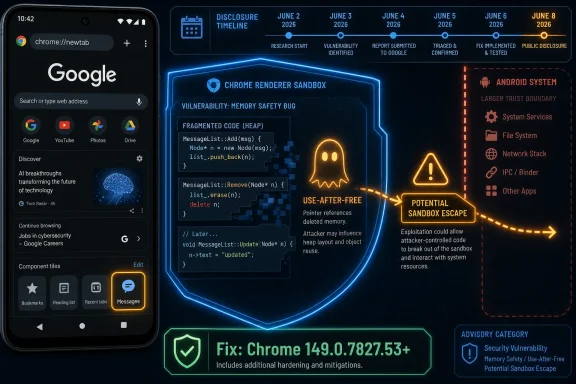 The “Medium” Label Does Not Make This a Medium Problem
Google’s Chrome release notes list CVE-2026-11163 as a Medium-severity use-after-free issue in Messages, reported internally by Google on April 13, 2026, and patched in the Chrome 149 stable release that began rolling out June 2, 2026. The NVD entry followed on June 4 and was modified on June 8 with CPE configuration data and CISA-ADP scoring. On paper, this looks routine: a browser memory-safety bug, a fixed version, a vendor advisory, and a restricted Chromium issue link.But the description carries a phrase that should make administrators pause: sandbox escape. In Chrome security taxonomy, the browser sandbox is one of the major barriers between “a malicious page did something bad inside the renderer” and “the attacker now has a broader foothold.” A bug that potentially helps cross that boundary may sit in Google’s release notes as Medium because of internal exploitability assumptions, platform constraints, or chaining requirements, but defenders do not get to live inside Google’s internal risk model.
That is why CISA-ADP’s CVSS 3.1 score of 9.6 looks jarring but not irrational. The vector says network attack, low complexity, no privileges, required user interaction, changed scope, and high impact to confidentiality, integrity, and availability. In ordinary English: the victim still has to load something, but the attacker does not need an account, the attack can be delivered remotely, and a successful exploit could break out of the security boundary that was supposed to contain it.
The practical lesson is familiar but still underappreciated. Browser vendors often rate bugs by their position in a chain; vulnerability scanners often rate them by their theoretical consequence. Neither view is complete. For enterprise patching, the right answer is not to argue over whether “Medium” or “Critical” is the morally correct adjective. The right answer is to ask whether exposed Android Chrome clients can be brought to 149.0.7827.53 or later quickly, and whether your inventory actually knows which devices are in scope.
NVD’s CPE Entry Is Awkward Because the Product Boundary Is Awkward
The user-facing question here is whether NVD is missing a CPE. Based on the change history provided, the configuration added by NIST is an AND relationship containing two OR branches: vulnerable Google Chrome versions before 149.0.7827.53, and the Android operating system CPE. That structure appears intended to express “Chrome running on Android,” not “all Chrome everywhere” and not “Android itself independently.”That distinction matters. CVE-2026-11163 is described as affecting Google Chrome on Android, not desktop Chrome on Windows, macOS, or Linux. Yet the reference used in the NVD record is Google’s “Stable Channel Update for Desktop,” because that Chrome 149 advisory is where Google published the long list of security fixes, including this Android-specific entry. The result is a slightly inelegant public record: a desktop release advisory carrying a mobile-only CVE, and an NVD CPE configuration that must represent both the application and the platform.
In CPE terms, the current entry is not obviously missing the core application CPE. It includes
cpe:2.3:a:google:chrome:*:*:*:*:*:*:*:* with versions up to but excluding 149.0.7827.53. It also includes cpe:2.3:o:google:android:-:*:*:*:*:*:*:*, apparently to constrain the vulnerable application to the Android platform. If the configuration is truly modeled as an AND, that is the expected shape: vulnerable Chrome plus Android.Where it may still be incomplete is in the ecosystem around Chrome on Android. Android browsers can be represented differently across scanners, mobile device management tools, Google Play package identifiers, OEM builds, and WebView-related inventories. NVD CPEs are blunt instruments for mobile software, especially when the application is updated outside the OS image through Play services or an app store pipeline. A scanner looking only for desktop Chrome CPEs could overreport; a mobile inventory that does not map Chrome APK versions to CPE could underreport.
So the short answer is: the NVD entry does not look like it is missing the obvious Chrome CPE, but it may not be expressive enough for every real-world Android software inventory. The configuration is trying to say “Chrome before 149.0.7827.53 on Android.” If your tooling cannot interpret the AND relationship correctly, the problem may be less an absent CPE than a mismatch between CPE’s old-world product model and Android’s app-delivery reality.
Chrome 149 Turned One Bug Into an Inventory Test
Chrome 149 was not a small security release. Google’s June 2 stable-channel post says the release included 429 security fixes, with many externally reported issues called out individually. CVE-2026-11163 sits deep in that long list, surrounded by other medium-severity entries and far away from the critical items that naturally draw the first wave of attention.That is precisely how bugs like this become operationally interesting. A single named vulnerability in a giant Chrome update is easy to miss if teams triage only by headline severity or only by desktop advisory summaries. The release note’s title says desktop, the CVE text says Android, the CPE says Chrome and Android, and the CVSS enrichment says critical. Every part is defensible; together they create room for bad assumptions.
For WindowsForum readers, the Windows angle is indirect but real. Many organizations manage Chrome as a cross-platform browser fleet, not as isolated Windows, macOS, Linux, Android, and iOS silos. The same security team may own Chrome policies on Windows endpoints and Android Enterprise devices. If the team’s dashboard says “Chrome 149 fixed,” it still needs to know which platform build that statement applies to.
There is also a timing issue. Chrome releases roll out over days or weeks, and mobile app updates depend on device policy, store availability, user behavior, battery state, network state, and sometimes OEM constraints. A Windows desktop can be forced through enterprise update policy with relatively predictable results. Android Chrome patching can be fast in well-managed fleets, but it can also vanish into the gray zone of personal devices, unmanaged contractors, shared tablets, and kiosk-style deployments.
That is why administrators should resist treating this as a mere vulnerability-feed cleanup item. CVE-2026-11163 is an example of the larger Chrome management problem: the browser is both an application and a platform, and on mobile it is tied to an operating environment that may or may not be visible to the same tools used for desktop patch compliance.
Use-After-Free Bugs Keep Surviving Because Browsers Are Memory-Safety Stress Tests
A use-after-free vulnerability is one of the oldest classes of memory corruption bug. Software allocates memory, frees it, and later continues to use a stale reference as if the object still exists. Depending on timing, layout, and attacker control, that stale reference can become a crash, an information leak, or a stepping stone toward code execution.In a browser, this class of bug is especially troublesome because the attacker’s input surface is the web itself. HTML, JavaScript, CSS, media, graphics APIs, IPC mechanisms, permissions prompts, and platform integrations all interact in a browser process model designed to be fast, compatible, and secure at the same time. That is a brutal engineering tradeoff, and Chrome’s long security-fix lists are evidence not of negligence but of the scale of the target.
The “Messages” component name does not give outsiders much to work with. Google routinely restricts bug details until most users have received a fix, and the Chromium issue attached to this CVE is marked in a way that limits public visibility. That is normal behavior for browser vulnerabilities, particularly where exploit details could help attackers reproduce the bug before patch adoption catches up.
Still, the component name is enough to suggest why Android matters. Chrome on Android has platform-specific UI, permissions, intents, prompts, sharing flows, and messaging surfaces that differ from desktop Chrome. A bug in a mobile-only or mobile-relevant component may not map cleanly to desktop builds, even if the fix appears in the same global Chrome milestone.
The irony is that Chrome is already one of the industry’s strongest arguments for memory-safe rewrites and hardening. Site isolation, sandboxing, MiraclePtr-style mitigations, fuzzing, exploit rewards, and process separation all raise the cost of exploitation. Yet use-after-free bugs keep appearing because the browser remains a massive C++ codebase sitting at the center of everyday computing.
The Sandbox Escape Wording Changes the Patch Conversation
The phrase “potentially perform a sandbox escape” should not be read as proof of a turnkey exploit. Public CVE descriptions are compressed, cautious, and often written to avoid handing attackers a recipe. In many cases, a sandbox escape is only useful after an attacker has already achieved code execution in a renderer or another constrained process.But the phrase also should not be waved away. A sandbox escape is the second half of many serious browser compromise chains. First, the attacker gets execution in a constrained context. Then, the attacker uses a separate vulnerability to escape containment and reach a more privileged process or broader device capability. The first bug gets attention because it is easier to explain; the second bug is what turns a browser crash into something more consequential.
CISA-ADP’s score reflects that broader reading. The “scope changed” portion of the vector is the giveaway: the vulnerable component’s failure can affect resources beyond its own security authority. For defenders, that is often more meaningful than whether Google labeled the bug Medium in the release note.
This is also where Android threat modeling diverges from desktop threat modeling. Android’s application sandbox, Chrome’s internal sandbox, OS permissions, Play Protect, and user consent flows all overlap. A browser sandbox escape does not automatically mean full device compromise, but it can move an attacker into territory where additional platform bugs, permissions confusion, or data exposure become more plausible.
The responsible position is neither panic nor complacency. There is no public indication in the provided material that CVE-2026-11163 is being actively exploited in the wild. There is also no good reason to leave Android Chrome below 149.0.7827.53 when the fix is available and the bug class is known to be exploitable in principle.
The Desktop Advisory Is a Reminder That Chrome Is One Codebase Wearing Many Badges
The most confusing part of the record is that the vendor reference is Google’s stable-channel update for desktop. That does not necessarily mean the vulnerability affects desktop Chrome. It means Google’s release machinery and advisory format bundled a large set of Chrome 149 security fixes into a single public post, and one of those fixes was for Chrome on Android.This is not new. Chromium is an upstream project shared by many products and platforms. Chrome releases, Chromium issue IDs, downstream Linux packages, Android apps, WebView, embedded browsers, and Chromium-based third-party browsers all orbit the same core but do not inherit every bug in the same way. The public advisory layer often flattens those distinctions because it is written for release communication, not asset management precision.
That flattening creates real work for administrators. A desktop Chrome scanner may ingest the CVE and flag Windows machines because the reference is a desktop advisory. A mobile vulnerability product may ingest the same CVE and correctly focus on Android Chrome. A Linux distribution tracker may list its own Chromium package status, even though the upstream CVE text says Chrome on Android. None of these systems is necessarily lying; they are projecting a shared vulnerability identifier onto different packaging models.
For Windows admins, the safe approach is to separate the Chrome 149 milestone from the CVE’s affected platform. Chrome on Windows had its own 149.0.7827.53/54 stable builds in the same release window and many other security fixes. CVE-2026-11163, however, is specifically described as Chrome on Android prior to 149.0.7827.53. Treat the desktop update as important for desktop reasons, but do not use this CVE alone as evidence that Windows Chrome is vulnerable to the Messages bug.
This distinction matters in reporting. Overstating platform exposure burns credibility with executives and users. Understating it leaves mobile fleets exposed. The right vulnerability note should say that Chrome 149 fixed CVE-2026-11163, that the CVE description identifies Chrome on Android before 149.0.7827.53, and that teams should verify Android Chrome app versions rather than assuming desktop Chrome status answers the question.
NVD’s “Awaiting Analysis” Era Has Made Enrichment a Second Source of Truth
The CVE record shows NVD had not yet provided its own CVSS assessment, while CISA-ADP had contributed a CVSS 3.1 score. This has become a familiar pattern: the CVE exists, the vendor advisory exists, third-party enrichment appears, and NVD’s own analysis may lag or remain incomplete for a period. Security teams increasingly consume a blended feed rather than a single canonical vulnerability record.That blended model is useful, but it is also noisy. Vendor severity, CNA descriptions, CISA enrichment, EPSS scores, Linux distribution trackers, commercial scanner plugins, and threat-intelligence writeups all answer slightly different questions. The vendor may ask, “How severe is this in our product architecture?” CISA scoring may ask, “What is the worst reasonable impact under CVSS rules?” EPSS asks, “How likely is exploitation based on observed patterns?” A patch manager asks, “Which devices need action by Friday?”
CVE-2026-11163 exposes the seams because the labels disagree. Google says Medium. CISA-ADP says Critical. Some third-party databases echo the critical score, while others may downgrade risk because no exploit is known. NVD’s own score is absent in the provided record. A weaker process picks whichever number supports the desired workload. A stronger process documents the disagreement and patches according to exposed asset class.
For most organizations, Android Chrome should not need a philosophical severity debate. Browser updates are frequent, the fixed version is known, and the attack vector is a crafted HTML page. If managed devices are behind, the remediation path is not to litigate CVSS; it is to push the app update, validate installation, and identify the pockets of Android usage outside management.
The CPE question belongs in that same practical frame. Yes, accurate CPEs matter because they drive scanners and dashboards. But a correct dashboard that cannot force mobile app updates is still a paper shield. Conversely, a slightly awkward CPE record can be survivable if the organization has direct app-version telemetry from Android Enterprise, MDM, EDR, or device inventory.
The Real Exposure Lives in the Devices Nobody Wants to Own
Chrome on Android is often treated as a consumer app until it becomes an enterprise risk. Employees use it on BYOD phones to access webmail, SaaS dashboards, password reset portals, intranet pages, ticketing systems, and admin consoles. Contractors use it because it is already there. Shared Android tablets use it because nobody wanted to maintain a hardened kiosk browser.That creates a governance gap. Windows Chrome is usually visible to endpoint management. Android Chrome may be visible only if the device is enrolled, the work profile is configured, and app inventory collection is permitted. The riskiest devices are the ones that fall between personal convenience and corporate dependency.
CVE-2026-11163 is not necessarily the bug that will burn those organizations. But it is a clean example of why browser patching has to include mobile. The exploit precondition is ordinary web behavior: a crafted HTML page and user interaction. That means email links, messaging apps, QR codes, captive portals, malicious ads, and compromised legitimate sites all belong in the delivery conversation.
The fix version is also concrete enough to operationalize. Chrome on Android prior to 149.0.7827.53 is the affected range stated in the CVE description. Administrators do not need to reverse-engineer the Chromium issue to act. They need to know whether their Android Chrome estate is at or beyond that version, whether updates are automatic, and whether exceptions exist.
There is a temptation to say this is “just Android” and therefore outside the WindowsForum center of gravity. That is outdated thinking. The Windows endpoint is no longer the only place where work happens, and Microsoft-heavy shops are often deep users of Android through Intune, Entra ID conditional access, Outlook mobile, Teams, Edge, and Chrome. Browser vulnerabilities do not care which device your org chart assigned to the endpoint team.
Chrome’s Security Machinery Is Working, but the Downstream Machinery Is Messier
It is worth giving Chrome’s security process its due. The bug was found, assigned a CVE, fixed in a stable release, and disclosed with enough information for defenders to identify the affected version. Details were restricted, as expected, to avoid giving attackers a head start. That is the modern browser security machine doing what it is supposed to do.The mess appears downstream. NVD enrichment had to model the platform dependency. CISA-ADP applied a critical CVSS score that appears more severe than Google’s release-note label. Third-party trackers began classifying the issue across ecosystems, including distributions that ship Chromium packages. Security teams then had to convert all of that into a yes-or-no answer for their own assets.
This is why mature vulnerability management depends on product intelligence, not just CVE ingestion. A CVE tells you a vulnerability exists. It does not always tell you whether your package, platform, channel, architecture, or deployment mode is affected. Chrome makes that harder because one version number can mean different things across desktop, mobile, stable, extended stable, WebView, and downstream Chromium builds.
The answer is not to abandon CVE feeds. It is to enrich them locally. If your organization manages Android devices, your source of truth should include app package name, installed version, update policy, device ownership type, and last check-in time. If you manage Chrome on Windows, your source of truth should include channel, version, update policy, and whether relaunches are pending. The CVE is the alarm bell; asset telemetry is the map.
That distinction is especially important when a public record asks, “Are we missing a CPE?” Sometimes the answer is yes. Sometimes the answer is that CPE is the wrong precision tool. In this case, the obvious Chrome-and-Android relationship appears present, but mobile Chrome’s real deployability cannot be captured perfectly by a pair of CPE strings.
The Patch Window Is Shorter Than the Advisory Trail Suggests
The chronology matters. Google promoted Chrome 149 to stable on June 2, 2026. The CVE was received by NVD on June 4. CISA-ADP modified the record on June 5. NIST added the CPE configuration and vendor reference on June 8. By the time many scanners fully reflected the issue, the patch had already been available for days.That lag is normal, but it should shape expectations. If an organization waits for every public database to converge before deploying browser updates, it is patching at the speed of paperwork. Chrome’s release cadence assumes the opposite: updates ship, users roll forward, and detailed public analysis catches up later.
The better operational model is to treat Chrome stable security releases as inherently urgent, then use CVE details to prioritize validation and exception handling. In other words, do not wait for CVE-2026-11163 to become beautifully modeled in every feed before updating Android Chrome. Update first; reconcile scanner semantics afterward.
This is especially true because Chrome 149 contained hundreds of security fixes. Even if CVE-2026-11163 were later rescored or narrowed, the release still carries a large pile of memory-safety, policy-enforcement, validation, and browser-component fixes. A device stuck below 149.0.7827.53 is not merely exposed to one Messages bug; it is behind an entire browser security train.
The June 8 NVD change record is useful for compliance teams, but it should not be the starting gun for defenders. For managed fleets, the starting gun was the vendor release. For unmanaged or lightly managed Android devices, the starting gun should be the moment the organization realizes it depends on Chrome for access to corporate resources.
The CPE Debate Should End in Better Asset Questions
The CPE currently shown in the record is trying to encode a platform-specific application flaw: Chrome before 149.0.7827.53 when running on Android. That is a reasonable expression, but it is not the same as complete operational truth. The real questions are more concrete and more uncomfortable.Do you know how many Android devices access company resources through Chrome? Do you know whether those devices are enrolled, personally owned, corporate owned, or unmanaged? Do you know whether Chrome updates are enforced or merely suggested? Do you know whether conditional access can block stale browser versions? Do you know whether your vulnerability dashboard distinguishes Chrome desktop from Chrome Android?
Those questions matter more than whether a single CPE line satisfies a scanner. If your estate can answer them, CVE-2026-11163 is a routine patch validation exercise. If it cannot, this CVE is a warning flare from the mobile edge of the browser fleet.
There is also a reporting hygiene point. Security teams should avoid telling stakeholders that “Android is vulnerable” in the broad OS sense unless the vulnerability is actually in Android itself. The CVE describes Chrome on Android, not the Android platform as an independently exploitable product. The Android CPE in the NVD configuration appears to be a platform qualifier, not an accusation that every Android component is flawed.
That nuance can prevent bad remediation orders. The fix is not an Android OS upgrade in the first instance. It is updating Chrome on Android to 149.0.7827.53 or later. OS patch level still matters for layered defense, but it is not the version boundary named in this CVE.
The Useful Answer Is Narrower Than the Risk
CVE-2026-11163 does not appear to be missing the main Chrome CPE in NVD’s June 8 configuration, because the record includes Google Chrome versions before 149.0.7827.53 and Android as a platform condition. The more likely issue is interpretation: tools must understand the AND relationship and avoid treating the CVE as either a generic desktop Chrome flaw or a generic Android OS flaw.That narrow answer should not shrink the security concern. The bug is a use-after-free in Chrome’s Messages component on Android, and the public description says it could potentially enable a sandbox escape through crafted HTML. Google’s release note labels it Medium, while CISA-ADP scores it as Critical under CVSS 3.1. That disagreement is not a reason to delay; it is a reason to patch and document assumptions.
For administrators, the target is straightforward: verify Chrome on Android is at least 149.0.7827.53. For vulnerability managers, the target is slightly harder: make sure scanners, MDM systems, and compliance dashboards are not collapsing platform-specific Chrome issues into misleading desktop or OS buckets. For executives, the message is simpler still: mobile browsers are enterprise attack surface, whether or not they appear in the traditional endpoint report.
The Signals This CVE Sends Are More Useful Than Its Label
CVE-2026-11163 is a small entry in a very large Chrome release, but it says a lot about how modern browser risk really works.- The affected product should be treated as Chrome on Android before 149.0.7827.53, not as a blanket claim about every desktop Chrome installation.
- The NVD CPE configuration appears to include the expected Chrome application CPE and an Android platform condition, so the bigger risk is scanner interpretation rather than an obviously absent core CPE.
- Google’s Medium severity and CISA-ADP’s Critical CVSS score can coexist because they reflect different risk models, especially around sandbox escape potential.
- The operational fix is to update Android Chrome, not to wait for NVD, scanners, and third-party databases to settle on identical wording.
- Organizations that manage Chrome well on Windows but poorly on Android have a browser-security blind spot that this CVE usefully exposes.
References
- Primary source: NVD / Chromium
Published: 2026-06-09T07:00:18-07:00
NVD - CVE-2026-11163
 nvd.nist.gov
- Security advisory: MSRC
Published: 2026-06-09T07:00:18-07:00
Original feed URL
Security Update Guide - Microsoft Security Response Center
 msrc.microsoft.com
- Related coverage: security.snyk.io
Use After Free in chromium | CVE-2026-11163 | Snyk
Use After Free in chromium | CVE-2026-11163security.snyk.io - Related coverage: vuldb.com
CVE-2026-11163 Google Chrome Messages use after free (ID 502072)
A security vulnerability has been detected in Google Chrome on Android. This vulnerability is listed as CVE-2026-11163. Upgrading the affected component is advised.vuldb.com - Related coverage: thehackerwire.com
Chrome PDFium Use-After-Free: Sandbox RCE – TheHackerWire
Summary CVE-2026-11307, published on June 5, 2026, details a high-severity (CVSS 8.8) use-after-free vulnerability affecting PDFium in Google Chrome. This fl...www.thehackerwire.com
- Related coverage: govcert.gov.hk
GovCERT.HK - Security Alert (A26-06-08): Multiple Vulnerabilities in Google Chrome
Security Alert (A26-06-08): Multiple Vulnerabilities in Google Chromewww.govcert.gov.hk
