

CVE-2026-10967 is a high-severity use-after-free vulnerability in Chrome’s SurfaceCapture component on Android, disclosed on June 4, 2026, affecting Google Chrome versions before 149.0.7827.53 and potentially allowing a renderer-compromise attacker to escape the browser sandbox through a crafted HTML page. The dry CVE phrasing hides the real story: this is not a one-click “own every phone” bug, but it is exactly the kind of browser flaw that matters when attackers already have the first half of an exploit chain. For WindowsForum readers, the lesson is broader than Android. Chrome security is increasingly a cross-platform discipline, and the weakest-looking entry in a release note can become the hinge between a contained web compromise and a device-level incident.
The most important phrase in the CVE description is not “crafted HTML page.” It is “had compromised the renderer process.” That condition means CVE-2026-10967 was not described as a standalone initial-entry bug; it was described as a way to move from a compromised renderer into something more powerful.
That distinction matters because modern browsers are built around containment. The renderer is where untrusted web content does much of its work, and the sandbox is supposed to make that dangerous space survivable. If a malicious page breaks JavaScript, media, graphics, or DOM handling inside a renderer, the browser’s job is to keep the blast radius small.
A sandbox escape changes the economics. It turns “the tab is compromised” into “the browser’s isolation boundary may be compromised.” On Android, where the browser sits amid app sandboxing, permissions, WebView dependencies, account state, and device management controls, that is a meaningful escalation even when the CVE stops short of promising full device takeover.
That is why a high-severity score can understate the operational significance. CVE-2026-10967 is not frightening because every user is one tap away from catastrophe. It is frightening because it describes the kind of second-stage primitive that polished exploit chains need.
A use-after-free bug is one of the oldest and most stubborn classes of memory safety failure. In plain English, software frees an object and later continues to use it as though it still exists. If an attacker can shape what occupies that freed memory, the stale pointer may become a lever for reading, corrupting, or controlling data the program never meant to expose.
Chrome’s security architecture has spent years trying to make those bugs harder to exploit. Site isolation, sandboxing, hardened allocators, compiler mitigations, MiraclePtr-style defenses, fuzzing, and process separation all raise the bar. Yet this CVE is a reminder that “harder” is not the same as “gone.”
The renderer precondition is also telling. Google and NVD did not describe a simple visit-and-escape scenario. They described a situation where the attacker has already compromised the renderer and then uses SurfaceCapture to cross a boundary. That is still serious, but it places the bug in the realistic world of chained browser exploitation rather than the cartoon version of a single magical CVE.
There is a wrinkle, though. Google’s June 2026 Chrome release train moved quickly. Chrome 149.0.7827.53 appeared as the security boundary for this CVE, while subsequent Chrome 149 updates were already arriving days later with additional fixes, including later builds for Android and desktop channels. In practice, “at least 149.0.7827.53” should not be read as “stop there forever.”
For individual users, the right answer is simple: install the newest Chrome build available from Google Play. For administrators, the answer is more tedious: inventory the actual deployed version, compare it against the current stable channel, and do not rely on a vulnerability scanner’s CPE match alone when the browser’s own update cadence has moved beyond the original CVE fix.
That is especially true in mixed environments. A Windows shop may treat Chrome as a desktop patching concern, while employees use Android devices for SSO, mail, password managers, chat, document review, and privileged approvals. Browser risk does not respect the platform boundary drawn in the asset spreadsheet.
But the CPE model can still feel unsatisfying. Chrome on Android is not merely “desktop Chrome, but smaller.” It is distributed through Google Play, tied into Android’s app lifecycle, sometimes confused with Android System WebView in enterprise inventories, and often observed through mobile device management rather than traditional endpoint agents. A scanner may know there is Chrome; it may not know whether the vulnerable package is installed, enabled, current, or superseded by Play-managed update behavior.
So are we “missing a CPE”? Probably not in the narrow sense if the record already captures Google Chrome as the affected application and Android as the platform. But defenders are right to be skeptical of any configuration entry that makes mobile browser exposure look cleaner than it is. The useful question is not whether the database has the prettiest possible CPE string; it is whether your tooling can identify vulnerable Android Chrome builds before attackers can rely on them.
There is also a naming trap. Google’s product naming, Chromium’s component naming, Android package realities, and NVD’s CPE taxonomy do not always line up in ways that are intuitive to sysadmins. The affected product is Chrome on Android, not Android itself, and not necessarily every Chromium-derived browser unless that downstream vendor has inherited the vulnerable code path and shipped it unfixed.
That distinction is important for WindowsForum readers who support Microsoft Edge, Brave, Vivaldi, Chrome, WebView2, Android browsers, and corporate mobile fleets in the same breath. Chromium lineage is a signal to investigate; it is not a substitute for vendor-specific patch confirmation.
The browser has become an operating-system-like attack surface. It parses hostile code, renders hostile media, brokers permissions, handles identity sessions, talks to GPUs, manages extensions, processes downloads, and mediates enterprise policy. A single point release may contain fixes for memory corruption, validation errors, extension policy issues, media handling, graphics bugs, and sandbox-relevant defects.
CVE-2026-10967 sits in that larger pattern. It is a high-severity sandbox-escape candidate with a renderer compromise prerequisite. Nearby advisories describe other ways attackers might get into a renderer, trigger memory corruption, or abuse complex browser subsystems. The exploit developer thinks in chains; the patch manager must learn to think in chains too.
That does not mean panic-patching every Chrome release without testing. It means Chrome belongs in the fast lane of update policy. If an organization can patch VPN clients, EDR agents, and identity components rapidly, it can justify treating browsers with the same urgency.
That fragmentation matters for CVE-2026-10967 because the exploit path begins with web content. A user does not need to install a suspicious APK for browser risk to matter. A phishing link, malicious ad, compromised website, captive portal, or embedded web flow can put untrusted content in front of Chrome.
The renderer-compromise prerequisite does reduce immediate risk, but it does not eliminate it. Serious attackers routinely combine bugs: one flaw to compromise the renderer, another to escape the sandbox, another to persist or steal tokens, and yet another to avoid detection. In that model, a SurfaceCapture use-after-free is not the whole weapon; it is a component in the weapon.
Mobile identity raises the stakes. Android Chrome may hold active sessions to Microsoft 365, Google Workspace, admin consoles, password vaults, SaaS dashboards, and internal portals. Even when app sandboxing prevents broad device compromise, a browser escape that improves access to local browser state or adjacent capabilities can have practical consequences.
But absence of public exploitation is a weak form of reassurance. Chrome bug details are often restricted until most users have updated, which is good defensive practice but leaves administrators judging from sparse prose. The more interesting a bug is to exploit developers, the less likely the public will have all the details while patch adoption is still incomplete.
CISA’s enrichment placed the CVSS 3.1 score at 8.3 high, with network attack vector, required user interaction, high attack complexity, no privileges required, changed scope, and high impact to confidentiality, integrity, and availability. That vector captures the odd balance of the bug: difficult to exploit, but potentially severe if successfully chained.
This is exactly the category that tempts organizations into delay. It is not a screaming unauthenticated server RCE. It is not a publicly exploited zero-day, at least based on the disclosed record. It is a browser sandbox escape for Android that requires a prior renderer compromise. Yet that is also why capable attackers may value it.
That should not be read as failure by Google alone. It is evidence that C and C++ memory safety debt continues to tax the entire software ecosystem. Browser vendors can mitigate, sandbox, isolate, fuzz, and refactor, but complex native code remains an inexhaustible source of subtle lifecycle errors.
Microsoft has reached similar conclusions in its own security messaging around memory-safe languages and hardened platform components. Mozilla, Google, Apple, Microsoft, and the wider security community have all been moving parts of the stack toward safer patterns. The transition is real, but the installed base of complex native browser code is enormous.
CVE-2026-10967 is therefore both a specific Chrome Android issue and another receipt from a long-running technical debt account. The industry knows the class of bug. It knows the likely consequences. It also knows that replacing or hardening the affected strata takes years.
Windows administrators increasingly manage identity and risk, not just Windows endpoints. A compromised Android browser session can become a Microsoft 365 incident. A mobile device with stale Chrome can be the place where an administrator approves MFA, opens a SharePoint link, signs into Entra-connected apps, or checks an alert from a privileged account.
There is also the Chromium ecosystem angle. Windows shops frequently run Chrome, Edge, Electron apps, WebView2 components, and mobile Chromium derivatives. CVE-2026-10967 may be Android-specific in its disclosed affected configuration, but the operational muscle used to respond to it is the same muscle required for every Chromium security cycle: fast inventory, fast version verification, fast exception handling, and fast user communication.
The Windows lesson is not “patch Android because Android is scary.” It is “your browser patching model must account for every place Chromium mediates identity, content, and code.” That includes devices that do not appear in the same console as your Windows laptops.
The harder part is policy. Organizations should decide how quickly mobile browsers must update after high-severity browser advisories, how they will detect lagging devices, and what conditional access posture applies to stale builds. If the answer is “we hope Google Play gets to it,” the organization has not made a decision; it has outsourced one.
For users, the advice is equally plain. Open Google Play, update Chrome, and restart the browser. If the device is managed, let the update complete before assuming the MDM dashboard has caught up. If Chrome cannot update because of an old Android version, storage problem, enterprise restriction, or unsupported device, that is not a cosmetic issue; it is a security lifecycle problem.
For defenders, the useful telemetry is not a CVE count. It is time-to-current. How many hours or days elapse between a Chrome stable security update and your fleet reaching that build? For browser vulnerabilities, that metric is often more meaningful than the severity label.
A scanner may say “fixed” once a device crosses 149.0.7827.53. That may be accurate for CVE-2026-10967 and still insufficient for the next Chrome flaw. Conversely, a device may appear vulnerable because a CPE feed lags behind vendor channel reality. Chrome’s release rhythm punishes static thinking.
This is where administrators need both CVE-based and channel-based views. CVE-based reporting answers, “Are we exposed to this named vulnerability?” Channel-based reporting answers, “Are we current with the vendor’s latest security train?” Mature browser management needs both.
The same applies to exceptions. If a business unit freezes Chrome updates because an internal web app breaks, that exception is no longer just a compatibility note. It is a widening exposure window across every browser CVE shipped after the freeze.
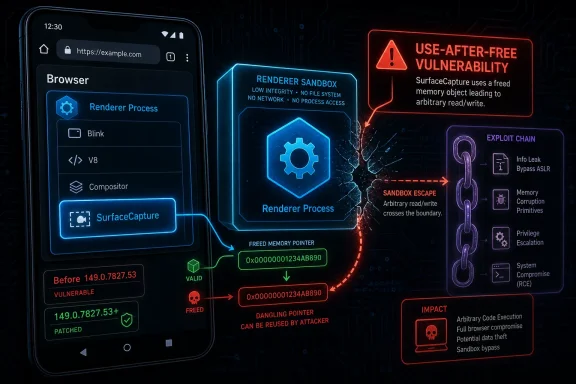 A Sandbox Escape Is the Part Attackers Save for Act Two
The most important phrase in the CVE description is not “crafted HTML page.” It is “had compromised the renderer process.” That condition means CVE-2026-10967 was not described as a standalone initial-entry bug; it was described as a way to move from a compromised renderer into something more powerful.That distinction matters because modern browsers are built around containment. The renderer is where untrusted web content does much of its work, and the sandbox is supposed to make that dangerous space survivable. If a malicious page breaks JavaScript, media, graphics, or DOM handling inside a renderer, the browser’s job is to keep the blast radius small.
A sandbox escape changes the economics. It turns “the tab is compromised” into “the browser’s isolation boundary may be compromised.” On Android, where the browser sits amid app sandboxing, permissions, WebView dependencies, account state, and device management controls, that is a meaningful escalation even when the CVE stops short of promising full device takeover.
That is why a high-severity score can understate the operational significance. CVE-2026-10967 is not frightening because every user is one tap away from catastrophe. It is frightening because it describes the kind of second-stage primitive that polished exploit chains need.
SurfaceCapture Sits in the Risky Borderland Between Web Content and the Device
The SurfaceCapture name points toward a component involved in capturing rendered surfaces, which is precisely the kind of browser subsystem that tends to live near complex, privilege-sensitive plumbing. Browser capture paths must coordinate graphics buffers, compositors, permissions, frames, surfaces, lifetimes, and handoffs between processes. That is fertile ground for memory-lifetime mistakes.A use-after-free bug is one of the oldest and most stubborn classes of memory safety failure. In plain English, software frees an object and later continues to use it as though it still exists. If an attacker can shape what occupies that freed memory, the stale pointer may become a lever for reading, corrupting, or controlling data the program never meant to expose.
Chrome’s security architecture has spent years trying to make those bugs harder to exploit. Site isolation, sandboxing, hardened allocators, compiler mitigations, MiraclePtr-style defenses, fuzzing, and process separation all raise the bar. Yet this CVE is a reminder that “harder” is not the same as “gone.”
The renderer precondition is also telling. Google and NVD did not describe a simple visit-and-escape scenario. They described a situation where the attacker has already compromised the renderer and then uses SurfaceCapture to cross a boundary. That is still serious, but it places the bug in the realistic world of chained browser exploitation rather than the cartoon version of a single magical CVE.
The Version Number Is the Patch Boundary, Not the Whole Story
The affected line is clean: Chrome on Android before 149.0.7827.53. For defenders, that makes the minimum action straightforward. Devices running older Android Chrome builds should be updated, and managed fleets should verify that the update actually landed rather than assuming Play Store auto-update completed the job.There is a wrinkle, though. Google’s June 2026 Chrome release train moved quickly. Chrome 149.0.7827.53 appeared as the security boundary for this CVE, while subsequent Chrome 149 updates were already arriving days later with additional fixes, including later builds for Android and desktop channels. In practice, “at least 149.0.7827.53” should not be read as “stop there forever.”
For individual users, the right answer is simple: install the newest Chrome build available from Google Play. For administrators, the answer is more tedious: inventory the actual deployed version, compare it against the current stable channel, and do not rely on a vulnerability scanner’s CPE match alone when the browser’s own update cadence has moved beyond the original CVE fix.
That is especially true in mixed environments. A Windows shop may treat Chrome as a desktop patching concern, while employees use Android devices for SSO, mail, password managers, chat, document review, and privileged approvals. Browser risk does not respect the platform boundary drawn in the asset spreadsheet.
The CPE Question Is Really a Modeling Problem
The user-submitted NVD change history shows a configuration using Google Chrome versions up to, but excluding, 149.0.7827.53, paired with Android as the operating system. That makes sense in ordinary vulnerability-database terms: the affected application is Chrome, and the platform context is Android.But the CPE model can still feel unsatisfying. Chrome on Android is not merely “desktop Chrome, but smaller.” It is distributed through Google Play, tied into Android’s app lifecycle, sometimes confused with Android System WebView in enterprise inventories, and often observed through mobile device management rather than traditional endpoint agents. A scanner may know there is Chrome; it may not know whether the vulnerable package is installed, enabled, current, or superseded by Play-managed update behavior.
So are we “missing a CPE”? Probably not in the narrow sense if the record already captures Google Chrome as the affected application and Android as the platform. But defenders are right to be skeptical of any configuration entry that makes mobile browser exposure look cleaner than it is. The useful question is not whether the database has the prettiest possible CPE string; it is whether your tooling can identify vulnerable Android Chrome builds before attackers can rely on them.
There is also a naming trap. Google’s product naming, Chromium’s component naming, Android package realities, and NVD’s CPE taxonomy do not always line up in ways that are intuitive to sysadmins. The affected product is Chrome on Android, not Android itself, and not necessarily every Chromium-derived browser unless that downstream vendor has inherited the vulnerable code path and shipped it unfixed.
That distinction is important for WindowsForum readers who support Microsoft Edge, Brave, Vivaldi, Chrome, WebView2, Android browsers, and corporate mobile fleets in the same breath. Chromium lineage is a signal to investigate; it is not a substitute for vendor-specific patch confirmation.
Chrome’s June Release Cadence Makes Single-CVE Thinking Look Antiquated
CVE-2026-10967 arrived inside a larger Chrome 149 security cycle, not as a lonely advisory. Google’s release notes around this period included large numbers of fixes across desktop and Android channels, and later June updates continued to move the stable branch forward. That cadence is now normal enough that treating any one Chrome CVE as an isolated event can lead to bad patch judgment.The browser has become an operating-system-like attack surface. It parses hostile code, renders hostile media, brokers permissions, handles identity sessions, talks to GPUs, manages extensions, processes downloads, and mediates enterprise policy. A single point release may contain fixes for memory corruption, validation errors, extension policy issues, media handling, graphics bugs, and sandbox-relevant defects.
CVE-2026-10967 sits in that larger pattern. It is a high-severity sandbox-escape candidate with a renderer compromise prerequisite. Nearby advisories describe other ways attackers might get into a renderer, trigger memory corruption, or abuse complex browser subsystems. The exploit developer thinks in chains; the patch manager must learn to think in chains too.
That does not mean panic-patching every Chrome release without testing. It means Chrome belongs in the fast lane of update policy. If an organization can patch VPN clients, EDR agents, and identity components rapidly, it can justify treating browsers with the same urgency.
Android Changes the Shape of Enterprise Exposure
On Windows, administrators often know where Chrome is installed, which update channel it follows, and whether Group Policy or enterprise management is keeping it current. On Android, the answer is more fractured. Some devices are fully managed, some are work-profile devices, some are BYOD phones with corporate apps, and some are invisible until they fail a conditional access check.That fragmentation matters for CVE-2026-10967 because the exploit path begins with web content. A user does not need to install a suspicious APK for browser risk to matter. A phishing link, malicious ad, compromised website, captive portal, or embedded web flow can put untrusted content in front of Chrome.
The renderer-compromise prerequisite does reduce immediate risk, but it does not eliminate it. Serious attackers routinely combine bugs: one flaw to compromise the renderer, another to escape the sandbox, another to persist or steal tokens, and yet another to avoid detection. In that model, a SurfaceCapture use-after-free is not the whole weapon; it is a component in the weapon.
Mobile identity raises the stakes. Android Chrome may hold active sessions to Microsoft 365, Google Workspace, admin consoles, password vaults, SaaS dashboards, and internal portals. Even when app sandboxing prevents broad device compromise, a browser escape that improves access to local browser state or adjacent capabilities can have practical consequences.
The Absence of Known Exploitation Is Comfort, Not Clearance
The public record around CVE-2026-10967 did not describe active exploitation in the way later Chrome advisories sometimes do for zero-days. That matters. There is a difference between “patched because it is dangerous” and “patched because attackers are already using it.”But absence of public exploitation is a weak form of reassurance. Chrome bug details are often restricted until most users have updated, which is good defensive practice but leaves administrators judging from sparse prose. The more interesting a bug is to exploit developers, the less likely the public will have all the details while patch adoption is still incomplete.
CISA’s enrichment placed the CVSS 3.1 score at 8.3 high, with network attack vector, required user interaction, high attack complexity, no privileges required, changed scope, and high impact to confidentiality, integrity, and availability. That vector captures the odd balance of the bug: difficult to exploit, but potentially severe if successfully chained.
This is exactly the category that tempts organizations into delay. It is not a screaming unauthenticated server RCE. It is not a publicly exploited zero-day, at least based on the disclosed record. It is a browser sandbox escape for Android that requires a prior renderer compromise. Yet that is also why capable attackers may value it.
Memory Safety Keeps Sending the Same Invoice
Use-after-free vulnerabilities are not new, but their persistence in modern browsers remains one of the industry’s most important security facts. Chrome is among the most aggressively tested consumer software products in the world. It has world-class fuzzing, hardening, bug bounties, release engineering, and telemetry. The bugs still appear.That should not be read as failure by Google alone. It is evidence that C and C++ memory safety debt continues to tax the entire software ecosystem. Browser vendors can mitigate, sandbox, isolate, fuzz, and refactor, but complex native code remains an inexhaustible source of subtle lifecycle errors.
Microsoft has reached similar conclusions in its own security messaging around memory-safe languages and hardened platform components. Mozilla, Google, Apple, Microsoft, and the wider security community have all been moving parts of the stack toward safer patterns. The transition is real, but the installed base of complex native browser code is enormous.
CVE-2026-10967 is therefore both a specific Chrome Android issue and another receipt from a long-running technical debt account. The industry knows the class of bug. It knows the likely consequences. It also knows that replacing or hardening the affected strata takes years.
Windows Administrators Should Not File This Under “Android Only”
It would be easy for a Windows-heavy forum to treat this CVE as somebody else’s problem. The product line says Chrome on Android, after all. But that interpretation misses how modern enterprise access works.Windows administrators increasingly manage identity and risk, not just Windows endpoints. A compromised Android browser session can become a Microsoft 365 incident. A mobile device with stale Chrome can be the place where an administrator approves MFA, opens a SharePoint link, signs into Entra-connected apps, or checks an alert from a privileged account.
There is also the Chromium ecosystem angle. Windows shops frequently run Chrome, Edge, Electron apps, WebView2 components, and mobile Chromium derivatives. CVE-2026-10967 may be Android-specific in its disclosed affected configuration, but the operational muscle used to respond to it is the same muscle required for every Chromium security cycle: fast inventory, fast version verification, fast exception handling, and fast user communication.
The Windows lesson is not “patch Android because Android is scary.” It is “your browser patching model must account for every place Chromium mediates identity, content, and code.” That includes devices that do not appear in the same console as your Windows laptops.
The Practical Response Is Boring, Which Is Why It Works
The fix path for CVE-2026-10967 is not exotic. Update Chrome on Android to a fixed version, preferably the latest stable release available rather than merely the first build named in the CVE. Verify the version on managed devices. Watch for downstream vendor advisories if you manage Chromium-based browsers beyond Google Chrome.The harder part is policy. Organizations should decide how quickly mobile browsers must update after high-severity browser advisories, how they will detect lagging devices, and what conditional access posture applies to stale builds. If the answer is “we hope Google Play gets to it,” the organization has not made a decision; it has outsourced one.
For users, the advice is equally plain. Open Google Play, update Chrome, and restart the browser. If the device is managed, let the update complete before assuming the MDM dashboard has caught up. If Chrome cannot update because of an old Android version, storage problem, enterprise restriction, or unsupported device, that is not a cosmetic issue; it is a security lifecycle problem.
For defenders, the useful telemetry is not a CVE count. It is time-to-current. How many hours or days elapse between a Chrome stable security update and your fleet reaching that build? For browser vulnerabilities, that metric is often more meaningful than the severity label.
The Patch Boundary Moves Faster Than the Advisory
One complication with Chrome security is that the advisory you read today may not be the newest patch boundary tomorrow. In this case, CVE-2026-10967 points to versions before 149.0.7827.53, while Google’s later Chrome 149 updates were already distributing newer builds. That is normal, but it can confuse vulnerability management systems that freeze on the first fixed version they ingest.A scanner may say “fixed” once a device crosses 149.0.7827.53. That may be accurate for CVE-2026-10967 and still insufficient for the next Chrome flaw. Conversely, a device may appear vulnerable because a CPE feed lags behind vendor channel reality. Chrome’s release rhythm punishes static thinking.
This is where administrators need both CVE-based and channel-based views. CVE-based reporting answers, “Are we exposed to this named vulnerability?” Channel-based reporting answers, “Are we current with the vendor’s latest security train?” Mature browser management needs both.
The same applies to exceptions. If a business unit freezes Chrome updates because an internal web app breaks, that exception is no longer just a compatibility note. It is a widening exposure window across every browser CVE shipped after the freeze.
The SurfaceCapture Bug Leaves Five Jobs for Defenders
CVE-2026-10967 is not the loudest Chrome bug of the year, and that is precisely why it is a useful test case. It separates organizations that patch only when headlines say “zero-day” from those that understand how browser exploit chains are assembled.- Organizations should update Chrome on Android beyond 149.0.7827.53 and aim for the newest stable build available through Google Play.
- Security teams should verify Android Chrome versions directly instead of assuming mobile auto-update has completed across the fleet.
- Vulnerability managers should treat the Chrome CPE plus Android platform entry as a useful signal, not a complete picture of mobile browser exposure.
- Administrators should check Chromium-based browsers and embedded web components separately because a Google Chrome CVE does not automatically prove every downstream product is fixed.
- Conditional access policies should consider stale mobile browsers as identity risk, not merely endpoint hygiene.
- Browser patch metrics should track time-to-current across Windows, macOS, Linux, Android, and managed mobile profiles rather than reporting only desktop compliance.
References
- Primary source: NVD / Chromium
Published: 2026-06-09T07:00:38-07:00
NVD - CVE-2026-10967
 nvd.nist.gov
- Security advisory: MSRC
Published: 2026-06-09T07:00:38-07:00
Original feed URL
Security Update Guide - Microsoft Security Response Center
 msrc.microsoft.com
