

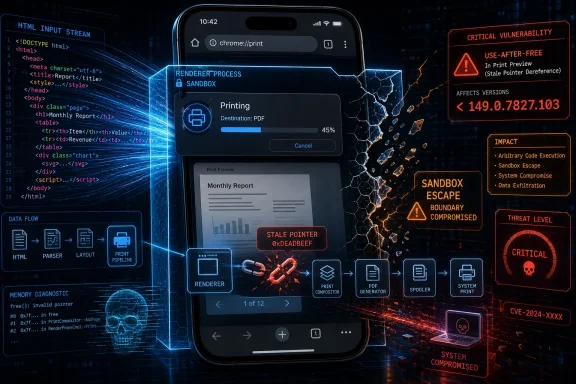
Google’s CVE-2026-11647 is a high-severity use-after-free flaw in Chrome’s Printing component on Android, disclosed June 8, 2026, affecting versions before 149.0.7827.103 and potentially allowing a renderer-compromising attacker to escape the browser sandbox with a crafted HTML page. That is the dry version. The more useful version is that this is not “just another Chrome bug” so much as another reminder that the browser’s least glamorous subsystems can still sit on the path from web content to device compromise. Printing sounds mundane; in browser security, mundane code is often where assumptions go to die.
The phrase use after free has become so familiar in Chromium advisories that it risks sounding routine. It should not. A use-after-free bug means software continues to use memory after it has been released, creating a window where carefully shaped input can turn stale pointers into attacker-controlled behavior.
In CVE-2026-11647, the affected area is Chrome’s Printing component on Android. The published description says a remote attacker who had already compromised the renderer process could potentially perform a sandbox escape through a crafted HTML page. That wording matters because it places the bug in the second act of an attack, not the first.
Chrome’s renderer sandbox is designed to contain hostile web content. If a malicious page exploits a renderer vulnerability, the browser’s security model is supposed to keep that foothold boxed in, away from broader device capabilities and sensitive system interfaces. A sandbox escape is the failure mode where the box starts to leak.
That is why this CVE is important even though it is not described as an initial code-execution bug by itself. The attacker first needs renderer compromise, but modern exploit chains are built exactly this way: one bug to get into the renderer, another to get out of it, and sometimes a third to harden persistence or deepen access. CVE-2026-11647 belongs to the uncomfortable middle of that chain.
It is narrower because the disclosed CVE specifically names Chrome on Android before version 149.0.7827.103. The NVD configuration history also ties the Chrome application CPE to Android as the operating system context, which is a useful hint for vulnerability management teams trying to avoid over-scoping the issue across every Chrome platform.
It is broader because Android devices are often harder to inventory than desktops. Enterprises may know exactly which Windows laptops are running which browser build, yet have weaker visibility into personally owned Android phones, field devices, rugged tablets, shared kiosks, or managed devices sitting outside the normal patch rhythm. Browser bugs do not respect the artificial boundary between “corporate endpoint” and “mobile convenience.”
There is also a behavioral difference. On desktop, printing is a familiar browser workflow. On mobile, printing sounds less central, but browser printing code can still be reached through preview paths, document handling, web content rendering, PDF-adjacent workflows, and platform integrations that ordinary users rarely think about. Attackers do not need users to understand a component for that component to be attack surface.
The “high complexity” part is doing real work. A sandbox escape that depends on a prior renderer compromise is not the same thing as a one-click, universal remote takeover. It likely requires exploit chaining, careful grooming of browser state, and enough target specificity to make the exploit reliable.
But high complexity is not the same as theoretical. Chrome exploitation has been an arms race for years, and sophisticated actors routinely chain bugs when the target is worth the cost. For defenders, the presence of complexity should shape prioritization, not justify inaction.
The more revealing part of the vector is scope changed, with high impacts to confidentiality, integrity, and availability. In plain English, once the sandbox boundary is crossed, the potential consequence is no longer limited to misbehaving web content. The exploit can become a bridge from the web page into more privileged browser or system territory.
That mismatch is common in fast-moving vulnerability publication. A CNA publishes a CVE, enrichment systems add vendor references and preliminary scoring, CISA or another party contributes a vector, and NVD’s own analysis may lag or appear incomplete. For scanners and patch dashboards, that can create a liminal period where the vulnerability is real but metadata is still settling.
The CPE question is especially important here. The listed configuration combines Google Chrome versions before 149.0.7827.103 with Android as the operating system. That reads like the correct intent: Chrome on Android, not generic Android itself, is the vulnerable product context.
Still, CPE modeling is notoriously awkward for browsers because a browser is both an application and an ecosystem component. On Android, Chrome may be updated through the Play Store, managed enterprise channels, OEM images, or delayed fleet policies. A clean CPE does not guarantee clean detection.
For WindowsForum readers, the immediate point is simple: do not treat “NVD assessment not yet provided” as “not real yet.” The vendor advisory and CVE assignment are enough to drive patch validation. NVD enrichment is helpful, but it is not the starting gun for remediation.
That makes the CVE-2026-11647 record easy to misread. Administrators skimming the release note may see desktop version numbers, desktop package names, and a more urgent zero-day narrative around V8. Meanwhile, the Printing issue’s description explicitly says Chrome on Android.
The result is a classic patch-management trap: the loudest item in the advisory is not necessarily the only one that matters, and the platform-specific item may be buried inside a cross-platform release train. Security teams that rely on one-line summaries can miss the distinction between “Chrome update for desktop” and “Chrome CVE affecting Android.”
This is where vendor release engineering and vulnerability disclosure collide. Chrome ships in coordinated waves, but CVEs describe product-specific flaws. The release note is a vehicle; the CVE is the object. Treating them as interchangeable is how organizations end up either over-alerting everyone or under-patching the devices that actually matter.
In Chromium, the printing pipeline has to handle hostile web content while preparing output that may interact with operating-system print services or cloud print abstractions. Even if the exact bug details remain restricted, the component category alone explains why the issue deserves attention. Any subsystem that transforms attacker-controlled markup into privileged workflows is worth scrutiny.
The Android angle makes this even more interesting. Mobile printing is less common than desktop printing, which can lead defenders to mentally downgrade it. But attack surface is not popularity; it is reachability plus consequence. If a crafted HTML page can trigger vulnerable code paths, the fact that users rarely print from phones is not much comfort.
Google and Chromium maintainers often restrict bug details until most users are patched. That is prudent, but it leaves defenders with a familiar information gap. We know the class, the component, the affected version boundary, and the rough exploit precondition. We do not know the exploit technique, reliability, or whether it was found during proactive research, fuzzing, or incident response.
A company may have fully managed Android Enterprise devices, personally enabled work-profile devices, rugged scanners, shared tablets, kiosks, point-of-sale devices, and executive phones all under different policy regimes. Some receive Play Store updates quickly. Others are pinned, controlled by OEM firmware cadence, or separated from standard user behavior.
That fragmentation is where a Chrome Android CVE becomes operationally relevant. The fix is straightforward in consumer terms: update Chrome to at least 149.0.7827.103. The enterprise challenge is proving every relevant device has done so.
Administrators should also remember that mobile browsers are often ignored in vulnerability dashboards built around desktop agents. If the asset inventory cannot answer which Android devices run Chrome below the fixed version, the organization does not have a Chrome patching program; it has a desktop Chrome patching program with mobile hopes attached.
This is particularly important for high-risk users. Journalists, executives, government staff, developers with production access, security teams, and employees working in sensitive regions are more plausible targets for chained browser exploitation. Those are the users for whom “high complexity” is least reassuring.
CVE-2026-11647 requires prior renderer compromise, so on its own it may not sound like a complete exploit. But the June 2026 Chrome update also involved other serious vulnerabilities, including the separately reported V8 issue that drew attention because Google acknowledged exploitation in the wild. Even when two bugs are not known to be chained together, their coexistence in a release window is a reminder of how modern browser attacks are assembled.
The renderer is the beachhead. The sandbox escape is the breakout. The post-escape payload is the point. In that framing, a Printing use-after-free is not a curiosity; it is a possible hinge between web compromise and broader device impact.
Defenders should resist both extremes. It is wrong to describe every high-severity Chrome bug as an imminent mass-exploitation crisis. It is also wrong to dismiss a sandbox escape because it needs another vulnerability first. Browser security is layered precisely because individual layers fail.
The practical response is to update quickly, verify coverage, and assume that high-value targets face chained exploitation before commodity telemetry makes the chain obvious. Waiting for public proof-of-concept code is not prudence. It is surrendering the timing advantage.
Browsers now hold session cookies, passkeys, enterprise SSO flows, cloud console access, password managers, device permissions, and internal application entry points. A browser sandbox escape is not just a browser problem; it is a potential identity, data, and endpoint problem. That is why browser patching belongs in the same seriousness tier as operating-system patching.
The cross-platform Chromium ecosystem also means that component bugs can ripple beyond Google Chrome. Microsoft Edge, Brave, Vivaldi, Opera, embedded Chromium surfaces, and Android WebView-related paths each have their own update mechanisms and exposure profiles. CVE-2026-11647 is described for Chrome on Android, but the broader lesson is that Chromium component boundaries often matter across products even when a particular CVE record is scoped narrowly.
This is also why version precision matters. Chrome 149 is not enough. The relevant fixed boundary in the CVE description is 149.0.7827.103 for Android. Security teams should avoid reporting “Chrome 149 deployed” as remediation unless they verify the exact build meets or exceeds the fixed version for the affected platform.
Google’s staged rollout model is good for stability, but it complicates security response. A patch may be published before every device receives it automatically. Users may need to open the Play Store, administrators may need to force update policies, and managed devices may need compliance checks rather than assumptions.
For Android, there is also a human factor. Users are trained to think of browser updates as background noise. They may not know what Chrome version they have, whether auto-update is paused, or whether a managed profile affects update behavior. In enterprise settings, that makes user education less effective than administrative enforcement.
The right operational question is not “Has Google fixed it?” The right question is “Have our vulnerable devices consumed the fix?” The difference is where most patch programs succeed or fail.
 The Printing Bug Is Really a Sandbox Story
The phrase use after free has become so familiar in Chromium advisories that it risks sounding routine. It should not. A use-after-free bug means software continues to use memory after it has been released, creating a window where carefully shaped input can turn stale pointers into attacker-controlled behavior.In CVE-2026-11647, the affected area is Chrome’s Printing component on Android. The published description says a remote attacker who had already compromised the renderer process could potentially perform a sandbox escape through a crafted HTML page. That wording matters because it places the bug in the second act of an attack, not the first.
Chrome’s renderer sandbox is designed to contain hostile web content. If a malicious page exploits a renderer vulnerability, the browser’s security model is supposed to keep that foothold boxed in, away from broader device capabilities and sensitive system interfaces. A sandbox escape is the failure mode where the box starts to leak.
That is why this CVE is important even though it is not described as an initial code-execution bug by itself. The attacker first needs renderer compromise, but modern exploit chains are built exactly this way: one bug to get into the renderer, another to get out of it, and sometimes a third to harden persistence or deepen access. CVE-2026-11647 belongs to the uncomfortable middle of that chain.
Android Makes the Blast Radius Different
Chrome on Android is not merely a mobile copy of desktop Chrome. It lives inside Android’s application sandbox, interacts with mobile permission models, and increasingly serves as a dependency for other browsing surfaces and embedded web workflows. That makes Chrome security on Android both narrower and broader than it looks.It is narrower because the disclosed CVE specifically names Chrome on Android before version 149.0.7827.103. The NVD configuration history also ties the Chrome application CPE to Android as the operating system context, which is a useful hint for vulnerability management teams trying to avoid over-scoping the issue across every Chrome platform.
It is broader because Android devices are often harder to inventory than desktops. Enterprises may know exactly which Windows laptops are running which browser build, yet have weaker visibility into personally owned Android phones, field devices, rugged tablets, shared kiosks, or managed devices sitting outside the normal patch rhythm. Browser bugs do not respect the artificial boundary between “corporate endpoint” and “mobile convenience.”
There is also a behavioral difference. On desktop, printing is a familiar browser workflow. On mobile, printing sounds less central, but browser printing code can still be reached through preview paths, document handling, web content rendering, PDF-adjacent workflows, and platform integrations that ordinary users rarely think about. Attackers do not need users to understand a component for that component to be attack surface.
The CVSS Score Says “Hard,” Not “Harmless”
CISA-ADP assigned the CVSS 3.1 vector AV:N/AC:H/PR:N/UI:R/S:C/C:H/I:H/A:H, with a base score of 8.3. That is a useful severity score precisely because it is not a panic button. It says the flaw is network reachable and requires no privileges, but it also says attack complexity is high and user interaction is required.The “high complexity” part is doing real work. A sandbox escape that depends on a prior renderer compromise is not the same thing as a one-click, universal remote takeover. It likely requires exploit chaining, careful grooming of browser state, and enough target specificity to make the exploit reliable.
But high complexity is not the same as theoretical. Chrome exploitation has been an arms race for years, and sophisticated actors routinely chain bugs when the target is worth the cost. For defenders, the presence of complexity should shape prioritization, not justify inaction.
The more revealing part of the vector is scope changed, with high impacts to confidentiality, integrity, and availability. In plain English, once the sandbox boundary is crossed, the potential consequence is no longer limited to misbehaving web content. The exploit can become a bridge from the web page into more privileged browser or system territory.
NVD’s Incomplete Enrichment Is a Practical Problem
The user-visible messiness around this CVE is not accidental. NVD’s record shows the vulnerability was received from Chrome on June 8, modified by CISA-ADP the same day with CVSS data, and then initially analyzed by NIST on June 9 with a CPE configuration added. Yet the NVD CVSS fields still show NVD assessment as not yet provided.That mismatch is common in fast-moving vulnerability publication. A CNA publishes a CVE, enrichment systems add vendor references and preliminary scoring, CISA or another party contributes a vector, and NVD’s own analysis may lag or appear incomplete. For scanners and patch dashboards, that can create a liminal period where the vulnerability is real but metadata is still settling.
The CPE question is especially important here. The listed configuration combines Google Chrome versions before 149.0.7827.103 with Android as the operating system. That reads like the correct intent: Chrome on Android, not generic Android itself, is the vulnerable product context.
Still, CPE modeling is notoriously awkward for browsers because a browser is both an application and an ecosystem component. On Android, Chrome may be updated through the Play Store, managed enterprise channels, OEM images, or delayed fleet policies. A clean CPE does not guarantee clean detection.
For WindowsForum readers, the immediate point is simple: do not treat “NVD assessment not yet provided” as “not real yet.” The vendor advisory and CVE assignment are enough to drive patch validation. NVD enrichment is helpful, but it is not the starting gun for remediation.
The Desktop Advisory Adds Noise to the Android Signal
One oddity in the record is that the cited Chrome Releases post is a Stable Channel Update for Desktop. That advisory covered Chrome 149.0.7827.102/.103 for Windows and Mac and 149.0.7827.102 for Linux, along with a large batch of security fixes. It also included a separate actively exploited V8 issue, CVE-2026-11645.That makes the CVE-2026-11647 record easy to misread. Administrators skimming the release note may see desktop version numbers, desktop package names, and a more urgent zero-day narrative around V8. Meanwhile, the Printing issue’s description explicitly says Chrome on Android.
The result is a classic patch-management trap: the loudest item in the advisory is not necessarily the only one that matters, and the platform-specific item may be buried inside a cross-platform release train. Security teams that rely on one-line summaries can miss the distinction between “Chrome update for desktop” and “Chrome CVE affecting Android.”
This is where vendor release engineering and vulnerability disclosure collide. Chrome ships in coordinated waves, but CVEs describe product-specific flaws. The release note is a vehicle; the CVE is the object. Treating them as interchangeable is how organizations end up either over-alerting everyone or under-patching the devices that actually matter.
Printing Remains a Strange but Persistent Attack Surface
Printing has a long history of being more security-sensitive than its reputation suggests. It touches document parsing, rendering, preview generation, device discovery, permissions, system dialogs, and platform APIs. It is a place where decades of user expectations meet modern browser isolation.In Chromium, the printing pipeline has to handle hostile web content while preparing output that may interact with operating-system print services or cloud print abstractions. Even if the exact bug details remain restricted, the component category alone explains why the issue deserves attention. Any subsystem that transforms attacker-controlled markup into privileged workflows is worth scrutiny.
The Android angle makes this even more interesting. Mobile printing is less common than desktop printing, which can lead defenders to mentally downgrade it. But attack surface is not popularity; it is reachability plus consequence. If a crafted HTML page can trigger vulnerable code paths, the fact that users rarely print from phones is not much comfort.
Google and Chromium maintainers often restrict bug details until most users are patched. That is prudent, but it leaves defenders with a familiar information gap. We know the class, the component, the affected version boundary, and the rough exploit precondition. We do not know the exploit technique, reliability, or whether it was found during proactive research, fuzzing, or incident response.
Enterprise Android Fleets Need Browser Patch Discipline
For managed Windows fleets, Chrome patching is almost muscle memory. Admins push updates, watch versions, and verify compliance through endpoint tooling. Android fleets are often more fragmented.A company may have fully managed Android Enterprise devices, personally enabled work-profile devices, rugged scanners, shared tablets, kiosks, point-of-sale devices, and executive phones all under different policy regimes. Some receive Play Store updates quickly. Others are pinned, controlled by OEM firmware cadence, or separated from standard user behavior.
That fragmentation is where a Chrome Android CVE becomes operationally relevant. The fix is straightforward in consumer terms: update Chrome to at least 149.0.7827.103. The enterprise challenge is proving every relevant device has done so.
Administrators should also remember that mobile browsers are often ignored in vulnerability dashboards built around desktop agents. If the asset inventory cannot answer which Android devices run Chrome below the fixed version, the organization does not have a Chrome patching program; it has a desktop Chrome patching program with mobile hopes attached.
This is particularly important for high-risk users. Journalists, executives, government staff, developers with production access, security teams, and employees working in sensitive regions are more plausible targets for chained browser exploitation. Those are the users for whom “high complexity” is least reassuring.
The Exploit Chain Is the Real Unit of Risk
CVE records naturally isolate flaws. Attackers do not. They compose them.CVE-2026-11647 requires prior renderer compromise, so on its own it may not sound like a complete exploit. But the June 2026 Chrome update also involved other serious vulnerabilities, including the separately reported V8 issue that drew attention because Google acknowledged exploitation in the wild. Even when two bugs are not known to be chained together, their coexistence in a release window is a reminder of how modern browser attacks are assembled.
The renderer is the beachhead. The sandbox escape is the breakout. The post-escape payload is the point. In that framing, a Printing use-after-free is not a curiosity; it is a possible hinge between web compromise and broader device impact.
Defenders should resist both extremes. It is wrong to describe every high-severity Chrome bug as an imminent mass-exploitation crisis. It is also wrong to dismiss a sandbox escape because it needs another vulnerability first. Browser security is layered precisely because individual layers fail.
The practical response is to update quickly, verify coverage, and assume that high-value targets face chained exploitation before commodity telemetry makes the chain obvious. Waiting for public proof-of-concept code is not prudence. It is surrendering the timing advantage.
The Browser Has Become the Operating System’s Most Exposed Door
For Windows users and admins, a Chrome Android CVE may seem peripheral. It is not. The security lesson applies directly to every platform where browsers mediate identity, documents, cloud apps, and administrative workflows.Browsers now hold session cookies, passkeys, enterprise SSO flows, cloud console access, password managers, device permissions, and internal application entry points. A browser sandbox escape is not just a browser problem; it is a potential identity, data, and endpoint problem. That is why browser patching belongs in the same seriousness tier as operating-system patching.
The cross-platform Chromium ecosystem also means that component bugs can ripple beyond Google Chrome. Microsoft Edge, Brave, Vivaldi, Opera, embedded Chromium surfaces, and Android WebView-related paths each have their own update mechanisms and exposure profiles. CVE-2026-11647 is described for Chrome on Android, but the broader lesson is that Chromium component boundaries often matter across products even when a particular CVE record is scoped narrowly.
This is also why version precision matters. Chrome 149 is not enough. The relevant fixed boundary in the CVE description is 149.0.7827.103 for Android. Security teams should avoid reporting “Chrome 149 deployed” as remediation unless they verify the exact build meets or exceeds the fixed version for the affected platform.
The Patch Window Is Where the Risk Lives
Most Chrome users eventually update. The dangerous period is the gap between disclosure and saturation. During that window, attackers can study patches, infer vulnerability details, and try to weaponize the difference between old and new builds.Google’s staged rollout model is good for stability, but it complicates security response. A patch may be published before every device receives it automatically. Users may need to open the Play Store, administrators may need to force update policies, and managed devices may need compliance checks rather than assumptions.
For Android, there is also a human factor. Users are trained to think of browser updates as background noise. They may not know what Chrome version they have, whether auto-update is paused, or whether a managed profile affects update behavior. In enterprise settings, that makes user education less effective than administrative enforcement.
The right operational question is not “Has Google fixed it?” The right question is “Have our vulnerable devices consumed the fix?” The difference is where most patch programs succeed or fail.
The Concrete Read for Chrome-on-Android Defenders
This CVE does not require theatrical advice. It requires version control, inventory, and a sober view of exploit chaining. The following points are the ones that should survive the dashboard meeting.- Chrome on Android versions before 149.0.7827.103 should be treated as vulnerable to CVE-2026-11647.
- The flaw is a use-after-free in the Printing component and is categorized under CWE-416.
- The published attack scenario requires a compromised renderer process, which makes the vulnerability more relevant as part of an exploit chain than as a standalone initial-entry bug.
- The CISA-ADP CVSS 3.1 score is 8.3 high, with high impact to confidentiality, integrity, and availability once the required conditions are met.
- NVD’s incomplete native assessment should not delay remediation because the CVE record, vendor reference, and contributed CVSS data are sufficient to justify action.
- Android fleet owners should verify exact Chrome build numbers rather than relying on broad “Chrome 149” labels or desktop-oriented patch reports.
References
- Primary source: NVD / Chromium
Published: 2026-06-15T19:13:56-07:00
NVD - CVE-2026-11647
 nvd.nist.gov
- Security advisory: MSRC
Published: 2026-06-15T19:13:56-07:00
Original feed URL
Security Update Guide - Microsoft Security Response Center
 msrc.microsoft.com
- Related coverage: radar.offseq.com
CVE-2026-11647: Use after free in Google Chrome - Live Threat Intelligence - Threat Radar | OffSeq.com
Detailed information about CVE-2026-11647: Use after free in Google Chrome affecting Google Chrome. Get real-time updates, technical details, and mitigation strradar.offseq.com
