

Google published CVE-2026-12009 on June 11, 2026, describing a Critical Chromium Accessibility flaw in Google Chrome for Mac before version 149.0.7827.115 that could let an attacker who already compromised the renderer process escape the browser sandbox through a crafted HTML page. The bug is narrow in platform and exploit conditions, but broad in implication: Chrome’s hardest security promises still depend on the fragile boundary between web content and operating-system services. For WindowsForum readers, the lesson is not that macOS users alone should worry; it is that browser sandbox escapes have become the currency of serious attack chains. Patch cadence, browser diversity, and endpoint visibility matter more than the reassuring word sandbox.
CVE-2026-12009 is not the kind of browser flaw that lets any random web page immediately own a machine. Its description contains an important precondition: the attacker must already have compromised the renderer process. In Chrome’s architecture, the renderer is where untrusted web content is supposed to be contained, isolated from the operating system by process separation, privilege reduction, and brokered access to sensitive capabilities.
That is why the phrase “sandbox escape” does so much work here. The first bug gets an attacker into the room; the sandbox escape opens the door to the hallway. Modern exploitation is often a chain, not a single dramatic flaw, and CVE-2026-12009 appears to be positioned as the second stage in that chain.
The vulnerable component is Accessibility on Mac, a part of the browser that exists for excellent reasons and creates uncomfortable security edges. Accessibility interfaces must translate page structure, user interface state, focus, labels, roles, and actions into forms that assistive technologies can consume. That means they sit near a boundary between untrusted web content and privileged system-facing behavior.
Google’s severity rating of Critical is therefore unsurprising even though the CISA ADP CVSS score is listed as 8.3 High. Security severity and CVSS often answer different questions. Chrome’s own severity reflects how dangerous the bug is inside the browser’s threat model, while CVSS attempts to standardize attack complexity, user interaction, scope change, and impact across a far wider vulnerability universe.
That is the promise the sandbox makes. A renderer compromise should not automatically become file-system access, credential theft, persistence, or arbitrary interaction with the operating system. It should be a contained failure, a breach of a compartment rather than a breach of the ship.
CVE-2026-12009 matters because it lives beyond that first failure. The attacker described by the advisory already has a foothold in the renderer. The question becomes whether the rest of Chrome, macOS, and the browser’s privileged services can keep that compromised renderer from turning into a system-level compromise.
This is also why browser vendors tend to treat sandbox escapes with urgency. A renderer remote-code-execution bug might be bad; a renderer bug paired with a sandbox escape is the kind of chain that turns a malicious web page into a real intrusion path. The public advisory does not say this vulnerability is being actively exploited, and that distinction matters. But exploit developers do not need a zero-day badge to care about a reliable escape primitive.
That requirement creates a difficult security problem. Accessibility subsystems need to describe untrusted content in structured ways, respond to user-interface events, and sometimes bridge into platform APIs. On macOS, that means Chrome’s accessibility implementation has to cooperate with Apple’s accessibility frameworks while maintaining Chrome’s own sandbox boundaries.
The vulnerability description points to “insufficient validation of untrusted input.” That phrase is generic, but in this context it is suggestive. Web content can influence accessibility trees and metadata. If some part of that data crosses from a less-trusted renderer into a more-privileged browser or platform-facing path without strict validation, the result can be more than a crash.
This is the uncomfortable part for browser engineering: the more faithfully a browser represents complex web applications to assistive tools, the more carefully it must police the representations. Rich accessibility support is a user-rights victory and a security engineering burden at the same time. The answer is not to weaken accessibility, but to treat it as first-class attack surface.
But Windows administrators should resist the temptation to file it under “someone else’s problem.” Chromium is a shared codebase, and security fixes often illuminate classes of bugs rather than isolated accidents. A Mac-only sandbox escape in Accessibility may depend on macOS APIs, process privileges, or implementation details, but the general lesson travels: every brokered interface between renderer and privileged browser code deserves suspicion.
Enterprise fleets are rarely as cleanly separated as dashboards suggest. Developers may use Macs, executives may carry MacBooks, contractors may authenticate from personal devices, and security tooling may treat browsers as update-afterthoughts compared with operating systems. A browser escape on a non-Windows endpoint can still become a corporate incident if that endpoint holds session tokens, VPN access, cloud credentials, source code, or administrator portals.
For WindowsForum’s core audience, the practical read is this: do not evaluate browser CVEs only by OS label. Evaluate them by whether the vulnerable browser exists anywhere in the trust fabric of your environment. A MacBook in the hands of a domain admin or cloud engineer is not a side quest.
The “high attack complexity” element is doing important work. CVE-2026-12009 is not described as a one-click complete compromise from a clean browser state. It requires the renderer to be compromised first, meaning the attacker needs a separate vulnerability, a malicious extension path, a logic abuse route, or some other way to gain code execution or equivalent control inside the renderer.
But the “scope changed” and high impact fields are equally important. A sandbox escape is precisely the kind of bug that crosses the boundary CVSS cares about. It changes the blast radius from browser-contained code to something with wider system consequences.
This difference between exploitability and consequence is where many patch debates go wrong. A vulnerability can be hard to exploit and still be urgent to patch because it is valuable as part of a chain. Attackers who buy, steal, or develop renderer exploits need escapes; defenders who patch escapes break chains.
This is not a knock on Chrome alone. The browser is now a runtime, document viewer, identity broker, app platform, graphics engine, media stack, PDF handler, and increasingly an enterprise control surface. Every major browser lives with similar pressures. Chromium’s scale merely makes the churn more visible.
The security industry tends to treat browser updates as routine until a zero-day forces attention. That is backwards. Routine browser updates are the mechanism that prevents many vulnerabilities from becoming zero-day incidents in the first place. The fact that a CVE appears in a stable-channel patch note rather than a breach report is not a reason to delay; it is the system working.
The problem is that “the system working” still depends on users and administrators completing the last mile. Chrome may update itself for many consumer users, but enterprise channels, managed policies, testing rings, frozen images, VDI environments, kiosks, and application compatibility exceptions can all slow deployment. Attackers do not need every endpoint to lag. They need the important ones.
Of course, user interaction is still required in the CVSS vector. Someone must visit a page, click a link, open content, or otherwise cause the malicious input to reach the browser. But phishing, malvertising, compromised legitimate sites, messaging links, SEO poisoning, and watering-hole attacks all exist because getting a user to load a page remains one of the easiest tasks in offensive operations.
The modern web’s defensive posture often assumes layers: site isolation, Safe Browsing, exploit mitigations, JIT hardening, memory safety work, sandboxing, OS notarization, endpoint detection, and patching. CVE-2026-12009 is a reminder that those layers are not interchangeable. If a renderer bug defeats one layer and an accessibility bug defeats the next, the chain starts to look far less theoretical.
This is also why “just don’t click bad links” is not a strategy. It is advice, and not very good advice at scale. Organizations need browsers that patch quickly, endpoint controls that can see suspicious post-exploitation behavior, and policies that reduce the value of any one browser session.
The NVD entry also shows the limits of that pipeline. At the time reflected in the provided detail, NVD had not supplied its own CVSS score, while CISA ADP had. The weakness mapping included Chrome’s CWE-20 classification and NIST’s no-information placeholder. The issue tracker reference required permissions, which is typical for sensitive Chromium security bugs.
None of that is scandalous. Browser vendors often keep bug details restricted until enough users are patched, and NVD enrichment can lag or differ from vendor descriptions. What matters for defenders is not waiting for the perfect database record before acting.
Security teams sometimes over-index on NVD completeness because it feels authoritative and machine-readable. But the most important facts here are already enough: Chrome for Mac before 149.0.7827.115 is affected, the bug is a sandbox escape candidate, the attacker needs renderer compromise, and Google rated it Critical. That is sufficient to trigger update validation.
In managed environments, the work is less glamorous. Administrators need inventory that reports actual browser versions, not merely installed package versions. They need to know which machines are pinned, which policies defer updates, which users habitually postpone restarts, and which alternate Chromium-based browsers may share related code but follow different patch schedules.
That last point deserves care. CVE-2026-12009 is assigned to Google Chrome, and the described affected software is Chrome on Mac. It should not be automatically projected onto every Chromium-derived browser without vendor confirmation. But administrators should still check Edge, Brave, Vivaldi, Opera, Electron-based apps, and embedded Chromium runtimes according to their vendors’ advisories, because shared upstream fixes frequently ripple outward.
The gap between “a patch exists” and “the risk is retired” is where enterprise browser security lives. Version drift is a vulnerability class of its own. In some organizations, the browser updates faster than the asset database can notice; in others, the asset database is the only place where everything appears green.
Accessibility is one of those brokered zones. The renderer understands the page; privileged browser or platform code may need to expose selected information to assistive technologies. Every message across that seam is a trust decision. Every parser, serializer, object handle, identifier, tree update, and callback can become an opportunity for confusion.
The phrase insufficient validation of untrusted input is almost boring in CWE form, but it captures the essence of many serious bugs. Something arrived from a less trusted place and was treated too generously by a more trusted place. In a sandboxed browser, generosity is dangerous.
This is why hardening is never finished. Memory-safe languages help, but they do not erase logic bugs. Site isolation helps, but it does not remove privileged services. Permission prompts help, but they do not govern internal browser IPC. The browser is a city of guarded gates, and every feature asks for another road.
That category includes sophisticated actors, exploit brokers, targeted surveillance vendors, and criminal groups willing to assemble multi-bug chains against high-value users. It can also include researchers and red teams. The public does not need full technical details for the strategic point to be clear: sandbox escapes are leverage.
A renderer exploit without an escape can still steal data available inside the browser context, abuse sessions, or attack same-user browser state depending on the bug. But escaping the sandbox can expand options dramatically. It may allow broader file access, process interaction, persistence attempts, credential theft, or further exploitation of the operating system.
The advisory does not prove that any of this happened in the wild. It does not claim active exploitation. But defenders should not confuse absence of public exploitation with absence of attacker interest. Browser escape bugs are valuable precisely because they make other bugs more useful.
For individual users, this is also a good moment to reduce browser attack surface. Remove extensions you do not use. Be suspicious of prompts to install new extensions, configuration profiles, or helper apps. Keep macOS updated, because the browser sandbox is only one part of the defense stack.
None of these steps is dramatic, but that is the point. Browser security is won through boring repetition. Fast update, restart, verify version, reduce extension clutter, and avoid turning the browser into a junk drawer of old permissions.
The user experience problem remains real. Browser updates interrupt work, restore sessions imperfectly, and sometimes introduce regressions. But delaying a Critical sandbox escape fix because a restart is inconvenient is a bad trade, especially on machines used for banking, administration, development, or corporate access.
CVE-2026-12009 should push teams to look at those exceptions rather than the median endpoint. If 95 percent of Chrome installations update quickly and the remaining 5 percent include executives, engineers, finance users, and administrators, the fleet risk is not captured by the average. Attackers care about access, not compliance percentages.
Administrators should also monitor the difference between installed version and running version. On macOS especially, users may leave browsers open for long stretches, preserving vulnerable processes after an update is available. A policy that forces browser relaunch after a reasonable grace period is not user-hostile; it is how auto-update becomes real.
The broader play is to treat browsers as tier-one infrastructure. They deserve the same inventory discipline, emergency patch workflow, and exception review as VPN clients, endpoint agents, and identity tools. In 2026, the browser is not an app on the endpoint. It is the front door.
Chain resilience means breaking any link attackers need. Patch the renderer bug, and the escape may be stranded. Patch the escape, and the renderer bug may be contained. Harden the OS, and post-escape activity may fail. Detect suspicious child processes, credential access, or persistence attempts, and the chain may be caught after exploitation.
This layered thinking matters because no single vendor advisory can describe the whole attack graph. Google can say what this Chrome flaw does under certain conditions. It cannot tell every organization whether that flaw combines with their extension policy, their identity posture, their MDM coverage, their EDR exclusions, or their privileged-user workflows.
The correct response is therefore both specific and general. Specifically, update Chrome for Mac to 149.0.7827.115 or later. Generally, stop treating browser sandbox escapes as isolated browser trivia. They are stress tests for the entire endpoint security model.
The concrete lessons are not complicated, which is why they are so easy to postpone.
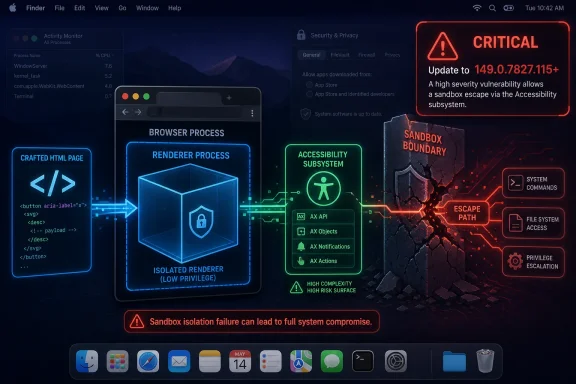 A Critical Chrome Bug With a Very Specific Shape
CVE-2026-12009 is not the kind of browser flaw that lets any random web page immediately own a machine. Its description contains an important precondition: the attacker must already have compromised the renderer process. In Chrome’s architecture, the renderer is where untrusted web content is supposed to be contained, isolated from the operating system by process separation, privilege reduction, and brokered access to sensitive capabilities.That is why the phrase “sandbox escape” does so much work here. The first bug gets an attacker into the room; the sandbox escape opens the door to the hallway. Modern exploitation is often a chain, not a single dramatic flaw, and CVE-2026-12009 appears to be positioned as the second stage in that chain.
The vulnerable component is Accessibility on Mac, a part of the browser that exists for excellent reasons and creates uncomfortable security edges. Accessibility interfaces must translate page structure, user interface state, focus, labels, roles, and actions into forms that assistive technologies can consume. That means they sit near a boundary between untrusted web content and privileged system-facing behavior.
Google’s severity rating of Critical is therefore unsurprising even though the CISA ADP CVSS score is listed as 8.3 High. Security severity and CVSS often answer different questions. Chrome’s own severity reflects how dangerous the bug is inside the browser’s threat model, while CVSS attempts to standardize attack complexity, user interaction, scope change, and impact across a far wider vulnerability universe.
The Renderer Was Never Supposed to Be Trusted
Chrome’s multi-process design changed the browser security conversation years ago by admitting a hard truth: web content is hostile. HTML, JavaScript, CSS, media codecs, fonts, images, WebAssembly, GPU acceleration, extensions, and document viewers create too much attack surface to pretend the renderer will never be compromised. The browser’s defensive strategy is to assume the renderer may fall and to limit what follows.That is the promise the sandbox makes. A renderer compromise should not automatically become file-system access, credential theft, persistence, or arbitrary interaction with the operating system. It should be a contained failure, a breach of a compartment rather than a breach of the ship.
CVE-2026-12009 matters because it lives beyond that first failure. The attacker described by the advisory already has a foothold in the renderer. The question becomes whether the rest of Chrome, macOS, and the browser’s privileged services can keep that compromised renderer from turning into a system-level compromise.
This is also why browser vendors tend to treat sandbox escapes with urgency. A renderer remote-code-execution bug might be bad; a renderer bug paired with a sandbox escape is the kind of chain that turns a malicious web page into a real intrusion path. The public advisory does not say this vulnerability is being actively exploited, and that distinction matters. But exploit developers do not need a zero-day badge to care about a reliable escape primitive.
Accessibility Is Both Essential and Awkwardly Powerful
Accessibility code is not a bolt-on luxury. It is part of making the modern web usable for people who rely on screen readers, switch controls, voice input, magnification, alternative navigation, and other assistive technologies. Browsers must expose enough semantic information for those tools to work, and they must do it across highly dynamic pages whose content and behavior can change constantly.That requirement creates a difficult security problem. Accessibility subsystems need to describe untrusted content in structured ways, respond to user-interface events, and sometimes bridge into platform APIs. On macOS, that means Chrome’s accessibility implementation has to cooperate with Apple’s accessibility frameworks while maintaining Chrome’s own sandbox boundaries.
The vulnerability description points to “insufficient validation of untrusted input.” That phrase is generic, but in this context it is suggestive. Web content can influence accessibility trees and metadata. If some part of that data crosses from a less-trusted renderer into a more-privileged browser or platform-facing path without strict validation, the result can be more than a crash.
This is the uncomfortable part for browser engineering: the more faithfully a browser represents complex web applications to assistive tools, the more carefully it must police the representations. Rich accessibility support is a user-rights victory and a security engineering burden at the same time. The answer is not to weaken accessibility, but to treat it as first-class attack surface.
The Mac-Only Label Should Not Make Windows Shops Relax
The NVD entry frames the affected configuration as Google Chrome before 149.0.7827.115 on Mac, paired with Apple macOS. That specificity is useful for triage. If you manage only Windows endpoints, this particular CVE is not described as a Windows vulnerability.But Windows administrators should resist the temptation to file it under “someone else’s problem.” Chromium is a shared codebase, and security fixes often illuminate classes of bugs rather than isolated accidents. A Mac-only sandbox escape in Accessibility may depend on macOS APIs, process privileges, or implementation details, but the general lesson travels: every brokered interface between renderer and privileged browser code deserves suspicion.
Enterprise fleets are rarely as cleanly separated as dashboards suggest. Developers may use Macs, executives may carry MacBooks, contractors may authenticate from personal devices, and security tooling may treat browsers as update-afterthoughts compared with operating systems. A browser escape on a non-Windows endpoint can still become a corporate incident if that endpoint holds session tokens, VPN access, cloud credentials, source code, or administrator portals.
For WindowsForum’s core audience, the practical read is this: do not evaluate browser CVEs only by OS label. Evaluate them by whether the vulnerable browser exists anywhere in the trust fabric of your environment. A MacBook in the hands of a domain admin or cloud engineer is not a side quest.
CVSS Says High, Chrome Says Critical, and Both Can Be True
The CVSS 3.1 vector assigned by CISA ADP is AV:N/AC:H/PR:N/UI:R/S:C/C:H/I:H/A:H. In plain English, the attack can be delivered over the network, requires no prior privileges, needs user interaction, has high attack complexity, crosses a security boundary, and can produce high confidentiality, integrity, and availability impact. That is a serious profile, even before Google’s Critical label is considered.The “high attack complexity” element is doing important work. CVE-2026-12009 is not described as a one-click complete compromise from a clean browser state. It requires the renderer to be compromised first, meaning the attacker needs a separate vulnerability, a malicious extension path, a logic abuse route, or some other way to gain code execution or equivalent control inside the renderer.
But the “scope changed” and high impact fields are equally important. A sandbox escape is precisely the kind of bug that crosses the boundary CVSS cares about. It changes the blast radius from browser-contained code to something with wider system consequences.
This difference between exploitability and consequence is where many patch debates go wrong. A vulnerability can be hard to exploit and still be urgent to patch because it is valuable as part of a chain. Attackers who buy, steal, or develop renderer exploits need escapes; defenders who patch escapes break chains.
Chrome 149’s Security Noise Is Becoming the Signal
CVE-2026-12009 did not arrive in a vacuum. The surrounding Chrome 149 update cycle has been noisy, with multiple advisories describing renderer compromise, sandbox escape potential, GPU issues, Safe Browsing races, Headless problems, and other high-impact bugs across platforms. Some entries are Mac-specific, some are not, but the pattern is familiar: Chrome is too important, too complex, and too exposed to ever enjoy a quiet security month.This is not a knock on Chrome alone. The browser is now a runtime, document viewer, identity broker, app platform, graphics engine, media stack, PDF handler, and increasingly an enterprise control surface. Every major browser lives with similar pressures. Chromium’s scale merely makes the churn more visible.
The security industry tends to treat browser updates as routine until a zero-day forces attention. That is backwards. Routine browser updates are the mechanism that prevents many vulnerabilities from becoming zero-day incidents in the first place. The fact that a CVE appears in a stable-channel patch note rather than a breach report is not a reason to delay; it is the system working.
The problem is that “the system working” still depends on users and administrators completing the last mile. Chrome may update itself for many consumer users, but enterprise channels, managed policies, testing rings, frozen images, VDI environments, kiosks, and application compatibility exceptions can all slow deployment. Attackers do not need every endpoint to lag. They need the important ones.
The Crafted HTML Page Is the Oldest Trick in the Modern Browser Book
The advisory’s delivery mechanism is almost mundane: a crafted HTML page. That mundanity is exactly why browser vulnerabilities matter. Users do not need to install a binary, open a suspicious executable, or approve an obviously dangerous prompt to encounter hostile HTML. They browse.Of course, user interaction is still required in the CVSS vector. Someone must visit a page, click a link, open content, or otherwise cause the malicious input to reach the browser. But phishing, malvertising, compromised legitimate sites, messaging links, SEO poisoning, and watering-hole attacks all exist because getting a user to load a page remains one of the easiest tasks in offensive operations.
The modern web’s defensive posture often assumes layers: site isolation, Safe Browsing, exploit mitigations, JIT hardening, memory safety work, sandboxing, OS notarization, endpoint detection, and patching. CVE-2026-12009 is a reminder that those layers are not interchangeable. If a renderer bug defeats one layer and an accessibility bug defeats the next, the chain starts to look far less theoretical.
This is also why “just don’t click bad links” is not a strategy. It is advice, and not very good advice at scale. Organizations need browsers that patch quickly, endpoint controls that can see suspicious post-exploitation behavior, and policies that reduce the value of any one browser session.
The NVD Record Tells a Story About Timing
The chronology is short but useful. Chrome issued the CVE on June 11, 2026. CISA ADP added its CVSS 3.1 assessment later that day. NIST performed initial NVD analysis on June 12, adding weakness and CPE configuration information. That is the modern vulnerability pipeline moving at something close to operational speed.The NVD entry also shows the limits of that pipeline. At the time reflected in the provided detail, NVD had not supplied its own CVSS score, while CISA ADP had. The weakness mapping included Chrome’s CWE-20 classification and NIST’s no-information placeholder. The issue tracker reference required permissions, which is typical for sensitive Chromium security bugs.
None of that is scandalous. Browser vendors often keep bug details restricted until enough users are patched, and NVD enrichment can lag or differ from vendor descriptions. What matters for defenders is not waiting for the perfect database record before acting.
Security teams sometimes over-index on NVD completeness because it feels authoritative and machine-readable. But the most important facts here are already enough: Chrome for Mac before 149.0.7827.115 is affected, the bug is a sandbox escape candidate, the attacker needs renderer compromise, and Google rated it Critical. That is sufficient to trigger update validation.
The Patch Is Simple; Proving It Landed Is Not
For unmanaged users, the practical remediation is straightforward: update Chrome to 149.0.7827.115 or later on macOS. Chrome’s built-in updater should handle that for most people, and a browser restart is usually the step that turns a downloaded update into a running fixed version. The dangerous endpoint is often not the one that never downloaded the update; it is the one with an updated installer and a still-running vulnerable browser process.In managed environments, the work is less glamorous. Administrators need inventory that reports actual browser versions, not merely installed package versions. They need to know which machines are pinned, which policies defer updates, which users habitually postpone restarts, and which alternate Chromium-based browsers may share related code but follow different patch schedules.
That last point deserves care. CVE-2026-12009 is assigned to Google Chrome, and the described affected software is Chrome on Mac. It should not be automatically projected onto every Chromium-derived browser without vendor confirmation. But administrators should still check Edge, Brave, Vivaldi, Opera, Electron-based apps, and embedded Chromium runtimes according to their vendors’ advisories, because shared upstream fixes frequently ripple outward.
The gap between “a patch exists” and “the risk is retired” is where enterprise browser security lives. Version drift is a vulnerability class of its own. In some organizations, the browser updates faster than the asset database can notice; in others, the asset database is the only place where everything appears green.
Sandboxes Fail Where Trust Boundaries Get Busy
Sandbox escapes often cluster around the messy parts of a browser: GPU processes, IPC interfaces, file handling, extensions, media, printing, accessibility, and platform integration. That is not an accident. The sandbox is strongest where the rule is simple — untrusted code cannot do the thing. It becomes harder where the browser must safely do the thing on the renderer’s behalf.Accessibility is one of those brokered zones. The renderer understands the page; privileged browser or platform code may need to expose selected information to assistive technologies. Every message across that seam is a trust decision. Every parser, serializer, object handle, identifier, tree update, and callback can become an opportunity for confusion.
The phrase insufficient validation of untrusted input is almost boring in CWE form, but it captures the essence of many serious bugs. Something arrived from a less trusted place and was treated too generously by a more trusted place. In a sandboxed browser, generosity is dangerous.
This is why hardening is never finished. Memory-safe languages help, but they do not erase logic bugs. Site isolation helps, but it does not remove privileged services. Permission prompts help, but they do not govern internal browser IPC. The browser is a city of guarded gates, and every feature asks for another road.
For Attackers, This Is a Chain Component
The most honest way to read CVE-2026-12009 is as a chain component. By itself, the advisory describes a post-renderer-compromise escape path. That means it is probably most interesting to attackers who already have or expect to obtain renderer execution.That category includes sophisticated actors, exploit brokers, targeted surveillance vendors, and criminal groups willing to assemble multi-bug chains against high-value users. It can also include researchers and red teams. The public does not need full technical details for the strategic point to be clear: sandbox escapes are leverage.
A renderer exploit without an escape can still steal data available inside the browser context, abuse sessions, or attack same-user browser state depending on the bug. But escaping the sandbox can expand options dramatically. It may allow broader file access, process interaction, persistence attempts, credential theft, or further exploitation of the operating system.
The advisory does not prove that any of this happened in the wild. It does not claim active exploitation. But defenders should not confuse absence of public exploitation with absence of attacker interest. Browser escape bugs are valuable precisely because they make other bugs more useful.
For Users, the Action Is Boring by Design
There is no clever mitigation that beats updating the browser. Users on macOS should confirm Chrome is at least 149.0.7827.115 and restart the browser if an update is pending. If Chrome is managed by an organization, the user may need to follow whatever restart or update prompt policy the administrator has configured.For individual users, this is also a good moment to reduce browser attack surface. Remove extensions you do not use. Be suspicious of prompts to install new extensions, configuration profiles, or helper apps. Keep macOS updated, because the browser sandbox is only one part of the defense stack.
None of these steps is dramatic, but that is the point. Browser security is won through boring repetition. Fast update, restart, verify version, reduce extension clutter, and avoid turning the browser into a junk drawer of old permissions.
The user experience problem remains real. Browser updates interrupt work, restore sessions imperfectly, and sometimes introduce regressions. But delaying a Critical sandbox escape fix because a restart is inconvenient is a bad trade, especially on machines used for banking, administration, development, or corporate access.
For Administrators, the Risk Is in the Exceptions
Enterprise IT usually knows how to patch Chrome. The harder problem is knowing where Chrome did not patch. Exceptions accumulate: a lab machine tied to a device, a kiosk image that updates quarterly, a developer Mac outside normal MDM scope, a VDI pool with stale snapshots, a conference-room system no one owns, a privileged user who postpones restarts indefinitely.CVE-2026-12009 should push teams to look at those exceptions rather than the median endpoint. If 95 percent of Chrome installations update quickly and the remaining 5 percent include executives, engineers, finance users, and administrators, the fleet risk is not captured by the average. Attackers care about access, not compliance percentages.
Administrators should also monitor the difference between installed version and running version. On macOS especially, users may leave browsers open for long stretches, preserving vulnerable processes after an update is available. A policy that forces browser relaunch after a reasonable grace period is not user-hostile; it is how auto-update becomes real.
The broader play is to treat browsers as tier-one infrastructure. They deserve the same inventory discipline, emergency patch workflow, and exception review as VPN clients, endpoint agents, and identity tools. In 2026, the browser is not an app on the endpoint. It is the front door.
The Real Lesson Is Chain Resilience
The security industry has spent years teaching users to ask whether a vulnerability is being exploited in the wild. That is a useful question, but it is too narrow for browser sandbox escapes. A vulnerability like CVE-2026-12009 may be most dangerous when combined with another bug that has not yet been disclosed, has not yet been patched everywhere, or exists in a different component entirely.Chain resilience means breaking any link attackers need. Patch the renderer bug, and the escape may be stranded. Patch the escape, and the renderer bug may be contained. Harden the OS, and post-escape activity may fail. Detect suspicious child processes, credential access, or persistence attempts, and the chain may be caught after exploitation.
This layered thinking matters because no single vendor advisory can describe the whole attack graph. Google can say what this Chrome flaw does under certain conditions. It cannot tell every organization whether that flaw combines with their extension policy, their identity posture, their MDM coverage, their EDR exclusions, or their privileged-user workflows.
The correct response is therefore both specific and general. Specifically, update Chrome for Mac to 149.0.7827.115 or later. Generally, stop treating browser sandbox escapes as isolated browser trivia. They are stress tests for the entire endpoint security model.
The 149.0.7827.115 Update Is a Small Patch With a Large Message
CVE-2026-12009 is easy to summarize and easy to underestimate. It affects Chrome on Mac before 149.0.7827.115, it involves insufficient validation in Accessibility, and it could allow a sandbox escape after renderer compromise. The advisory is short, but the implication is large: critical browser security often lives in the seams between noble features and hostile input.The concrete lessons are not complicated, which is why they are so easy to postpone.
- Chrome for Mac installations should be verified at version 149.0.7827.115 or later, not merely assumed to have auto-updated.
- Administrators should confirm that the running browser process has restarted after update deployment.
- The Mac-only scope should guide triage, but it should not exclude managed Macs, developer systems, or privileged-user devices from urgent attention.
- Security teams should treat sandbox escapes as chain-breaking patches, even when public exploitation has not been reported.
- Chromium-derived browsers and embedded runtimes should be checked through their own vendor channels rather than assumed safe or affected by default.
- Accessibility code should be understood as essential functionality with meaningful security exposure, not as a peripheral feature outside the threat model.
References
- Primary source: NVD / Chromium
Published: 2026-06-15T07:00:27-07:00
NVD - CVE-2026-12009
 nvd.nist.gov
- Security advisory: MSRC
Published: 2026-06-15T07:00:27-07:00
Original feed URL
Security Update Guide - Microsoft Security Response Center
 msrc.microsoft.com
- Related coverage: cvefeed.io
CVE-2026-12009 - Google Chrome Sandbox Escape
Insufficient validation of untrusted input in Accessibility in Google Chrome on Mac prior to 149.0.7827.115 allowed a remote attacker who had compromised the renderer process to potentially perform a sandbox escape via a crafted HTML page. (Chromium security severity: Critical)cvefeed.io - Related coverage: vulnerability.circl.lu
Vulnerability-Lookup
Vulnerability-Lookup - Fast vulnerability lookup correlation from different sources.vulnerability.circl.lu
