

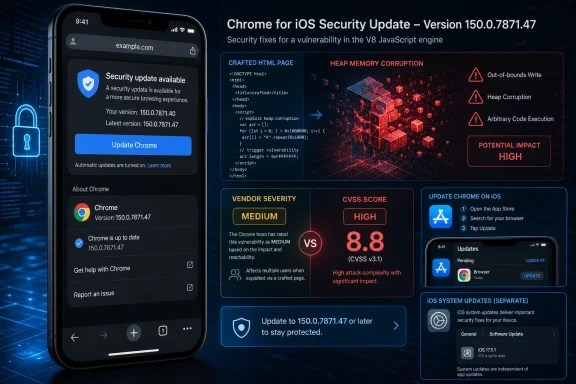
Google has fixed CVE-2026-13918 in Chrome for iOS 150.0.7871.47, closing a use-after-free flaw that could let a remote attacker use a crafted HTML page to trigger heap corruption on iPhones running an earlier Chrome version without first needing account privileges, although user interaction is required. Google calls the vulnerability Medium severity, but CISA’s contributed CVSS 3.1 assessment scores it 8.8 HIGH and models high potential impact to confidentiality, integrity, and availability. That apparent contradiction is not evidence that one side is wrong; it is a warning that severity labels, technical impact, exploitability, and evidence of real-world attacks are measuring different things. The immediate response is simple—update Chrome—but the larger lesson is that mobile browser patching remains dangerously easy to mistake for operating-system patching.
CVE-2026-13918 is classified as CWE-416, Use After Free, a class of memory-safety failure in which software continues to access an object after the memory holding that object has been released. Once that memory is returned to the allocator, it may be reused, overwritten, or reorganized while the program still retains a stale reference to it.
The result is not automatically code execution, device compromise, or data theft. A use-after-free condition may produce nothing more than a crash if the attacker cannot reliably influence the recycled memory, execution path, or object layout. But when the vulnerable process is handling attacker-controlled web content, the gap between “crash” and “security exploit” is precisely what browser security teams spend enormous effort trying to close.
Chrome’s description says a remote attacker could potentially exploit heap corruption through a crafted HTML page. That language matters: the page is the delivery mechanism, heap corruption is the immediate technical consequence, and whatever follows would depend on the attacker’s ability to turn corrupted memory into a controlled outcome.
The available record does not say that CVE-2026-13918 independently escapes an application sandbox, takes over an iPhone, persists after a reboot, or bypasses other iOS security boundaries. It also does not disclose whether the flaw sits in page handling, Chrome’s interface layer, an iOS-specific component, or some other part of the app. The underlying Chromium issue remains permission-restricted, so claims about the precise root cause or a complete exploit chain would be speculation.
That restraint should not be confused with reassurance. A remotely reachable memory-corruption flaw in a browser app deserves prompt patching even when the vendor labels it Medium, particularly because browsers routinely process untrusted content arriving through links, advertisements, redirects, embedded frames, messaging apps, and documents.
The vulnerability is serious enough to patch immediately, but the public evidence does not support calling it an actively exploited iPhone takeover.
NVD, meanwhile, displays the contributed CISA data but has not yet issued its own assessment under CVSS 4.0, CVSS 3.x, or CVSS 2.0. Its page is therefore an aggregation point rather than a final independent verdict.
These values are answering related but nonidentical questions. A vendor severity label can incorporate product architecture, mitigations, exploit reliability, component exposure, and internal knowledge that is difficult to represent in a single public score. CVSS, by contrast, describes a standardized worst-case technical scenario based on selected attributes.
CISA’s SSVC entry adds another layer. Its “exploitation: none” option indicates that the assessment did not identify evidence of exploitation, while “automatable: no” suggests the attack is not considered readily scalable as a fully automated campaign under that model. “Technical impact: total” says that successful exploitation could have a severe effect on the affected system or component.
That combination is entirely plausible. A vulnerability can be difficult to operationalize broadly, have no observed exploitation, and still be capable of substantial damage when a skilled attacker successfully uses it against a target.
The practical error would be to choose whichever label confirms a preferred response. Reading “Medium” and postponing the update ignores the memory-corruption mechanism and CISA’s impact assessment. Reading “8.8 HIGH” and announcing an ongoing mass compromise ignores the lack of reported exploitation and the requirement for user interaction.
AV:N means the attack can be initiated over a network rather than requiring local access to the device. For a browser vulnerability, that generally aligns with malicious web content being delivered remotely, although the public description limits the specific mechanism to a crafted HTML page.
AC:L classifies attack complexity as low within the CVSS model. It does not guarantee that building a stable exploit is easy, nor does it mean any attacker can immediately turn the bug into reliable compromise. It means the modeled attack does not depend on unusually complex preconditions as defined by the scoring framework.
PR:N says the attacker does not need existing privileges or an authenticated account on the target. UI:R, however, says user interaction is required. The public record does not explain the exact interaction, so it would be unsafe to claim that merely receiving a link, previewing a message, or leaving Chrome installed is sufficient.
S:U means the modeled impact remains within the same security authority rather than crossing a CVSS-defined scope boundary. The three final metrics—C:H, I:H, and A:H—model high potential consequences to confidentiality, integrity, and availability.
This is why the score reaches 8.8. The vector imagines a remotely delivered, low-complexity attack requiring no privileges but some user participation, followed by high impact if exploitation succeeds. It does not account for every platform mitigation, exploit-development obstacle, or environmental control that may stand between heap corruption and a useful payload.
CVSS is most valuable when treated as a compact technical hypothesis. It becomes misleading when treated as a live threat-intelligence feed.
There is no basis in the disclosed data for flagging desktop Chrome installations as vulnerable to this particular issue merely because they share the Chrome name. There is likewise no basis for treating every iOS browser, Safari deployment, or application containing a web view as affected.
That product boundary matters because Chrome on iOS is distributed and updated through Apple’s App Store. Google’s own Chrome Help documentation says the browser should update automatically according to the device’s App Store settings, while also providing a manual update path through the App Store’s available-updates list.
In other words, updating iOS and updating Chrome are separate operational acts. An iPhone can have current operating-system patches while retaining an outdated Chrome app if App Store updates are delayed, disabled, pending, or prevented from installing. Conversely, updating Chrome addresses this application-level version boundary without the disclosure requiring a particular iOS update.
The architecture becomes more nuanced in regions where Apple permits approved browser developers to use alternative browser engines under specific entitlements. Apple describes those engines as high-risk components because they continuously process untrusted content and can access sensitive data, which is why its authorization requirements include commitments to timely security updates.
Nothing in the public CVE record establishes which engine or framework contains this particular flaw. Administrators should therefore avoid jumping from “Chrome on iOS” to unsupported conclusions about WebKit, Blink, Safari, or a region-specific alternative engine. The defensible operational conclusion is narrower: the vulnerable unit is the Chrome for iOS app before the fixed build.
This distinction also prevents a common scanning mistake. Product-name matching alone can produce noisy alerts when security tools fail to preserve platform context. A Windows endpoint running Chrome should not be classified as affected by an iOS-only vulnerability solely because a generic Chrome CPE appears in a feed; the operating-system configuration is part of the applicability test.
NVD’s affected-product JSON expresses the data somewhat awkwardly by listing version 150.0.7871.47 alongside a
Operationally, there is little ambiguity. If Chrome reports a version below 150.0.7871.47, it should be treated as vulnerable. If it reports 150.0.7871.47 or a later version, it has crossed the documented fix boundary.
The word “prior” in the description and “excluding” in the NIST configuration both reinforce that interpretation. Administrators should not mark the fixed version itself as vulnerable merely because it appears in a raw affected-version object.
This is a useful reminder that vulnerability feeds are machine-readable evidence, not infallible policy. Security platforms sometimes flatten nested version conditions, ignore
The correct validation sequence is product, platform, installed version, and comparison operator. For CVE-2026-13918, all four matter.
That initially looks like a platform mismatch, but the post functions as a broad security ledger containing vulnerabilities from several Chrome components and platforms. It is not a focused iOS bulletin explaining the exact code path, attack flow, or remediation process.
The associated Chromium issue is listed as requiring permission. Google warns in its Chrome release material that bug details may remain restricted until enough users have received fixes, or longer when shared code could leave other projects exposed. Restricted details are therefore not evidence of exploitation; they are part of coordinated vulnerability-management practice.
The result is a disclosure that provides enough information to patch but not enough to reproduce. Defenders know the CVE, weakness class, affected platform, attack medium, impact type, severity labels, and fixed version. They do not know the vulnerable function, heap-manipulation strategy, exact user gesture, exploit reliability, or whether additional vulnerabilities would be needed for a meaningful device compromise.
That information asymmetry is intentional during a rollout. Publishing exploit-enabling detail while a meaningful population remains below the fixed version would improve attacker capability faster than defender capability.
It does, however, put pressure on organizations to trust the version boundary rather than wait for a polished technical autopsy. By the time deep exploit analysis becomes publicly available, the appropriate defensive action—installing the fixed app version—should already have been completed.
Because the CVSS vector requires user interaction, defenders can infer that some action by the target is part of the modeled path. They cannot responsibly infer the exact action. It may involve navigating to or engaging with content, but the restricted issue prevents a more precise description.
Once triggered, the vulnerability can potentially corrupt heap memory. Heap corruption can destabilize the application, alter data used by later operations, or—in a successful exploit—redirect execution in a way favorable to the attacker.
Modern operating systems and browsers deploy layers of mitigation intended to make that transition difficult. Those defenses are exactly why a memory-corruption primitive should not be described as synonymous with full device control. An attacker may need additional techniques or vulnerabilities to move beyond the affected process, defeat isolation, gain broader privileges, or establish persistence.
CISA’s technical-impact assessment nevertheless warns defenders not to dismiss the flaw as a mere crash bug. Its CVSS vector models high impact across all three conventional security properties, and its SSVC assessment uses the “total” technical-impact option.
The responsible interpretation is conditional: if an attacker successfully exploits the flaw in the assessed manner, the consequences could be severe. The public evidence does not tell us how practical that successful path is on real devices.
That wording must remain intact. It does not prove that nobody has ever found or used the flaw, and it does not promise that exploitation will remain absent after disclosure. It means the assessment did not identify exploitation evidence.
The distinction matters because vulnerability reporting often collapses three separate stages into one dramatic phrase: a vulnerable condition exists, researchers can potentially exploit it, and attackers are exploiting it in the wild. CVE-2026-13918 clearly satisfies the first stage and is described as potentially satisfying the second. The supplied record does not establish the third.
“Automatable: no” similarly requires care. It suggests exploitation is not readily reducible to reliable, scalable, end-to-end automation under the SSVC model. It does not mean the attack cannot be scripted, delivered remotely, incorporated into a toolkit, or used selectively against valuable targets.
Targeted exploitation and mass exploitation have different economics. An unreliable browser exploit may be unattractive to ordinary cybercriminals yet useful to a sophisticated operator willing to tune delivery for a device, application state, or victim. The absence of broad automation can lower population-wide risk without making individual exposure acceptable.
For administrators, the lack of known exploitation affects prioritization but not the remediation decision. The update is already available, the affected range is explicit, and the attack surface is routine web content. There is little defensive value in waiting for exploitation evidence before installing a browser security fix.
June 30, 2026: NVD published the CVE entry.
July 1, 2026, 11:16:46 AM: CISA-ADP added the CVSS 3.1 vector, CWE-416 classification, and SSVC assessment.
July 1, 2026, 3:16:42 PM: CISA-ADP removed the CWE-416 entry in a later change record, although NVD’s current weakness enumeration continues to show CWE-416 sourced from Chrome.
July 6, 2026, 2:30:22 PM: NIST added the Chrome and iPhone operating-system CPE configuration and categorized the Chrome references.
July 6, 2026: NVD recorded the entry as last modified.
The temporary removal of the weakness entry is a reminder that enrichment records can change as multiple organizations process the same CVE. It does not alter Chrome’s supplied weakness classification or the current NVD display identifying the flaw as Use After Free.
More broadly, the timeline shows how a CVE becomes operationally richer after publication. The vendor provides the core description and affected version; CISA contributes scoring and decision-support data; NIST adds platform configurations and reference classifications.
Security tools ingesting the record at different moments may therefore display different levels of detail. A scanner that imported the initial entry might know the affected version but lack the later CPE logic, while another might display the CISA score without making clear that NVD has not completed its own assessment.
That creates a different failure pattern. Users may assume Chrome is current because it opens normally, the iPhone itself recently installed an update, or automatic app updates are nominally enabled. None of those observations proves that the fixed Chrome build is installed.
Automatic updates are a convenience mechanism, not a compliance report. App Store rollout timing, device connectivity, storage pressure, power state, user settings, and deferred installations can all create a population of devices that eventually update but remain exposed during the interval.
Organizations with managed iPhones need application-version visibility, not just operating-system-version visibility. If their device-management tooling can inventory installed app builds, the practical query is straightforward: identify managed devices with Chrome installed below the fixed version and push, request, or otherwise enforce the available application update according to organizational policy.
Unmanaged or bring-your-own devices require a different control. Administrators may need to provide user instructions, require attestation through an approved access workflow, or temporarily restrict sensitive browser-based access from devices whose application posture cannot be established.
The wider issue is that mobile application security often falls between teams. Endpoint operations may track iOS releases, browser teams may focus on Windows and macOS, and security operations may rely on vulnerability scanners that have limited visibility into App Store applications. CVE-2026-13918 belongs precisely in that organizational gap.
Microsoft-centered environments increasingly expose the same identity, document, messaging, collaboration, and administrative services through mobile browsers. An iPhone running Chrome may be used to open corporate mail links, authenticate to cloud services, review shared documents, or access internal applications even when the organization thinks of Windows as its primary endpoint platform.
A browser exploit on that device could therefore intersect with corporate sessions and data without targeting Windows itself. The relevant risk boundary is no longer the operating system named in the IT department’s job title; it is the full set of clients allowed to handle organizational information.
There is also a tooling lesson. Windows security teams often work with precise build and KB applicability rules, but third-party mobile applications arrive through different channels and expose different inventory data. Translating desktop patch-management habits directly to iOS can leave teams monitoring the operating system while missing the vulnerable application.
At the same time, administrators should resist the opposite overreaction: turning an iOS-specific Chrome CVE into a universal browser emergency. Applicability discipline is part of security. False positives consume the same analyst attention needed to find genuinely outdated iPhones.
There is no disclosed proof-of-concept in the supplied material, no statement that attacks have been observed, and no evidence that the vulnerability alone provides full control of an iPhone. There is also no disclosed list of affected iOS releases beyond NIST’s generic iPhone operating-system configuration.
Those limitations should shape reporting and incident response. Organizations should not hunt for an invented process name, file artifact, network signature, or crash pattern that the advisory never identified. They should not claim compromise merely because an old Chrome version was present.
Exposure and compromise are different findings. A device with Chrome below 150.0.7871.47 is exposed according to the affected-version record; deciding whether it was attacked would require separate evidence from device, identity, network, and application telemetry.
The unknowns also make version remediation more valuable than speculative detection. Without a public exploit signature, eliminating the vulnerable build is the most reliable control available.
Google has identified the defect, defined a fixed boundary, and restricted technical details while users update. CISA has modeled a high-impact successful attack but reported no exploitation evidence and no easy automation. NIST has added platform-specific configuration data while leaving its own CVSS assessments pending.
Taken together, those facts support an urgent but proportionate response. Update Chrome promptly, verify the resulting version, and watch for new intelligence. Do not declare an active zero-day campaign, but do not leave a remotely reachable browser memory flaw unpatched simply because Google used the word Medium.
The episode also illustrates why organizations need more than a numerical service-level agreement. A policy that patches every “critical” issue immediately, every “high” issue in a week, and every “medium” issue eventually can mishandle a vulnerability whose vendor label, external score, attack surface, and real-world evidence point in different directions.
Context should be allowed to accelerate the timetable. Browser exposure, crafted remote content, memory corruption, lack of required privileges, and availability of a fixed build all argue for faster action even before exploitation appears.
 A Medium Label Hides a High-Impact Failure Mode
CVE-2026-13918 is classified as CWE-416, Use After Free, a class of memory-safety failure in which software continues to access an object after the memory holding that object has been released. Once that memory is returned to the allocator, it may be reused, overwritten, or reorganized while the program still retains a stale reference to it.The result is not automatically code execution, device compromise, or data theft. A use-after-free condition may produce nothing more than a crash if the attacker cannot reliably influence the recycled memory, execution path, or object layout. But when the vulnerable process is handling attacker-controlled web content, the gap between “crash” and “security exploit” is precisely what browser security teams spend enormous effort trying to close.
Chrome’s description says a remote attacker could potentially exploit heap corruption through a crafted HTML page. That language matters: the page is the delivery mechanism, heap corruption is the immediate technical consequence, and whatever follows would depend on the attacker’s ability to turn corrupted memory into a controlled outcome.
The available record does not say that CVE-2026-13918 independently escapes an application sandbox, takes over an iPhone, persists after a reboot, or bypasses other iOS security boundaries. It also does not disclose whether the flaw sits in page handling, Chrome’s interface layer, an iOS-specific component, or some other part of the app. The underlying Chromium issue remains permission-restricted, so claims about the precise root cause or a complete exploit chain would be speculation.
That restraint should not be confused with reassurance. A remotely reachable memory-corruption flaw in a browser app deserves prompt patching even when the vendor labels it Medium, particularly because browsers routinely process untrusted content arriving through links, advertisements, redirects, embedded frames, messaging apps, and documents.
The vulnerability is serious enough to patch immediately, but the public evidence does not support calling it an actively exploited iPhone takeover.
Three Risk Lenses Produce Three Different Answers
The most conspicuous feature of the disclosure is the disagreement—or, more accurately, the difference in emphasis—between Google’s severity classification and CISA’s scoring contribution. Chromium rates the issue Medium, while CISA-ADP supplies a CVSS 3.1 base score of 8.8 HIGH.NVD, meanwhile, displays the contributed CISA data but has not yet issued its own assessment under CVSS 4.0, CVSS 3.x, or CVSS 2.0. Its page is therefore an aggregation point rather than a final independent verdict.
| Assessment source | Framework | Result | What it conveys |
|---|---|---|---|
| Chromium | Vendor security severity | Medium | Google’s internal prioritization of the vulnerability in its product context |
| CISA-ADP | CVSS 3.1 | 8.8 HIGH | High modeled impact if exploitation succeeds under the stated conditions |
| CISA-ADP | SSVC 2.0.3 | Exploitation: none; automatable: no; technical impact: total | No known exploitation in the supplied assessment, limited automation potential, but potentially severe technical consequences |
| NVD | CVSS 4.0, 3.x, and 2.0 | Assessment not yet provided | NIST has not published its own severity calculation |
CISA’s SSVC entry adds another layer. Its “exploitation: none” option indicates that the assessment did not identify evidence of exploitation, while “automatable: no” suggests the attack is not considered readily scalable as a fully automated campaign under that model. “Technical impact: total” says that successful exploitation could have a severe effect on the affected system or component.
That combination is entirely plausible. A vulnerability can be difficult to operationalize broadly, have no observed exploitation, and still be capable of substantial damage when a skilled attacker successfully uses it against a target.
The practical error would be to choose whichever label confirms a preferred response. Reading “Medium” and postponing the update ignores the memory-corruption mechanism and CISA’s impact assessment. Reading “8.8 HIGH” and announcing an ongoing mass compromise ignores the lack of reported exploitation and the requirement for user interaction.
The CVSS Vector Describes the Successful Attack, Not Its Prevalence
CISA-ADP’s vector is CVSS:3.1/AV:N/AC:L/PR:N/UI:R/S:U/C:H/I:H/A:H. Each component says something useful, but none says that attackers are currently using the flaw.AV:N means the attack can be initiated over a network rather than requiring local access to the device. For a browser vulnerability, that generally aligns with malicious web content being delivered remotely, although the public description limits the specific mechanism to a crafted HTML page.
AC:L classifies attack complexity as low within the CVSS model. It does not guarantee that building a stable exploit is easy, nor does it mean any attacker can immediately turn the bug into reliable compromise. It means the modeled attack does not depend on unusually complex preconditions as defined by the scoring framework.
PR:N says the attacker does not need existing privileges or an authenticated account on the target. UI:R, however, says user interaction is required. The public record does not explain the exact interaction, so it would be unsafe to claim that merely receiving a link, previewing a message, or leaving Chrome installed is sufficient.
S:U means the modeled impact remains within the same security authority rather than crossing a CVSS-defined scope boundary. The three final metrics—C:H, I:H, and A:H—model high potential consequences to confidentiality, integrity, and availability.
This is why the score reaches 8.8. The vector imagines a remotely delivered, low-complexity attack requiring no privileges but some user participation, followed by high impact if exploitation succeeds. It does not account for every platform mitigation, exploit-development obstacle, or environmental control that may stand between heap corruption and a useful payload.
CVSS is most valuable when treated as a compact technical hypothesis. It becomes misleading when treated as a live threat-intelligence feed.
Chrome on iOS Is Its Own Patch Boundary
The phrase “Chrome vulnerability” naturally leads many administrators to think of Chromium on Windows, macOS, Linux, or Android. CVE-2026-13918 is more specific: the affected product is Google Chrome on iOS, and the NVD configuration combines the Chrome application with Apple’s iPhone operating system.There is no basis in the disclosed data for flagging desktop Chrome installations as vulnerable to this particular issue merely because they share the Chrome name. There is likewise no basis for treating every iOS browser, Safari deployment, or application containing a web view as affected.
That product boundary matters because Chrome on iOS is distributed and updated through Apple’s App Store. Google’s own Chrome Help documentation says the browser should update automatically according to the device’s App Store settings, while also providing a manual update path through the App Store’s available-updates list.
In other words, updating iOS and updating Chrome are separate operational acts. An iPhone can have current operating-system patches while retaining an outdated Chrome app if App Store updates are delayed, disabled, pending, or prevented from installing. Conversely, updating Chrome addresses this application-level version boundary without the disclosure requiring a particular iOS update.
The architecture becomes more nuanced in regions where Apple permits approved browser developers to use alternative browser engines under specific entitlements. Apple describes those engines as high-risk components because they continuously process untrusted content and can access sensitive data, which is why its authorization requirements include commitments to timely security updates.
Nothing in the public CVE record establishes which engine or framework contains this particular flaw. Administrators should therefore avoid jumping from “Chrome on iOS” to unsupported conclusions about WebKit, Blink, Safari, or a region-specific alternative engine. The defensible operational conclusion is narrower: the vulnerable unit is the Chrome for iOS app before the fixed build.
This distinction also prevents a common scanning mistake. Product-name matching alone can produce noisy alerts when security tools fail to preserve platform context. A Windows endpoint running Chrome should not be classified as affected by an iOS-only vulnerability solely because a generic Chrome CPE appears in a feed; the operating-system configuration is part of the applicability test.
The Version Boundary Is Clear Even Where the Metadata Is Awkward
The most important number in the record is 150.0.7871.47. Chrome for iOS versions before that boundary are affected; that version is the fixed threshold.NVD’s affected-product JSON expresses the data somewhat awkwardly by listing version 150.0.7871.47 alongside a
lessThan value of 150.0.7871.47 and a custom version type. Its NIST-added CPE configuration is clearer: Google Chrome versions up to, but excluding, 150.0.7871.47, in combination with Apple’s iPhone operating system.Operationally, there is little ambiguity. If Chrome reports a version below 150.0.7871.47, it should be treated as vulnerable. If it reports 150.0.7871.47 or a later version, it has crossed the documented fix boundary.
The word “prior” in the description and “excluding” in the NIST configuration both reinforce that interpretation. Administrators should not mark the fixed version itself as vulnerable merely because it appears in a raw affected-version object.
This is a useful reminder that vulnerability feeds are machine-readable evidence, not infallible policy. Security platforms sometimes flatten nested version conditions, ignore
lessThan operators, lose the accompanying operating-system clause, or treat the base version field as an explicitly vulnerable release. A malformed alert generated from that process may look authoritative while being semantically wrong.The correct validation sequence is product, platform, installed version, and comparison operator. For CVE-2026-13918, all four matter.
The Advisory Trail Is Broad but Deliberately Shallow
Google’s Chrome Releases post for the stable promotion of Chrome 150 is titled as a desktop update, yet its security-fix list also includes CVE-2026-13918 as a Medium use-after-free vulnerability in Chrome for iOS. NVD classifies that page as both release notes and a vendor advisory.That initially looks like a platform mismatch, but the post functions as a broad security ledger containing vulnerabilities from several Chrome components and platforms. It is not a focused iOS bulletin explaining the exact code path, attack flow, or remediation process.
The associated Chromium issue is listed as requiring permission. Google warns in its Chrome release material that bug details may remain restricted until enough users have received fixes, or longer when shared code could leave other projects exposed. Restricted details are therefore not evidence of exploitation; they are part of coordinated vulnerability-management practice.
The result is a disclosure that provides enough information to patch but not enough to reproduce. Defenders know the CVE, weakness class, affected platform, attack medium, impact type, severity labels, and fixed version. They do not know the vulnerable function, heap-manipulation strategy, exact user gesture, exploit reliability, or whether additional vulnerabilities would be needed for a meaningful device compromise.
That information asymmetry is intentional during a rollout. Publishing exploit-enabling detail while a meaningful population remains below the fixed version would improve attacker capability faster than defender capability.
It does, however, put pressure on organizations to trust the version boundary rather than wait for a polished technical autopsy. By the time deep exploit analysis becomes publicly available, the appropriate defensive action—installing the fixed app version—should already have been completed.
A Crafted Page Is the Entry Point, Not the Whole Exploit Story
The disclosed attack method is a crafted HTML page. That could arrive through a conventional phishing link, a compromised legitimate site, a malicious advertisement, an embedded browser flow, or another mechanism that causes Chrome to process attacker-controlled content. The sources do not identify a specific delivery campaign.Because the CVSS vector requires user interaction, defenders can infer that some action by the target is part of the modeled path. They cannot responsibly infer the exact action. It may involve navigating to or engaging with content, but the restricted issue prevents a more precise description.
Once triggered, the vulnerability can potentially corrupt heap memory. Heap corruption can destabilize the application, alter data used by later operations, or—in a successful exploit—redirect execution in a way favorable to the attacker.
Modern operating systems and browsers deploy layers of mitigation intended to make that transition difficult. Those defenses are exactly why a memory-corruption primitive should not be described as synonymous with full device control. An attacker may need additional techniques or vulnerabilities to move beyond the affected process, defeat isolation, gain broader privileges, or establish persistence.
CISA’s technical-impact assessment nevertheless warns defenders not to dismiss the flaw as a mere crash bug. Its CVSS vector models high impact across all three conventional security properties, and its SSVC assessment uses the “total” technical-impact option.
The responsible interpretation is conditional: if an attacker successfully exploits the flaw in the assessed manner, the consequences could be severe. The public evidence does not tell us how practical that successful path is on real devices.
No Known Exploitation Is Not the Same as No Exploitability
CISA-ADP’s SSVC record marks exploitation as “none.” That is the strongest publicly supplied indication that CVE-2026-13918 was not known to be under active exploitation at the assessment timestamp.That wording must remain intact. It does not prove that nobody has ever found or used the flaw, and it does not promise that exploitation will remain absent after disclosure. It means the assessment did not identify exploitation evidence.
The distinction matters because vulnerability reporting often collapses three separate stages into one dramatic phrase: a vulnerable condition exists, researchers can potentially exploit it, and attackers are exploiting it in the wild. CVE-2026-13918 clearly satisfies the first stage and is described as potentially satisfying the second. The supplied record does not establish the third.
“Automatable: no” similarly requires care. It suggests exploitation is not readily reducible to reliable, scalable, end-to-end automation under the SSVC model. It does not mean the attack cannot be scripted, delivered remotely, incorporated into a toolkit, or used selectively against valuable targets.
Targeted exploitation and mass exploitation have different economics. An unreliable browser exploit may be unattractive to ordinary cybercriminals yet useful to a sophisticated operator willing to tune delivery for a device, application state, or victim. The absence of broad automation can lower population-wide risk without making individual exposure acceptable.
For administrators, the lack of known exploitation affects prioritization but not the remediation decision. The update is already available, the affected range is explicit, and the attack surface is routine web content. There is little defensive value in waiting for exploitation evidence before installing a browser security fix.
The Disclosure Record Evolved Over Six Days
Timeline
June 30, 2026: Chrome submitted the new CVE record, including the use-after-free description, crafted-HTML attack method, Medium Chromium severity, CWE-416 classification, affected-version data, release reference, and restricted Chromium issue.June 30, 2026: NVD published the CVE entry.
July 1, 2026, 11:16:46 AM: CISA-ADP added the CVSS 3.1 vector, CWE-416 classification, and SSVC assessment.
July 1, 2026, 3:16:42 PM: CISA-ADP removed the CWE-416 entry in a later change record, although NVD’s current weakness enumeration continues to show CWE-416 sourced from Chrome.
July 6, 2026, 2:30:22 PM: NIST added the Chrome and iPhone operating-system CPE configuration and categorized the Chrome references.
July 6, 2026: NVD recorded the entry as last modified.
The temporary removal of the weakness entry is a reminder that enrichment records can change as multiple organizations process the same CVE. It does not alter Chrome’s supplied weakness classification or the current NVD display identifying the flaw as Use After Free.
More broadly, the timeline shows how a CVE becomes operationally richer after publication. The vendor provides the core description and affected version; CISA contributes scoring and decision-support data; NIST adds platform configurations and reference classifications.
Security tools ingesting the record at different moments may therefore display different levels of detail. A scanner that imported the initial entry might know the affected version but lack the later CPE logic, while another might display the CISA score without making clear that NVD has not completed its own assessment.
App Store Delivery Is the Hidden Control Plane
Desktop Chrome has trained users and administrators to expect the browser’s own update mechanism to manage most security releases. On iOS, the distribution path runs through the App Store and its update settings.That creates a different failure pattern. Users may assume Chrome is current because it opens normally, the iPhone itself recently installed an update, or automatic app updates are nominally enabled. None of those observations proves that the fixed Chrome build is installed.
Automatic updates are a convenience mechanism, not a compliance report. App Store rollout timing, device connectivity, storage pressure, power state, user settings, and deferred installations can all create a population of devices that eventually update but remain exposed during the interval.
Organizations with managed iPhones need application-version visibility, not just operating-system-version visibility. If their device-management tooling can inventory installed app builds, the practical query is straightforward: identify managed devices with Chrome installed below the fixed version and push, request, or otherwise enforce the available application update according to organizational policy.
Unmanaged or bring-your-own devices require a different control. Administrators may need to provide user instructions, require attestation through an approved access workflow, or temporarily restrict sensitive browser-based access from devices whose application posture cannot be established.
The wider issue is that mobile application security often falls between teams. Endpoint operations may track iOS releases, browser teams may focus on Windows and macOS, and security operations may rely on vulnerability scanners that have limited visibility into App Store applications. CVE-2026-13918 belongs precisely in that organizational gap.
Action checklist for admins
- Inventory Chrome on managed iPhones and identify every installed version below 150.0.7871.47.
- Trigger or require the Chrome update through the organization’s supported App Store or device-management workflow.
- Verify the installed version after deployment rather than treating an update command as proof of completion.
- Confirm that vulnerability scanners apply both the Chrome version condition and the iOS platform condition.
- Do not mark desktop Chrome, Safari, or all iOS web views as affected without product-specific evidence.
- Review devices with disabled, delayed, or unsuccessful automatic app updates and follow up manually.
- Advise users not to open untrusted links in outdated Chrome installations while remediation is pending.
Windows-Centric IT Teams Still Own the Mobile Browser Risk
CVE-2026-13918 does not affect Windows according to the supplied product configuration. That does not make it irrelevant to Windows-focused administrators.Microsoft-centered environments increasingly expose the same identity, document, messaging, collaboration, and administrative services through mobile browsers. An iPhone running Chrome may be used to open corporate mail links, authenticate to cloud services, review shared documents, or access internal applications even when the organization thinks of Windows as its primary endpoint platform.
A browser exploit on that device could therefore intersect with corporate sessions and data without targeting Windows itself. The relevant risk boundary is no longer the operating system named in the IT department’s job title; it is the full set of clients allowed to handle organizational information.
There is also a tooling lesson. Windows security teams often work with precise build and KB applicability rules, but third-party mobile applications arrive through different channels and expose different inventory data. Translating desktop patch-management habits directly to iOS can leave teams monitoring the operating system while missing the vulnerable application.
At the same time, administrators should resist the opposite overreaction: turning an iOS-specific Chrome CVE into a universal browser emergency. Applicability discipline is part of security. False positives consume the same analyst attention needed to find genuinely outdated iPhones.
The Unknowns Should Narrow Claims, Not Delay the Patch
Several important questions remain unanswered publicly. The restricted issue does not reveal the precise vulnerable code, and the disclosure does not explain the required interaction beyond the CVSS flag. No public NVD assessment has yet been supplied for any displayed CVSS generation.There is no disclosed proof-of-concept in the supplied material, no statement that attacks have been observed, and no evidence that the vulnerability alone provides full control of an iPhone. There is also no disclosed list of affected iOS releases beyond NIST’s generic iPhone operating-system configuration.
Those limitations should shape reporting and incident response. Organizations should not hunt for an invented process name, file artifact, network signature, or crash pattern that the advisory never identified. They should not claim compromise merely because an old Chrome version was present.
Exposure and compromise are different findings. A device with Chrome below 150.0.7871.47 is exposed according to the affected-version record; deciding whether it was attacked would require separate evidence from device, identity, network, and application telemetry.
The unknowns also make version remediation more valuable than speculative detection. Without a public exploit signature, eliminating the vulnerable build is the most reliable control available.
Patch Management Must Outrun the Severity Debate
The disagreement between Medium and 8.8 HIGH will attract more attention than the actual remediation because severity labels are easier to argue about than application inventories. Yet the operational decision does not depend on resolving that debate.Google has identified the defect, defined a fixed boundary, and restricted technical details while users update. CISA has modeled a high-impact successful attack but reported no exploitation evidence and no easy automation. NIST has added platform-specific configuration data while leaving its own CVSS assessments pending.
Taken together, those facts support an urgent but proportionate response. Update Chrome promptly, verify the resulting version, and watch for new intelligence. Do not declare an active zero-day campaign, but do not leave a remotely reachable browser memory flaw unpatched simply because Google used the word Medium.
The episode also illustrates why organizations need more than a numerical service-level agreement. A policy that patches every “critical” issue immediately, every “high” issue in a week, and every “medium” issue eventually can mishandle a vulnerability whose vendor label, external score, attack surface, and real-world evidence point in different directions.
Context should be allowed to accelerate the timetable. Browser exposure, crafted remote content, memory corruption, lack of required privileges, and availability of a fixed build all argue for faster action even before exploitation appears.
What Defenders Should Carry Forward
The essential facts are narrower than the most alarming interpretation, but more actionable than the Medium label suggests. This is a fixed Chrome-for-iOS vulnerability with a clear version test, a potentially severe successful outcome, and no supplied evidence of exploitation.- CVE-2026-13918 affects Google Chrome on iOS before 150.0.7871.47.
- A crafted HTML page can potentially trigger use-after-free heap corruption.
- Google rates it Medium; CISA-ADP scores it 8.8 HIGH.
- The CVSS model requires user interaction and no prior attacker privileges.
- CISA-ADP reports no exploitation and says the attack is not automatable under its SSVC assessment.
- Chrome must be updated through the iOS application-update path and the installed version must be verified.
References
- Primary source: NVD / Chromium
Published: 2026-07-11T15:40:29-07:00
NVD - CVE-2026-13918
 nvd.nist.gov
- Security advisory: MSRC
Published: 2026-07-11T15:40:29-07:00
Original feed URL
Security Update Guide - Microsoft Security Response Center
 msrc.microsoft.com
- Related coverage: chromereleases.googleblog.com
Chrome Releases: Chrome Stable for iOS Update
Hi everyone! We've just released Chrome Stable 150 (150.0.7871.34) for iOS; it'll become available on App Store in the next few hours. This ...chromereleases.googleblog.com
- Official source: support.google.com

Update Google Chrome - iPhone and iPad - Google Chrome Help
To make sure that you're protected by the latest security updates, Google Chrome can automatically update when a new version of the browser is available on your device. Before you update, check if Chr
support.google.com
- Related coverage: chromium.org