

Google disclosed CVE-2026-14012 on June 30, 2026, as a medium-severity Chrome flaw in CSS that could let a remote attacker obtain potentially sensitive process-memory information through a crafted HTML page before Chrome 150.0.7871.47. The fix landed inside the much larger Chrome 150 stable desktop release for Windows, macOS, and Linux, according to Google’s Chrome Releases blog. NVD later recorded the issue with a CISA ADP CVSS 3.1 score of 5.3 and classified it under CWE-1300, the category for improper protection of physical side channels. The short version for Windows users is simple: this is not a panic-grade browser bug, but it is exactly the kind of leak that makes delayed browser patching look increasingly indefensible.
CVE-2026-14012 is easy to underestimate because the labels around it seem almost designed to lower the room temperature. Chromium rates it Medium. CISA’s ADP vector requires user interaction and assigns high attack complexity. NVD, as of its July 1 modification record, had not yet published its own NIST CVSS score.
But the description is the part that should stop administrators from shrugging: “side-channel information leakage in CSS.” In practical terms, that means the browser’s rendering and styling machinery exposed some observable behavior that could be abused to infer information that should not have been visible to the attacker. The attacker’s delivery mechanism was not exotic malware or a local privilege foothold; it was a crafted HTML page.
That does not mean every user who opened a hostile page was automatically handing over secrets. The public record does not say the bug was exploited in the wild, and CISA’s SSVC enrichment marked exploitation as “none” and automation as “no.” It does mean, however, that the web platform’s decorative layer — the part most users think of as fonts, layouts, colors, and responsive design — continues to sit frighteningly close to memory, isolation, and timing behavior.
Google’s June 30 Chrome 150 release was not a small security tune-up. The Chrome Releases post says the desktop update contained 433 security fixes and promoted Chrome 150 to stable for Windows, Mac, and Linux. In that crowd, CVE-2026-14012 is just one line item, reported by Google on May 27 and associated with a restricted Chromium issue tracker entry.
That scale matters. When a browser ships hundreds of security fixes in one stable release, the risk story is no longer about any single CVE in isolation. It is about whether the organization’s browser update process can keep pace with the speed at which the browser itself is becoming a full application runtime.
A side channel is not a classic memory corruption bug where an attacker directly smashes a buffer and takes control of instruction flow. It is usually subtler. The attacker observes a secondary effect — timing, layout changes, cache behavior, rendering differences, resource loading, or other externally visible signals — and uses those clues to infer information that the browser’s security model intended to hide.
That is why the CVE’s CWE classification is important. CWE-1300, “Improper Protection of Physical Side Channels,” points to a family of problems where the leak happens through measurements or effects rather than explicit data access. For a browser, that category is especially uncomfortable because the web platform is built around measurable effects. Pages measure time, respond to layout, react to media state, and observe rendering behavior because those capabilities are essential to building modern sites.
Chrome, Edge, Firefox, and Safari have spent years adding mitigations for this class of problem. Timer precision has been reduced in sensitive contexts. Cross-origin isolation became a prerequisite for certain high-resolution capabilities. Site isolation moved web origins into separate processes to limit blast radius. None of that eliminates the underlying tension: the more powerful and responsive the web platform becomes, the more ways it creates for one context to learn something about another.
CVE-2026-14012 appears, from the public description, to fall into that uncomfortable gray zone. It is not presented as a sandbox escape or arbitrary code execution. It is presented as an information disclosure flaw that could expose potentially sensitive data from process memory. In browser security, information disclosure is often not the final attack; it is the ingredient that makes a later attack cleaner.
That is especially true in the post-Spectre era. Once speculative execution attacks forced browser vendors to rethink assumptions about process boundaries and timing leaks, “just an info leak” stopped being a reassuring phrase. A memory disclosure can defeat address-space layout randomization, expose tokens, reveal cross-origin data fragments, or provide the attacker with enough environmental knowledge to chain another vulnerability.
That should affect prioritization, not action. A high-complexity information leak is not the same thing as a wormable remote code execution flaw. It should not trigger the same emergency playbook as a widely exploited zero-day. But in a managed Windows environment, where Chrome and Edge are among the most exposed software on the machine, the difference between “patch this immediately” and “patch this during the next browser maintenance cycle” is measured in days, not months.
The user-interaction requirement is also less comforting than it sounds. For a browser flaw, user interaction usually means convincing someone to visit a page, click a link, open a web app, or interact with content. That is the baseline condition of the web. The browser is an attack surface precisely because users spend the day feeding it untrusted content.
The public advisory does not say which secrets were practically recoverable, how reliable the attack was, or whether the leak crossed origin boundaries. Google’s own Chromium issue remains access-restricted, which is standard while patches are still propagating. That leaves defenders with a familiar browser-security dilemma: the vendor has said enough to justify patching, but not enough to let outsiders fully model the exploit.
That opacity is not necessarily a failure. If Google disclosed a reliable exploit primitive before most users updated, it would help attackers more than defenders. The practical consequence, though, is that enterprise IT cannot wait for perfect exploit detail before acting. The browser update itself is the control.
That number should be read carefully. It does not mean 433 independently weaponizable internet catastrophes landed on user desktops at once. Chrome’s security release notes combine issues across components, severities, internally found bugs, externally reported bugs, and sometimes platform-specific fixes. Many bug details are restricted. Some issues may be hard to exploit or reachable only through unusual conditions.
Still, the volume tells a real story about browser complexity. Chrome is no longer just a browser in the traditional sense. It is a PDF reader, media stack, GPU client, WebGPU and WebGL host, password manager interface, WebAuthn broker, extension platform, remote desktop participant, download manager, sync client, updater, and application shell. CSS is merely one part of a sprawling runtime that parses, compiles, draws, decodes, isolates, and negotiates trust on every page load.
For WindowsForum readers, the Windows angle is not that Chrome is uniquely dangerous on Windows. The Windows angle is that Chrome often becomes part of the managed endpoint baseline, whether as the default browser, a required browser for line-of-business apps, or a tolerated second browser beside Edge. If it exists on the fleet, it must be patched like core infrastructure, not like a discretionary user app.
Microsoft Edge users should also pay attention, even when the CVE name says Chrome. Edge is Chromium-based, and Microsoft typically ships its own browser security updates as Chromium fixes flow downstream. The exact Edge applicability and fixed version should be checked against Microsoft’s release notes, but the strategic lesson is unchanged: a Chromium bug rarely stays a “Chrome-only” operational concern for long.
That is enough for asset matching, but not enough for a full risk decision. CVSS is a useful common language, not an operations calendar. A 5.3 Medium score can still deserve rapid deployment when the vulnerable product is a default internet-facing application, the patch is available, and the remediation is routine. Conversely, a higher score in a dormant or unreachable component might deserve less immediate attention.
The CISA SSVC enrichment is more operationally expressive than the score alone. “Exploitation: none” means there was no public indication of observed exploitation in that record. “Automatable: no” suggests broad, hands-off exploitation was not considered straightforward. “Technical impact: partial” aligns with an information disclosure issue rather than a full system compromise.
But SSVC should not become a sedative. Side-channel bugs are often hard to score because their severity depends on what can be inferred, in what context, and whether the leak composes with another weakness. A leak that only reveals low-value implementation details is one thing. A leak that exposes memory useful for bypassing mitigations is another. Public CVE text rarely distinguishes those cases early.
The best way to read CVE-2026-14012 is as a medium-severity vulnerability with potentially high-value confidentiality implications under constrained exploit conditions. That is a mouthful, but it is more honest than either “ignore it” or “drop everything.” It belongs in the fast browser-patching lane.
That ordinariness is why browser bugs age badly in unpatched environments. Attackers do not need to send an executable if the target routinely opens untrusted markup in a feature-rich runtime. The web page is already executable enough: JavaScript, CSS, fonts, images, media, WebAssembly, GPU paths, and privileged browser services all converge behind the tab.
CVE-2026-14012’s CSS angle also cuts against a common but risky user instinct. People tend to associate dangerous web content with scripts and downloads. They may think of CSS as passive. But rendering is computation, and computation has side effects. If those effects are observable with enough precision, they can become a leak.
Enterprise defenses that focus only on blocking executables or disabling macros miss this class of risk. The mitigation is not user education alone, though users should still be trained not to follow suspicious links. The mitigation is keeping the browser’s security boundary current, reducing unnecessary extension exposure, isolating risky browsing where appropriate, and treating browser telemetry as meaningful endpoint signal.
For high-risk users — administrators, developers with access to production credentials, finance staff, executives, journalists, and anyone with privileged SaaS access — the browser is often the most sensitive application on the machine. A memory disclosure in that context does not need to own the operating system to matter. It only needs to expose something useful from the wrong process at the wrong time.
Browser version drift is configuration drift. If a machine is still running a vulnerable Chrome version after a stable security release has rolled out, that is not just “a user has not restarted yet.” It is a measurable gap between vendor patch availability and endpoint state. Mature organizations should be able to answer how many systems are behind, which business units they belong to, and whether update failures are caused by policy, network, packaging, or user behavior.
The restart problem remains stubborn. Chrome can download an update silently, but the vulnerable code may remain loaded until the browser relaunches. On Windows, where users keep browser sessions open for days or weeks, “updated” can become an ambiguous state. Administrators should distinguish between update staged, browser relaunched, and fixed version actively running.
There is also a VDI and golden-image issue. If your base image lags, every new session or desktop pool can resurrect an old browser. If your software inventory only checks installed package versions but not running process versions, you may miss the gap between what is on disk and what users are actually executing. Browser patching has become too important for those blind spots.
For small businesses and home power users, the advice is less elaborate but no less urgent. Open Chrome’s version page, let it update, and relaunch. If you use Edge, Brave, Vivaldi, Opera, or another Chromium-based browser, check that vendor’s update channel as well. Chromium fixes do not protect you until your chosen browser consumes and ships them.
Chrome’s site isolation work was a direct response to precisely that class of problem. If a renderer process can infer information from data it should never have had in its address space, the answer is not merely to fix one leak. It is to reduce what sensitive data can coexist in the same process. That architecture has made some attacks harder, but the browser remains full of shared subsystems, performance optimizations, and compatibility compromises.
CSS makes the problem more interesting because layout engines are designed to answer questions. How wide is this element? Did this font load? How did this container resize? What happened after a scroll? Can this selector match? The browser must expose some of those answers to web authors or the web breaks. Security engineering is the work of deciding which answers are too revealing, too precise, or too cross-origin.
That is a moving target. New CSS features add expressive power. New hardware changes timing behavior. New mitigations alter attacker techniques. A side channel that was impractical five years ago may become viable when combined with a different API, a faster machine, or a clever measurement strategy. Conversely, a scary theoretical channel may prove unreliable in real-world noise.
The public record for CVE-2026-14012 does not let us say where on that spectrum this particular bug sits. What it does show is that Google found enough risk in CSS-side observable behavior to assign a CVE and ship a fix. That is enough to treat CSS not as a harmless declarative stylesheet language, but as part of the browser’s security boundary.
Enterprises, however, often complicate that simplicity. They hold back browser versions for compatibility testing. They manage update channels. They pin versions for kiosk systems. They package browsers through software distribution tools. They disable auto-update in the name of control, then fail to replace it with an equally fast controlled process.
There are legitimate reasons to test browser releases. Chrome 150 is a major stable release, and major versions can break extensions, enterprise web apps, media behavior, printing workflows, or authentication flows. Some Reddit users and community reports around the Chrome 150 timeframe, for example, discussed post-update friction with native video controls and Manifest V2 workarounds, though those reports are anecdotal rather than vendor-confirmed root-cause analyses.
The problem is not testing. The problem is treating browser testing like old-style desktop application certification. A six-week browser deferral may have been tolerable when the browser was mostly a document viewer. It is harder to justify when the browser is the primary interface to identity, finance, collaboration, development environments, and administrative consoles.
The healthier model is ring-based deployment with rapid promotion. A small pilot group gets the update immediately. A broader business pilot follows within a day or two. Production moves quickly unless a confirmed blocker appears. Critical systems get special handling, but not indefinite exception. The default posture should be patch unless broken, not wait unless scared.
Still, the Chromium ecosystem behaves like a software supply chain. A flaw found in a shared component can propagate across browsers that consume that component. The fix must then propagate downstream through vendor integration, testing, signing, and release. Chrome users get Google’s build; Edge users get Microsoft’s; Brave, Vivaldi, and Opera users wait on their vendors’ build pipelines.
This is why browser monoculture is a double-edged security story. Chromium’s scale brings enormous fuzzing, engineering, and patch velocity. Bugs are found and fixed at industrial speed. But shared code also means a single class of vulnerability can touch a broad slice of the desktop web ecosystem, even if the branding on the icon differs.
For administrators, the inventory lesson is obvious and often ignored. “Chrome installed” is not enough. You need to know which Chromium-based browsers exist, which channels they are on, which versions are running, and whether auto-update is working. Shadow browsers installed by users can quietly become unpatched internet-facing runtimes with access to corporate SaaS.
Edge’s presence on Windows also changes user behavior. Some organizations patch Chrome quickly but forget that Edge is available and used for Microsoft 365, intranet apps, or authentication flows. Others standardize on Edge and leave Chrome unmanaged because “only a few users need it.” In either case, the browser you forgot is the browser attackers will be happy to find.
But it absolutely deserves prompt remediation. The vulnerability affects a browser component reachable through web content. Its stated impact is potentially sensitive process-memory disclosure. It sits inside a massive Chrome 150 security update that also contains many more severe fixes. And the cost of applying the fix, for most environments, is lower than the cost of analyzing the exploitability of one restricted Chromium bug.
This is the recurring lesson of browser security in 2026. The browser is too exposed, too privileged, and too frequently attacked to let Medium become a synonym for “later.” Medium should mean “prioritize intelligently,” not “leave it until quarterly patching.” If your patch process cannot move a browser from vulnerable to fixed within days for a routine stable security release, the process is the vulnerability.
There is a cultural adjustment here for Windows administrators. Windows Update taught generations of IT teams to think in monthly cycles, cumulative updates, and change-control windows. Browsers operate on a faster rhythm. They are closer to cloud clients than traditional desktop applications, and their patch cadence reflects an adversary model that does not respect Patch Tuesday.
Security teams should make peace with that mismatch rather than fight it. The browser update lane should be separate, faster, observable, and reversible. Compatibility testing should be real but compressed. Version compliance should be measured in hours and days. Exceptions should expire.
CVE-2026-14012 will probably disappear into the long tail of Chrome security history: one medium CSS side-channel fixed in a release full of louder bugs. But its lesson should stick. The web platform’s quiet surfaces are still attack surfaces, memory disclosure still matters, and browser patching is no longer a housekeeping chore to be postponed until the next convenient window; it is one of the core disciplines of Windows endpoint defense, and it will only become more central as more of the operating environment moves into the tab.
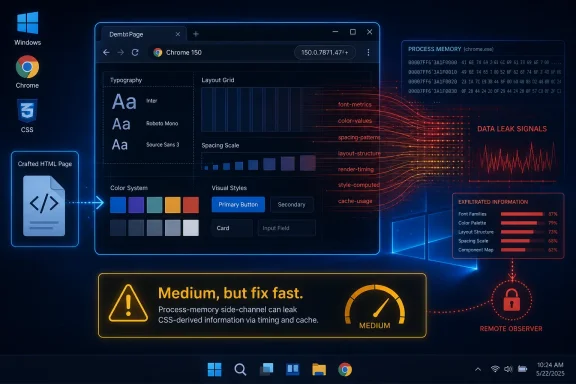 A Medium Bug Hiding in a Very Large Patch Train
CVE-2026-14012 is easy to underestimate because the labels around it seem almost designed to lower the room temperature. Chromium rates it Medium. CISA’s ADP vector requires user interaction and assigns high attack complexity. NVD, as of its July 1 modification record, had not yet published its own NIST CVSS score.But the description is the part that should stop administrators from shrugging: “side-channel information leakage in CSS.” In practical terms, that means the browser’s rendering and styling machinery exposed some observable behavior that could be abused to infer information that should not have been visible to the attacker. The attacker’s delivery mechanism was not exotic malware or a local privilege foothold; it was a crafted HTML page.
That does not mean every user who opened a hostile page was automatically handing over secrets. The public record does not say the bug was exploited in the wild, and CISA’s SSVC enrichment marked exploitation as “none” and automation as “no.” It does mean, however, that the web platform’s decorative layer — the part most users think of as fonts, layouts, colors, and responsive design — continues to sit frighteningly close to memory, isolation, and timing behavior.
Google’s June 30 Chrome 150 release was not a small security tune-up. The Chrome Releases post says the desktop update contained 433 security fixes and promoted Chrome 150 to stable for Windows, Mac, and Linux. In that crowd, CVE-2026-14012 is just one line item, reported by Google on May 27 and associated with a restricted Chromium issue tracker entry.
That scale matters. When a browser ships hundreds of security fixes in one stable release, the risk story is no longer about any single CVE in isolation. It is about whether the organization’s browser update process can keep pace with the speed at which the browser itself is becoming a full application runtime.
CSS Is No Longer Just Paint on the Wall
The phrase “CSS vulnerability” still sounds faintly absurd to people who remember web styling as a convenience layer bolted onto HTML. That mental model is obsolete. Modern CSS participates in layout, animation, containment, scrolling, font selection, GPU acceleration, media adaptation, privacy boundaries, and sometimes timing-sensitive rendering paths that browsers have spent years trying to harden.A side channel is not a classic memory corruption bug where an attacker directly smashes a buffer and takes control of instruction flow. It is usually subtler. The attacker observes a secondary effect — timing, layout changes, cache behavior, rendering differences, resource loading, or other externally visible signals — and uses those clues to infer information that the browser’s security model intended to hide.
That is why the CVE’s CWE classification is important. CWE-1300, “Improper Protection of Physical Side Channels,” points to a family of problems where the leak happens through measurements or effects rather than explicit data access. For a browser, that category is especially uncomfortable because the web platform is built around measurable effects. Pages measure time, respond to layout, react to media state, and observe rendering behavior because those capabilities are essential to building modern sites.
Chrome, Edge, Firefox, and Safari have spent years adding mitigations for this class of problem. Timer precision has been reduced in sensitive contexts. Cross-origin isolation became a prerequisite for certain high-resolution capabilities. Site isolation moved web origins into separate processes to limit blast radius. None of that eliminates the underlying tension: the more powerful and responsive the web platform becomes, the more ways it creates for one context to learn something about another.
CVE-2026-14012 appears, from the public description, to fall into that uncomfortable gray zone. It is not presented as a sandbox escape or arbitrary code execution. It is presented as an information disclosure flaw that could expose potentially sensitive data from process memory. In browser security, information disclosure is often not the final attack; it is the ingredient that makes a later attack cleaner.
That is especially true in the post-Spectre era. Once speculative execution attacks forced browser vendors to rethink assumptions about process boundaries and timing leaks, “just an info leak” stopped being a reassuring phrase. A memory disclosure can defeat address-space layout randomization, expose tokens, reveal cross-origin data fragments, or provide the attacker with enough environmental knowledge to chain another vulnerability.
The Exploit Story Is Narrow, but the Exposure Surface Is Wide
The known exploit conditions for CVE-2026-14012 are not trivial. CISA’s ADP vector uses network attack vector, no privileges required, user interaction required, unchanged scope, high confidentiality impact, and no integrity or availability impact. The high attack complexity rating is significant because it suggests exploitation requires more than simply serving a page and waiting.That should affect prioritization, not action. A high-complexity information leak is not the same thing as a wormable remote code execution flaw. It should not trigger the same emergency playbook as a widely exploited zero-day. But in a managed Windows environment, where Chrome and Edge are among the most exposed software on the machine, the difference between “patch this immediately” and “patch this during the next browser maintenance cycle” is measured in days, not months.
The user-interaction requirement is also less comforting than it sounds. For a browser flaw, user interaction usually means convincing someone to visit a page, click a link, open a web app, or interact with content. That is the baseline condition of the web. The browser is an attack surface precisely because users spend the day feeding it untrusted content.
The public advisory does not say which secrets were practically recoverable, how reliable the attack was, or whether the leak crossed origin boundaries. Google’s own Chromium issue remains access-restricted, which is standard while patches are still propagating. That leaves defenders with a familiar browser-security dilemma: the vendor has said enough to justify patching, but not enough to let outsiders fully model the exploit.
That opacity is not necessarily a failure. If Google disclosed a reliable exploit primitive before most users updated, it would help attackers more than defenders. The practical consequence, though, is that enterprise IT cannot wait for perfect exploit detail before acting. The browser update itself is the control.
Chrome 150 Makes the Single-CVE View Look Outdated
The bigger story around CVE-2026-14012 is that it arrived in a release dense enough to make individual CVE triage feel almost quaint. Google’s June 30 stable-channel post lists Chrome 150.0.7871.46 for Linux and 150.0.7871.46/.47 for Windows and Mac, with rollout over the following days and weeks. The same post says the update includes 433 security fixes.That number should be read carefully. It does not mean 433 independently weaponizable internet catastrophes landed on user desktops at once. Chrome’s security release notes combine issues across components, severities, internally found bugs, externally reported bugs, and sometimes platform-specific fixes. Many bug details are restricted. Some issues may be hard to exploit or reachable only through unusual conditions.
Still, the volume tells a real story about browser complexity. Chrome is no longer just a browser in the traditional sense. It is a PDF reader, media stack, GPU client, WebGPU and WebGL host, password manager interface, WebAuthn broker, extension platform, remote desktop participant, download manager, sync client, updater, and application shell. CSS is merely one part of a sprawling runtime that parses, compiles, draws, decodes, isolates, and negotiates trust on every page load.
For WindowsForum readers, the Windows angle is not that Chrome is uniquely dangerous on Windows. The Windows angle is that Chrome often becomes part of the managed endpoint baseline, whether as the default browser, a required browser for line-of-business apps, or a tolerated second browser beside Edge. If it exists on the fleet, it must be patched like core infrastructure, not like a discretionary user app.
Microsoft Edge users should also pay attention, even when the CVE name says Chrome. Edge is Chromium-based, and Microsoft typically ships its own browser security updates as Chromium fixes flow downstream. The exact Edge applicability and fixed version should be checked against Microsoft’s release notes, but the strategic lesson is unchanged: a Chromium bug rarely stays a “Chrome-only” operational concern for long.
The NVD Record Is Useful, but It Is Not the Whole Risk Model
The NVD entry for CVE-2026-14012 is still thin in ways that administrators will recognize. NVD shows the Chrome description, the affected product data, the CISA ADP score, and the change history. It also shows that NIST had not yet provided its own CVSS assessment at the time of the July 1 update. The entry’s affected configuration points to Google Chrome versions before 150.0.7871.47 across Windows, Linux, and macOS environments.That is enough for asset matching, but not enough for a full risk decision. CVSS is a useful common language, not an operations calendar. A 5.3 Medium score can still deserve rapid deployment when the vulnerable product is a default internet-facing application, the patch is available, and the remediation is routine. Conversely, a higher score in a dormant or unreachable component might deserve less immediate attention.
The CISA SSVC enrichment is more operationally expressive than the score alone. “Exploitation: none” means there was no public indication of observed exploitation in that record. “Automatable: no” suggests broad, hands-off exploitation was not considered straightforward. “Technical impact: partial” aligns with an information disclosure issue rather than a full system compromise.
But SSVC should not become a sedative. Side-channel bugs are often hard to score because their severity depends on what can be inferred, in what context, and whether the leak composes with another weakness. A leak that only reveals low-value implementation details is one thing. A leak that exposes memory useful for bypassing mitigations is another. Public CVE text rarely distinguishes those cases early.
The best way to read CVE-2026-14012 is as a medium-severity vulnerability with potentially high-value confidentiality implications under constrained exploit conditions. That is a mouthful, but it is more honest than either “ignore it” or “drop everything.” It belongs in the fast browser-patching lane.
The Crafted HTML Page Remains the Web’s Most Boring Delivery Vehicle
One of the strange things about browser security is how ordinary the attack delivery often sounds. A crafted HTML page is not a cinematic exploit artifact. It is the native file format of the modern internet. It can appear as a link in email, an ad landing page, a compromised website, a hostile SaaS document preview, or a browser-rendered attachment.That ordinariness is why browser bugs age badly in unpatched environments. Attackers do not need to send an executable if the target routinely opens untrusted markup in a feature-rich runtime. The web page is already executable enough: JavaScript, CSS, fonts, images, media, WebAssembly, GPU paths, and privileged browser services all converge behind the tab.
CVE-2026-14012’s CSS angle also cuts against a common but risky user instinct. People tend to associate dangerous web content with scripts and downloads. They may think of CSS as passive. But rendering is computation, and computation has side effects. If those effects are observable with enough precision, they can become a leak.
Enterprise defenses that focus only on blocking executables or disabling macros miss this class of risk. The mitigation is not user education alone, though users should still be trained not to follow suspicious links. The mitigation is keeping the browser’s security boundary current, reducing unnecessary extension exposure, isolating risky browsing where appropriate, and treating browser telemetry as meaningful endpoint signal.
For high-risk users — administrators, developers with access to production credentials, finance staff, executives, journalists, and anyone with privileged SaaS access — the browser is often the most sensitive application on the machine. A memory disclosure in that context does not need to own the operating system to matter. It only needs to expose something useful from the wrong process at the wrong time.
Windows Admins Should Treat Browser Version Drift as Configuration Drift
The practical remediation for Chrome is straightforward: update to Chrome 150.0.7871.47 or later on Windows and Mac, and to the fixed Chrome 150 train on Linux as provided by Google’s release channel. On individual Windows systems, Chrome’s built-in updater usually handles this through the About Chrome page and a relaunch. In managed environments, the question is not whether Chrome can update; it is whether policy, maintenance windows, virtual desktop images, and application testing practices allow it to update quickly enough.Browser version drift is configuration drift. If a machine is still running a vulnerable Chrome version after a stable security release has rolled out, that is not just “a user has not restarted yet.” It is a measurable gap between vendor patch availability and endpoint state. Mature organizations should be able to answer how many systems are behind, which business units they belong to, and whether update failures are caused by policy, network, packaging, or user behavior.
The restart problem remains stubborn. Chrome can download an update silently, but the vulnerable code may remain loaded until the browser relaunches. On Windows, where users keep browser sessions open for days or weeks, “updated” can become an ambiguous state. Administrators should distinguish between update staged, browser relaunched, and fixed version actively running.
There is also a VDI and golden-image issue. If your base image lags, every new session or desktop pool can resurrect an old browser. If your software inventory only checks installed package versions but not running process versions, you may miss the gap between what is on disk and what users are actually executing. Browser patching has become too important for those blind spots.
For small businesses and home power users, the advice is less elaborate but no less urgent. Open Chrome’s version page, let it update, and relaunch. If you use Edge, Brave, Vivaldi, Opera, or another Chromium-based browser, check that vendor’s update channel as well. Chromium fixes do not protect you until your chosen browser consumes and ships them.
CSS Side Channels Expose the Limits of Browser Sandboxing
Browser sandboxing is one of the great security engineering success stories of the last two decades. It has made drive-by exploitation harder, raised the cost of renderer compromise, and forced attackers to chain multiple bugs for full system impact. But side channels attack the spaces between clean boundaries. They do not always need to break the wall; sometimes they listen through it.Chrome’s site isolation work was a direct response to precisely that class of problem. If a renderer process can infer information from data it should never have had in its address space, the answer is not merely to fix one leak. It is to reduce what sensitive data can coexist in the same process. That architecture has made some attacks harder, but the browser remains full of shared subsystems, performance optimizations, and compatibility compromises.
CSS makes the problem more interesting because layout engines are designed to answer questions. How wide is this element? Did this font load? How did this container resize? What happened after a scroll? Can this selector match? The browser must expose some of those answers to web authors or the web breaks. Security engineering is the work of deciding which answers are too revealing, too precise, or too cross-origin.
That is a moving target. New CSS features add expressive power. New hardware changes timing behavior. New mitigations alter attacker techniques. A side channel that was impractical five years ago may become viable when combined with a different API, a faster machine, or a clever measurement strategy. Conversely, a scary theoretical channel may prove unreliable in real-world noise.
The public record for CVE-2026-14012 does not let us say where on that spectrum this particular bug sits. What it does show is that Google found enough risk in CSS-side observable behavior to assign a CVE and ship a fix. That is enough to treat CSS not as a harmless declarative stylesheet language, but as part of the browser’s security boundary.
The Patch Is Simple; the Governance Is Not
For most users, patching Chrome is boring by design. That is a triumph. The browser updates itself, prompts for relaunch, and the user gets a new build without downloading a standalone installer or deciphering vendor advisories. Automatic updating is one of the reasons consumer browser security is not far worse.Enterprises, however, often complicate that simplicity. They hold back browser versions for compatibility testing. They manage update channels. They pin versions for kiosk systems. They package browsers through software distribution tools. They disable auto-update in the name of control, then fail to replace it with an equally fast controlled process.
There are legitimate reasons to test browser releases. Chrome 150 is a major stable release, and major versions can break extensions, enterprise web apps, media behavior, printing workflows, or authentication flows. Some Reddit users and community reports around the Chrome 150 timeframe, for example, discussed post-update friction with native video controls and Manifest V2 workarounds, though those reports are anecdotal rather than vendor-confirmed root-cause analyses.
The problem is not testing. The problem is treating browser testing like old-style desktop application certification. A six-week browser deferral may have been tolerable when the browser was mostly a document viewer. It is harder to justify when the browser is the primary interface to identity, finance, collaboration, development environments, and administrative consoles.
The healthier model is ring-based deployment with rapid promotion. A small pilot group gets the update immediately. A broader business pilot follows within a day or two. Production moves quickly unless a confirmed blocker appears. Critical systems get special handling, but not indefinite exception. The default posture should be patch unless broken, not wait unless scared.
The Edge Question Is Really a Chromium Supply-Chain Question
WindowsForum readers naturally ask what a Chrome CVE means for Microsoft Edge. The answer is usually: watch Microsoft’s Edge release notes and assume relevance until proven otherwise. Edge uses Chromium, but Microsoft ships its own builds, integrates its own features, and may have different exposure depending on platform and component. That makes one-to-one version mapping imperfect.Still, the Chromium ecosystem behaves like a software supply chain. A flaw found in a shared component can propagate across browsers that consume that component. The fix must then propagate downstream through vendor integration, testing, signing, and release. Chrome users get Google’s build; Edge users get Microsoft’s; Brave, Vivaldi, and Opera users wait on their vendors’ build pipelines.
This is why browser monoculture is a double-edged security story. Chromium’s scale brings enormous fuzzing, engineering, and patch velocity. Bugs are found and fixed at industrial speed. But shared code also means a single class of vulnerability can touch a broad slice of the desktop web ecosystem, even if the branding on the icon differs.
For administrators, the inventory lesson is obvious and often ignored. “Chrome installed” is not enough. You need to know which Chromium-based browsers exist, which channels they are on, which versions are running, and whether auto-update is working. Shadow browsers installed by users can quietly become unpatched internet-facing runtimes with access to corporate SaaS.
Edge’s presence on Windows also changes user behavior. Some organizations patch Chrome quickly but forget that Edge is available and used for Microsoft 365, intranet apps, or authentication flows. Others standardize on Edge and leave Chrome unmanaged because “only a few users need it.” In either case, the browser you forgot is the browser attackers will be happy to find.
A Medium CSS Leak Still Belongs in the Fast Lane
CVE-2026-14012 does not deserve theatrical treatment. There is no public evidence in the provided records that it is being exploited in the wild. It is not described as remote code execution. It requires user interaction and has high attack complexity. The integrity and availability impacts in CISA’s vector are none.But it absolutely deserves prompt remediation. The vulnerability affects a browser component reachable through web content. Its stated impact is potentially sensitive process-memory disclosure. It sits inside a massive Chrome 150 security update that also contains many more severe fixes. And the cost of applying the fix, for most environments, is lower than the cost of analyzing the exploitability of one restricted Chromium bug.
This is the recurring lesson of browser security in 2026. The browser is too exposed, too privileged, and too frequently attacked to let Medium become a synonym for “later.” Medium should mean “prioritize intelligently,” not “leave it until quarterly patching.” If your patch process cannot move a browser from vulnerable to fixed within days for a routine stable security release, the process is the vulnerability.
There is a cultural adjustment here for Windows administrators. Windows Update taught generations of IT teams to think in monthly cycles, cumulative updates, and change-control windows. Browsers operate on a faster rhythm. They are closer to cloud clients than traditional desktop applications, and their patch cadence reflects an adversary model that does not respect Patch Tuesday.
Security teams should make peace with that mismatch rather than fight it. The browser update lane should be separate, faster, observable, and reversible. Compatibility testing should be real but compressed. Version compliance should be measured in hours and days. Exceptions should expire.
Chrome 150 Turns One CVE Into a Fleet Hygiene Test
The practical take on CVE-2026-14012 is not that CSS suddenly became terrifying. It is that an apparently modest CSS side-channel bug gives administrators a useful test of whether their browser-management process is serious enough for the modern web.- Chrome users on Windows and macOS should be on 150.0.7871.47 or later to clear the version threshold identified in the CVE record.
- Linux users should take the Chrome 150 stable update provided for their distribution or Google’s channel, noting that Google’s release post listed 150.0.7871.46 for Linux.
- The public record describes no known exploitation at the time of CISA’s enrichment, but the flaw is still remotely reachable through crafted web content with user interaction.
- Organizations should verify the running browser version after relaunch, not merely the installed package version staged on disk.
- Chromium-based browsers beyond Chrome should be tracked separately, because shared engine fixes only help after each vendor ships and the endpoint installs them.
- Browser patch rings should move faster than traditional desktop application rings, with exceptions documented and time-limited.
CVE-2026-14012 will probably disappear into the long tail of Chrome security history: one medium CSS side-channel fixed in a release full of louder bugs. But its lesson should stick. The web platform’s quiet surfaces are still attack surfaces, memory disclosure still matters, and browser patching is no longer a housekeeping chore to be postponed until the next convenient window; it is one of the core disciplines of Windows endpoint defense, and it will only become more central as more of the operating environment moves into the tab.
References
- Primary source: NVD / Chromium
Published: 2026-07-03T07:00:49-07:00
NVD - CVE-2026-14012
 nvd.nist.gov
- Security advisory: MSRC
Published: 2026-07-03T07:00:49-07:00
Original feed URL
Security Update Guide - Microsoft Security Response Center
 msrc.microsoft.com
- Related coverage: cvefeed.io
CVE-2026-14012 - Google Chrome Information Leakage
Side-channel information leakage in CSS in Google Chrome prior to 150.0.7871.47 allowed a remote attacker to obtain potentially sensitive information from process memory via a crafted HTML page. (Chromium security severity: Medium)cvefeed.io - Related coverage: chromereleases.googleblog.com
Chrome Releases: Stable Channel Update for Desktop
The Stable channel has been updated to 149.0.7827.155/.156 for Windows and Mac and 149.0.7827.155 for Linux, which will roll out over the c...chromereleases.googleblog.com
