

CVE-2026-14059 is a Google Chrome vulnerability published by NVD on June 30, 2026, affecting Chrome versions before 150.0.7871.47 and allowing a remote attacker to leak cross-origin data through a crafted HTML page. The immediate fix is mundane: update Chrome. The more interesting story is that a “Low” Chromium severity bug still earned a “Medium” CISA-ADP score because the browser boundary it touches is one of the web’s most important security promises. As detailed by NVD, CISA-ADP, and Google’s Chrome Releases blog, this is not a panic button bug, but it is exactly the sort of quiet policy failure that administrators should not ignore.
Chrome’s own wording is terse: “insufficient policy enforcement” in Related Website Sets allowed cross-origin data leakage before version 150.0.7871.47. That phrase sounds bureaucratic, but it points at a foundational browser bargain. Web pages are allowed to be hostile, curious, and extremely clever; the browser’s job is to stop one origin from reading data that belongs to another.
The bug sits in a feature designed for the modern web’s messy ownership reality. A company may operate several domains for login, payments, media, support, or regional services, and those domains may need limited ways to behave as related properties. Related Website Sets, formerly known in the Chrome ecosystem as First-Party Sets, is Google’s attempt to let related domains declare a controlled relationship without throwing open the gates to arbitrary cross-site tracking or data access.
That is why the word policy matters here. This is not described as a classic memory corruption bug, a GPU use-after-free, or a JavaScript engine flaw that leads directly to code execution. It is a logic and enforcement problem in the rules that decide when one site relationship should be treated as legitimate.
The NVD record says the flaw could allow a remote attacker to leak cross-origin data via a crafted HTML page. CISA-ADP scored it 6.5 Medium under CVSS 3.1, with network attack vector, low attack complexity, no privileges required, user interaction required, and high confidentiality impact. Chrome’s internal security severity is Low, but CISA’s scoring explains why defenders may still care: if the only thing lost is confidentiality, but the confidentiality boundary is cross-origin isolation, the operational risk is not automatically trivial.
That same update was not a boutique patch for one obscure privacy feature. Google said the release included hundreds of security fixes, and the public advisory listed a long run of Critical, High, Medium, and Low issues across the Chromium stack. In that crowd, CVE-2026-14059 risks becoming just another line item near the bottom of the severity table.
But enterprise patching rarely works by reading Chrome’s full bug list line by line. It works by release train, deployment ring, exception list, and deadline. A Chrome update with hundreds of fixes is a signal that the browser is not a static application in the old desktop sense; it is a security platform under constant repair.
For Windows admins, the practical lesson is not that CVE-2026-14059 deserves emergency treatment above every other Chrome issue in the release. It is that Chrome 150.0.7871.47 should be treated as the relevant fixed floor for Windows and Mac systems where this CVE is concerned. Anything below that is in the vulnerable range described by the CVE entry.
The versioning wrinkle is also worth noting. NVD’s change history shows a CPE configuration initially listing Chrome versions up to, but excluding, 150.0.7871.46, while the CVE description and affected-version statement point to versions prior to 150.0.7871.47. That kind of mismatch is common in fast-moving vulnerability metadata, but it is exactly why admins should anchor on the vendor-fixed version in the description and Chrome’s release channel notes rather than over-reading one generated CPE line.
Related Website Sets is one of those compromise mechanisms. It lets organizations declare that certain domains are related, under policy-defined limits, so browsers can grant narrowly scoped behavior that would otherwise be blocked or constrained. In theory, it is a way to avoid breaking sign-in flows, embedded services, and multi-domain product suites while still reducing arbitrary third-party tracking.
The danger is that any exception to a security boundary becomes a new place where enforcement bugs matter. The same-origin policy is simple in spirit: a page from one origin should not freely read another origin’s data. Modern web reality adds layers of cookies, storage partitioning, permissions, frames, redirects, service workers, and browser-managed relationship declarations.
That is where a flaw like CVE-2026-14059 becomes interesting. The vulnerable component is not merely storing a list of friendly domains. It is participating in the browser’s decision about when cross-site behavior is allowed. If that decision is made too broadly, too early, or without the right validation, a crafted page can benefit from trust it should not receive.
This is the uncomfortable bargain of privacy-preserving web compatibility. The more browsers replace blunt mechanisms with nuanced policy engines, the more security depends on those engines being exact. Related Website Sets may reduce one class of tracking abuse, but it also gives Chromium another policy surface that must be audited, fuzzed, and patched.
The modern browser attack path often begins with normal user behavior. A phishing email, a malicious ad, a compromised website, a poisoned search result, or a link in a collaboration tool can all deliver a crafted page. “User interaction required” increasingly means “the user used the web,” not “the user bypassed six warnings and installed malware.”
This distinction matters for Chrome because the browser is the place where personal accounts, enterprise identity, SaaS dashboards, admin consoles, and internal web apps converge. A cross-origin leak may not hand an attacker code execution, but it can expose data that helps build the next stage of an attack. The CVSS vector’s high confidentiality impact is doing real work here.
There is no public indication in the NVD entry that CVE-2026-14059 is being exploited in the wild. CISA-ADP’s SSVC data lists exploitation as “none,” automatable as “no,” and technical impact as “partial.” That should temper the response. This is not a zero-day fire drill based on current public evidence.
Still, the absence of known exploitation is not a reason to leave browsers stale. Chrome bug details are often restricted until most users receive fixes, as Google routinely notes in Chrome security advisories. Attackers read patch notes too, and a privacy-policy enforcement bug becomes more understandable once patches, tests, and related code changes are studied.
NVD’s CPE model tries to express vulnerable software configurations in a standardized way, but browsers make that harder than it looks. Chrome is an application, yet its exposure depends on operating system platform, release channel, architecture, managed-update state, and downstream Chromium-based products that may or may not have absorbed the fix. A neat CPE row rarely captures all of that cleanly on day one.
The NVD change history shows Windows, Linux kernel, and macOS operating-system CPEs under an AND configuration with the Google Chrome application entry. That does not mean Windows, Linux, or macOS themselves contain the vulnerability. It means the vulnerable application exists in those OS contexts. For asset teams, this distinction is important because otherwise a browser CVE can look like an OS vulnerability in dashboards that flatten CPE relationships.
The more notable inconsistency is the apparent version boundary. The description says Chrome prior to 150.0.7871.47. The “affected” statement received from Chrome also uses lessThan 150.0.7871.47. The NVD CPE configuration displayed in the change record says versions up to, excluding, 150.0.7871.46. In a vulnerability management system, that discrepancy can produce false negatives or false positives depending on how the scanner interprets the feed.
So, if you are maintaining a WindowsForum advisory or a vulnerability database entry, the safest correction is not to invent an exotic missing CPE. It is to make the product/version statement unambiguous: Google Chrome before 150.0.7871.47 is affected for this CVE, with platform applicability to Windows, macOS, and Linux as represented by the Chrome desktop release. If a scanner is using the NVD CPE cutoff of 150.0.7871.46 alone, it should be checked against the CVE description and vendor release data.
The crucial distinction is between component presence and product exposure. Related Website Sets is a Chromium/Chrome-area feature, and downstream browsers may enable, modify, disable, or lag portions of the relevant code. Without a vendor advisory from Microsoft, Brave, or another downstream maintainer, it would be irresponsible to declare every Chromium browser vulnerable to CVE-2026-14059 in the same way.
For administrators, however, the patching logic remains familiar. Managed browsers should be inventoried by product and version, not merely by engine family. Edge’s update channel, Chrome’s update channel, and any embedded Chromium runtime in enterprise software can move at different speeds.
Windows environments are especially prone to browser sprawl. A corporate image may ship Edge by default, users may install Chrome for compatibility, developers may run Chrome Beta or Canary, and line-of-business apps may bundle a Chromium runtime that nobody in security owns. When a CVE touches a browser policy surface, that sprawl becomes a visibility problem.
The right response is not to panic about every Chromium-branded binary. It is to confirm which browsers are present, which ones expose the affected functionality, and which vendors have shipped corresponding fixes. Chrome itself has a clear threshold: get to 150.0.7871.47 or later on Windows and Mac for this issue.
That understated failure mode can be dangerous. Cross-origin data leakage may reveal account state, page content, tokens, identifiers, internal application responses, or enough behavioral signal to support targeted phishing. The public description for CVE-2026-14059 does not specify exactly what data could be leaked, and that restraint is expected while bug details remain restricted. But the class of bug is inherently about information crossing an origin boundary.
For consumers, the most likely practical advice is boring: update Chrome and restart it. For enterprise users, the consequences are more varied. If employees access internal apps, cloud consoles, HR systems, ticketing platforms, or identity portals through Chrome, then a browser confidentiality flaw is part of the organization’s data protection surface.
Security teams sometimes underweight browser confidentiality bugs because they are less likely to trigger endpoint detection alerts. That is the wrong instinct. A leak that reveals session-adjacent data, internal hostnames, user-specific content, or authentication state can be valuable even if it never executes code.
The better mental model is that the browser is both a document viewer and a policy enforcement engine. When the policy engine fails, attackers may not need to break the operating system. They only need to make the browser answer a question it should have refused.
Permissions, site isolation, storage partitioning, cookie controls, FedCM, fenced frames, private network access, enterprise policies, and related-site declarations all operate as rules engines. They decide which context may see which data, which page may ask for which capability, and which legacy web behavior gets grandfathered under controlled circumstances. That is an enormous amount of logic.
CVE-2026-14059 belongs to this newer category of browser weakness. It is not the browser forgetting how to allocate memory safely; it is the browser failing to enforce a relationship boundary strictly enough. The result can still be security-significant because web trust is mostly a series of denied relationships.
This is also why severity labels can feel mismatched. Chromium calls the bug Low, likely reflecting exploitability, scope, or the nature of the affected feature within its internal severity framework. CISA-ADP calls it Medium because the CVSS vector gives high weight to confidentiality impact. Both can be true, and neither should be read in isolation.
For WindowsForum readers, the takeaway is that browser risk has broadened. The spectacular bugs still deserve attention, but the quieter ones increasingly live in the glue code that makes privacy, identity, and compatibility coexist. That glue code is where enterprise browsing policy now lives.
Chrome’s rapid update model is built around that reality. Google ships often, with staggered rollouts and restricted bug details. That can frustrate admins who want full technical disclosure before deployment, but the browser ecosystem has largely settled on speed over perfect transparency. The alternative is giving attackers a longer window to reverse-engineer fixes while users remain exposed.
For managed Windows fleets, Chrome update posture should be measurable. Admins should know how many endpoints are on the current stable build, how many are behind by more than one release, how many cannot auto-update because of policy or packaging decisions, and how quickly a forced relaunch can be applied when a browser security release matters. CVE-2026-14059 is a good test case precisely because it is not a headline-grabbing zero-day.
The relaunch problem remains the soft underbelly of browser patching. Chrome can download an update, but the fix may not fully take effect until the browser restarts. Users who keep sessions open for days can appear patched in one dashboard and remain effectively unprotected in practice. Enterprises that manage Chrome should pair update policy with reasonable restart enforcement.
The same applies to virtual desktops, persistent browser sessions, kiosk systems, lab machines, and shared workstations. Anywhere Chrome stays open for long stretches is a place where “updated” deserves verification. A low-severity confidentiality bug should not require heroics, but it should still close within the normal browser patch SLA.
Administrators should also check vulnerability scanners for version-boundary interpretation. If a tool flags Chrome below 150.0.7871.46, it may be following the NVD CPE configuration too literally. If it clears 150.0.7871.46 even though the CVE description says prior to 150.0.7871.47, it may be missing a narrow but important distinction. This is the kind of feed mismatch that deserves a tuning note, not a war room.
There is no public evidence in the NVD record that CVE-2026-14059 is actively exploited, and CISA-ADP’s SSVC data says exploitation is currently none. That should keep the response proportional. Patch promptly, verify deployment, and do not inflate the bug into a crisis.
But proportional does not mean passive. The browser is often the first and last application standing between a crafted web page and sensitive enterprise data. A bug that leaks cross-origin data is a reminder that confidentiality failures can begin and end inside the browser without touching the kernel, dropping malware, or tripping traditional defenses.
Here is the practical reading for Windows users and administrators:
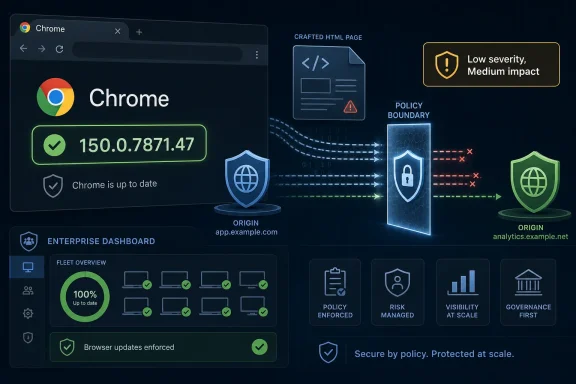 A Low-Severity Chrome Bug Still Hits a High-Value Boundary
Chrome’s own wording is terse: “insufficient policy enforcement” in Related Website Sets allowed cross-origin data leakage before version 150.0.7871.47. That phrase sounds bureaucratic, but it points at a foundational browser bargain. Web pages are allowed to be hostile, curious, and extremely clever; the browser’s job is to stop one origin from reading data that belongs to another.The bug sits in a feature designed for the modern web’s messy ownership reality. A company may operate several domains for login, payments, media, support, or regional services, and those domains may need limited ways to behave as related properties. Related Website Sets, formerly known in the Chrome ecosystem as First-Party Sets, is Google’s attempt to let related domains declare a controlled relationship without throwing open the gates to arbitrary cross-site tracking or data access.
That is why the word policy matters here. This is not described as a classic memory corruption bug, a GPU use-after-free, or a JavaScript engine flaw that leads directly to code execution. It is a logic and enforcement problem in the rules that decide when one site relationship should be treated as legitimate.
The NVD record says the flaw could allow a remote attacker to leak cross-origin data via a crafted HTML page. CISA-ADP scored it 6.5 Medium under CVSS 3.1, with network attack vector, low attack complexity, no privileges required, user interaction required, and high confidentiality impact. Chrome’s internal security severity is Low, but CISA’s scoring explains why defenders may still care: if the only thing lost is confidentiality, but the confidentiality boundary is cross-origin isolation, the operational risk is not automatically trivial.
Chrome 150 Arrived Carrying a Security Conveyor Belt
The timing matters. Google promoted Chrome 150 to the stable channel for Windows, Mac, and Linux on June 30, 2026, according to the Chrome Releases blog. The desktop release listed Chrome 150.0.7871.46 for Linux and 150.0.7871.46/.47 for Windows and Mac, with rollout expected over the following days and weeks.That same update was not a boutique patch for one obscure privacy feature. Google said the release included hundreds of security fixes, and the public advisory listed a long run of Critical, High, Medium, and Low issues across the Chromium stack. In that crowd, CVE-2026-14059 risks becoming just another line item near the bottom of the severity table.
But enterprise patching rarely works by reading Chrome’s full bug list line by line. It works by release train, deployment ring, exception list, and deadline. A Chrome update with hundreds of fixes is a signal that the browser is not a static application in the old desktop sense; it is a security platform under constant repair.
For Windows admins, the practical lesson is not that CVE-2026-14059 deserves emergency treatment above every other Chrome issue in the release. It is that Chrome 150.0.7871.47 should be treated as the relevant fixed floor for Windows and Mac systems where this CVE is concerned. Anything below that is in the vulnerable range described by the CVE entry.
The versioning wrinkle is also worth noting. NVD’s change history shows a CPE configuration initially listing Chrome versions up to, but excluding, 150.0.7871.46, while the CVE description and affected-version statement point to versions prior to 150.0.7871.47. That kind of mismatch is common in fast-moving vulnerability metadata, but it is exactly why admins should anchor on the vendor-fixed version in the description and Chrome’s release channel notes rather than over-reading one generated CPE line.
Related Website Sets Were Built to Soften the Cookie Crackdown
To understand why this bug exists, you have to look at where browser privacy engineering has gone. The web spent years leaning on third-party cookies and cross-site identifiers. Browser vendors then began restricting those mechanisms, creating pressure for features that preserve some legitimate cross-domain workflows without preserving the entire surveillance economy.Related Website Sets is one of those compromise mechanisms. It lets organizations declare that certain domains are related, under policy-defined limits, so browsers can grant narrowly scoped behavior that would otherwise be blocked or constrained. In theory, it is a way to avoid breaking sign-in flows, embedded services, and multi-domain product suites while still reducing arbitrary third-party tracking.
The danger is that any exception to a security boundary becomes a new place where enforcement bugs matter. The same-origin policy is simple in spirit: a page from one origin should not freely read another origin’s data. Modern web reality adds layers of cookies, storage partitioning, permissions, frames, redirects, service workers, and browser-managed relationship declarations.
That is where a flaw like CVE-2026-14059 becomes interesting. The vulnerable component is not merely storing a list of friendly domains. It is participating in the browser’s decision about when cross-site behavior is allowed. If that decision is made too broadly, too early, or without the right validation, a crafted page can benefit from trust it should not receive.
This is the uncomfortable bargain of privacy-preserving web compatibility. The more browsers replace blunt mechanisms with nuanced policy engines, the more security depends on those engines being exact. Related Website Sets may reduce one class of tracking abuse, but it also gives Chromium another policy surface that must be audited, fuzzed, and patched.
“User Interaction Required” Is Not the Comfort It Used to Be
CISA-ADP’s vector includes user interaction, which usually means the victim has to do something such as visiting or opening a malicious page. That prevents this CVE from looking like a wormable browser catastrophe. It does not make it irrelevant.The modern browser attack path often begins with normal user behavior. A phishing email, a malicious ad, a compromised website, a poisoned search result, or a link in a collaboration tool can all deliver a crafted page. “User interaction required” increasingly means “the user used the web,” not “the user bypassed six warnings and installed malware.”
This distinction matters for Chrome because the browser is the place where personal accounts, enterprise identity, SaaS dashboards, admin consoles, and internal web apps converge. A cross-origin leak may not hand an attacker code execution, but it can expose data that helps build the next stage of an attack. The CVSS vector’s high confidentiality impact is doing real work here.
There is no public indication in the NVD entry that CVE-2026-14059 is being exploited in the wild. CISA-ADP’s SSVC data lists exploitation as “none,” automatable as “no,” and technical impact as “partial.” That should temper the response. This is not a zero-day fire drill based on current public evidence.
Still, the absence of known exploitation is not a reason to leave browsers stale. Chrome bug details are often restricted until most users receive fixes, as Google routinely notes in Chrome security advisories. Attackers read patch notes too, and a privacy-policy enforcement bug becomes more understandable once patches, tests, and related code changes are studied.
The CPE Mess Is a Symptom, Not the Main Event
The user-facing question here asks whether we are missing a CPE. The short answer is: maybe the metadata is still settling, but the operational answer is clearer than the CPE table. The vulnerable product is Google Chrome before 150.0.7871.47, across the desktop platforms called out in the NVD configuration and Chrome release notes.NVD’s CPE model tries to express vulnerable software configurations in a standardized way, but browsers make that harder than it looks. Chrome is an application, yet its exposure depends on operating system platform, release channel, architecture, managed-update state, and downstream Chromium-based products that may or may not have absorbed the fix. A neat CPE row rarely captures all of that cleanly on day one.
The NVD change history shows Windows, Linux kernel, and macOS operating-system CPEs under an AND configuration with the Google Chrome application entry. That does not mean Windows, Linux, or macOS themselves contain the vulnerability. It means the vulnerable application exists in those OS contexts. For asset teams, this distinction is important because otherwise a browser CVE can look like an OS vulnerability in dashboards that flatten CPE relationships.
The more notable inconsistency is the apparent version boundary. The description says Chrome prior to 150.0.7871.47. The “affected” statement received from Chrome also uses lessThan 150.0.7871.47. The NVD CPE configuration displayed in the change record says versions up to, excluding, 150.0.7871.46. In a vulnerability management system, that discrepancy can produce false negatives or false positives depending on how the scanner interprets the feed.
So, if you are maintaining a WindowsForum advisory or a vulnerability database entry, the safest correction is not to invent an exotic missing CPE. It is to make the product/version statement unambiguous: Google Chrome before 150.0.7871.47 is affected for this CVE, with platform applicability to Windows, macOS, and Linux as represented by the Chrome desktop release. If a scanner is using the NVD CPE cutoff of 150.0.7871.46 alone, it should be checked against the CVE description and vendor release data.
Edge, Brave, Vivaldi, and the Chromium Shadow
This CVE is filed against Google Chrome, but Windows users live in a Chromium-shaped world. Microsoft Edge, Brave, Vivaldi, Opera, and other browsers depend on Chromium to varying degrees, then layer their own features, release schedules, and patch pipelines on top. A Chromium bug is not automatically exploitable in every Chromium-derived browser, but it is automatically worth watching.The crucial distinction is between component presence and product exposure. Related Website Sets is a Chromium/Chrome-area feature, and downstream browsers may enable, modify, disable, or lag portions of the relevant code. Without a vendor advisory from Microsoft, Brave, or another downstream maintainer, it would be irresponsible to declare every Chromium browser vulnerable to CVE-2026-14059 in the same way.
For administrators, however, the patching logic remains familiar. Managed browsers should be inventoried by product and version, not merely by engine family. Edge’s update channel, Chrome’s update channel, and any embedded Chromium runtime in enterprise software can move at different speeds.
Windows environments are especially prone to browser sprawl. A corporate image may ship Edge by default, users may install Chrome for compatibility, developers may run Chrome Beta or Canary, and line-of-business apps may bundle a Chromium runtime that nobody in security owns. When a CVE touches a browser policy surface, that sprawl becomes a visibility problem.
The right response is not to panic about every Chromium-branded binary. It is to confirm which browsers are present, which ones expose the affected functionality, and which vendors have shipped corresponding fixes. Chrome itself has a clear threshold: get to 150.0.7871.47 or later on Windows and Mac for this issue.
Why Cross-Origin Leaks Age Badly
Confidentiality bugs often look less dramatic than code execution bugs because they lack a cinematic payload. No shell pops. No ransomware banner appears. No administrator password is visibly typed into the attacker’s terminal. Data simply crosses a boundary it should not cross.That understated failure mode can be dangerous. Cross-origin data leakage may reveal account state, page content, tokens, identifiers, internal application responses, or enough behavioral signal to support targeted phishing. The public description for CVE-2026-14059 does not specify exactly what data could be leaked, and that restraint is expected while bug details remain restricted. But the class of bug is inherently about information crossing an origin boundary.
For consumers, the most likely practical advice is boring: update Chrome and restart it. For enterprise users, the consequences are more varied. If employees access internal apps, cloud consoles, HR systems, ticketing platforms, or identity portals through Chrome, then a browser confidentiality flaw is part of the organization’s data protection surface.
Security teams sometimes underweight browser confidentiality bugs because they are less likely to trigger endpoint detection alerts. That is the wrong instinct. A leak that reveals session-adjacent data, internal hostnames, user-specific content, or authentication state can be valuable even if it never executes code.
The better mental model is that the browser is both a document viewer and a policy enforcement engine. When the policy engine fails, attackers may not need to break the operating system. They only need to make the browser answer a question it should have refused.
The Chrome Security Model Is Becoming More Policy Than Sandbox
For years, browser security coverage focused heavily on sandbox escapes, memory safety, JavaScript engines, GPU processes, and renderer compromise. Those still matter enormously, and the Chrome 150 advisory included plenty of severe bugs in exactly those areas. But the modern browser’s security model increasingly depends on policy machinery layered above the sandbox.Permissions, site isolation, storage partitioning, cookie controls, FedCM, fenced frames, private network access, enterprise policies, and related-site declarations all operate as rules engines. They decide which context may see which data, which page may ask for which capability, and which legacy web behavior gets grandfathered under controlled circumstances. That is an enormous amount of logic.
CVE-2026-14059 belongs to this newer category of browser weakness. It is not the browser forgetting how to allocate memory safely; it is the browser failing to enforce a relationship boundary strictly enough. The result can still be security-significant because web trust is mostly a series of denied relationships.
This is also why severity labels can feel mismatched. Chromium calls the bug Low, likely reflecting exploitability, scope, or the nature of the affected feature within its internal severity framework. CISA-ADP calls it Medium because the CVSS vector gives high weight to confidentiality impact. Both can be true, and neither should be read in isolation.
For WindowsForum readers, the takeaway is that browser risk has broadened. The spectacular bugs still deserve attention, but the quieter ones increasingly live in the glue code that makes privacy, identity, and compatibility coexist. That glue code is where enterprise browsing policy now lives.
Patch Management Should Treat Chrome as Infrastructure
There was a time when a browser update felt like an application update. That era is gone. Chrome, Edge, and their peers are now user-facing infrastructure, carrying identity, SaaS access, device posture checks, and internal web workflows for nearly every organization.Chrome’s rapid update model is built around that reality. Google ships often, with staggered rollouts and restricted bug details. That can frustrate admins who want full technical disclosure before deployment, but the browser ecosystem has largely settled on speed over perfect transparency. The alternative is giving attackers a longer window to reverse-engineer fixes while users remain exposed.
For managed Windows fleets, Chrome update posture should be measurable. Admins should know how many endpoints are on the current stable build, how many are behind by more than one release, how many cannot auto-update because of policy or packaging decisions, and how quickly a forced relaunch can be applied when a browser security release matters. CVE-2026-14059 is a good test case precisely because it is not a headline-grabbing zero-day.
The relaunch problem remains the soft underbelly of browser patching. Chrome can download an update, but the fix may not fully take effect until the browser restarts. Users who keep sessions open for days can appear patched in one dashboard and remain effectively unprotected in practice. Enterprises that manage Chrome should pair update policy with reasonable restart enforcement.
The same applies to virtual desktops, persistent browser sessions, kiosk systems, lab machines, and shared workstations. Anywhere Chrome stays open for long stretches is a place where “updated” deserves verification. A low-severity confidentiality bug should not require heroics, but it should still close within the normal browser patch SLA.
The Right Fix Is Small; the Governance Lesson Is Not
The fix for an individual user is simple enough: open Chrome’s About page, allow the update to install, and relaunch the browser. On Windows, that generally means reaching 150.0.7871.47 or later for this CVE. On managed systems, it means confirming that update policies and deployment tools have pushed the fixed stable build and that users have restarted.Administrators should also check vulnerability scanners for version-boundary interpretation. If a tool flags Chrome below 150.0.7871.46, it may be following the NVD CPE configuration too literally. If it clears 150.0.7871.46 even though the CVE description says prior to 150.0.7871.47, it may be missing a narrow but important distinction. This is the kind of feed mismatch that deserves a tuning note, not a war room.
There is no public evidence in the NVD record that CVE-2026-14059 is actively exploited, and CISA-ADP’s SSVC data says exploitation is currently none. That should keep the response proportional. Patch promptly, verify deployment, and do not inflate the bug into a crisis.
But proportional does not mean passive. The browser is often the first and last application standing between a crafted web page and sensitive enterprise data. A bug that leaks cross-origin data is a reminder that confidentiality failures can begin and end inside the browser without touching the kernel, dropping malware, or tripping traditional defenses.
Chrome 150 Makes the Quiet Browser Bug Harder to Dismiss
This CVE is easy to miss because it arrives as one entry in a massive Chrome 150 security release. It is also easy to overstate because the public technical detail is limited and Chrome rates the bug Low. The useful position is between those extremes.Here is the practical reading for Windows users and administrators:
- Google Chrome versions before 150.0.7871.47 are the affected range described for CVE-2026-14059.
- The vulnerability is a cross-origin data leakage issue in Related Website Sets, not a publicly described code execution flaw.
- CISA-ADP scored the issue as Medium with high confidentiality impact, while Chromium’s own severity label is Low.
- Public metadata currently says exploitation is not known, but bug details may remain restricted while users update.
- Vulnerability tools should be checked for the 150.0.7871.46 versus 150.0.7871.47 boundary if their results look inconsistent.
- Downstream Chromium-based browsers should be monitored through their own vendor advisories rather than assumed safe or vulnerable by name alone.
References
- Primary source: NVD / Chromium
Published: 2026-07-03T07:00:50-07:00
NVD - CVE-2026-14059
 nvd.nist.gov
- Security advisory: MSRC
Published: 2026-07-03T07:00:50-07:00
Original feed URL
Security Update Guide - Microsoft Security Response Center
 msrc.microsoft.com
