

Google disclosed CVE-2026-14412 on July 1, 2026, a high-severity input-validation flaw in Chrome’s ANGLE graphics layer that could let an attacker who had already compromised a renderer process escape the browser sandbox through a crafted HTML page on versions earlier than 150.0.7871.46. The crucial qualifier is that this is not described as a one-click, standalone compromise: the attacker first needs control inside the renderer. The crucial warning is that sandbox escape is precisely the second step that can turn a contained browser exploit into a much broader endpoint incident.
CISA’s contributed CVSS 3.1 score of 8.3 reflects that uncomfortable balance. Exploitation is classified as complex and requires user interaction, but a successful chain could cross a security boundary and carry high consequences for confidentiality, integrity, and availability. Chrome users should treat 150.0.7871.46 as the minimum safe baseline, not as an update to postpone until the next convenient maintenance cycle.
CVE-2026-14412 is categorized as CWE-20, Improper Input Validation. According to the CVE record submitted by Chrome and published through the National Vulnerability Database, ANGLE did not sufficiently validate untrusted input before processing it, creating a path by which a crafted HTML page could potentially help an attacker escape Chrome’s sandbox.
That wording describes a staged attack rather than a self-contained browser takeover. The remote attacker must already have compromised the renderer process, generally implying that another vulnerability, exploit technique, or prior foothold is needed to execute code inside the process handling web content. CVE-2026-14412 then potentially provides the bridge out of that restricted environment.
This distinction should prevent two opposite mistakes. The first is exaggerating the flaw into a claim that merely visiting any malicious page automatically gives an attacker complete control of Windows. The disclosed conditions do not support that conclusion. The second mistake is dismissing the vulnerability because it requires an earlier renderer compromise; modern browser attacks routinely depend on chains in which separate bugs defeat separate defenses.
Chrome’s security architecture assumes web content is hostile. Pages are rendered in restricted processes designed to have sharply limited access to the operating system, the filesystem, user data, devices, and privileged browser functions. Chromium’s own security documentation explicitly includes compromised renderers in its threat model, because preventing every possible renderer compromise in a codebase of this size is not realistic.
The sandbox exists to keep such a compromise from becoming a machine compromise. A sandbox escape therefore attacks the architecture’s containment layer rather than merely another browser feature. It can be the difference between malicious code being trapped in a disposable process and that code reaching resources the process was never meant to touch.
That is why the CVE’s precondition does not make it unimportant. It tells defenders where the vulnerability sits in an exploit chain—and that position is strategically valuable.
That makes ANGLE an interoperability success, but it also places the component in a difficult security position. Web pages can provide complex graphics content, shaders, states, formats, dimensions, and commands influenced by untrusted input. ANGLE must interpret that material consistently while navigating different graphics drivers, hardware capabilities, operating systems, and API rules.
Graphics software is particularly unforgiving of bad assumptions. Values that appear to be harmless metadata can influence memory layouts, array access, resource allocation, command translation, and synchronization. A missing or incomplete validation check can therefore become more than a visual glitch or renderer crash.
CVE-2026-14412 is not described in the public record as a conventional memory-corruption category such as a use-after-free or heap buffer overflow. Chrome assigned it CWE-20, indicating that the central defect is failure to validate input correctly. That broad classification does not reveal the precise implementation mistake, and the associated Chromium issue requires permission to view.
Google commonly restricts access to browser security bugs while updates are still reaching users or while related downstream software remains exposed. The Chrome release advisory reiterates this practice, noting that bug details can remain restricted until most users are protected or when the problem also exists in a third-party library on which other projects depend.
That restriction is defensible, but it leaves administrators working from impact and version data rather than a complete technical narrative. What is publicly established is that malicious HTML can reach the affected path, that the renderer must first be compromised, and that successful exploitation could allow a sandbox escape. What is not publicly established is the exact malformed input, the reliability of exploitation, the affected graphics back ends, or whether exploitation depends on a particular driver or hardware configuration.
The practical response is not to speculate about those missing mechanics. It is to deploy the corrected browser.
Network attack vector means the vulnerable path can be reached remotely rather than requiring physical or local access. User interaction means a victim must take some action, most plausibly navigating to or interacting with attacker-controlled content. No privileges are required before the attack begins.
High attack complexity is the strongest limiting factor. It indicates that successful exploitation depends on conditions beyond simply sending one malformed request. In this case, the description explicitly says the renderer must already have been compromised, making CVE-2026-14412 a likely chain component rather than the opening move.
The changed-scope designation is the most consequential part of the vector. It means successful exploitation crosses from the authority governed by the vulnerable component into another security context. That matches the description of a sandbox escape: the attacker is trying to move from a deliberately constrained renderer into a domain with greater access.
The confidentiality, integrity, and availability impacts are all rated high. In CVSS terms, that supports the possibility of severe consequences if the entire chain succeeds. It should not be read as proof that every exploit would automatically gain permanent administrator control, but it does indicate that the theoretical impact is not confined to crashing one tab.
The fixed-version boundary is refreshingly clear even though the vulnerability mechanics are not. NIST’s CPE configuration marks Google Chrome versions up to, but excluding, 150.0.7871.46 as vulnerable. The Chrome-supplied affected-version record uses the same less-than boundary.
For administrators, the full four-part version matters. Verifying only that an endpoint reports “Chrome 150” is not precise enough, because pre-release, staged, unmanaged, or otherwise lagging installations can share a major version while carrying different security fixes. Inventory and compliance rules should evaluate the complete installed version against 150.0.7871.46.
That provenance matters. CVSS scores are structured estimates derived from known characteristics; they are not measurements of how often a vulnerability is attacked or how reliably an exploit works. The score captures the severe potential impact alongside the chain complexity and user-interaction requirement.
CISA’s Stakeholder-Specific Vulnerability Categorization record supplies a second and arguably more operational view. It lists exploitation as “none,” automatable as “no,” and technical impact as “total.” The CISA Coordinator record uses SSVC version 2.0.3.
“Exploitation: none” means the record does not identify evidence of active exploitation. It does not mean exploitation is impossible, nor does it establish that no proof of concept exists privately. It means defenders should not claim that CVE-2026-14412 is being used in attacks based on the available record.
“Automatable: no” fits the disclosed chain requirements. A renderer must already be compromised, the attack complexity is high, and the victim must interact with hostile content. Those conditions make broad, repeatable, worm-like exploitation less straightforward than a vulnerability requiring no user action and no preparatory compromise.
“Technical impact: total” points in the other direction. If an attacker does satisfy those conditions, the security boundary crossed is important enough that the consequence may be comprehensive. The SSVC record therefore describes low observed immediacy but high potential impact, a combination that should produce prompt patching without unsupported zero-day rhetoric.
This is where enterprise risk scoring often goes wrong. Organizations may downgrade anything not known to be exploited, allowing a browser sandbox escape to sit behind lower-impact vulnerabilities with louder threat intelligence. Others may see an 8.3 score and trigger emergency procedures designed for confirmed mass exploitation.
A more defensible posture falls between those extremes. The vulnerability should receive accelerated browser remediation because Chrome is an exposed, frequently used application and the flaw could complete a serious exploit chain. It does not, on the disclosed evidence, require telling executives that an active global campaign is underway.
The advisory presents this as a very large security release. Google’s page says the update includes 433 security fixes, while coverage from Malwarebytes, PCWorld, and some other outlets reported 382. The differing totals may reflect different counting methods, revisions, platform scope, or which categories of internally found fixes were included, but the available material does not conclusively reconcile the gap.
The discrepancy does not alter the cutoff for CVE-2026-14412. NIST’s record points to the June 30 release as both release notes and vendor advisory, and the affected-version configuration independently sets 150.0.7871.46 as the boundary. The number of other fixes in the package is secondary to whether the corrected binaries are actually running.
Still, the disagreement illustrates a communications problem with enormous browser updates. A release containing hundreds of fixes is difficult to interpret as a list of individual risks. High-impact vulnerabilities can disappear into a wall of issue identifiers, severity labels, and terse weakness descriptions.
The Chrome advisory visible publicly does not prominently enumerate CVE-2026-14412 in the same way that the NVD record does. Instead, the CVE record links the broader release and a restricted Chromium issue. That means someone reading only the vendor’s highlighted list could miss the specific sandbox-escape description, while someone reading only a third-party story about the aggregate patch count could miss it entirely.
NVD publication on July 1 provided the vulnerability with a stable identifier and a concise description. CISA-ADP then added scoring and SSVC context, and NIST added the affected CPE configuration and reference classifications on July 2. The administrative picture became clearer through enrichment after the Chrome binaries were already being distributed.
That sequence is normal for vulnerability disclosure, but it creates a temporary gap between patch availability and detailed risk understanding. Mature organizations should be able to deploy a browser security release before every CVE record has finished accumulating metadata. Waiting for perfect enrichment can mean continuing to run a build the vendor has already replaced.
July 1, 2026, 7:16:49 PM — Chrome submitted the new CVE record with the description, CWE-20 classification, affected-version boundary, release reference, and restricted issue reference.
July 1, 2026, 8:16:42 PM — CISA-ADP added the CVSS 3.1 vector and the original SSVC record.
July 2, 2026, 12:04:20 PM — NIST added the Chrome CPE configuration, marking versions earlier than 150.0.7871.46 as vulnerable, and classified the linked Chrome pages as release notes, a vendor advisory, and a permission-restricted issue.
July 3, 2026, 12:17:48 AM — CISA-ADP modified the SSVC record’s timestamp representation without changing its exploitation, automation, or technical-impact conclusions.
The distinction is especially relevant on workstations where users keep dozens of tabs open for days. A fleet dashboard may report update activity, yet active sessions can remain on the previous build until the process is restarted. The most meaningful control is therefore not simply “update downloaded,” but “corrected version running.”
Google provides enterprise relaunch policies for this reason. Administrators can recommend or require relaunches and specify a notification period. Those controls should be tuned tightly enough to close the exposure window while still avoiding abrupt browser termination during sensitive work.
Browser deployment also becomes complicated when organizations pin versions for application compatibility. Version pinning can be sensible for testing major feature changes, but a pin below the corrected four-part build converts a temporary compatibility control into a security exception. The burden then shifts to IT to prove that compensating controls justify continued exposure.
Disabled updates deserve even more scrutiny. Google’s enterprise documentation explicitly warns that disabling Chrome updates prevents security fixes from being applied. If an organization has chosen manual distribution, it needs an equally deliberate process for acquiring, testing, approving, deploying, and verifying security builds.
Per-user installations are another source of blind spots. A centrally managed machine-wide copy of Chrome does not guarantee that users lack a separate installation under their own profile. Software inventory should identify executable versions rather than merely confirming that the approved package exists.
Virtual desktop images, nonpersistent systems, application-layer packages, golden images, and offline machines can similarly reintroduce old browser builds. Updating today’s live endpoints is not enough if tomorrow’s newly provisioned endpoint is created from an image containing a vulnerable version.
Patching this CVE breaks the disclosed sandbox-escape link even if another renderer vulnerability remains unknown. That is the practical value of defense in depth: defenders do not need to predict every possible first-stage exploit if they can deny the attacker the next transition.
The inverse is also true. Security teams should not assume that sandbox escape automatically equals full system or administrator compromise. Windows still provides user privilege boundaries, process protections, endpoint controls, and other mitigations. An attacker escaping Chrome’s renderer sandbox may still need additional techniques to achieve persistence, elevation, credential theft, or lateral movement.
User privilege therefore remains important. Running everyday browsing sessions under accounts without unnecessary administrative rights can constrain what a post-sandbox attacker is able to do directly. It will not repair Chrome, but it can reduce the blast radius of successful exploitation.
Endpoint detection also remains relevant, though browser exploit chains can be difficult to identify from conventional indicators. Defenders can watch for abnormal child processes, unexpected access to user data, suspicious persistence activity, unusual scripting engines, or network behavior associated with a browser session. These signals are not specific to CVE-2026-14412, and no public evidence establishes the behaviors of a working exploit.
Network controls can reduce exposure to known malicious infrastructure but cannot reliably identify every crafted page, particularly on compromised legitimate sites. Content inspection is not a substitute for correcting the browser’s input validation. The browser must safely handle hostile data even when perimeter systems fail to recognize it as hostile.
Disabling hardware acceleration may appear attractive because ANGLE sits in the graphics stack, but the public record does not establish that doing so fully removes the vulnerable path or constitutes a supported mitigation. Administrators should not replace a verified fixed-version requirement with a configuration workaround inferred from the component name.
The same caution applies to blocklists and application-control rules. They can provide valuable layers, but none changes the affected-version statement. If Chrome is earlier than 150.0.7871.46, the CVE record considers it vulnerable.
Other vendors integrate Chromium on their own schedules and may backport individual security fixes without adopting the same visible version number. Some products expose a Chromium version; others present only a vendor-specific release. A Chrome cutoff therefore cannot always be pasted directly into compliance rules for another browser.
The sensible response is vendor-specific verification. Organizations using other Chromium-derived browsers should look for an advisory or release statement confirming whether the CVE applies and whether its fix has been incorporated. In the absence of such confirmation, administrators can ask the vendor rather than assuming that a superficially newer product version contains the correction.
This matters because browser monocultures create both efficiency and correlated risk. Chromium’s shared foundation allows multiple vendors to benefit from upstream fixes, but it also means a security defect in a common component can require coordinated downstream action. Restricting technical issue details until downstream projects have patched can reduce attacker advantage, though it leaves customers with less information during the rollout.
For Chrome itself, the NVD boundary is explicit. For other products, the right unit of evidence is the downstream vendor’s security status, not the branding or a rough comparison of major versions.
Administrators should rely on the complete record rather than isolating one field from its range semantics. Both the description and CPE configuration establish an exclusive upper boundary. Version 150.0.7871.46 is the correction threshold, not a vulnerable endpoint included in the range.
The July 3 SSVC modification is similarly procedural rather than substantive. CISA-ADP changed the timestamp from a value containing fractional seconds to midnight in a standard offset format. The decision options remained exploitation “none,” automatable “no,” and technical impact “total.”
NVD’s lack of an independent score is also not a sign that the CVE is unverified. The source is Chrome, the weakness and affected range came from Chrome, CISA-ADP supplied the 8.3 vector, and NIST added product configuration and reference metadata. The enrichment process was incomplete in one respect, but the remediation boundary was already sufficiently defined.
Security databases are assembled from multiple contributors and evolve after publication. Fields can arrive at different times, use different schemas, and be normalized later. Operational teams need enough familiarity with that process to distinguish a meaningful contradiction from an administrative change.
Here, there is no meaningful conflict over the core facts. The vulnerability is in Chrome’s ANGLE handling, the weakness is improper input validation, exploitation requires a compromised renderer and crafted HTML, the potential result is sandbox escape, and versions before 150.0.7871.46 are affected.
CISA’s contributed CVSS 3.1 score of 8.3 reflects that uncomfortable balance. Exploitation is classified as complex and requires user interaction, but a successful chain could cross a security boundary and carry high consequences for confidentiality, integrity, and availability. Chrome users should treat 150.0.7871.46 as the minimum safe baseline, not as an update to postpone until the next convenient maintenance cycle.
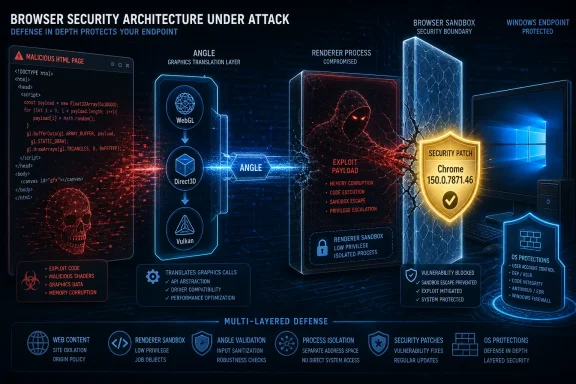 The Vulnerability Matters Because It Attacks Chrome’s Second Line of Defense
CVE-2026-14412 is categorized as CWE-20, Improper Input Validation. According to the CVE record submitted by Chrome and published through the National Vulnerability Database, ANGLE did not sufficiently validate untrusted input before processing it, creating a path by which a crafted HTML page could potentially help an attacker escape Chrome’s sandbox.That wording describes a staged attack rather than a self-contained browser takeover. The remote attacker must already have compromised the renderer process, generally implying that another vulnerability, exploit technique, or prior foothold is needed to execute code inside the process handling web content. CVE-2026-14412 then potentially provides the bridge out of that restricted environment.
This distinction should prevent two opposite mistakes. The first is exaggerating the flaw into a claim that merely visiting any malicious page automatically gives an attacker complete control of Windows. The disclosed conditions do not support that conclusion. The second mistake is dismissing the vulnerability because it requires an earlier renderer compromise; modern browser attacks routinely depend on chains in which separate bugs defeat separate defenses.
Chrome’s security architecture assumes web content is hostile. Pages are rendered in restricted processes designed to have sharply limited access to the operating system, the filesystem, user data, devices, and privileged browser functions. Chromium’s own security documentation explicitly includes compromised renderers in its threat model, because preventing every possible renderer compromise in a codebase of this size is not realistic.
The sandbox exists to keep such a compromise from becoming a machine compromise. A sandbox escape therefore attacks the architecture’s containment layer rather than merely another browser feature. It can be the difference between malicious code being trapped in a disposable process and that code reaching resources the process was never meant to touch.
That is why the CVE’s precondition does not make it unimportant. It tells defenders where the vulnerability sits in an exploit chain—and that position is strategically valuable.
ANGLE Turns a Graphics Translation Layer Into a Security Boundary
ANGLE, short for Almost Native Graphics Layer Engine, translates graphics calls into APIs supported by the underlying operating system and hardware. Chromium’s project documentation describes it as the translation machinery that allows WebGL and other OpenGL ES content to run across back ends including Direct3D, Vulkan, desktop OpenGL, OpenGL ES, and Metal.That makes ANGLE an interoperability success, but it also places the component in a difficult security position. Web pages can provide complex graphics content, shaders, states, formats, dimensions, and commands influenced by untrusted input. ANGLE must interpret that material consistently while navigating different graphics drivers, hardware capabilities, operating systems, and API rules.
Graphics software is particularly unforgiving of bad assumptions. Values that appear to be harmless metadata can influence memory layouts, array access, resource allocation, command translation, and synchronization. A missing or incomplete validation check can therefore become more than a visual glitch or renderer crash.
CVE-2026-14412 is not described in the public record as a conventional memory-corruption category such as a use-after-free or heap buffer overflow. Chrome assigned it CWE-20, indicating that the central defect is failure to validate input correctly. That broad classification does not reveal the precise implementation mistake, and the associated Chromium issue requires permission to view.
Google commonly restricts access to browser security bugs while updates are still reaching users or while related downstream software remains exposed. The Chrome release advisory reiterates this practice, noting that bug details can remain restricted until most users are protected or when the problem also exists in a third-party library on which other projects depend.
That restriction is defensible, but it leaves administrators working from impact and version data rather than a complete technical narrative. What is publicly established is that malicious HTML can reach the affected path, that the renderer must first be compromised, and that successful exploitation could allow a sandbox escape. What is not publicly established is the exact malformed input, the reliability of exploitation, the affected graphics back ends, or whether exploitation depends on a particular driver or hardware configuration.
The practical response is not to speculate about those missing mechanics. It is to deploy the corrected browser.
The Attack Chain Is Harder Than a Drive-By but More Serious Than a Renderer Crash
The CISA-ADP CVSS vector is unusually helpful because it exposes the assumptions behind the 8.3 score: AV:N/AC:H/PR:N/UI:R/S:C/C:H/I:H/A:H. Each element adds context that the headline severity alone cannot provide.Network attack vector means the vulnerable path can be reached remotely rather than requiring physical or local access. User interaction means a victim must take some action, most plausibly navigating to or interacting with attacker-controlled content. No privileges are required before the attack begins.
High attack complexity is the strongest limiting factor. It indicates that successful exploitation depends on conditions beyond simply sending one malformed request. In this case, the description explicitly says the renderer must already have been compromised, making CVE-2026-14412 a likely chain component rather than the opening move.
The changed-scope designation is the most consequential part of the vector. It means successful exploitation crosses from the authority governed by the vulnerable component into another security context. That matches the description of a sandbox escape: the attacker is trying to move from a deliberately constrained renderer into a domain with greater access.
The confidentiality, integrity, and availability impacts are all rated high. In CVSS terms, that supports the possibility of severe consequences if the entire chain succeeds. It should not be read as proof that every exploit would automatically gain permanent administrator control, but it does indicate that the theoretical impact is not confined to crashing one tab.
| Chrome security state | Version range | Exposure to CVE-2026-14412 | Operational interpretation |
|---|---|---|---|
| Vulnerable baseline | Earlier than 150.0.7871.46 | Affected | Renderer compromise could potentially be chained into a sandbox escape |
| Corrected baseline | 150.0.7871.46 or newer | Outside the affected range | Contains the vendor correction associated with this CVE record |
For administrators, the full four-part version matters. Verifying only that an endpoint reports “Chrome 150” is not precise enough, because pre-release, staged, unmanaged, or otherwise lagging installations can share a major version while carrying different security fixes. Inventory and compliance rules should evaluate the complete installed version against 150.0.7871.46.
An 8.3 Score Does Not Mean Exploitation Has Been Seen
The NVD page displays the 8.3 HIGH score as a contribution from CISA-ADP, not as an independent NVD assessment. At the time reflected in the record, NVD had not supplied its own CVSS 4.0, CVSS 3.x, or CVSS 2.0 assessment.That provenance matters. CVSS scores are structured estimates derived from known characteristics; they are not measurements of how often a vulnerability is attacked or how reliably an exploit works. The score captures the severe potential impact alongside the chain complexity and user-interaction requirement.
CISA’s Stakeholder-Specific Vulnerability Categorization record supplies a second and arguably more operational view. It lists exploitation as “none,” automatable as “no,” and technical impact as “total.” The CISA Coordinator record uses SSVC version 2.0.3.
“Exploitation: none” means the record does not identify evidence of active exploitation. It does not mean exploitation is impossible, nor does it establish that no proof of concept exists privately. It means defenders should not claim that CVE-2026-14412 is being used in attacks based on the available record.
“Automatable: no” fits the disclosed chain requirements. A renderer must already be compromised, the attack complexity is high, and the victim must interact with hostile content. Those conditions make broad, repeatable, worm-like exploitation less straightforward than a vulnerability requiring no user action and no preparatory compromise.
“Technical impact: total” points in the other direction. If an attacker does satisfy those conditions, the security boundary crossed is important enough that the consequence may be comprehensive. The SSVC record therefore describes low observed immediacy but high potential impact, a combination that should produce prompt patching without unsupported zero-day rhetoric.
This is where enterprise risk scoring often goes wrong. Organizations may downgrade anything not known to be exploited, allowing a browser sandbox escape to sit behind lower-impact vulnerabilities with louder threat intelligence. Others may see an 8.3 score and trigger emergency procedures designed for confirmed mass exploitation.
A more defensible posture falls between those extremes. The vulnerability should receive accelerated browser remediation because Chrome is an exposed, frequently used application and the flaw could complete a serious exploit chain. It does not, on the disclosed evidence, require telling executives that an active global campaign is underway.
Chrome’s Bulk Security Release Makes Individual Risk Harder to See
Google’s June 30 Chrome stable-channel advisory promoted Chrome 150 for Windows, macOS, and Linux and identified 150.0.7871.46 as the Linux build, with corresponding Windows and Mac builds in the same release family. The rollout was staged over the following days and weeks, Google said.The advisory presents this as a very large security release. Google’s page says the update includes 433 security fixes, while coverage from Malwarebytes, PCWorld, and some other outlets reported 382. The differing totals may reflect different counting methods, revisions, platform scope, or which categories of internally found fixes were included, but the available material does not conclusively reconcile the gap.
The discrepancy does not alter the cutoff for CVE-2026-14412. NIST’s record points to the June 30 release as both release notes and vendor advisory, and the affected-version configuration independently sets 150.0.7871.46 as the boundary. The number of other fixes in the package is secondary to whether the corrected binaries are actually running.
Still, the disagreement illustrates a communications problem with enormous browser updates. A release containing hundreds of fixes is difficult to interpret as a list of individual risks. High-impact vulnerabilities can disappear into a wall of issue identifiers, severity labels, and terse weakness descriptions.
The Chrome advisory visible publicly does not prominently enumerate CVE-2026-14412 in the same way that the NVD record does. Instead, the CVE record links the broader release and a restricted Chromium issue. That means someone reading only the vendor’s highlighted list could miss the specific sandbox-escape description, while someone reading only a third-party story about the aggregate patch count could miss it entirely.
NVD publication on July 1 provided the vulnerability with a stable identifier and a concise description. CISA-ADP then added scoring and SSVC context, and NIST added the affected CPE configuration and reference classifications on July 2. The administrative picture became clearer through enrichment after the Chrome binaries were already being distributed.
That sequence is normal for vulnerability disclosure, but it creates a temporary gap between patch availability and detailed risk understanding. Mature organizations should be able to deploy a browser security release before every CVE record has finished accumulating metadata. Waiting for perfect enrichment can mean continuing to run a build the vendor has already replaced.
Timeline
June 30, 2026 — Google released Chrome 150 to the stable channel for Windows, macOS, and Linux, establishing 150.0.7871.46 as the relevant corrected baseline in the CVE record.July 1, 2026, 7:16:49 PM — Chrome submitted the new CVE record with the description, CWE-20 classification, affected-version boundary, release reference, and restricted issue reference.
July 1, 2026, 8:16:42 PM — CISA-ADP added the CVSS 3.1 vector and the original SSVC record.
July 2, 2026, 12:04:20 PM — NIST added the Chrome CPE configuration, marking versions earlier than 150.0.7871.46 as vulnerable, and classified the linked Chrome pages as release notes, a vendor advisory, and a permission-restricted issue.
July 3, 2026, 12:17:48 AM — CISA-ADP modified the SSVC record’s timestamp representation without changing its exploitation, automation, or technical-impact conclusions.
A Downloaded Update Is Not the Same as a Protected Browser
Chrome normally retrieves updates in the background, but the newly downloaded browser code takes effect when Chrome relaunches. That creates a familiar enterprise gap: the updater may have successfully staged the package while the user continues operating a long-lived browser process containing the older code.The distinction is especially relevant on workstations where users keep dozens of tabs open for days. A fleet dashboard may report update activity, yet active sessions can remain on the previous build until the process is restarted. The most meaningful control is therefore not simply “update downloaded,” but “corrected version running.”
Google provides enterprise relaunch policies for this reason. Administrators can recommend or require relaunches and specify a notification period. Those controls should be tuned tightly enough to close the exposure window while still avoiding abrupt browser termination during sensitive work.
Browser deployment also becomes complicated when organizations pin versions for application compatibility. Version pinning can be sensible for testing major feature changes, but a pin below the corrected four-part build converts a temporary compatibility control into a security exception. The burden then shifts to IT to prove that compensating controls justify continued exposure.
Disabled updates deserve even more scrutiny. Google’s enterprise documentation explicitly warns that disabling Chrome updates prevents security fixes from being applied. If an organization has chosen manual distribution, it needs an equally deliberate process for acquiring, testing, approving, deploying, and verifying security builds.
Per-user installations are another source of blind spots. A centrally managed machine-wide copy of Chrome does not guarantee that users lack a separate installation under their own profile. Software inventory should identify executable versions rather than merely confirming that the approved package exists.
Virtual desktop images, nonpersistent systems, application-layer packages, golden images, and offline machines can similarly reintroduce old browser builds. Updating today’s live endpoints is not enough if tomorrow’s newly provisioned endpoint is created from an image containing a vulnerable version.
Action checklist for admins
- Inventory the full four-part Chrome version on every managed endpoint and flag anything earlier than 150.0.7871.46.
- Confirm that update policies, version pins, maintenance windows, proxies, and software-distribution rules are not blocking the corrected release.
- Require or strongly prompt a Chrome relaunch so that downloaded binaries replace existing browser processes.
- Search for unmanaged per-user installations, portable copies, virtual desktop layers, and stale golden images.
- Recheck fleet telemetry after deployment and investigate devices that remain below the corrected baseline.
- Preserve normal browser hardening, web filtering, endpoint detection, and least-privilege controls; the absence of reported exploitation is not a compensating patch.
Windows Defenders Should Think in Chains, Not Isolated CVEs
For Windows security teams, the most useful way to model CVE-2026-14412 is as a missing link in a potential chain. A malicious page first needs a method of compromising the renderer. The ANGLE validation flaw could then be used to move beyond the sandbox, after which the attacker would seek access to data, browser functions, user resources, or another privilege boundary.Patching this CVE breaks the disclosed sandbox-escape link even if another renderer vulnerability remains unknown. That is the practical value of defense in depth: defenders do not need to predict every possible first-stage exploit if they can deny the attacker the next transition.
The inverse is also true. Security teams should not assume that sandbox escape automatically equals full system or administrator compromise. Windows still provides user privilege boundaries, process protections, endpoint controls, and other mitigations. An attacker escaping Chrome’s renderer sandbox may still need additional techniques to achieve persistence, elevation, credential theft, or lateral movement.
User privilege therefore remains important. Running everyday browsing sessions under accounts without unnecessary administrative rights can constrain what a post-sandbox attacker is able to do directly. It will not repair Chrome, but it can reduce the blast radius of successful exploitation.
Endpoint detection also remains relevant, though browser exploit chains can be difficult to identify from conventional indicators. Defenders can watch for abnormal child processes, unexpected access to user data, suspicious persistence activity, unusual scripting engines, or network behavior associated with a browser session. These signals are not specific to CVE-2026-14412, and no public evidence establishes the behaviors of a working exploit.
Network controls can reduce exposure to known malicious infrastructure but cannot reliably identify every crafted page, particularly on compromised legitimate sites. Content inspection is not a substitute for correcting the browser’s input validation. The browser must safely handle hostile data even when perimeter systems fail to recognize it as hostile.
Disabling hardware acceleration may appear attractive because ANGLE sits in the graphics stack, but the public record does not establish that doing so fully removes the vulnerable path or constitutes a supported mitigation. Administrators should not replace a verified fixed-version requirement with a configuration workaround inferred from the component name.
The same caution applies to blocklists and application-control rules. They can provide valuable layers, but none changes the affected-version statement. If Chrome is earlier than 150.0.7871.46, the CVE record considers it vulnerable.
The Chromium Ecosystem Cannot Be Reduced to Chrome’s Version Number
ANGLE is a Chromium project component, but the verified affected product in the CVE record is Google Chrome. Administrators should resist converting that fact into unsupported claims about every Chromium-based browser.Other vendors integrate Chromium on their own schedules and may backport individual security fixes without adopting the same visible version number. Some products expose a Chromium version; others present only a vendor-specific release. A Chrome cutoff therefore cannot always be pasted directly into compliance rules for another browser.
The sensible response is vendor-specific verification. Organizations using other Chromium-derived browsers should look for an advisory or release statement confirming whether the CVE applies and whether its fix has been incorporated. In the absence of such confirmation, administrators can ask the vendor rather than assuming that a superficially newer product version contains the correction.
This matters because browser monocultures create both efficiency and correlated risk. Chromium’s shared foundation allows multiple vendors to benefit from upstream fixes, but it also means a security defect in a common component can require coordinated downstream action. Restricting technical issue details until downstream projects have patched can reduce attacker advantage, though it leaves customers with less information during the rollout.
For Chrome itself, the NVD boundary is explicit. For other products, the right unit of evidence is the downstream vendor’s security status, not the branding or a rough comparison of major versions.
The Record’s Small Inconsistencies Do Not Change the Remediation
The affected-version object included in the Chrome submission is mechanically awkward: it names 150.0.7871.46 while also specifying “less than 150.0.7871.46” and marking the range affected. Read alongside the plain-English description and NIST’s CPE analysis, the intended meaning is unambiguous—versions before that build are affected.Administrators should rely on the complete record rather than isolating one field from its range semantics. Both the description and CPE configuration establish an exclusive upper boundary. Version 150.0.7871.46 is the correction threshold, not a vulnerable endpoint included in the range.
The July 3 SSVC modification is similarly procedural rather than substantive. CISA-ADP changed the timestamp from a value containing fractional seconds to midnight in a standard offset format. The decision options remained exploitation “none,” automatable “no,” and technical impact “total.”
NVD’s lack of an independent score is also not a sign that the CVE is unverified. The source is Chrome, the weakness and affected range came from Chrome, CISA-ADP supplied the 8.3 vector, and NIST added product configuration and reference metadata. The enrichment process was incomplete in one respect, but the remediation boundary was already sufficiently defined.
Security databases are assembled from multiple contributors and evolve after publication. Fields can arrive at different times, use different schemas, and be normalized later. Operational teams need enough familiarity with that process to distinguish a meaningful contradiction from an administrative change.
Here, there is no meaningful conflict over the core facts. The vulnerability is in Chrome’s ANGLE handling, the weakness is improper input validation, exploitation requires a compromised renderer and crafted HTML, the potential result is sandbox escape, and versions before 150.0.7871.46 are affected.
The Patch Decision Is Simpler Than the Exploit Story
The technical details of CVE-2026-14412 are intentionally limited, but defenders do not need the restricted Chromium issue to make the immediate decision. The available evidence supports accelerated updating, relaunch verification, and careful fleet inventory without supporting claims of active exploitation.- CVE-2026-14412 is a high-severity Chrome ANGLE input-validation vulnerability.
- It is described as a sandbox-escape step that requires an already compromised renderer.
- CISA-ADP scores it 8.3 HIGH, with potentially high impact across confidentiality, integrity, and availability.
- CISA’s SSVC record lists no known exploitation and says the attack is not readily automatable.
- Chrome versions earlier than 150.0.7871.46 are within the affected range.
- Protection depends on running the corrected browser, not merely downloading an update or identifying the major version as Chrome 150.
References
- Primary source: NVD / Chromium
Published: 2026-07-11T15:37:59-07:00
NVD - CVE-2026-14412
 nvd.nist.gov
- Security advisory: MSRC
Published: 2026-07-11T15:37:59-07:00
Original feed URL
Security Update Guide - Microsoft Security Response Center
 msrc.microsoft.com
- Related coverage: security.snyk.io
Improper Input Validation in chromium | CVE-2026-14412 | Snyk
Improper Input Validation in chromium | CVE-2026-14412security.snyk.io - Related coverage: chromium.googlesource.com
- Related coverage: chromium.org