

Chrome 150.0.7871.46 is outside the documented affected range for CVE-2026-14417, a Critical use-after-free vulnerability in Dawn that could allow a remote attacker to potentially perform a sandbox escape via a crafted HTML page. The National Vulnerability Database record identifies applicable Google Chrome versions earlier than 150.0.7871.46 as affected.
The practical answer is to update Chrome and verify that the running version is 150.0.7871.46 or later. The severity warrants prompt remediation, but the available evidence does not support claims of active attacks, a complete endpoint-compromise chain, or specific post-escape actions.
CVE-2026-14417 is described as a use-after-free vulnerability in Chrome’s Dawn component. The public record says a remote attacker could potentially perform a sandbox escape via a crafted HTML page.
The affected-version boundary is the clearest operational fact in the record. Applicable Google Chrome versions earlier than 150.0.7871.46 are affected, while 150.0.7871.46 is excluded from that range.
That supports a concise exposure test:
This wording is intentionally narrower than saying Google “fixed” the vulnerability in that release. The NVD material establishes that versions before 150.0.7871.46 are affected and that 150.0.7871.46 is outside the documented range. Without a Chrome release advisory explicitly tying the CVE to a particular stable-channel update, the version boundary should not be expanded into a broader claim about Google’s release process.
The same caution applies to later builds. A version later than 150.0.7871.46 is numerically outside the affected range recorded by NVD, but that record is not a complete release history for every Chrome platform, channel, or package. Administrators should use the threshold to evaluate this CVE while continuing to follow their normal vendor-supported update channel.
For WindowsForum readers, the central distinction is straightforward: the affected range and the CISA-ADP assessment are documented; active exploitation and endpoint takeover are not. That is enough information to justify prompt action without turning a severe vulnerability into an unsupported breach narrative.
The phrase “potentially perform a sandbox escape” should therefore stand on its own. It communicates a serious possible result while preserving the uncertainty in the source. It should not be rewritten as guaranteed code execution, automatic compromise, or total control of the endpoint.
Restricted or unavailable technical detail does not change those limits. It neither proves nor disproves exploitation; it simply means the current public record cannot support a more detailed technical narrative.
The product scope also needs discipline. The documented product is Google Chrome. Shared Chromium ancestry or use of Dawn is not, by itself, proof that Microsoft Edge, Brave, Opera, Vivaldi, Electron applications, or other embedded runtimes are affected under Chrome’s version numbering. Organizations that operate those products should consult each vendor’s own advisory and release information rather than transferring the Chrome threshold to unrelated packages.
CISA-ADP supplies the following vector:
Under CVSS 3.1, that vector represents:
The correct attribution is:
The absence of an NVD-authored CVSS assessment should not be presented as disagreement with CISA-ADP. It means only that the supplied record does not contain a separate NVD score.
The CISA-ADP SSVC fields also need careful wording. “Exploitation: none” means the assessment did not identify exploitation; it is not a guarantee that exploitation is impossible or will never be reported. “Automatable: no” does not mean the vulnerability cannot be exploited. “Technical impact: total” describes the potential seriousness of successful exploitation under that assessment, not proof that an endpoint takeover has occurred.
The defensible conclusion is therefore to remediate promptly while preserving the distinction between technical severity and observed threat activity.
Organizations may answer that question through tools already deployed in their environments, including endpoint-management systems, software inventory platforms, vulnerability scanners, EDR products, configuration-management databases, or scripted local collection. The specific console and field names will vary, so administrators should follow the documentation for the products they actually use rather than assume a particular Google Admin console path or reporting behavior.
The inventory should preserve the full Chrome version string. A major-version value such as “Chrome 150” is not precise enough for a boundary defined as 150.0.7871.46.
A useful enterprise workflow is:
Version data also has a freshness dimension. This article does not assume a particular reporting delay for Google or any other management platform. Instead, administrators should evaluate the timestamp and collection method attached to each record. An old observation proves what was present when it was collected, not necessarily what is running now.
Direct validation deserves priority for endpoints that:
They should also avoid describing ordinary Chrome crashes, graphics errors, or endpoint alerts as indicators of CVE-2026-14417 unless later authoritative reporting supplies a validated detection method. The available material does not identify CVE-specific indicators of compromise.
Each development would answer a different question:
The forward-looking task is not to predict an undocumented exploit chain. It is to identify Chrome installations below the threshold, update them, preserve current version evidence, and watch authoritative records for any change in product scope, exploitation status, or vendor guidance.
The practical answer is to update Chrome and verify that the running version is 150.0.7871.46 or later. The severity warrants prompt remediation, but the available evidence does not support claims of active attacks, a complete endpoint-compromise chain, or specific post-escape actions.
Remediation
Enterprise path: Use the browser inventory, endpoint-management, vulnerability-management, EDR, or software-deployment platform already approved by the organization to locate Chrome installations and collect their full version strings. The required result is verifiable evidence that systems have moved outside the documented affected range—not merely confirmation that an update job was created or sent.
- Determine the full version of Chrome currently running on the endpoint.
- If it is earlier than 150.0.7871.46, update Chrome through the organization’s supported browser or software-management process.
- Complete any browser or update workflow presented by that process.
- Check the running version again and confirm that it is 150.0.7871.46 or later.
- Investigate endpoints whose versions are missing, stale, or cannot be verified.
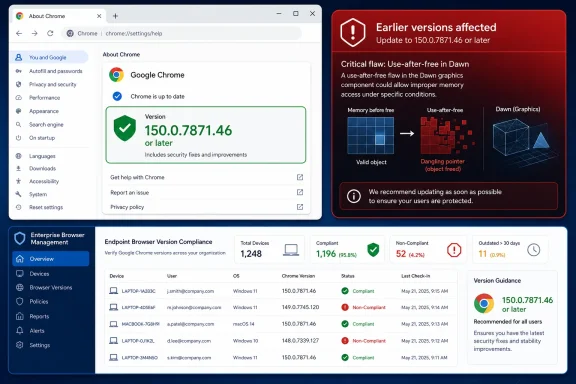 A Critical Bug With a Clear Version Boundary
CVE-2026-14417 is described as a use-after-free vulnerability in Chrome’s Dawn component. The public record says a remote attacker could potentially perform a sandbox escape via a crafted HTML page.The affected-version boundary is the clearest operational fact in the record. Applicable Google Chrome versions earlier than 150.0.7871.46 are affected, while 150.0.7871.46 is excluded from that range.
That supports a concise exposure test:
| Chrome version state | Status under the documented range | Required action |
|---|---|---|
| Earlier than 150.0.7871.46 | Affected | Update and verify the resulting version |
| 150.0.7871.46 | Outside the documented affected range | Record the verified version |
| Later than 150.0.7871.46 | Outside the documented affected range | Record the verified version and continue normal servicing |
| Version unavailable or unverified | Unknown | Obtain direct endpoint evidence before marking the system remediated |
The same caution applies to later builds. A version later than 150.0.7871.46 is numerically outside the affected range recorded by NVD, but that record is not a complete release history for every Chrome platform, channel, or package. Administrators should use the threshold to evaluate this CVE while continuing to follow their normal vendor-supported update channel.
For WindowsForum readers, the central distinction is straightforward: the affected range and the CISA-ADP assessment are documented; active exploitation and endpoint takeover are not. That is enough information to justify prompt action without turning a severe vulnerability into an unsupported breach narrative.
What Is Confirmed—and What Is Not
The public record confirms the following:- The affected product is Google Chrome.
- Dawn is the named component.
- The weakness is categorized as CWE-416, Use After Free.
- The documented entry point is a crafted HTML page.
- The stated potential result is a sandbox escape.
- Applicable versions earlier than 150.0.7871.46 are affected.
- Chrome 150.0.7871.46 is outside that documented range.
- CISA-ADP assigns a Critical CVSS 3.1 score of 9.6.
- The available CISA-ADP assessment lists exploitation as “none.”
- The precise object-lifetime error inside Dawn.
- A particular graphics API call, buffer, texture, callback, device state, or driver dependency.
- A reliable or publicly demonstrated exploit.
- A specific delivery campaign involving phishing, advertising, compromised websites, or embedded third-party content.
- A complete exploit chain from a web page to control of the operating system.
- Persistence, credential theft, administrative privileges, lateral movement, or other post-compromise behavior.
- A unique crash signature, network indicator, endpoint artifact, or process pattern for detecting attempts.
- Equivalent exposure in every Chromium-derived browser or application that uses related code.
The phrase “potentially perform a sandbox escape” should therefore stand on its own. It communicates a serious possible result while preserving the uncertainty in the source. It should not be rewritten as guaranteed code execution, automatic compromise, or total control of the endpoint.
Restricted or unavailable technical detail does not change those limits. It neither proves nor disproves exploitation; it simply means the current public record cannot support a more detailed technical narrative.
The product scope also needs discipline. The documented product is Google Chrome. Shared Chromium ancestry or use of Dawn is not, by itself, proof that Microsoft Edge, Brave, Opera, Vivaldi, Electron applications, or other embedded runtimes are affected under Chrome’s version numbering. Organizations that operate those products should consult each vendor’s own advisory and release information rather than transferring the Chrome threshold to unrelated packages.
The 9.6 Score Comes From CISA-ADP
The Critical 9.6 rating displayed in the available record is CISA-ADP’s CVSS 3.1 assessment, not an NVD-authored score.CISA-ADP supplies the following vector:
CVSS:3.1/AV:N/AC:L/PR:N/UI:R/S:C/C:H/I:H/A:HUnder CVSS 3.1, that vector represents:
- A network attack vector.
- Low attack complexity under the scoring model.
- No privileges required.
- User interaction required.
- Changed security scope.
- High potential impact to confidentiality, integrity, and availability.
The correct attribution is:
| Assessment item | Available record |
|---|---|
| Chromium severity | Critical |
| CISA-ADP CVSS 3.1 score | 9.6 Critical |
| CISA-ADP vector | AV:N/AC:L/PR:N/UI:R/S:C/C:H/I:H/A:H |
| NVD-authored CVSS score | Not provided in the supplied record |
| CISA-ADP exploitation status | None |
| CISA-ADP automatable status | No |
| CISA-ADP technical impact | Total |
The CISA-ADP SSVC fields also need careful wording. “Exploitation: none” means the assessment did not identify exploitation; it is not a guarantee that exploitation is impossible or will never be reported. “Automatable: no” does not mean the vulnerability cannot be exploited. “Technical impact: total” describes the potential seriousness of successful exploitation under that assessment, not proof that an endpoint takeover has occurred.
The defensible conclusion is therefore to remediate promptly while preserving the distinction between technical severity and observed threat activity.
Enterprise Verification
Enterprise response should begin with an inventory question: which endpoints are running a Chrome version earlier than 150.0.7871.46?Organizations may answer that question through tools already deployed in their environments, including endpoint-management systems, software inventory platforms, vulnerability scanners, EDR products, configuration-management databases, or scripted local collection. The specific console and field names will vary, so administrators should follow the documentation for the products they actually use rather than assume a particular Google Admin console path or reporting behavior.
The inventory should preserve the full Chrome version string. A major-version value such as “Chrome 150” is not precise enough for a boundary defined as 150.0.7871.46.
A useful enterprise workflow is:
- Identify Windows endpoints on which Google Chrome is installed.
- Collect the full installed or running version string.
- Flag versions earlier than 150.0.7871.46.
- Update affected installations through the supported enterprise process.
- Collect the version again after the update workflow completes.
- Record systems reporting 150.0.7871.46 or later as outside the documented affected range.
- Separate missing or stale inventory results from verified compliant systems.
- Investigate update failures, unreachable endpoints, unmanaged installations, and machines that remain below the threshold.
- Use vendor-specific advisories before extending the finding to another Chromium-based product.
- Update requested: A deployment or management system has sent an instruction.
- Update reported as installed: A management platform believes the package operation completed.
- Version verified: Current endpoint evidence shows Chrome at 150.0.7871.46 or later.
Version data also has a freshness dimension. This article does not assume a particular reporting delay for Google or any other management platform. Instead, administrators should evaluate the timestamp and collection method attached to each record. An old observation proves what was present when it was collected, not necessarily what is running now.
Direct validation deserves priority for endpoints that:
- Report a version earlier than 150.0.7871.46.
- Have no Chrome version in inventory.
- Have not checked in within the organization’s accepted interval.
- Failed an update or software-deployment job.
- Are powered on only intermittently.
- Use persistent or nonpersistent virtual desktop images.
- Run as kiosks, shared workstations, lab systems, or other special-purpose devices.
- Fall outside the normal software-management population.
Administrator Checklist
- [ ] Inventory Google Chrome installations across managed Windows endpoints.
- [ ] Collect full four-part version strings rather than major versions alone.
- [ ] Identify installations earlier than 150.0.7871.46.
- [ ] Update affected installations through an approved method.
- [ ] Verify the version after the update workflow completes.
- [ ] Treat missing or stale inventory as unknown rather than compliant.
- [ ] Investigate endpoints that remain below the documented threshold.
- [ ] Record the source and timestamp of version evidence.
- [ ] Check special-purpose systems that may not follow the standard update process.
- [ ] Consult separate vendor advisories for Edge and other Chromium-derived products.
- [ ] Monitor authoritative Chrome, CVE, NVD, and CISA information for material changes.
How Windows Teams Should Report the Risk
Internal advisories and help-desk notices should lead with the action and avoid unnecessary speculation. A suitable summary is:If severity context is included, the score should be attributed to CISA-ADP:CVE-2026-14417 is a Critical use-after-free vulnerability in Google Chrome’s Dawn component. The public description says a remote attacker could potentially perform a sandbox escape via a crafted HTML page. Applicable Chrome versions earlier than 150.0.7871.46 are affected. Update affected installations and verify that the running version is 150.0.7871.46 or later.
If exploitation status is included, it should remain equally precise:CISA-ADP assigns CVE-2026-14417 a CVSS 3.1 score of 9.6 Critical. NVD does not provide its own CVSS assessment in the supplied record.
Teams should avoid headlines saying the vulnerability is being actively exploited, has already compromised Windows systems, provides guaranteed remote code execution, or gives attackers complete control of a PC. None of those claims is established by the supplied record.The available CISA-ADP assessment lists exploitation as none. That is not evidence of active attacks, and it is not a prediction about future exploitation.
They should also avoid describing ordinary Chrome crashes, graphics errors, or endpoint alerts as indicators of CVE-2026-14417 unless later authoritative reporting supplies a validated detection method. The available material does not identify CVE-specific indicators of compromise.
What Defenders Should Watch Next
The public picture may change if Google publishes a Chrome release advisory explicitly associating CVE-2026-14417 with a stable update, if NVD adds its own analysis, if CISA-ADP changes its assessment, or if a responsible authority reports exploitation.Each development would answer a different question:
- A Chrome release advisory could establish the vendor’s exact release and remediation wording.
- A revised affected-product record could change the version or platform scope.
- A new CVSS assessment could provide another technical-severity perspective.
- A credible exploitation report could change incident-response priority.
- Vendor advisories for other Chromium-based products could establish separate product-specific exposure and version thresholds.
- Public technical analysis could clarify exploit prerequisites without proving that attacks occurred before publication.
The forward-looking task is not to predict an undocumented exploit chain. It is to identify Chrome installations below the threshold, update them, preserve current version evidence, and watch authoritative records for any change in product scope, exploitation status, or vendor guidance.
References
- Primary source: NVD / Chromium
Published: 2026-07-11T15:38:05-07:00
NVD - CVE-2026-14417
 nvd.nist.gov
- Security advisory: MSRC
Published: 2026-07-11T15:38:05-07:00
Original feed URL
Security Update Guide - Microsoft Security Response Center
 msrc.microsoft.com
- Related coverage: issues.chromium.org
Chromium
issues.chromium.org
- Related coverage: chromium.googlesource.com
- Related coverage: dawn.googlesource.com
- Related coverage: seclab.stanford.edu