

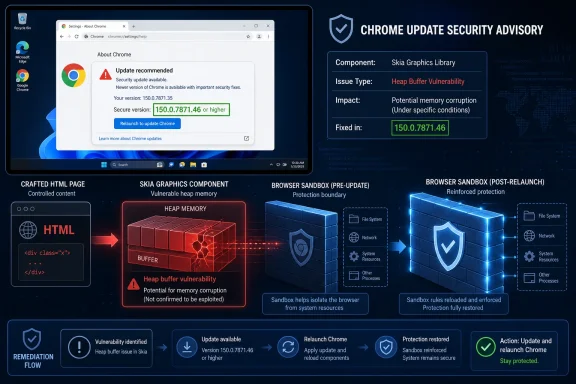
What changed: Google fixed CVE-2026-14427, a Critical heap-based buffer overflow in Chrome’s Skia component. Google Chrome versions earlier than 150.0.7871.46 are affected. The public description says a remote attacker who had already compromised the renderer process could potentially use a crafted HTML page to escape the browser sandbox.
Who is affected: Users and organizations running Google Chrome below the documented fixed-version threshold. The supplied record identifies Google Chrome; it does not establish equivalent version boundaries for other Chromium-based products.
What to do now: In Chrome, open Menu (⋮) > Help > About Google Chrome. Confirm that the displayed version is 150.0.7871.46 or later, and select Relaunch if prompted. CISA-ADP contributed a CVSS 3.1 score of 8.3 High. Chromium separately rates the vulnerability Critical.
 A Renderer Compromise Is the Required First Stage
CVE-2026-14427 is not publicly described as a self-contained, one-step takeover of a clean Chrome installation. The Chrome-originated description says the attacker must already have compromised the renderer process before potentially using the Skia heap buffer overflow to escape the sandbox through a crafted HTML page.That prerequisite is important and should remain visible in vulnerability tickets, user notices, and executive summaries. Reporting the issue simply as “a malicious page can take over the computer” would omit a material condition. At the same time, the prerequisite does not make the vulnerability unimportant: the documented potential result is a sandbox escape, which could allow an existing renderer compromise to cross a containment boundary.
The most defensible concise description is therefore:
CVE-2026-14427 is a Critical Skia heap overflow that can potentially enable sandbox escape after renderer compromise.
The public record does not identify the first-stage vulnerability that would provide that renderer compromise. It does not say that CVE-2026-14427 independently compromises a renderer, guarantees escape under every configuration, or produces a complete operating-system takeover whenever a victim opens a page.
“Potentially” also matters. It describes a possible security outcome without asserting universal exploit reliability. The restricted Chromium issue does not provide public triggering conditions, a proof of concept, or enough technical detail to reconstruct the exploitation process. Administrators do not need those details to apply the documented version-based remediation.
What the Heap Buffer Overflow Classification Establishes
The vulnerability is associated with CWE-122, the standard weakness category for a heap-based buffer overflow. That classification identifies the general memory-safety problem: software accesses memory beyond the bounds of a buffer allocated on the heap.The weakness category alone does not establish exactly what data might be overwritten, how the vulnerable state is reached, whether a particular attempt would cause a crash, or how an attacker might convert memory corruption into a reliable sandbox escape. Those details are not available in the supplied public record and should not be inferred from the CWE label.
The security consequence comes from the Chrome-originated vulnerability description, which explicitly identifies a potential sandbox escape after renderer compromise. Chromium’s Critical classification supplies a separate vendor severity judgment. Together, those facts support prompt remediation without requiring unsupported claims about the internal graphics operations, affected rendering paths, memory layout, or exploit-development techniques.
The affected component is identified as Skia, but the supplied record should not be expanded into a general technical profile of everything Skia does. For this CVE, the supported facts are narrower: the flaw is a heap buffer overflow in Skia, it affects Google Chrome before the fixed threshold, it requires prior renderer compromise, and it could potentially allow a sandbox escape through a crafted HTML page.
The linked Chromium issue is classified with the reference type Permissions Required. That establishes that access to the issue is restricted. It does not, by itself, establish why access is restricted, how long the restriction will remain, whether disclosure is being delayed for other products, or what undisclosed details the issue contains.
Critical Severity and the 8.3 Score Measure Different Things
Chromium rates CVE-2026-14427 Critical, while the CVSS 3.1 assessment contributed by CISA-ADP gives it a base score of 8.3 High. These labels should be preserved separately rather than blended into an unattributed severity rating.The recorded vector is:
CVSS:3.1/AV:N/AC:H/PR:N/UI:R/S:C/C:H/I:H/A:HIts components record:
- AV:N — Network attack vector
- AC:H — High attack complexity
- PR:N — No privileges required
- UI:R — User interaction required
- S:C — Changed scope
- C:H — High confidentiality impact
- I:H — High integrity impact
- A:H — High availability impact
It is reasonable to observe that those selections are compatible with the public description of a conditional sandbox escape, but the vector does not assign a Chrome-specific technical explanation to each metric. In particular, the record does not explicitly say that AC:H was chosen specifically to represent the renderer-compromise prerequisite, or that S:C was chosen specifically to model Chrome’s sandbox architecture. Treating those connections as possible interpretations is safer than presenting them as statements from CISA-ADP.
The PR:N metric also should not be paraphrased as “no prerequisites.” In CVSS, it means the attacker does not need existing privileges in the vulnerable system before attempting the attack. The written vulnerability description separately states that the renderer process must already have been compromised. Both facts must remain part of the assessment.
The supplied record does not contain a separate NVD- or NIST-authored CVSS assessment. The 8.3 score displayed with the record is attributed to CISA-ADP. Accurate internal reporting should therefore say:
- Chromium severity: Critical
- CISA-ADP CVSS 3.1: 8.3 High
- NVD/NIST-authored CVSS assessment: Not provided in the supplied record
| Assessment signal | Recorded value | Operational meaning |
|---|---|---|
| Chromium security severity | Critical | Vendor classification for the Chrome vulnerability |
| CISA-ADP CVSS 3.1 | 8.3 High | Contributed standardized assessment |
| Attack complexity | High | Significant attack conditions are reflected in the vector |
| User interaction | Required | The modeled attack is not interaction-free |
| Scope | Changed | The modeled impact crosses a security authority or boundary |
| Potential C/I/A impact | High / High / High | A successful attack could have severe technical consequences |
| NVD/NIST CVSS | Not provided | No separate NVD-authored score appears in the supplied record |
Exact Update and Verification Procedure
Individual users should verify the full Chrome version rather than relying on the major version number alone.- Open Google Chrome.
- Select the three-dot Menu (⋮) in the upper-right corner.
- Select Help.
- Select About Google Chrome.
- Read the complete version number displayed on the page.
- Confirm that it is 150.0.7871.46 or later.
- If Chrome displays a Relaunch button, select it.
- After Chrome reopens, return to Menu (⋮) > Help > About Google Chrome and verify the displayed version again.
150.0.7871.45 remains below the fixed boundary, while 150.0.7871.46 meets it.| Displayed Google Chrome version | CVE-2026-14427 status | Required response |
|---|---|---|
| Earlier than 150.0.7871.46 | Within the documented affected range | Update, relaunch if prompted, and verify again |
| Exactly 150.0.7871.46 | Meets the documented minimum threshold | Record the verified version |
| Numerically later than 150.0.7871.46 | Outside the documented affected range | Record the verified version |
| Missing, stale, or conflicting | Unknown | Keep the finding open and investigate |
| Chrome confirmed not installed | Not applicable to that asset | Record the supporting inventory evidence |
The same boundary should not automatically be copied to Microsoft Edge, Brave, Vivaldi, Opera, embedded Chromium components, or other software that uses Chromium-related technology. The supplied record formally identifies Google Chrome. Each other product should be evaluated using that vendor’s own affected-version and remediation information.
The Public Record Does Not Claim Active Exploitation
The supplied CISA-ADP Stakeholder-Specific Vulnerability Categorization entry records:- Exploitation: none
- Automatable: no
- Technical impact: total
“Exploitation: none” should be presented narrowly: the contributed SSVC assessment did not identify exploitation at that time. It is not proof that exploitation has never occurred, that private research does not exist, or that the status cannot change later.
“Automatable: no” likewise should not be converted into a detailed narrative about exploit reliability or attacker effort. It records the SSVC categorization. The public description’s prior-renderer-compromise requirement provides separate context showing that this is not documented as a single-stage attack against an otherwise uncompromised browser.
“Technical impact: total” reflects the potentially severe result of successful exploitation. That value is consistent with the high confidentiality, integrity, and availability impact selections in the CISA-ADP CVSS vector. It describes potential consequence, not current attack prevalence.
The appropriate operational posture is urgency without sensationalism. An outdated Chrome installation is evidence of vulnerability exposure, not evidence that the endpoint has been compromised. Administrators should remediate the affected version while continuing to distinguish patch status from incident findings.
The supplied material does not include CVE-specific indicators of compromise, malicious domains, file hashes, process patterns, or campaign details. Security teams should not invent narrowly tailored detection rules based on assumptions about how the vulnerability would be delivered or exploited.
Process Checklist for Managed Fleets
The supplied record does not identify a particular management console, report name, registry query, PowerShell command, or endpoint-management product as the authoritative verification method. The following is therefore a process checklist, not a product-specific technical procedure.- Inventory Google Chrome installations using the organization’s established asset or software-management process.
- Collect the complete running or verified Chrome version, including all four numeric components.
- Flag every installation earlier than 150.0.7871.46 as affected.
- Treat missing, stale, conflicting, or incomplete version data as unverified rather than compliant.
- Approve or deploy the Chrome update through the organization’s normal browser-management channel.
- Tell users to save relevant work and use Relaunch when Chrome presents that option.
- Collect fresh version information after the update and relaunch activity.
- Keep each device open for action until current evidence shows 150.0.7871.46 or later.
- Investigate failed updates and devices that did not return current inventory.
- Review kiosks, shared workstations, virtual images, intermittently connected laptops, and systems outside the primary management scope.
- Maintain a device-level exception list for systems that cannot be remediated immediately.
- Evaluate other browsers and Chromium-derived applications separately under their own vendor guidance.
- Preserve normal endpoint monitoring without treating an outdated version as proof of exploitation.
- Document closure using verified version evidence rather than package approval or deployment status alone.
A deployment dashboard may report that an action was sent successfully without providing current browser-version evidence. Under this checklist, such a device remains unverified until the organization obtains a fresh, trustworthy version result. The relevant measure is the endpoint’s confirmed Chrome version, not the status label attached to the deployment job.
Keep Product Scope Precise
The affected-software information supplied for CVE-2026-14427 identifies Google Chrome. It does not establish that every browser or application containing Chromium-related code is vulnerable, nor does it establish a fixed version for those products.That distinction is especially important on Windows systems, where users may have several browsers installed and where other applications may include web-rendering technology. Updating Google Chrome establishes the status of Google Chrome. It does not prove that a different browser, desktop application, or embedded component has incorporated an equivalent correction.
Administrators should maintain separate inventory and remediation records for each browser product. If another vendor publishes guidance connecting its product to CVE-2026-14427, that guidance can be evaluated on its own terms. Until then, Chrome’s version threshold should not be projected onto another product’s version scheme.
The reverse error should also be avoided. The presence of another updated Chromium-based browser does not remediate an outdated Google Chrome installation. Each installed product remains a separate item for inventory, verification, and closure.
The Record’s Development Is Secondary to the Fix
The vulnerability record progressed through the usual stages of a Chrome-originated description, CISA-ADP scoring and SSVC enrichment, and NVD configuration and reference classification. That sequence can explain why different security tools may initially display different amounts of metadata, but it does not change the operational boundary: Google Chrome versions earlier than 150.0.7871.46 are affected.Exact publication and modification timestamps are unnecessary to the remediation decision and should not be repeated unless they can be verified directly against the applicable record. A database “modified” status can reflect metadata activity rather than a change in exploit status, affected versions, or technical impact.
The more important attribution point is that NVD can display information contributed by several sources. The CVSS 8.3 score in the supplied material is from CISA-ADP, not an independent NIST calculation. Scanner tickets and internal reports should preserve that provenance rather than labeling every number shown on an NVD page as an “NVD score.”
Security tools may also ingest different fields at different times. If one dashboard has the vulnerability description but not the affected-version configuration, or another displays the CISA-ADP score without its attribution, administrators should return to the supported core facts instead of waiting for every system to synchronize.
Those facts are sufficient to act:
- The affected product is Google Chrome.
- The vulnerability is CVE-2026-14427.
- The component is identified as Skia.
- The weakness is a heap-based buffer overflow.
- Chromium rates it Critical.
- Chrome earlier than 150.0.7871.46 is affected.
- Prior renderer compromise is required by the public description.
- A crafted HTML page could potentially enable sandbox escape.
- CISA-ADP contributed a CVSS 3.1 score of 8.3 High.
- The supplied SSVC assessment records exploitation as none, automatable as no, and technical impact as total.
- The corrective action is to update, relaunch when prompted, and verify the displayed version.
Restricted Details Do Not Block Remediation
The permission-restricted Chromium issue limits public technical analysis. It does not prevent defenders from making a version-based decision.The public record does not provide enough information to state which internal object, operation, data structure, or rendering sequence triggers the overflow. It does not provide a public proof of concept or establish how reliable exploitation might be. It also does not identify a companion renderer vulnerability or document a complete attack chain.
Those gaps should lead to disciplined language, not delayed remediation. Administrators do not need to understand the precise corruption sequence to compare an installed version with 150.0.7871.46.
Likewise, the restricted reference should not be used to claim that information was withheld specifically to protect an update rollout or because related software remains affected. The supported statement is simply that the Chromium issue requires permission. Any explanation for that access status would require additional evidence.
Where the limited disclosure does constrain defenders is CVE-specific threat hunting. Without supported indicators or technical behavior, organizations cannot responsibly attribute ordinary Chrome crashes, unusual browser behavior, or generic endpoint alerts to CVE-2026-14427. Such events can still be investigated under normal incident-response procedures, but the CVE label should be applied only when evidence justifies it.
Close the Verification Loop
The practical measure of success is the number of in-scope Google Chrome installations that remain below 150.0.7871.46 or lack current verification.For individual users, the process takes only a few steps: open Menu (⋮) > Help > About Google Chrome, confirm 150.0.7871.46 or later, use Relaunch if prompted, and check the version again after Chrome reopens.
For administrators, the same principle applies at fleet scale. Discover Chrome installations, compare complete versions with the fixed boundary, deploy through established processes, obtain fresh post-action inventory, and investigate every failed, stale, or unknown result. Systems that cannot yet provide reliable version evidence should remain open as exceptions rather than being counted as remediated.
CVE-2026-14427 does not need an exaggerated exploit narrative to justify action. The supported facts are already serious: a Critical Skia heap buffer overflow, a requirement for prior renderer compromise, and the potential for a crafted HTML page to enable sandbox escape. CISA-ADP’s 8.3 score and SSVC data add prioritization context, while the fixed-version threshold supplies a clear test.
The forward-looking lesson is straightforward. Browser vulnerability response should end with verified version evidence, not with an assumption that an update reached every device. For CVE-2026-14427, the defensible target is explicit: move every affected Google Chrome installation to 150.0.7871.46 or later, complete the relaunch when offered, verify the displayed version, and keep every unresolved endpoint visible until the result is proven.
References
- Primary source: NVD / Chromium
Published: 2026-07-11T15:38:14-07:00
NVD - CVE-2026-14427
 nvd.nist.gov
- Security advisory: MSRC
Published: 2026-07-11T15:38:14-07:00
Original feed URL
Security Update Guide - Microsoft Security Response Center
 msrc.microsoft.com
- Related coverage: chromium.googlesource.com
- Related coverage: skia.org
Issue Tracking | Skia
The Skia Issue Tracker Skia’s Issue Tracker (bug.skia.org or skbug.com) is the primary bug database where we track all defect reports and feature requests. When filing a new issue, please select the appropriate template, most likely “Defect report from user” or “Feature...skia.org
- Related coverage: security.snyk.io
Heap-based Buffer Overflow in chromium | CVE-2026-14427 | Snyk
Heap-based Buffer Overflow in chromium | CVE-2026-14427security.snyk.io - Related coverage: issues.chromium.org
Chromium
issues.chromium.org