

There is total loss of availability in the affected DNS validation path, and Microsoft’s own wording makes clear that the issue can be abused to drive sustained CPU exhaustion during insecure delegation validation. In practical terms, CVE-2026-1519 is the sort of flaw that can turn a resolver or validation service into a self-inflicted denial-of-service machine when it processes maliciously constructed NSEC3 data with excessive iteration counts. The important detail is not just that the system gets slower; it is that the attacker can force the component into a condition where it cannot reliably serve requests at all, which aligns with the high-impact availability language you quoted. Microsoft’s public advisory page exists for the CVE, but the page itself is currently inaccessible without JavaScript, so the technical description has to be inferred from the CVE title and impact language rather than from a full on-page breakdown (msrc.microsoft.com)
This CVE belongs to a familiar but still dangerous class of DNS failures: computational abuse. Rather than corrupt memory or hijack control flow, the attacker pushes the validation logic into doing far more work than it should. That kind of bug is especially painful in DNS because resolvers sit in the path of everything else, from endpoint lookups to authentication workflows, content delivery, and service discovery.
The phrase “insecure delegation validation” is the clue that matters most. In DNSSEC, delegation checks are supposed to confirm trust relationships across zones, and NSEC3 adds a hashed denial-of-existence mechanism that can be computationally expensive by design. If the code accepts or honors excessive iteration values without sufficient guardrails, the cost of validating a malicious response can explode very quickly.
That is why this looks like an availability bug rather than a data-integrity bug. The system is still doing “the right thing” from its own perspective, but it is doing it in the most expensive way possible. In a resolver fleet, that can be enough to create queue buildup, timeout cascades, and secondary failures in anything that depends on name resolution.
The broader lesson is that DNS security is no longer just about spoofing and cache poisoning. Modern DNSSEC logic also has to resist resource-exhaustion attacks, because a validation algorithm that is correct in principle can still become dangerous in practice if the attacker controls the cost envelope.
That is where the risk comes from. If the validator does not cap, reject, or otherwise constrain pathological iteration values early enough, the attacker can make each validation attempt disproportionately expensive. One expensive query may be tolerable; thousands of them can starve the service.
This is one reason availability bugs in DNSSEC are often more serious than they appear. The resolver may not crash, but if it cannot keep up with incoming work, the result is functionally the same as an outage. That makes CVE-2026-1519 a service-plane problem as much as a protocol bug.
That asymmetry matters even more in shared infrastructure. A validating resolver often supports many downstream clients, so one abusive pattern can degrade service for an entire organization. In the worst case, the validation path becomes a choke point that disrupts authentication, software updates, service discovery, and application startup.
The wording in Microsoft’s advisory description strongly suggests a condition that can persist while the attacker keeps sending crafted inputs, and may continue to affect service health after the initial spike. That is exactly the kind of availability loss that defenders need to treat as urgent rather than theoretical.
That is why the boundary between partial and total denial is not very comforting in practice. If the vulnerable component is on the critical path, small delays can have big operational effects.
The wording also suggests that the attack surface is not the entire resolver stack. Instead, it centers on a particular path that handles insecure delegations. That is good news for defenders in one sense, because it may limit exposure to certain deployments. It is bad news in another, because the affected path is likely to be exercised repeatedly on systems that actually validate DNSSEC.
That matters for enterprises that depend on Windows DNS features, resolver roles, or software built on Microsoft-managed components. The practical question is not whether the bug is elegant; it is whether it affects production DNS behavior. For a high-availability DNS flaw, that answer is usually yes if the component is exposed to untrusted or semi-trusted DNS traffic.
In other words, the resolver is trapped between correctness and performance. If it validates properly, it burns CPU. If it shortcuts the work, it risks accepting an untrusted delegation. That is exactly why these bugs are hard to mitigate after the fact.
That can be especially useful in mixed environments where not every resolver is equally hardened. A weaker edge resolver can become the amplification point for a wider failure, especially if multiple clients retry simultaneously.
This is why defenders should think of CVE-2026-1519 as a computational DoS vulnerability, not just a traffic-volume issue.
Cloud environments raise the stakes further. DNS often underpins service mesh lookups, workload bootstrapping, and automation pipelines. If resolution slows down or stalls, orchestration systems may misbehave in ways that are hard to connect back to the original vulnerability.
That means the bug can still matter at the edge of the home network. A consumer may not see the CVE name, but they will absolutely notice if web pages fail to load, sign-ins time out, or applications report “network unavailable” when the real issue is DNS exhaustion.
That means defenders should think in terms of algorithmic abuse. If a validation path can be coerced into doing too much work, the adversary has already won part of the battle. The right response is not to disable security checks, but to make those checks resilient to abusive cost profiles.
This is where operational tooling matters. If responders can see that one resolver is spending far more time on NSEC3 validation than its peers, they can isolate the event before it turns into a widespread outage. Early visibility is half the fix in bugs of this kind.
For that reason, organizations should treat Microsoft’s advisory as a patching event, not a “monitor and hope” issue. If the affected component is exposed to untrusted DNS traffic, the patch belongs in the next urgent maintenance cycle.
Longer term, this is another sign that DNSSEC implementation quality will be judged not just by correctness, but by resilience under abuse. That is a good thing for defenders, because it pushes vendors toward safer defaults and tighter validation boundaries. It is also a warning that attackers increasingly look for expensive code paths rather than dramatic exploits, which means the most dangerous weaknesses may be the ones that merely work too hard when confronted with hostile input.
Source: MSRC Security Update Guide - Microsoft Security Response Center
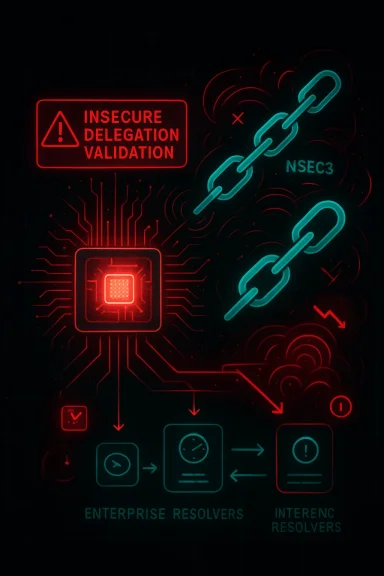 Overview
This CVE belongs to a familiar but still dangerous class of DNS failures: computational abuse. Rather than corrupt memory or hijack control flow, the attacker pushes the validation logic into doing far more work than it should. That kind of bug is especially painful in DNS because resolvers sit in the path of everything else, from endpoint lookups to authentication workflows, content delivery, and service discovery.The phrase “insecure delegation validation” is the clue that matters most. In DNSSEC, delegation checks are supposed to confirm trust relationships across zones, and NSEC3 adds a hashed denial-of-existence mechanism that can be computationally expensive by design. If the code accepts or honors excessive iteration values without sufficient guardrails, the cost of validating a malicious response can explode very quickly.
That is why this looks like an availability bug rather than a data-integrity bug. The system is still doing “the right thing” from its own perspective, but it is doing it in the most expensive way possible. In a resolver fleet, that can be enough to create queue buildup, timeout cascades, and secondary failures in anything that depends on name resolution.
The broader lesson is that DNS security is no longer just about spoofing and cache poisoning. Modern DNSSEC logic also has to resist resource-exhaustion attacks, because a validation algorithm that is correct in principle can still become dangerous in practice if the attacker controls the cost envelope.
What NSEC3 Is Doing Here
NSEC3 is a DNSSEC mechanism designed to prove that a record does not exist without exposing the entire zone’s contents in the clear. It does that by hashing names and chaining proofs of nonexistence. That makes it useful, but also computationally heavier than simpler approaches.Why iterations matter
In NSEC3, the iteration count determines how many additional hash rounds are applied. More iterations mean more CPU work for each proof. In a trusted environment, that cost is acceptable because it is bounded by policy and normal zone design. Under attack, however, a malicious response can turn the validator into a hash grinder.That is where the risk comes from. If the validator does not cap, reject, or otherwise constrain pathological iteration values early enough, the attacker can make each validation attempt disproportionately expensive. One expensive query may be tolerable; thousands of them can starve the service.
Why delegation validation is a sensitive path
Delegation validation is not an obscure background feature. It is part of the trust machinery that determines whether a resolver should accept a delegation as secure. If that path bogs down, the ripple effects are immediate: clients wait, retries increase, caches age out, and dependent applications start failing in ways that look unrelated at first.This is one reason availability bugs in DNSSEC are often more serious than they appear. The resolver may not crash, but if it cannot keep up with incoming work, the result is functionally the same as an outage. That makes CVE-2026-1519 a service-plane problem as much as a protocol bug.
- NSEC3 is computationally heavier than simpler DNS denial-of-existence mechanisms.
- Iteration counts directly affect CPU cost during validation.
- Delegation validation is a trust-critical path, so performance failures can cascade.
- Attackers do not need code execution if they can force sustained resource exhaustion.
- Resolvers and validating forwarders are the primary exposure points.
Why This Becomes a High-Impact Availability Bug
The availability language attached to the CVE is not boilerplate. It signals that repeated exploitation can deny access in a way that is operationally serious, not merely annoying. A resolver that spends too much time on one malicious response is a resolver that is not answering normal queries.The CPU-exhaustion pattern
DNSSEC validation is a classic example of a resource asymmetry problem. The attacker sends a compact trigger; the defender performs expensive cryptographic and validation work. Even if the attacker’s bandwidth is low, the server’s CPU cost can be very high.That asymmetry matters even more in shared infrastructure. A validating resolver often supports many downstream clients, so one abusive pattern can degrade service for an entire organization. In the worst case, the validation path becomes a choke point that disrupts authentication, software updates, service discovery, and application startup.
The wording in Microsoft’s advisory description strongly suggests a condition that can persist while the attacker keeps sending crafted inputs, and may continue to affect service health after the initial spike. That is exactly the kind of availability loss that defenders need to treat as urgent rather than theoretical.
Why “partial” denial is still serious
Even if the bug does not fully take a system offline, a resolver can become degraded enough to break real business processes. Modern applications often assume near-instant DNS answers. When that assumption fails, the symptom may be latency, but the consequence can be dropped sessions, failed logins, or broken service dependencies.That is why the boundary between partial and total denial is not very comforting in practice. If the vulnerable component is on the critical path, small delays can have big operational effects.
- High CPU utilization can starve other DNS work.
- Retries multiply the load, worsening the outage.
- Shared resolvers widen the blast radius.
- Service discovery and authentication can fail upstream.
- Degradation can look like generic network trouble, delaying diagnosis.
Microsoft’s Advisory Context
Microsoft’s Security Update Guide has become a central place for CVE tracking, but the public page for CVE-2026-1519 is currently not readable through a simple fetch because the site requires JavaScript to render the content (msrc.microsoft.com). That means the strongest available signal is still the CVE title and the impact description itself.What the title implies
“Excessive NSEC3 iterations cause high CPU load during insecure delegation validation” is a very specific formulation. Microsoft is not describing a generic DNS failure; it is narrowing the issue to a cost-amplification flaw tied to validation logic. That usually means the bug is either in a parsing check, a policy enforcement check, or both.The wording also suggests that the attack surface is not the entire resolver stack. Instead, it centers on a particular path that handles insecure delegations. That is good news for defenders in one sense, because it may limit exposure to certain deployments. It is bad news in another, because the affected path is likely to be exercised repeatedly on systems that actually validate DNSSEC.
Why this kind of disclosure matters
Microsoft’s inclusion of the CVE in the Security Update Guide matters because it signals operational relevance, not just academic interest. Even where the vendor is not the primary upstream maintainer of the DNS code, a Microsoft advisory usually means the flaw is relevant to products, services, or platforms in the Microsoft ecosystem.That matters for enterprises that depend on Windows DNS features, resolver roles, or software built on Microsoft-managed components. The practical question is not whether the bug is elegant; it is whether it affects production DNS behavior. For a high-availability DNS flaw, that answer is usually yes if the component is exposed to untrusted or semi-trusted DNS traffic.
The documentation gap
Because the page could not be fully rendered, defenders should be careful not to over-interpret the public title alone. It is reasonable to infer a resource-exhaustion issue, but not to invent a specific exploit recipe. That distinction matters. The title gives enough to prioritize, but not enough to claim the full mechanics of abuse.- The advisory title is already operationally meaningful.
- The site rendering limitation leaves some details unconfirmed.
- The CVE appears tightly scoped to DNSSEC validation behavior.
- Defenders should prioritize based on impact, not on missing narrative detail.
- Microsoft’s inclusion suggests ecosystem relevance beyond a single implementation.
How Attackers Would Likely Abuse It
The most plausible abuse model is straightforward: send DNS responses or delegation data that maximize NSEC3 validation cost, then repeat the pattern enough times to keep the resolver busy. The attacker’s goal is not stealth; it is sustained work generation.The asymmetry at the heart of the bug
A small amount of attacker input can force a disproportionately large amount of processing. That is the hallmark of a denial-of-service design flaw. It is especially effective against validation logic because the defender cannot safely skip the expensive work without weakening security guarantees.In other words, the resolver is trapped between correctness and performance. If it validates properly, it burns CPU. If it shortcuts the work, it risks accepting an untrusted delegation. That is exactly why these bugs are hard to mitigate after the fact.
Why insecure delegation is a useful target
Delegation points are attractive because they sit at a structural boundary in DNS. Attackers love structural boundaries: they are where trust decisions happen, and trust decisions are usually expensive to validate. If the malicious data can be made to look just plausible enough to reach the NSEC3 path, the attacker gets a high-value CPU sink.That can be especially useful in mixed environments where not every resolver is equally hardened. A weaker edge resolver can become the amplification point for a wider failure, especially if multiple clients retry simultaneously.
What makes this different from ordinary query floods
A basic flood is noisy and easy to rate-limit. A validation-cost attack is subtler because each individual transaction may look like a legitimate DNSSEC exercise. That means traditional volumetric protections might not catch it quickly enough, particularly if the traffic rate is modest but each request is expensive.This is why defenders should think of CVE-2026-1519 as a computational DoS vulnerability, not just a traffic-volume issue.
- The attacker likely wants repeated expensive validations.
- Legitimate-looking DNSSEC traffic can be the trigger.
- Rate-based defenses may not be enough on their own.
- Delegation boundaries are attractive abuse points.
- The true risk is sustained work generation, not packet volume alone.
Enterprise and Cloud Impact
The enterprise impact is likely much broader than the consumer impact. DNS is one of those invisible services that becomes visible only when it fails, and in cloud and enterprise environments it is wired into nearly everything.Why enterprises should care first
Large organizations often operate internal resolvers, recursive caches, conditional forwarders, or DNSSEC-aware appliances. If any of those systems validate insecure delegations in the vulnerable way, a crafted attack can take down name resolution for a whole segment of the network. That can interrupt sign-in flows, software distribution, access to internal services, and even parts of monitoring and incident response.Cloud environments raise the stakes further. DNS often underpins service mesh lookups, workload bootstrapping, and automation pipelines. If resolution slows down or stalls, orchestration systems may misbehave in ways that are hard to connect back to the original vulnerability.
Consumer environments are less exposed, but not immune
A typical consumer device is less likely to run its own validating resolver at scale, so the direct exposure is smaller. But consumer systems still depend on upstream DNS infrastructure, and if those upstream services are degraded, the consumer experiences the problem as broken connectivity.That means the bug can still matter at the edge of the home network. A consumer may not see the CVE name, but they will absolutely notice if web pages fail to load, sign-ins time out, or applications report “network unavailable” when the real issue is DNS exhaustion.
Operational symptoms to watch
The scary part of CPU-exhaustion bugs is that they often masquerade as ordinary load spikes. By the time the resolver is visibly unhealthy, the organization may already have multiple downstream symptoms. That is why this kind of issue belongs in DNS monitoring playbooks, not just vulnerability management.- Resolver latency spikes
- Sudden increases in CPU usage
- Timeouts on application startup
- Authentication or service-discovery failures
- Retry storms from dependent clients
- Cache churn or apparent intermittent network failure
Enterprise vs. consumer prioritization
For enterprises, this should be treated as a high-priority service availability issue. For consumers, the update urgency is still real, but it is usually mediated through vendors and service providers rather than something that can be patched on an individual laptop by itself. The difference is not severity in abstract terms; it is where the vulnerable code lives and who controls it.Defensive Implications
This CVE is a reminder that security teams need to think about cost limits, not just correctness. DNSSEC validation is supposed to be trustworthy, but trustworthiness includes bounded computation.Why simple allow/deny thinking is not enough
Traditional security thinking tends to focus on whether a request is authorized or malformed. In this case, neither question fully captures the problem. The request may be structurally valid enough to reach validation, yet still be malicious because it causes pathological resource usage.That means defenders should think in terms of algorithmic abuse. If a validation path can be coerced into doing too much work, the adversary has already won part of the battle. The right response is not to disable security checks, but to make those checks resilient to abusive cost profiles.
Possible defensive layers
The best defense is usually layered. Input validation should reject nonsensical or out-of-policy iteration counts early. Rate limiting can help, but only if it is tuned to the expensive path rather than just query volume. Telemetry should also distinguish normal DNSSEC activity from anomalous validation load.This is where operational tooling matters. If responders can see that one resolver is spending far more time on NSEC3 validation than its peers, they can isolate the event before it turns into a widespread outage. Early visibility is half the fix in bugs of this kind.
Why patching still matters even with mitigations
Temporary protections are useful, but they are not a substitute for a code fix. Resource-exhaustion attacks evolve quickly, and workarounds often only reduce the blast radius. The vulnerability itself remains in the code path until it is corrected.For that reason, organizations should treat Microsoft’s advisory as a patching event, not a “monitor and hope” issue. If the affected component is exposed to untrusted DNS traffic, the patch belongs in the next urgent maintenance cycle.
- Bounded computation is a security requirement
- Validation cost must be treated as attack surface
- Rate limiting helps, but only as one layer
- Telemetry should separate normal DNSSEC load from abuse
- Patching is the durable fix, not the workaround
Strengths and Opportunities
The good news is that vulnerabilities like this are usually fixable with relatively narrow changes. A small validation improvement can remove a disproportionate amount of risk, especially when the bug sits in a clearly defined protocol path. The disclosure also gives operators a concrete place to focus their attention: DNSSEC delegation validation and NSEC3 handling.- The bug appears narrow and well-scoped, which usually helps remediation.
- The issue is easy to reason about operationally, even if the on-page details are sparse.
- Resolvers can often be patched without architectural redesign.
- Telemetry around validation cost can improve future detection.
- Policy guards on NSEC3 iteration counts can shrink the attack surface.
- This CVE may prompt broader review of DNSSEC cost controls.
- Organizations can use the event to test resolver failover behavior under load.
Risks and Concerns
The main concern is underestimation. CPU-exhaustion bugs are easy to dismiss because they do not sound as dramatic as code execution, but DNS sits so close to core infrastructure that any sustained degradation can be serious. Another concern is that the vulnerability may be present in multiple downstream products, not just a single Microsoft-branded component.- Availability bugs are often treated as lower priority than they deserve.
- Downstream vendors may lag on backports or packaging updates.
- Resolver failures can cascade into unrelated application outages.
- Attack traffic may resemble legitimate DNSSEC validation.
- Monitoring systems may misclassify the problem as generic latency.
- Mixed fleets make exposure harder to audit quickly.
- Cloud and enterprise resolvers face the largest blast radius.
Looking Ahead
The first thing to watch is whether Microsoft publishes a fuller advisory page or any supplemental guidance that clarifies the affected products and mitigation options. The second thing to watch is how quickly downstream vendors translate the CVE into concrete package updates, especially for enterprise DNS roles and appliance firmware. The third is whether the issue leads to broader guidance around acceptable NSEC3 iteration limits, because that would turn a single CVE into a broader hardening pattern.Longer term, this is another sign that DNSSEC implementation quality will be judged not just by correctness, but by resilience under abuse. That is a good thing for defenders, because it pushes vendors toward safer defaults and tighter validation boundaries. It is also a warning that attackers increasingly look for expensive code paths rather than dramatic exploits, which means the most dangerous weaknesses may be the ones that merely work too hard when confronted with hostile input.
- Watch for Microsoft to add more product-specific guidance
- Track vendor backports for DNS resolver and DNS server components
- Review NSEC3 policy settings and iteration caps
- Test resolver behavior under repeated validation load
- Check whether monitoring can surface DNSSEC-specific CPU spikes early
Source: MSRC Security Update Guide - Microsoft Security Response Center
Last edited:
