

A National Vulnerability Database page labeled CVE-2026-15901, described as a Chromium use-after-free flaw in the Network component, does not currently contain a vulnerability record, severity score, affected-version range, exploitability assessment, or remediation guidance. More importantly, the supplied timestamp of July 17, 2026 at 17:42:39 Pacific time converts to July 18, 2026 at 00:42:39 UTC — later than the current July 17 UTC reporting window.
That makes this an item to watch, not a patchable Chromium security advisory. NIST’s NVD page returns its standard “CVE ID Not Found” notice and explains that an identifier can be assigned but remain absent from NVD while it is still in the CVE program’s RESERVED state. Neither Google’s Chrome Releases channel nor the publicly indexed CVE record currently corroborates the stated “Use after free in Network” description for CVE-2026-15901.
For Windows administrators, the immediate takeaway is straightforward: do not create a production detection rule, emergency change ticket, or affected-version list around CVE-2026-15901 yet. There is no reliable fixed build to deploy, nor evidence that the identifier has been published by Google as part of a Chrome release.
The NVD’s missing-record message is easily misread as a database failure. It is usually a status signal instead: a CVE number may have been reserved by a CNA, or CVE Numbering Authority, before the vulnerability’s public description and technical metadata have been released.
That interim state is common in coordinated disclosure. Vendors may reserve identifiers while validating a fix, rolling it through release channels, or holding issue details until enough users have upgraded. Chromium’s own release notes routinely state that bug details can remain restricted until a majority of users have received the fix, particularly where third-party components or downstream projects are involved.
But the presence of a plausible-looking identifier and a plausible-looking component name does not establish the facts administrators actually need. At present, CVE-2026-15901 has no public record establishing:
CVE-2026-15901 is not among them.
That does not prove the CVE is invalid. It could belong to a forthcoming Chrome update, a channel-specific build, an Android or ChromeOS release, a downstream vendor advisory, or a record that is simply not yet published. It does, however, mean there is no basis for saying that Chrome 150.0.7871.124/.125 remediates this particular issue.
This distinction matters because “Chromium” is not a single deployable product. Chrome, Microsoft Edge, Brave, Opera, Vivaldi, Electron, and numerous embedded applications pull Chromium changes on different schedules. A Chromium fix may land upstream before any Windows browser exposes a public advisory, while a downstream vendor may ship it under its own version number later.
Until a vendor identifies a fixed commit, build, or release, vulnerability scanners should not infer exposure from the generic label “Chromium” alone.
Chromium has a long history of treating memory-safety defects with urgency, especially when a web page can trigger them remotely or when they can help cross a browser security boundary. Google’s June and July 2026 Chrome releases have included multiple use-after-free fixes in Network, GPU, Ozone, Core, UI, WebRTC, and other components.
Yet component names alone cannot determine severity. Earlier Chromium Network use-after-free vulnerabilities have ranged in impact: some have been described as potential code execution inside a sandbox through crafted HTML, while others have required a renderer compromise before a sandbox escape was possible. The missing CVE record for 2026-15901 provides none of the conditions needed to place it in either category.
It would be inaccurate to call CVE-2026-15901 a zero-day, a remote-code-execution flaw, or a critical vulnerability based solely on the text supplied with the NVD link. NIST has not assigned a CVSS score, and Google has not publicly tied the identifier to an affected Chrome version or exploitation status.
For managed Windows fleets, that means verifying that Chrome’s standard automatic-update path is healthy rather than forcing an update to an unidentified target version. Enterprises using Chrome Browser Cloud Management, Microsoft Intune, Configuration Manager, WSUS-connected third-party patching tools, or a software asset management platform should confirm that their browser inventory can report installed version numbers accurately.
The current Chrome Stable release deserves routine attention on its own merits. Google’s July 14 bulletin includes two critical Ozone use-after-free fixes, identified as CVE-2026-15764 and CVE-2026-15765, plus a broader set of high-severity fixes. Organizations that defer browser updates should assess those published issues against their usual testing and rollout windows.
Administrators should also avoid a familiar trap: treating Microsoft Edge as automatically covered by a Chrome update. Edge uses Chromium but ships through Microsoft’s separate servicing pipeline. If and when CVE-2026-15901 receives a confirmed upstream fix, Edge’s security release notes and version history will determine the relevant Windows remediation.
Until then, the most defensible status is unconfirmed public disclosure with no actionable version guidance. The NVD page is not evidence of a patched Chromium flaw; it is evidence that NVD has no published record for that identifier yet.
That makes this an item to watch, not a patchable Chromium security advisory. NIST’s NVD page returns its standard “CVE ID Not Found” notice and explains that an identifier can be assigned but remain absent from NVD while it is still in the CVE program’s RESERVED state. Neither Google’s Chrome Releases channel nor the publicly indexed CVE record currently corroborates the stated “Use after free in Network” description for CVE-2026-15901.
For Windows administrators, the immediate takeaway is straightforward: do not create a production detection rule, emergency change ticket, or affected-version list around CVE-2026-15901 yet. There is no reliable fixed build to deploy, nor evidence that the identifier has been published by Google as part of a Chrome release.
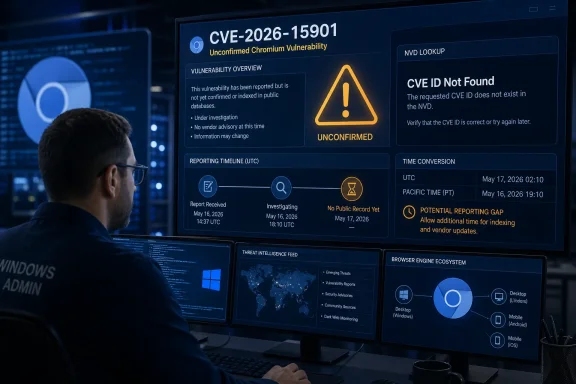 The Identifier Exists in a Reporting Gap, Not a Complete Advisory
The NVD’s missing-record message is easily misread as a database failure. It is usually a status signal instead: a CVE number may have been reserved by a CNA, or CVE Numbering Authority, before the vulnerability’s public description and technical metadata have been released.That interim state is common in coordinated disclosure. Vendors may reserve identifiers while validating a fix, rolling it through release channels, or holding issue details until enough users have upgraded. Chromium’s own release notes routinely state that bug details can remain restricted until a majority of users have received the fix, particularly where third-party components or downstream projects are involved.
But the presence of a plausible-looking identifier and a plausible-looking component name does not establish the facts administrators actually need. At present, CVE-2026-15901 has no public record establishing:
- Which Google Chrome or Chromium build first contains the fix.
- Whether the issue affects Windows, macOS, Linux, Android, ChromeOS, or only a subset of those platforms.
- Whether exploitation begins with a malicious web page, compromised renderer, local network traffic, user interaction, or another prerequisite.
- Whether Google knows of exploitation in the wild.
- Whether Microsoft Edge, Brave, Vivaldi, Opera, Electron applications, WebView-based software, or other Chromium consumers inherit the defect.
Google’s Latest Windows Stable Release Does Not List CVE-2026-15901
Google’s most recent Chrome Stable desktop announcement, published July 14, moved Windows and macOS users to Chrome 150.0.7871.124 or 150.0.7871.125, with Linux receiving 150.0.7871.124. The release includes 15 security fixes, including two critical use-after-free defects in Ozone and several high-severity issues across Skia, V8, GPU, UI, and media-related code.CVE-2026-15901 is not among them.
That does not prove the CVE is invalid. It could belong to a forthcoming Chrome update, a channel-specific build, an Android or ChromeOS release, a downstream vendor advisory, or a record that is simply not yet published. It does, however, mean there is no basis for saying that Chrome 150.0.7871.124/.125 remediates this particular issue.
This distinction matters because “Chromium” is not a single deployable product. Chrome, Microsoft Edge, Brave, Opera, Vivaldi, Electron, and numerous embedded applications pull Chromium changes on different schedules. A Chromium fix may land upstream before any Windows browser exposes a public advisory, while a downstream vendor may ship it under its own version number later.
Until a vendor identifies a fixed commit, build, or release, vulnerability scanners should not infer exposure from the generic label “Chromium” alone.
“Use After Free” Is Serious, but Not a Severity Rating
A use-after-free occurs when software continues to access memory after the object associated with that memory has been released. In native code, that class of flaw can lead to crashes, data exposure, or controlled memory corruption, depending on the reachable code path and available mitigations.Chromium has a long history of treating memory-safety defects with urgency, especially when a web page can trigger them remotely or when they can help cross a browser security boundary. Google’s June and July 2026 Chrome releases have included multiple use-after-free fixes in Network, GPU, Ozone, Core, UI, WebRTC, and other components.
Yet component names alone cannot determine severity. Earlier Chromium Network use-after-free vulnerabilities have ranged in impact: some have been described as potential code execution inside a sandbox through crafted HTML, while others have required a renderer compromise before a sandbox escape was possible. The missing CVE record for 2026-15901 provides none of the conditions needed to place it in either category.
It would be inaccurate to call CVE-2026-15901 a zero-day, a remote-code-execution flaw, or a critical vulnerability based solely on the text supplied with the NVD link. NIST has not assigned a CVSS score, and Google has not publicly tied the identifier to an affected Chrome version or exploitation status.
Treat It as a Monitoring Event Until a Vendor Names a Build
Security teams can still use the item constructively. The right posture is to add CVE-2026-15901 to a watchlist and wait for one of three concrete events: publication in the CVE List, an NVD enrichment record, or a vendor advisory from Google or a downstream Chromium supplier.For managed Windows fleets, that means verifying that Chrome’s standard automatic-update path is healthy rather than forcing an update to an unidentified target version. Enterprises using Chrome Browser Cloud Management, Microsoft Intune, Configuration Manager, WSUS-connected third-party patching tools, or a software asset management platform should confirm that their browser inventory can report installed version numbers accurately.
The current Chrome Stable release deserves routine attention on its own merits. Google’s July 14 bulletin includes two critical Ozone use-after-free fixes, identified as CVE-2026-15764 and CVE-2026-15765, plus a broader set of high-severity fixes. Organizations that defer browser updates should assess those published issues against their usual testing and rollout windows.
Administrators should also avoid a familiar trap: treating Microsoft Edge as automatically covered by a Chrome update. Edge uses Chromium but ships through Microsoft’s separate servicing pipeline. If and when CVE-2026-15901 receives a confirmed upstream fix, Edge’s security release notes and version history will determine the relevant Windows remediation.
The Next Record Must Supply the Missing Facts
The first useful publication for CVE-2026-15901 will need to name an affected product version, a fixed version, a severity assessment, and the vulnerability’s actual preconditions. A Google Chrome release bulletin would also establish whether bug details will remain restricted during rollout and whether the company is aware of exploitation.Until then, the most defensible status is unconfirmed public disclosure with no actionable version guidance. The NVD page is not evidence of a patched Chromium flaw; it is evidence that NVD has no published record for that identifier yet.
References
- Primary source: NVD / Chromium
Published: 2026-07-17T17:42:39-07:00
NVD - CVE-2026-15901
 nvd.nist.gov
- Security advisory: MSRC
Published: 2026-07-17T17:42:39-07:00
Original feed URL
Security Update Guide - Microsoft Security Response Center
 msrc.microsoft.com