

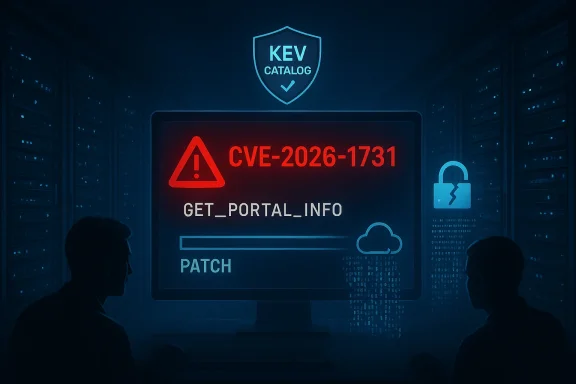
CISA’s addition of CVE-2026-1731 to the Known Exploited Vulnerabilities (KEV) Catalog puts a high‑priority, pre‑authentication OS command‑injection flaw in BeyondTrust Remote Support (RS) and certain Privileged Remote Access (PRA) versions squarely in the crosshairs of federal and enterprise defenders — and with good reason: the vulnerability is critical, weaponizable with minimal effort, and has been observed being probed and exploited in the wild within days of public disclosure. //www.rapid7.com/blog/post/etr-cve-2026-1731-critical-unauthenticated-remote-code-execution-rce-beyondtrust-remote-support-rs-privileged-remote-access-pra/)
Background
BeyondTrust’s Remote Support (RS) and Privileged Remote Access (PRA) products are widely deployed enterprise remote‑access platforms used to deliver vendor support, perform administrative tasks, and manage privileged sessions. The vendor disclosed a critical OS command injection vulnerability, tracked as CVE‑2026‑1731, that affects RS versions 25.3.1 and earlier and PRA versions 24.3.4 and earlier. BeyondTrust reported that a patch was applied to their cloud/SaaS instances and released fixes for self‑hosted customers.CISA’s KEV Catalog — and the Binding Operational Directive BOD 22‑01 that underpins it — functions as the federal government’s prioritized “fix now” list. When CISA adds a CVE to KEV the practical effect is imivilian Executive Branch (FCEB) agencies: they must remediate according to the deadlines in the advisory. The advisory language and the directive’s enforcement mechanism make KEV additions high‑urgency events for government and industry TR/IR teams alike.
What the vulnerability is and why it’s severe
The technical issue at a glance
CVE‑2026‑1731 is an OS command injection (CWE‑78) vulnerability reachable via specially crafted client requests to the appliance’s exposed endpoint. Because the flaw can be triggered without authentication and requires no user interaction, it enables pre‑authentication remote code execution (RCE) in the context of the site user. The vulnerability has been rated at the highest severity bands (near‑maximum CVSS), reflecting the immediate risk to confidentiality, integrity, and availability.Why remote‑access appliances matter to attackers
Remote‑access platforms like RS and PRA act as privileged gateways into enterprise environments. A successful compromise of such a product can yield:- Immediate privileged access to target networks and assets.
- Persistent footholds that survive simple password resets or single‑system remediation.
- Low detection risk, because vendor access channels and support tools are often exempted or trusted by monitoring controls.
- High downstream impact, enabling data theft, lateral movement, and deployment of ransomware or remote management tools for persistence.
Timeline of disclosure, patching, and observed exploitation
- February 6, 2026: BeyondTrust published advisory BT26‑02 and acknowledged CVE‑2026‑1731, warning of unauthenticated command injection and urging customers to patch. Cloud/SaaS instances received automatic fixes; on‑premises customers were instructed to apply vendor patches or upgrade.
- Early February 2026: Researchers from Hacktron AI and independent discoverers (reported names include Harsh Jaiswal and Hacktron AI teams) publicly disclosed the issue and quantified the exposure of internet‑facing instances, estimating roughly 11,000 exposed instances with about 8,500 on‑prem potentially vulnerable if not patched.
- February 9–12, 2026: Security vendors and researchers analyzed the patch and released technical write‑ups. Rapid7 published a technical analysis and subsequently released a proof‑of‑concept (PoC) exploit after patch analysis. That PoC materially reduced the defensive window.
- February 11–13, 2026: Threat‑intelligence telemetry providers reported rapid scanning and reconnaissance activity for the vulnerable endpoint (notably the get_portal_info path and related WebSocket behavior), followed by reports of in‑the‑wild exploitation. Multiple vendors and detection teams (watchTowr, GreyNoise, Arctic Wolf) observed scanning and active exploitation activity; some incident responders reported confirmed compromises of on‑prem appliances and post‑exploit activity including deployment of remote‑management tools and lateral movement.
Vendor response and patching realities
BeyondTrust’s technical response followed the expected pattern for a widely used SaaS + on‑prem software vendor:- Automatic patching for cloud/SaaS customers (applied Feb 2, 2026, per vendor statements).
- Advisory‑driven patch releases for on‑premises customers, with patch identifiers BT26‑02‑RS for Remote Support and BT26‑02‑PRA for PRA, and recommended upgrade paths for older versions that cannot receive incremental fixes.
- Cloud patching was applied quickly, reducing immediate exposure for hosted tenants.
- The vendor issued clear version‑based guidance and specific fixed versions for on‑premise upgrades.
- End‑of‑life appliances (Bomgar B‑series, legacy hardware) pose a serious problem: older appliances often can’t be upgraded to a patched image without a migration path, leaving them residually vulnerable. Researchers reported Bomgar appliance compromises in active intrusions.
- Self‑hosted patching lag remains the primary exposure vector: where organizations must manually install updates, human and change‑management delays create a wide attack surface.
- Patch diffing and PoC publication compressed the time defenders had to identify and remediate vulnerable endpoints before exploit code became widespread. Rapid7’s public analysis and PoC substantially increased exploitation potential.
Evidence of exploitation: what telemetry shows
Multiple independent telemetry sources reported:- Reconnaissance surge against the get_portal_info endpoint within 24 hours of PoC publication. GreyNoise and watchTowr telemetry showed concentrated scanning from a small set of IPs, indicating automated reconnaissance tooling adding CVE checks quickly.
- Active intrusions that resulted in on‑host persistence and lateral movement. Arctic Wolf and other responders documented observed activity where attackers cr(renamed remote‑management executables), created domain accounts using
net user, and used lateral tools like Impacket and PSExec to spread. Some operations included deploying the SimpleHelp RMM tool for persistence. These details point to opportunistic attackers moving fast to convert compromised appliances into footholds. - Rapid weaponization following PoC release: proof‑of‑concept code makes it trivial for low‑skill actors to convert reconnaissance into compromise when systems are left unpatched. Multiple vendors publicly called out instances of active exploitation after PoC publication, and incident responders advised treating unpatched systems as compromised until proven otherwise.
Risk analysis for federal and enterprise environments
For Federal Civilian Executive Branch (FCEB) agencies
Because KEV additions carry remediation deadlines under BOD 22‑01, agencies must prioritize inventory, remediation, and evidence collection immediately. Failure to meet deadlines is not just an operational risk — it raises compliance and national‑security risk when high‑value, internet‑exposed remote‑access systems are implicated.For private sector and critical infrastructure operators
Even though BOD 22‑01 doesn’t legally bind private organizations, the operational risk is identical: an attacker exploiting a vendor access point can pivot to sensitive assets. Organizations with on‑prem BeyondTrust appliances, especially those using legacy hardware, face elevated risk where patching or upgrade is nontrivial.Likelihood and impact
- Likelihood: High for internet‑exposed, unpatched on‑prem instances (scanning and PoC availability increases attacker activity).
- Impact: High to catastrophic, because compromise can yield domain admin account creation, lateral movement, data exfiltration, and persistent remote control. Arctic Wolf and CSO reporting describe post‑exploit activity consistent with high‑impact intrusions.
Practical remediation and containment checklist (immediate to short term)
- Inventory and prioritize
- Identify all instances of BeyondTrust RS and PRA, including appliances, virtual appliances, and SaaS tenants.
- Flag internet‑facing endpoints first; then internal instances reachable by third parties or vendor networks.
- Patch and upgrade (highest priority)
- Apply vendor‑released patches immediately to on‑prem instances where possible.
- Upgrade older versions that cannot accept incremental patches to the minimum fixed version specified by BeyondTrust.
- Confirm cloud/SaaS instances have received the vendor patch (BeyondTrust reported automatic cloud remediation).
- Isolate and restrict access
- Where immediate patching isn’t possible (EOL appliances, complex change windows), remove internet exposure: block public access via firewall rules, VPN requirement, or network ACLs.
- Restrict management ports to specific vendor/partner IP addresses and implement Zero Trust access controls for vendor connections.
- Look for indicators reported by detection vendors: unexpected binaries in ProgramData, newly created domain accounts, Impacket/PSExec usage, and outbound WebSocket or unusual TLS sessions to attacker‑controlled endpoints.
- Apply compensating controls
- Enforce multi‑factor authentication for all domain‑level access.
- Harden logging: forward appliance and gateway logs to centralized SIEM and enable EDR on adjacent hosts.
- Consider temporary network segmentation of systems reachable via the remote‑access appliance.
- Monitor external telemetry
- Subscribe to vendor and major security vendor advisories for indicators and updated detection signatures.
- Watch GreyNoise/watchTowr feeds for scanning patterns relevant to your IP space.
Strategic recommendations — beyond emergency patching
- Treat vendor remote‑access tools as crown jewels in asset management: they deserve higher patching priority, continuous monitoring, and explicit exception handling in change management.
- Reduce internet exposure by design: place vendor access behind bastion hosts, Zero Trust Network Access (ZTNA), or strictly limited jump hosts rather than exposing appliances directly to the public internet.
- Maintain an upgrade/migration calendar for appliances: vendors increasingly move customers off hardware appliances to SaaS and virtualized models — ensure an organizational plan exists toware promptly.
- Adopt a fast track for KEV‑listed vulnerabilities: KEV additions should translate to immediate ticketing and executive visibility for any organization that operates the affected product family.
What this incident exposes about the vulnerability lifecycle
This event is an archetypal example of modern vulnerability exploitation dynamics:- Automated discovery (including AI‑assisted tools) reduces the time from vulnerability discovery to public disclosure and subsequent patch diffing.
- Public PoC publication accelerates weaponization, making high‑severity issues exploitable by less skilled operators within hours to days. Rapid7’s public analysis and PoC materially lowered the bar for attackers.
- Organizations that rely on manual, calendar‑driven patch management remain the soft target for scanning and exploitation storms. SaaS tenants benefit from vendor patching but on‑prem customers face operational clogs.
Caveats and unverifiable elements
- While multiple telemetry feeds and incident responders have reported active exploitation and compromises of on‑prem appliances, definitive attribution and full campaign scope remain fluid. Some reporting attributes early reconnaissance to automated scanning operations rather than a single attribution‑quality actor. Readers should treat claims about actor identity and full compromise counts as provisional and rely on in‑house IR to determine scope.
- CISA’s KEV additions and deadlines are authoritative for FCEB agencies. Some public summaries reported additional KEV catalog changes around the same dates; where an exact catalog entry date or remediation deadline is material to your compliance posture, verify the KEV catalog entry and deadline in your agency’s portal or through official CISA channels before certifying compliance.
Final assessment and call to action
CVE‑2026‑1731 is a textbook high‑risk vulnerability: unauthenticated, remote, and impactful in a class of software that attackers prize for its privileged access. The combination of vendor patches, public PoC availability, and immediate scanning/exploitation activity means the threat is both real and urgent.- If you operate BeyondTrust RS or PRA — assume you are at risk until you verify otherwise.
- Prioritize inventory, patching, and immediate containment for internet‑exposed appliances.
- Conduct proactive threat hunting for artifacts described by incident responders and apply network restrictions where patching is delayed.
- For government customers, follow KEV remediation timelines to stay compliant with BOD 22‑01; for private sector and critical infrastructure operators, treat the KEV designation as a red flag that warrants the same urgency.
Source: CISA CISA Adds One Known Exploited Vulnerability to Catalog | CISA
