

Microsoft’s Security Update Guide appears to reference CVE‑2026‑20815 for an elevation of privilege in the Capability Access Management Service (camsvc), but as of this writing the public technical record for CVE‑2026‑20815 cannot be corroborated in major third‑party vulnerability trackers or canonical databases — the MSRC page requires client‑side rendering and provides limited textual detail without an immediately retrievable advisory entry.
Capability Access Management Service (camsvc) is a Windows inbox service that mediates capability and permission tokens for certain OS subsystems; because it runs with elevated privileges and touches cross‑process capability checks, faults in camsvc historically have been treated as potentially valuable privilege‑escalation primitives. Several prior, documented camsvc advisories from 2025 were described as race‑condition (CWE‑362) vulnerabilities that allow a local attacker to escalate privileges by exploiting improper synchronization in the service’s handling of shared resources. These earlier advisories were patched by Microsoft and tracked by independent vulnerability databases. The entry point the vendor uses to communicate such defects — the Microsoft Security Response Center (MSRC) Update Guide — embeds a short “exploitability / confidence” metric used to indicate how certain Microsoft is about the reported flaw and the published technical detail. That confidence metric matters operationally: confirmed vendor acknowledgements + KBs = high urgency; uncorroborated reports or mirrors = lower confidence and more caution for defenders who must avoid false positives.
Actionable priorities now:
Source: MSRC Security Update Guide - Microsoft Security Response Center
 Background / Overview
Capability Access Management Service (camsvc) is a Windows inbox service that mediates capability and permission tokens for certain OS subsystems; because it runs with elevated privileges and touches cross‑process capability checks, faults in camsvc historically have been treated as potentially valuable privilege‑escalation primitives. Several prior, documented camsvc advisories from 2025 were described as race‑condition (CWE‑362) vulnerabilities that allow a local attacker to escalate privileges by exploiting improper synchronization in the service’s handling of shared resources. These earlier advisories were patched by Microsoft and tracked by independent vulnerability databases. The entry point the vendor uses to communicate such defects — the Microsoft Security Response Center (MSRC) Update Guide — embeds a short “exploitability / confidence” metric used to indicate how certain Microsoft is about the reported flaw and the published technical detail. That confidence metric matters operationally: confirmed vendor acknowledgements + KBs = high urgency; uncorroborated reports or mirrors = lower confidence and more caution for defenders who must avoid false positives.What we can verify right now
- Microsoft has an MSRC Update Guide page at the URL for CVE‑2026‑20815, but the page’s content is delivered via a client‑side app requiring JavaScript; direct machine‑fetch of line‑level advisory text was not available from the automated retrieval used during preparation. That means the vendor entry exists as a pointer but the human‑readable advisory either requires interactive rendering or is intentionally sparse.
- Independent, reputable vulnerability trackers (Rapid7, CVE aggregation sites, and cvedetails) contain multiple Canonical camsvc CVEs from 2025 — for example CVE‑2025‑49690 and CVE‑2025‑54108 — which were described as race conditions allowing local elevation of privilege. Those entries include vendor KB mappings for affected Windows builds and indicate vendor patches were released. The technical class and mitigation approach for the 2025 camsvc entries provide an important, verifiable precedent for how Microsoft handles camsvc flaws.
- At the time of publication of this article there was no authoritative NVD record or broad third‑party corroboration that explicitly references CVE‑2026‑20815 in public, searchable feeds that typically aggregate Microsoft advisories. That absence raises two possibilities: (a) the CVE identifier has been reserved/published by MSRC but detailed notes/KB mappings are accessible only through the interactive MSRC page; or (b) the identifier is newer/under embargo or simply not yet reflected in third‑party feeds. Either way, defenders must not assume a remote‑exploitable or weaponized condition until the vendor KB and package mapping are validated. (If your patching tooling depends on NVD or other third‑party indices, confirm MSRC → KB → update catalog entries before rolling changes.
Why camsvc vulnerabilities matter (operational context)
camsvc is not a cosmetic user service. Its responsibilities include mediation of capability checks and interactions between lower‑privileged processes and OS capability tokens. When a privileged system service performs asynchronous workflows involving short‑lived objects, race conditions are a common root cause — freeing an object in one thread while another thread still holds a reference is a classic window for exploitation. In an elevated service, successful exploitation usually means escalation to SYSTEM or equivalent privileges.- High‑value primitive: Local elevation of privilege (EoP) in camsvc converts a simple local foothold (malware or a malicious local user) into a system‑level compromise.
- Blended attack chains: EoP bugs are especially dangerous when paired with remote or social‑engineering vectors; an attacker who gains local code execution through phishing or misconfigured services can chain into camsvc to achieve persistence, credential theft, or lateral movement.
- Management plane risk: Administrative and management hosts are high priority. If camsvc is present on jump boxes, build servers, or management VMs, a local EoP there can amplify into broader environment compromise.
Technical anatomy — plausible exploit classes for camsvc race issues
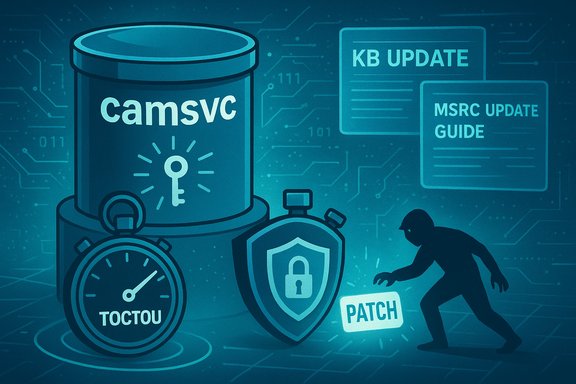
The vendor’s limited public text for recent camsvc CVEs characterized the root cause as a race condition in camsvc’s handling of shared resources (CWE‑362). From first principles and historical precedent, the conservative, high‑value exploitation models are:- TOCTOU / race to replace resource: camsvc creates or uses a transient object (file, handle, memory object). An attacker races to replace that object (symlink, reparse point, or reopened handle) before the privileged context completes verification, causing the service to operate on an attacker‑controlled target under elevated privileges.
- Use‑after‑free (UAF): camsvc frees an object while another thread still holds a reference. Reallocating or grooming the heap yields attacker‑controlled data when camsvc later dereferences the stale pointer; in privileged contexts, that can convert into token corruption, vtable overwrite, or controlled code execution.
- Improper synchronization on shared resources: inadequate locking or misordered checks can let low‑privilege actors manipulate service state during a critical window. This is especially likely when operations involve background threads or async callback flows.
Urgency and exploitability confidence — how to read Microsoft’s metric
Microsoft’s Update Guide contains an “exploitability / confidence” field designed to tell defenders how certain the vendor is about the technical details and whether the issue has been corroborated by independent researchers. In practice:- High confidence / vendor confirmed typically means a tested patch exists and defenders should prioritize immediate application following normal testing.
- Corroborated by third‑party research raises urgency because independent technical write‑ups can enable exploit development.
- Low confidence / uncorroborated means the claim exists but the public details are sparse; patching remains prudent when the impact class is high (EoP), but detection and triage should be adjusted to reflect uncertainty.
Practical detection, hunting, and telemetry guidance
Detecting exploitation of local EoP primitives is inherently hard because many attacks take place entirely on the host. Focus on high‑signal, correlated events and post‑escalation behaviours that are consistent across many Windows local EoP incidents:- Service instability and crashes:
- Monitor for repeated camsvc process crashes, faulting module names, or abnormal service restarts that cannot be explained by legitimate updates or configuration changes.
- Token and impersonation indicators:
- Hunt for unusual sequences of API calls or EDR events that show token duplication/impersonation (DuplicateTokenEx, SetTokenInformation, CreateProcessAsUser) originating from processes that normally do not perform those actions.
- Unexpected privileged actions from non‑privileged parents:
- An unprivileged parent spawning a SYSTEM‑context child (cmd.exe, PowerShell, or self‑signed binaries) is high signal for escalation.
- Filesystem & ownership anomalies:
- Watch for privileged writes to protected areas (Program Files, System32) issued during or immediately after camsvc events; look for service binary tampering or new service installs.
- Correlate with lateral / follow‑on activity:
- After an escalation event hunt for credential dumping, scheduled task creation, persistence modifications, or unusual outbound authentication requests.
Remediation and mitigation — prioritized steps for administrators
1. Confirm the vendor mapping- Use the Microsoft Security Update Guide and the Microsoft Update Catalog to map CVE → KB → per‑SKU package. Do not rely solely on a CVE string if your patch automation uses different indices; always confirm the exact KB for the Windows build you run.
- Pilot updates on a small, representative set (admin workstations, jump boxes, VDI images) and validate functionality before broad deployment. Expect service restarts and reboots for fixes touching core system services.
- Jump hosts, build servers, administrative workstations, and systems that accept local accounts from untrusted users should be the first to receive patches. These hosts provide high leverage to attackers post‑escalation.
- Enforce least privilege and remove unnecessary local admin rights.
- Harden high‑value endpoints with WDAC/AppLocker to limit script/binary execution from user‑writable locations.
- Restrict access to camsvc‑related management interfaces (if any) using firewall rules and host ACLs.
- Temporarily restrict or isolate systems that accept untrusted local code execution until patches are deployed.
- After deployment, confirm updated file versions, absence of repeated camsvc faults, and run smoke tests for functionality that interacts with capability management flows.
- If exploitation is suspected, preserve volatile evidence (memory dumps, service process dumps, EDR telemetry) before rebooting or applying fixes. Isolation, forensic capture, and credential rotation should follow standard IR playbooks for privilege escalation incidents.
Detection playbook — short hunt recipes
- EDR hunt: processes that request token duplication or impersonation where caller is a user‑context process but target is camsvc or another SYSTEM process.
- SIEM correlation: link camsvc service crashes with subsequent privileged process creation within a 60‑second window.
- File integrity checks: changes to system directories and new service registrations in HKLM following a camsvc event.
- Memory artifacts: collect live memory and search for injected modules or unusual loaded DLLs in the camsvc process.
Risks, strengths and where uncertainty matters
Strengths in Microsoft’s approach- Centralized KB mapping via the MSRC Update Guide provides the definitive remediation mapping once fully published. When the vendor publishes an authoritative KB for a CVE, defenders have the canonical package to deploy.
- Historically Microsoft has distributed camsvc fixes as part of regular security servicing and, when necessary, out‑of‑band updates for critical services — a pragmatic distribution mechanism once the KB mapping is identified.
- Identifier ambiguity and delayed third‑party mirroring: As observed in other Windows advisories, CVE numbers or metadata sometimes propagate unevenly across trackers, producing operational confusion for automated patch pipelines. Do not patch by CVE string alone; always verify the vendor KB and the exact package for your build.
- Sparse public technical detail on interactive MSRC pages: MSRC entries often provide a concise impact summary and KB mappings without exploit mechanics. While this reduces short‑term weaponization risk, it leaves defenders reliant on coarse detection signals until independent technical write‑ups or patch diffs are available. Treat any community claims that provide exploit steps as unverified until corroborated.
- Local‑vector EoP as a chaining primitive: The absolute risk increases when unpatched endpoints also permit local code execution (unrestricted USB, developer laptops, or exposed shared machines). The camsvc class of issues is not wormable on its own, but is extremely valuable to attackers within multi‑stage campaigns.
If you rely on automation — exact guidance
- Do not configure automatic approval rules solely on CVE identifiers in third‑party feeds. Instead:
- Query Microsoft’s Security Update Guide for the CVE and extract the KB(s) for the specific Windows build.
- Cross‑check the KB(s) against the Microsoft Update Catalog package hashes.
- Stage the KB in test rings and verify before approving automatic deployment across the enterprise.
- If your asset inventory or patch automation lacks accurate build mappings, prioritize enriching that inventory: a single mismatched KB can leave hosts unpatched or cause unwanted regressions in critical management hosts.
Conclusion
CVE‑2026‑20815 is referenced by the Microsoft Update Guide URL provided by the user, but at the time of writing the public, retrievable technical record for CVE‑2026‑20815 is not mirrored in NVD or prominent third‑party aggregators that researchers commonly use to validate KB mappings. Because camsvc has a recent history of race‑condition EoP defects (documented camsvc CVEs in 2025) and because the service runs in an elevated context, any camsvc advisory must be treated as high priority for hosts that expose local code execution to untrusted actors.Actionable priorities now:
- Immediately confirm whether your systems are affected by querying the Microsoft Security Update Guide and the Microsoft Update Catalog for CVE‑2026‑20815 → KB mapping. Do not rely on CVE strings alone.
- If a KB is published for your builds, stage and deploy it rapidly to high‑value hosts (admin workstations, jump boxes, build servers), validate functionality, and monitor for regressions.
- If the KB is not yet published or you cannot validate it, implement compensating controls: remove unnecessary local admin rights, enforce WDAC/AppLocker where feasible, lock down USB/removable access, and raise telemetry/hunting posture for camsvc anomalies and post‑escalation indicators.
Source: MSRC Security Update Guide - Microsoft Security Response Center
