

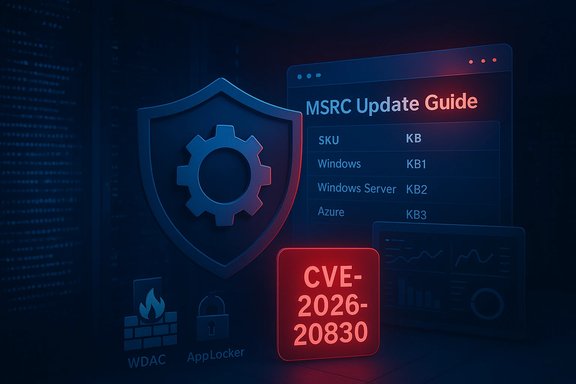
Microsoft’s Security Update Guide lists CVE-2026-20830 as an elevation-of-privilege issue affecting the Capability Access Management Service (camsvc), but the vendor’s public entry is terse and delivered via an interactive, client-side page — meaning defenders must treat the advisory as authoritative while also confirming per‑SKU KB mappings before any automated patch rollout.
Capability Access Management Service (camsvc) is an inbox Windows service that mediates capability tokens and permission checks between processes and certain OS subsystems. Because it runs with elevated rights and brokers cross‑process capability state, defects in camsvc have repeatedly been high‑value primitives for local privilege escalation. Past camsvc advisories from 2025 were commonly race‑condition or synchronization bugs that allowed local attackers to escalate to SYSTEM when exploitation succeeded; those incidents set the operational precedent defenders should follow today. Microsoft’s Update Guide also shows an “exploitability / confidence” metric that describes how certain the vendor is about the vulnerability’s existence and how detailed the technical disclosure is. That confidence metric matters operationally: a vendor‑confirmed, high‑confidence advisory with KB mappings creates immediate urgency; a low‑confidence or sparse advisory still requires attention but imposes additional caution when creating brittle detections or automated remediations. Multiple community reviews of recent Windows advisories explain this metric and recommend tying any automated change to the vendor’s KB→SKU mapping rather than a bare CVE string.
Likely technical classes for a camsvc elevation of privilege include:
Practical takeaways for defenders:
CVE‑2026‑20830 is a reminder that privileged inbox services remain an attractive local attack surface: vendor acknowledgement via MSRC is the signal to act, but operational safety depends on careful KB validation, prioritized patching, behavior‑based detection, and conservative treatment of speculative technical claims until patch diffs or independent analyses confirm exact exploit mechanics.
Source: MSRC Security Update Guide - Microsoft Security Response Center
 Background / Overview
Capability Access Management Service (camsvc) is an inbox Windows service that mediates capability tokens and permission checks between processes and certain OS subsystems. Because it runs with elevated rights and brokers cross‑process capability state, defects in camsvc have repeatedly been high‑value primitives for local privilege escalation. Past camsvc advisories from 2025 were commonly race‑condition or synchronization bugs that allowed local attackers to escalate to SYSTEM when exploitation succeeded; those incidents set the operational precedent defenders should follow today. Microsoft’s Update Guide also shows an “exploitability / confidence” metric that describes how certain the vendor is about the vulnerability’s existence and how detailed the technical disclosure is. That confidence metric matters operationally: a vendor‑confirmed, high‑confidence advisory with KB mappings creates immediate urgency; a low‑confidence or sparse advisory still requires attention but imposes additional caution when creating brittle detections or automated remediations. Multiple community reviews of recent Windows advisories explain this metric and recommend tying any automated change to the vendor’s KB→SKU mapping rather than a bare CVE string.What the public record currently says about CVE‑2026‑20830
- Microsoft has published an Update Guide entry for CVE‑2026‑20830 that classifies the issue as an elevation of privilege in camsvc. The MSRC UI is the canonical source for the CVE→KB→affected builds mapping, but its client‑side rendering often prevents automated scrapers from extracting the full advisory with per‑SKU KBs. Treat the MSRC entry as the authoritative acknowledgement, and then confirm the exact KB(s) for your Windows builds using the Microsoft Update Catalog or the Update Guide rendered in a browser.
- Public, independent vulnerability aggregators and security vendors typically mirror Microsoft’s entries; however, mirrors can lag and sometimes fragment related fixes under different CVE strings. For the camsvc family of bugs, reputable trackers (Rapid7, CVE aggregators, cvedetails) previously recorded multiple race‑condition EoP entries in 2025 — a data point that helps shape realistic exploit models for this new CVE even if low‑level details are not published.
- At the time of this writing there is no widely distributed, vendor‑approved proof‑of‑concept (PoC) for CVE‑2026‑20830 in public feeds. The absence of PoC does not imply the bug cannot be exploited; in past camsvc disclosures, patch diffs and even short vendor notes were sufficient for researchers and attackers to craft PoCs within days. Expect technical write‑ups or private exploit attempts to follow once patch diffs are available.
Why camsvc bugs matter — threat model and blast radius
camsvc is more than a convenience service: it mediates capability checks used by other components and runs with elevated privileges. That combination makes local information‑disclosure or elevation bugs particularly valuable. In practical terms:- A local EoP in camsvc converts a limited local foothold (malware, malicious user, or compromised application) into SYSTEM‑level control on the affected host. That enables disabling or tampering with security tooling, credential harvesting, persistence mechanisms, and lateral movement preparation.
- Management and multi‑user hosts (jump boxes, build servers, VDI/RDS hosts) are high‑value targets. A camsvc EoP on such hosts dramatically increases enterprise risk because those machines already hold administrative capabilities or credentials. Historically, Microsoft and community responders prioritized remediation of camsvc CVEs on management hosts for that reason.
- The attack vector is typically local (AV:L): exploitation requires some level of code execution or influence on the host. That reduces wormability across networks but does not reduce the local impact: once a host is compromised, privilege escalation is a short path to persistence and wider compromise.
Technical likelihoods and plausible exploitation classes
Microsoft’s concise advisory language for many inbox service CVEs often omits low‑level exploit primitives. Where vendor details are sparse, defenders should reason from historically common classes that produce EoP in privileged services and flag these inferences as plausible, not proven.Likely technical classes for a camsvc elevation of privilege include:
- Race conditions / TOCTOU (CWE‑362): camsvc frequently handles transient objects and asynchronous operations. An attacker racing the service to replace a file, handle, or resource can coerce privileged operations into working on attacker‑controlled targets. This was a dominant root cause for several 2025 camsvc advisories.
- Use‑after‑free (UAF) / heap corruption: freeing an object while another thread maintains a reference is a classic window for heap grooming and vtable or token corruption, which can lead to token manipulation or code execution. Prior inbox service bugs showed this pattern.
- Improper access control on IPC/RPC handlers: if an authenticated or unauthenticated client can invoke a privileged operation without proper validation, the service may return privileged data or perform privileged actions for the wrong caller. This class explains many management‑plane EoPs historically.
Exploitability / confidence: how to read Microsoft’s metric
Microsoft’s Update Guide includes a brief “exploitability / confidence” indicator that attempts to communicate two things: (1) whether Microsoft is confident the vulnerability exists, and (2) how much technical fidelity the public advisory contains (for example: whether exploit mechanics, PoCs, or corroborating research exist).Practical takeaways for defenders:
- A high confidence / vendor‑confirmed entry typically means an authoritative patch exists and should be prioritized after normal testing. It also increases the chance that independent researchers will publish PoCs once diffs are available.
- A low or uncorroborated confidence rating means the vendor acknowledges a problem but is withholding technical detail; patching remains important, but immediate detection logic based on exploit primitives is ill‑advised. Instead, focus on post‑exploit behaviors.
- Because the MSRC Update Guide often renders interactive content client‑side, automated CVE‑only patch systems can misapply or miss the correct KB if they depend on third‑party mirrors. Teams must validate KB→SKU mappings directly in the Microsoft Update Guide (rendered) or the Microsoft Update Catalog before mass deployment.
Immediate operational guidance (0–72 hours)
These steps are prioritized for speed and safety on production fleets.- Confirm the vendor mapping now
- Open the Microsoft Security Update Guide entry for CVE‑2026‑20830 in a browser and record the KB→SKU mapping for every Windows build in your estate. Do not rely solely on third‑party CVE feeds or automated scanners.
- Stage a controlled pilot
- Apply the vendor KB(s) to a representative pilot ring (admin workstations, jump boxes, and a subset of servers) and validate functionality and that camsvc-related binaries are updated.
- Prioritize high‑value and multi‑user hosts
- Patch jump boxes, domain controllers where camsvc is present, VDI and RDS hosts, build servers, and admin workstations first. These are the systems that maximize attacker leverage if escalated.
- Apply compensating controls while patching
- Where immediate patching is not possible:
- Remove unnecessary local administrator privileges and enforce least privilege accounts.
- Use application control (WDAC/AppLocker) to restrict untrusted code execution.
- For non‑essential systems, consider disabling features that invoke camsvc or restricting access to service endpoints temporarily.
- Increase telemetry and hunting posture
- Tune EDR/SIEM to look for:
- Repeated camsvc crashes or Service Control Manager events showing unexpected restarts.
- Non‑privileged parent processes spawning SYSTEM‑context children (cmd.exe, PowerShell).
- Token duplication/impersonation API use (DuplicateTokenEx, SetTokenInformation) originating from unusual processes.
Detection and hunting recipes
Detection for local EoP primitives focuses on post‑exploit behavior because the trigger mechanics may be withheld from public vendor advisories.- EDR queries to implement:
- Process ancestry rules that flag user‑context parents creating SYSTEM processes within a short time window after any camsvc event.
- Calls to token APIs (DuplicateTokenEx, ImpersonateLoggedOnUser) by processes that normally do not perform impersonation.
- Writes to protected directories (C:\Windows\System32, Program Files) coincident with camsvc process crashes or restarts.
- SIEM correlation guidance:
- Correlate Service Control Manager (SCM) crash/fault events for camsvc with subsequent privileged operations within a 60–120 second window.
- Use correlation rules to elevate alerts when privileged filesystem changes occur immediately after camsvc instability.
- Forensic collection:
- If you suspect exploitation, capture volatile evidence before rebooting patched systems: memory snapshots, process dumps (ProcDump or Windows Error Reporting), and relevant EDR logs. Preserve artifacts for offline diffing and IR.
Remediation checklist (detailed)
- Map each host’s Windows build to the exact KB(s) Microsoft lists in the Update Guide and the Update Catalog.
- Stage the update in a pilot ring and verify:
- camsvc binary file versions and timestamp changes.
- Absence of repeated camsvc crashes post‑update.
- That critical management workflows are unaffected.
- Roll out to production in prioritized waves: jump boxes → admin workstations → multi‑user hosts → server fleet.
- After deployment, run a short verification sweep:
- EDR checks for token duplication events following camsvc activity.
- File integrity checks on System32 / Program Files.
- Automated reports confirming KB installation and system reboots where required.
Long‑term hardening and policy changes
- Enforce least privilege and reduce local admin counts across the estate; many local EoP exploits fail when local admin is absent.
- Implement application control (WDAC / AppLocker) on management hosts to limit the set of executable binaries and scripts.
- Harden jump boxes and build hosts with stricter network segmentation and multifactor authentication for interactive sessions.
- Improve telemetry retention for crash dumps and process ancestry data so investigations are actionable when vendor diffs are published.
Verification, cross‑checks, and caution flags
- Confirm all KB numbers by rendering the MSRC Update Guide in a browser and cross‑checking the Microsoft Update Catalog. Automated CVE mirrors and third‑party packagers can lag or misassociate KBs; relying on them alone risks deploying the wrong package.
- Cross‑reference at least two independent vulnerability trackers (for prior camsvc CVEs these included Rapid7, cvedetails, and vendor CVE feeds). Doing so helps spot mirrored or split records and confirms whether a CVE has been widely correlated to the same KBs. Past camsvc advisories were mirrored by multiple vendors shortly after Microsoft published fixes.
- Flag any claim of in‑the‑wild exploitation or public PoC that cannot be corroborated by multiple reputable sources (vendor advisories, national CERTs, or forensic reports). Historically, PoCs for privileged service bugs tend to follow patch publication and diff analysis; treat early unverified technical claims as provisional.
Strengths, weaknesses, and risk appraisal
Strengths- The MSRC Update Guide is the authoritative source and provides the canonical CVE→KB→SKU mapping defenders must use. Treating it as ground truth reduces the chance of misapplied patches.
- Historical precedent for camsvc bugs gives defenders tested operational playbooks (patch mapping, prioritized patching, behavioral detection) that are directly applicable to CVE‑2026‑20830.
- Vendor disclosures for inbox services are often intentionally terse to reduce short‑term weaponization; that conservative posture increases reliance on behavior‑based detection and careful KB validation.
- Automated patch workflows that depend solely on CVE strings or third‑party mirrors risk missing per‑SKU differences that Microsoft frequently issues across servicing branches. Confirming KB numbers manually or via the Update Catalog is essential.
- Likelihood of private exploit code: moderate. Prior camsvc fixes were weaponized rapidly after patches and diffs were published. Defenders should expect private exploitation or public PoCs to appear within days to weeks after the patch.
- Severity on affected hosts: high where the service is present on multi‑user or administrative systems; less critical on single‑user systems with strict execution policies. Prior CVSS scores for camsvc EoP entries were in the high‑6 to mid‑7 range, reflecting significant impact to confidentiality, integrity, and availability when exploited.
Final recommendations (operational summary)
- Treat the MSRC Update Guide entry for CVE‑2026‑20830 as authoritative and confirm KB→SKU mappings immediately in a browser and the Update Catalog before automating deployments.
- Prioritize patching for jump boxes, admin workstations, VDI/RDS hosts, and other multi‑user or management systems where camsvc runs.
- Enforce compensating controls (least privilege, WDAC/AppLocker) where immediate patching is infeasible.
- Tune EDR and SIEM to hunt for camsvc crashes, token duplication, and non‑privileged processes spawning SYSTEM children; capture forensic artifacts before remediation if you suspect exploitation.
- Cross‑check vendor KBs against at least two independent trackers and preserve evidence for IR if suspicious activity is observed.
CVE‑2026‑20830 is a reminder that privileged inbox services remain an attractive local attack surface: vendor acknowledgement via MSRC is the signal to act, but operational safety depends on careful KB validation, prioritized patching, behavior‑based detection, and conservative treatment of speculative technical claims until patch diffs or independent analyses confirm exact exploit mechanics.
Source: MSRC Security Update Guide - Microsoft Security Response Center
