

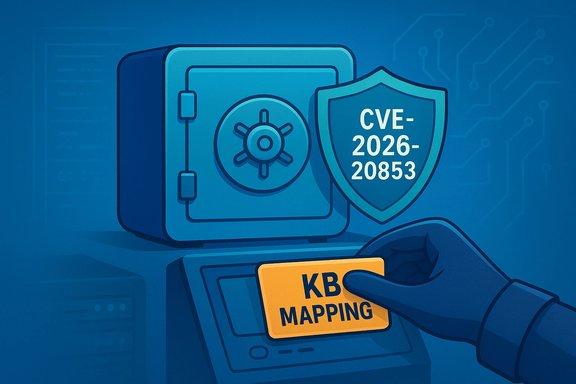
Microsoft has recorded CVE-2026-20853 — an elevation‑of‑privilege vulnerability affecting the Windows WalletService — in its Security Update Guide, but the vendor’s public entry currently provides only a terse existence/impact notice while withholding low‑level exploit details, leaving defenders to treat the risk as confirmed but partially specified until Microsoft publishes KB mappings and patch packages for affected builds.
The Windows WalletService is a built‑in Windows component historically responsible for managing user payment and credential tokens for system services and apps. Over the years WalletService has been the subject of multiple CVE entries that share a common pattern: memory‑handling flaws and improper object lifetime validations that, when reached by a local attacker, can be converted into elevation‑of‑privilege (EoP) primitives. Public vulnerability trackers and vendor advisories for earlier WalletService CVEs (2020–2021) catalogued such defects and show how Microsoft typically responds with targeted security updates.
Microsoft’s Security Update Guide (MSRC Update Guide) is the canonical place to confirm whether a CVE is recorded, which products and builds are affected, and which KB packages fix the issue. For CVE‑2026‑20853 the MSRC entry exists but is rendered dynamically (JavaScript required), so automated fetches often show only the placeholder page; operations teams must consult the interactive Update Guide or the Microsoft Update Catalog to obtain the exact KB→SKU mappings before deploying fixes.
Why the vendor’s disclosure model matters: Microsoft intentionally uses a short public advisory for many inbox components and includes a confidence or technical detail signal to indicate how certain and how detailed the vendor’s public record is. When MSRC’s confidence is high (vendor acknowledgement and KBs published), administrators should treat the CVE as authoritative and prioritize patching. When details are sparse, the entry still confirms existence but leaves lower‑level mechanics omitted until fixes are broadly deployed. This nuance shapes triage and remediation decisions for enterprise defenders.
Action checklist (essentials):
Source: MSRC Security Update Guide - Microsoft Security Response Center
 Background / Overview
The Windows WalletService is a built‑in Windows component historically responsible for managing user payment and credential tokens for system services and apps. Over the years WalletService has been the subject of multiple CVE entries that share a common pattern: memory‑handling flaws and improper object lifetime validations that, when reached by a local attacker, can be converted into elevation‑of‑privilege (EoP) primitives. Public vulnerability trackers and vendor advisories for earlier WalletService CVEs (2020–2021) catalogued such defects and show how Microsoft typically responds with targeted security updates.Microsoft’s Security Update Guide (MSRC Update Guide) is the canonical place to confirm whether a CVE is recorded, which products and builds are affected, and which KB packages fix the issue. For CVE‑2026‑20853 the MSRC entry exists but is rendered dynamically (JavaScript required), so automated fetches often show only the placeholder page; operations teams must consult the interactive Update Guide or the Microsoft Update Catalog to obtain the exact KB→SKU mappings before deploying fixes.
Why the vendor’s disclosure model matters: Microsoft intentionally uses a short public advisory for many inbox components and includes a confidence or technical detail signal to indicate how certain and how detailed the vendor’s public record is. When MSRC’s confidence is high (vendor acknowledgement and KBs published), administrators should treat the CVE as authoritative and prioritize patching. When details are sparse, the entry still confirms existence but leaves lower‑level mechanics omitted until fixes are broadly deployed. This nuance shapes triage and remediation decisions for enterprise defenders.
What is known about CVE‑2026‑20853 (concise, verifiable facts)
- Vendor record: CVE‑2026‑20853 is listed in Microsoft’s Security Update Guide; the entry identifies the issue as an Elevation of Privilege affecting WalletService. The Update Guide page may require interactive rendering to fully display KB mappings for affected SKUs.
- Public detail level: The vendor’s public advisory is intentionally short on exploitation mechanics. Microsoft’s disclosure model for inbox components often confirms the vulnerability and impact class but omits exploit primitives until the fix is staged and broadly available.
- Historical pattern: Past WalletService CVEs have been memory‑handling defects (object lifetime, improper validation) exploitable by a local authenticated attacker to escalate privileges; those historical entries and mitigations provide a threat model that is likely relevant here but do not prove the same root cause for CVE‑2026‑20853.
Technical analysis — likely classes of weakness and realistic exploit models
Because Microsoft’s public advisory for CVE‑2026‑20853 is abbreviated, the most reliable approach is to analyze plausible exploit paths using WalletService’s historical weaknesses and typical Windows EoP patterns. The goal is not to speculate on the exact bug but to map realistic attacker techniques defenders should prioritize detecting and mitigating.Typical root causes observed in WalletService and similar inbox services
- Improper object lifetime / memory handling: Past WalletService CVEs were described as handling objects improperly in memory. These manifest as heap overflows, use‑after‑free (UAF), or uninitialized memory reads that can be escalated by skilled exploit authors once local code execution exists.
- Insufficient input validation: Services that accept or parse structured input from less‑privileged contexts can be tricked into dereferencing attacker‑controlled pointers or data. This is a recurring pattern across Windows inbox EoP advisories.
- Race conditions (TOCTOU): Time‑of‑check/time‑of‑use windows are a common escalation primitive where privileged services check a property and then act on a resource that can be swapped by the attacker in the small window between check and use. Although not proven for CVE‑2026‑20853, TOCTOU is a realistic pattern for local escalations against privileged services.
Realistic exploitation model (high level)
- Initial foothold: Attacker attains the ability to execute code as a standard (non‑admin) user on the target host via a separate vector (malicious installer, app exploit, macro, or social engineering).
- Trigger path: The attacker interacts with a WalletService interface (local IPC, COM API, or service‑exposed endpoint) with crafted inputs that exploit a memory or logic bug.
- Privilege conversion: The memory corruption or logic bypass is converted into a token swap, arbitrary write, or code execution in a privileged context, yielding SYSTEM‑equivalent privileges.
- Post‑exploit abuse: With SYSTEM privileges an attacker can disable endpoint protections, harvest credentials, persist, and move laterally.
Microsoft’s “confidence” metric: how to read it and why it matters
Microsoft’s public CVE entries often include a confidence / technical detail signal that communicates two things: (1) how certain Microsoft is that the vulnerability exists, and (2) how much technical data is being made public. That metric is a practical triage tool for operations:- High / confirmed: Vendor acknowledgement and KBs exist — treat as authoritative; urgent patching required.
- Medium / corroborated: Multiple researchers or vendors have partially reproduced or described the issue — escalate lab testing and apply targeted mitigations.
- Low / uncorroborated: Early reports or third‑party claims without vendor confirmation — monitor and gather context; avoid disruptive mass changes until corroborated.
Immediate operational priorities and remediation playbook
Treat CVE‑2026‑20853 as a confirmed local EoP and execute the following prioritized actions.1. Confirm vendor mappings and obtain the correct KB(s)
- Open Microsoft’s Security Update Guide (interactive page) and search for CVE‑2026‑20853 to get the KB→SKU mappings for your deployed builds. The MSRC page often requires JavaScript rendering; automated scrapers may not show the table.
- Cross‑check the KB numbers in the Microsoft Update Catalog and your patch management system (WSUS/SCCM/Intune) before staging.
2. Patch promptly (test → pilot → deploy)
- Stage the vendor KB on a small pilot ring (representative images). Validate app compatibility and reboot behavior.
- Roll out to high‑value endpoints first: admin workstations, jump boxes, build servers, RDS/VDI hosts, and domain controllers where applicable.
- For servers or critical systems with maintenance windows, schedule immediate patching in the next available window; prioritize ones with multiple human operators or shared access.
3. If you cannot patch immediately — apply compensating controls
- Restrict local code execution on high‑value hosts (AppLocker / Windows Defender Application Control).
- Reduce the number of accounts with local sign‑on and enforce least privilege.
- Isolate unpatched hosts from critical networks or sensitive resources.
4. Detection & hunting guidance
- Anchor hunts to the post‑exploit behaviors expected from local EoP exploitation:
- Unexplained process elevation to NT AUTHORITY\SYSTEM.
- SYSTEM processes spawning cmd.exe, powershell.exe, or scheduled tasks shortly after user context activity.
- Creation of new services, unsigned binaries appearing in system paths, or modifications to boot/startup artifacts.
- Example EDR queries and telemetry signals to prioritize (generic):
- Look for CreateProcess events where parent process is a user session and child is a SYSTEM‑level service.
- Monitor for token manipulation APIs (OpenProcessToken, AdjustTokenPrivileges) invoked from user contexts.
- Hunt for anomalous loads of DLLs or unexpected image loads by WalletService‑related processes.
5. Incident response checklist (if suspected exploitation)
- Isolate the host while preserving forensic artifacts (memory and disk images).
- Collect timeline for user actions, new service installs, scheduled tasks, and network connections originating from the host.
- Rotate secrets and credentials that may have been exposed by the compromised host.
- Rebuild host from known‑good images once cleanup is confirmed.
Detection challenges and mitigation nuances
- Local EoP vulnerabilities are inherently post‑compromise primitives: detection depends on spotting the chain (initial foothold plus EoP). This makes early prevention (patching, least privilege, application allow‑listing) more effective than reactive detection alone.
- Vendors often withhold exploit details until patches are widely distributed — a conservative disclosure posture that reduces short‑term weaponization but increases the importance of rapid patch mapping and deployment. Relying on third‑party CVE mirrors without verifying KB mappings can cause patching mistakes and operational confusion. Confirm mappings in the MSRC Update Guide and the Microsoft Update Catalog.
- Historically, WalletService CVEs published in 2020–2021 carried local attack vectors and medium‑to‑high CVSS scores; defenders should assume CVE‑2026‑20853 is best treated with similar urgency until proven otherwise.
Why this matters to administrators and endpoint owners
- An unpatched EoP becomes a force multiplier after an initial compromise. A single user‑level foothold can be converted into SYSTEM, enabling credential theft, lateral movement, and persistence.
- Shared or multi‑user hosts (build servers, CI/CD agents, remote admin machines) amplify the blast radius — these systems should be top priorities for patching and hardening.
- The operational risk is not limited to desktops; service accounts and automation tooling run on many machines that may surface WalletService‑like surfaces.
Recommended long‑term hardening and policy changes
- Harden high‑risk host classes with application control (WDAC/AppLocker) and block unsigned or untrusted code execution.
- Enforce least privilege and reduce the number of admins who can run arbitrary code on critical machines.
- Use controlled update cadences that still permit emergency patching for critical EoP vulnerabilities.
- Improve telemetry and baseline behavior for privileged services so anomalous child processes or token manipulations raise high‑severity alerts.
- Conduct regular patch‑validation exercises that confirm KB→SKU mappings and remediate gaps in WSUS/ConfigMgr catalogs — automated patching by CVE alone can lead to missed updates if KB mapping is not validated.
Cross‑references and verification posture
- Microsoft’s Security Update Guide is the authoritative source for CVE entries and KB mappings; for CVE‑2026‑20853 an interactive check of the Update Guide (or the Microsoft Update Catalog) is necessary because the entry is dynamically rendered. Administrators should avoid relying solely on scraped lists or mirrors.
- Historical WalletService advisories and third‑party trackers (NVD, Rapid7, CISA bulletins) consistently show the WalletService class of issues is exploitable by local attackers when a memory or object lifecycle defect exists; these records provide an evidence base for a conservative operational stance while details for CVE‑2026‑20853 are limited.
Conclusion
CVE‑2026‑20853 is recorded as an Elevation of Privilege affecting Windows WalletService in Microsoft’s Security Update Guide, but Microsoft’s public entry for the CVE is currently concise and the interactive page requires the Update Guide or Update Catalog to retrieve KB→SKU mappings. Because the vendor confirms the existence and impact class but is withholding low‑level exploitation details until fixes are available, organizations should treat the vulnerability as confirmed and operationally urgent for patching and hardening purposes while avoiding premature speculation about the exact root cause.Action checklist (essentials):
- Verify the MSRC Update Guide entry for CVE‑2026‑20853 and obtain the exact KB(s) for your Windows builds.
- Stage and deploy Microsoft’s fixes following test→pilot→deploy best practices.
- Harden and isolate high‑value hosts that could multiply the blast radius of a local EoP.
- Tune EDR telemetry for post‑exploit behaviors (unexpected SYSTEM elevations, suspicious child processes, token manipulation).
- Treat any public exploit claims as unverified until validated by Microsoft’s KB notes or multiple independent technical analyses.
Source: MSRC Security Update Guide - Microsoft Security Response Center
