

Microsoft has recorded CVE-2026-20862 as an information disclosure vulnerability in Windows Management Services (WMS), and the vendor’s terse public advisory — delivered via the Microsoft Security Response Center’s Update Guide — makes this a high-priority operational problem for administrators of management hosts, bastions, and other high-value Windows endpoints.
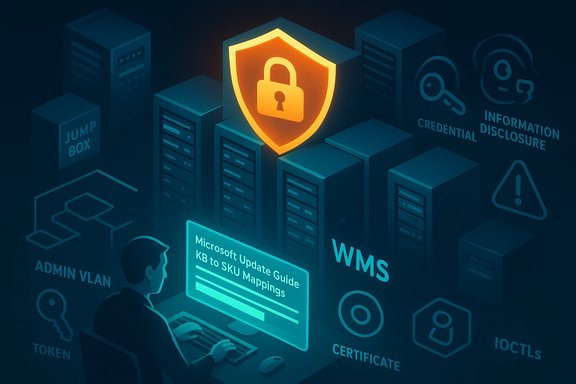
Windows Management Services is a privileged management plane used across client and server SKUs to expose administrative APIs, orchestrate management workflows, and mediate many automation and update operations. Because WMS commonly runs with elevated privileges on jump boxes, bastions, VDI hosts, and servers that store credentials or tokens, any confidentiality flaw in this surface can be an enabling primitive for more serious compromises.
Microsoft’s Security Update Guide (MSRC Update Guide) acts as the canonical record for CVE registration, vendor classification, and KB→SKU mappings. For CVE-2026-20862 the Update Guide confirms the existence and impact class (information disclosure) but the published entry is intentionally concise and may withhold low-level exploit mechanics while fixes are distributed. This short, vendor-first acknowledgement is useful for triage but leaves several high-value operational questions unanswered in the public record.
Source: MSRC Security Update Guide - Microsoft Security Response Center
 Background
Windows Management Services is a privileged management plane used across client and server SKUs to expose administrative APIs, orchestrate management workflows, and mediate many automation and update operations. Because WMS commonly runs with elevated privileges on jump boxes, bastions, VDI hosts, and servers that store credentials or tokens, any confidentiality flaw in this surface can be an enabling primitive for more serious compromises.Microsoft’s Security Update Guide (MSRC Update Guide) acts as the canonical record for CVE registration, vendor classification, and KB→SKU mappings. For CVE-2026-20862 the Update Guide confirms the existence and impact class (information disclosure) but the published entry is intentionally concise and may withhold low-level exploit mechanics while fixes are distributed. This short, vendor-first acknowledgement is useful for triage but leaves several high-value operational questions unanswered in the public record.
What Microsoft’s “exploitability / confidence” metric means
Microsoft augments each Update Guide entry with a compact exploitability / confidence metric that signals two important things: the vendor’s degree of confidence that the vulnerability exists and how much technical detail Microsoft will publish publicly. When confidence is high (vendor-confirmed and corroborated with technical detail), defenders should treat the advisory as urgent; when confidence is lower or details are withheld, defenders must still patch but place greater emphasis on telemetry, testing, and containment.- Existence confidence: Whether Microsoft is certain the defect exists and has mapped a remediation (CVE registered and tied to KBs).
- Technical-detail confidence: How much the vendor will disclose about the root cause, exploitability, and technical traces.
Technical overview — what “information disclosure” typically implies in WMS
Microsoft’s high-level label — information disclosure — covers several concrete technical classes that are commonly observed in privileged Windows services, and those classes line up with historical WMS defects:- Uninitialized memory or out-of-bounds reads (heap/stack leaks) that reveal kernel or process pointers, tokens, or other sensitive data. Leaked pointers often defeat KASLR and accelerate exploit development.
- Improper access control on IPC/RPC interfaces, where lower-privileged clients can read privileged buffers or session artifacts.
- Race conditions / TOCTOU windows that expose transient state or allow an attacker to read sensitive values while another thread manipulates the resource.
- Side-channel or lifecycle leaks where timing or resource-management errors reveal ephemeral internal state.
Confirmed facts and what remains unverified
What is verifiable now:- Microsoft has an Update Guide entry for CVE-2026-20862 that classifies it as an information disclosure in Windows Management Services. The presence of an MSRC entry is the canonical vendor confirmation that a defect exists and that fixes will be published.
- Vendor posture for this class of bug often includes limited public technical detail at disclosure time to reduce short-term weaponization risk; this is consistent with Microsoft’s handling of high-impact management-plane flaws.
- Exact KB article numbers for each affected SKU, the CVSS vector string, and any patch diffs or public proof-of-concept (PoC) exploit code are not reliably extractable from static mirrors at the time of the advisory’s initial publication. The Update Guide’s interactive UI sometimes requires a full browser render to access per-build KB mappings, which is why defenders must cross-check the Microsoft Update Catalog. Treat any claim about specific function names, IOCTLs, or code paths as speculative until confirmed by Microsoft or multiple independent technical analyses.
Practical risk assessment: how dangerous is CVE-2026-20862?
The practical danger depends on environment and exposure:- On a single-user desktop with no untrusted local code execution, an information leak is less immediately exploitable.
- On multi-user systems, jump hosts, VDI pools, build agents, or management servers, the impact is significantly higher: leaked tokens and layout information can be weaponized into stable local privilege escalations or credential theft. WMS frequently runs on these exact high-value hosts, which is why defenders should prioritize them.
- The existence of an MSRC advisory plus a vendor patch increases the chance that dedicated researchers and adversaries will reverse the patch diffs to craft PoCs; once patches are public, exploitation techniques often follow. Until the vendor explicitly marks the vulnerability as low-impact, treat it as an enabling primitive that could be chained into elevation or lateral movement.
Immediate, prioritized response (0–72 hours)
- Confirm applicability (MSRC → Update Catalog)
Use the Microsoft Update Guide to identify the exact KB→SKU mapping for CVE-2026-20862, then cross-check each KB in the Microsoft Update Catalog before building deployment packages. Do not rely only on community KB numbers. - Patch high-value hosts first
Prioritize jump boxes, admin workstations, domain-joined management servers, VDI/RDS hosts, CI/CD build agents, and any machine that stores or uses automation tokens. These hosts provide the fastest pivot to broader compromise if exploited. - Stage in a pilot ring
Deploy the vendor-supplied KB to a representative pilot group to validate patch behavior (reboots, service restarts, compatibility with management tooling) before wide rollout. - Apply compensating controls if immediate patching is impossible
- Enforce application allow-listing (WDAC/AppLocker) on management hosts.
- Restrict local administrative accounts and interactive logons on servers where feasible.
- Isolate management hosts on segmented admin VLANs and limit lateral authentication paths.
- Assume leak-as-a-primitive
Rotate any secrets, tokens or credentials that might have been exposed from high-value hosts, especially if those secrets are used across services or automation systems. Treat log and credential stores as potentially compromised until proven otherwise.
Detection and hunting guidance
Because vendor advisories may omit exploit mechanics, detection should emphasize behavior, not brittle IOCs:- Instrument file-access and process-creation telemetry for unexpected access to management-service log directories by non-privileged accounts.
- Monitor for anomalous use of token APIs (DuplicateTokenEx, OpenProcessToken) and for processes that spawn SYSTEM shells after interacting with management service binaries.
- Watch for repeated crashes or restarts of WMS-related services, service control manager events, or DeviceIoControl/IOCTL patterns if the advisory suggests driver interactions.
- Add EDR/SIEM rules that correlate read access to sensitive log files with subsequent privilege changes, network scanning, or persistence activity.
- Sysmon process creation rules for non-SYSTEM processes launching administrative binaries.
- File integrity and access auditing for directories where management logs or signed artifacts are stored.
- EDR-based detection for token manipulation or privilege duplication attempts.
Forensics and incident response
If you suspect exploitation:- Preserve volatile evidence — capture memory dumps, process dumps, and EDR telemetry before remediation that may overwrite artifacts.
- Collect relevant logs — copy WMS logs, Windows Event logs, and any management-host artifacts to a secure evidence store. Do not reboot until evidence is captured if you are actively investigating.
- Correlate chain activity — look for pre- and post-access behavior (file reads, token requests, new services, lateral authentication attempts) that indicate an attempt to convert a leak into privilege escalation or lateral movement.
- Treat exposed tokens as compromised — rotate keys, secrets, or tokens that could have been persisted or leaked, and verify that automation systems have not been tampered with.
Why Microsoft’s disclosure posture is a double-edged sword
Strengths:- The MSRC Update Guide provides an authoritative, centralized mapping of CVEs to KBs and servicing branches; when correctly used it is the best starting point for remediation.
- Limiting low-level exploit detail in public advisories reduces short-term mass weaponization risk and gives organizations time to patch before PoCs spread.
- The interactive nature of the Update Guide (client-side rendering) can slow automated scraping and third-party mirrors, delaying KB→SKU mapping visibility; this increases operational friction for teams that rely on automation to build patches.
- Withholding exploit-level details creates practical triage ambiguity: defenders must balance urgency against the cost of wide, unsupervised rollouts. That ambiguity can lead to either under-patching high-value hosts or over-reactive mass rollouts that break business-critical workflows.
Longer-term recommendations for risk reduction
- Adopt least privilege as standard practice for management hosts: remove local admin rights from users who do not require them and use dedicated, ephemeral admin accounts for privileged tasks.
- Harden management surfaces with allow-listing, host-based firewall rules, and network segmentation to reduce the blast radius if a privileged service is abused.
- Reduce the amount of secret material written to logs; adopt structured logging with redaction and minimize transient credential leakage in debug or verbose outputs.
- Maintain a practice of staged patching with clear pilot→ramp→full pipeline and integrated verification that KBs applied match vendor guidance. Validate remediation by checking registry/WMI state rather than relying solely on CVE strings.
Critical analysis — what defenders need to understand now
- The vendor has confirmed CVE-2026-20862 and categorized it as an information disclosure in WMS; that confirmation should not be downplayed. The presence of an MSRC entry is the primary signal that a real defect exists and that Microsoft has prepared fixes.
- The lack of publicly available PoC, patch diffs, or granular function-level detail is not evidence the flaw is low-risk; historically, managed disclosures for privileged services are weaponized quickly once patches are public. Defenders should therefore treat the advisory as operationally significant for high-value hosts.
- Cross-referencing independent trackers (NVD, Rapid7 and other vendor trackers) is useful but not a substitute for the vendor’s KB→SKU mapping: always verify the exact update package names in the Microsoft Update Catalog before deployment.
Checklist for IT teams (actionable, copy-ready)
- Open Microsoft’s Security Update Guide and identify the KB(s) for CVE-2026-20862 for each affected build.
- Cross-check KBs in the Microsoft Update Catalog and stage the exact packages in your pilot ring.
- Patch jump boxes, admin workstations, build agents, and other high-value hosts first.
- Enforce WDAC/AppLocker and reduce local admin assignments on management hosts while patching completes.
- Implement or tune hunting rules for file-access to management logs, token manipulation, and post-access privilege escalations.
Conclusion
CVE-2026-20862 is a confirmed information disclosure in Windows Management Services with an MSRC Update Guide entry that organizations must treat as the authoritative signal to act. The vendor’s measured disclosure posture reduces immediate PoC-driven weaponization but increases the operational burden on defenders: verify KB mappings in Microsoft’s update systems, prioritize high-value management hosts, and use behavior-focused telemetry to hunt for exploitation attempts. Short-term urgency should focus on inventory, pilot deployment, and compensating controls, while medium-term posture improvements should reduce secret exposure, harden management surfaces, and enforce least privilege. The most effective single action remains timely, verified patching of the exact KBs Microsoft maps to your environment.Source: MSRC Security Update Guide - Microsoft Security Response Center
