

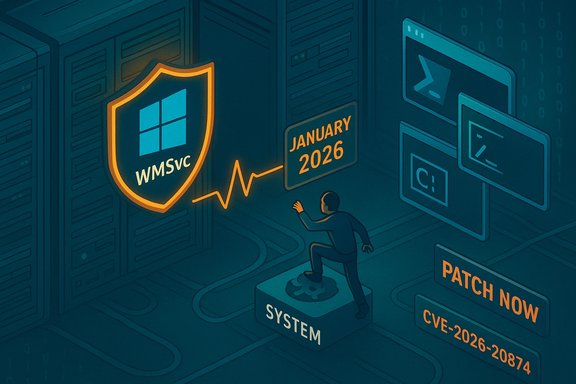
Microsoft has recorded CVE-2026-20874 as an Elevation of Privilege vulnerability affecting Windows Management Services (WMSvc), and the issue appears in the vendor’s January 2026 security rollup — making it a confirmed, high-priority item for administrators responsible for management-plane hosts and privileged endpoints.
Windows Management Services (often surfaced as WMSvc or related management-host binaries) is a privileged subsystem that exposes administrative APIs used by remote management tooling, IIS remote management, and assorted automation workflows. Because WMS components typically run with high privileges, a local elevation-of-privilege (EoP) in this component can convert a modest foothold into SYSTEM-level control, enabling credential theft, defense tampering, persistence, and lateral movement.
Microsoft’s Security Update Guide uses a short “confidence / exploitability” indicator to communicate two things: (1) how certain Microsoft is that a vulnerability exists, and (2) how much technical detail the vendor will publish publicly. For CVE-2026-20874, the presence of an MSRC entry mapped to the January 2026 cumulative updates is a vendor acknowledgement — an important signal that the issue is real and that patches have been issued.
The immediate, practical actions are clear: confirm KB→SKU mappings, prioritize and pilot patches on jump hosts and admin workstations, apply compensating controls where necessary, and tune detection to spot management-service abuse. Do not wait for a public PoC to appear — history shows exploit code follows published patches quickly, and management-plane EoP bugs are the kind of second-stage primitives attackers love to weaponize.
Caveat: precise root-cause details and exploit primitives for CVE-2026-20874 were not published in full in the vendor’s initial advisory; any public technical reconstructions should be treated as provisional until corroborated by Microsoft or by multiple independent technical analyses. Act on the vendor’s KB mapping now, and run detection and hunting in parallel.
(For operational teams: prioritize the inventory → pilot → deploy rhythm, tighten access to management hosts, and hunt actively for the behavioral indicators described above until the enterprise-wide rollout is complete.
Source: MSRC Security Update Guide - Microsoft Security Response Center
 Background
Windows Management Services (often surfaced as WMSvc or related management-host binaries) is a privileged subsystem that exposes administrative APIs used by remote management tooling, IIS remote management, and assorted automation workflows. Because WMS components typically run with high privileges, a local elevation-of-privilege (EoP) in this component can convert a modest foothold into SYSTEM-level control, enabling credential theft, defense tampering, persistence, and lateral movement.Microsoft’s Security Update Guide uses a short “confidence / exploitability” indicator to communicate two things: (1) how certain Microsoft is that a vulnerability exists, and (2) how much technical detail the vendor will publish publicly. For CVE-2026-20874, the presence of an MSRC entry mapped to the January 2026 cumulative updates is a vendor acknowledgement — an important signal that the issue is real and that patches have been issued.
What is known (technical summary)
- Impact class: Elevation of Privilege (local) — a successful exploit could let a low-privilege user or process escalate to higher privileges (up to SYSTEM).
- Attack vector: Local — exploitation requires the ability to run code locally or manipulate a local process that interacts with the management service.
- Vendor status: Acknowledged and patched — Microsoft included the fix within the January 2026 security update cycle; administrators must map the CVE to the correct KB for each Windows build.
Why this matters (threat model & operational impact)
WMS vulnerabilities are high-value to attackers because of where and how they run:- High privilege by design — management services run in elevated contexts, so a local EoP yields immediate, powerful attack primitives.
- Trusted automation channels — management hosts often integrate with automation and update pipelines; a compromised management host can be used to distribute later-stage payloads.
- Concentrated value — admin workstations, jump boxes and bastion hosts frequently host cached credentials, tokens, or orchestration tooling that can be leveraged to escalate an attack beyond a single host.
Confidence, exploitability, and public PoC status
The critical operational takeaway from Microsoft’s “confidence” signal is straightforward:- Vendor acknowledgement plus inclusion in a cumulative update = high confidence that the vulnerability exists and has been addressed by a vendor-supplied patch.
- A terse advisory with limited technical details does not mean low risk — it usually means Microsoft is withholding exploit mechanics while fixes are distributed. Defenders must act on patch availability and detection guidance.
Immediate operational guidance (0–72 hours)
When Microsoft records a WMS EoP in the Update Guide and ships patches, follow this prioritized, practical plan:- Confirm applicability and exact KB mapping (first action). Use Microsoft’s Security Update Guide or the Microsoft Update Catalog to retrieve the precise KB→SKU mapping for CVE-2026-20874 for every Windows build in your environment. Do not rely solely on third‑party feeds or CVE identifiers in scanner results.
- Inventory and prioritize affected hosts. Identify and prioritize:
- Jump servers and bastion hosts
- Admin workstations and VDI pools used for management tasks
- Domain‑joined machines that run management tooling
- Any server where multiple users or services can trigger management APIs
The highest-value targets should be patched first. - Stage and pilot the update. Apply the vendor patch to a small pilot ring that includes representative management hosts and automation endpoints. Validate management workflows, scheduled tasks, monitoring agents, and any integration points before wide deployment.
- Apply compensating controls where you cannot patch immediately:
- Restrict remote/local access to management hosts via host firewalls and network ACLs.
- Enforce least privilege — remove unnecessary local admin accounts and reduce interactive admin assignments.
- Temporarily disable unneeded management features or services if that is operationally feasible.
- Increase detection posture and telemetry. Tune EDR / SIEM and auditing to catch indicators of privilege escalation and management‑service abuse (details in next section).
Detection and hunting recommendations
While detailed exploit artifacts may not be public, behavioral indicators are reliable hunting signals. Recommended telemetry and hunts include:- Windows Event Logs:
- Service Control Manager events indicating unexpected crashes or restarts for WMSvc-related processes.
- Event IDs for process creation and logon elevation that appear anomalously.
- Process telemetry:
- Management service binaries (e.g., wsmprovhost.exe or any binary Microsoft names in the KB) spawning shells or administrative tools (cmd.exe, powershell.exe, regedit.exe, msiexec.exe).
- Non‑SYSTEM processes suddenly duplicating tokens or spawning SYSTEM‑level children.
- Kernel/driver signals (if relevant):
- Repeated DeviceIoControl/IOCTL calls or high-frequency socket control sequences correlated with sudden privilege changes.
- Example conceptual detection (illustrative Sigma-like rule — test and tune):
- Condition: management_service_binary spawns child_process in [cmd.exe, powershell.exe, msiexec.exe] AND parent process is not an approved automation account.
- Action: alert for investigation and capture memory/process dump for forensic triage.
Mitigations and hardening (short and medium term)
- Patch promptly: applying Microsoft’s KB for the affected SKUs closes the root cause and is the primary mitigation. Use Windows Update, WSUS, or the Microsoft Update Catalog for distribution.
- Application allow‑listing: enforce WDAC/AppLocker on high-value hosts to reduce the chance an attacker with a low-privilege foothold can run exploit tooling.
- Network segmentation: block SMB and management protocols across untrusted network boundaries and the Internet. Apply host firewall rules to limit which endpoints can talk to management service ports.
- Remove unnecessary features: where management services are not required, consider disabling them temporarily. Test impact first — disabling WMSvc can break remote management flows.
What defenders should not assume (caveats and unverified claims)
- Do not assume the public advisory includes the exact root cause. Microsoft often withholds low-level exploit details for inbox components while fixes are distributed. Any claim outside of the vendor KB (specific function names, precise exploit chains, or exact CVSS vectors) should be treated as provisional unless corroborated by Microsoft or multiple independent technical writeups.
- Do not assume no risk because no public PoC exists. Historically, EoP bugs in privileged Windows services are rapidly analyzed and weaponized after patches are published. The safest posture is to patch first, detect in parallel.
Risk analysis — strengths and weaknesses of the current posture
Strengths:- Vendor acknowledgement and patch distribution mean there is an authoritative remediation path. That pushes this CVE into the “must-patch” category for affected systems.
- The limited public disclosure reduces immediate exploit details available to widespread opportunistic actors, buying defenders a small window to respond.
- Management hosts and jump boxes are high-value assets; unpatched vulnerabilities on those systems present outsized enterprise risk and a high potential blast radius.
- The vendor’s terse advisory may cause some teams to defer action while seeking more technical detail; this behavior expands the window for attackers to reverse-engineer patches and develop exploits.
- Incomplete or incorrect KB→SKU mapping in patch automation tools can lead to missed updates; always confirm mappings using Microsoft’s Update Guide or Update Catalog before mass deployment.
Long-term remediation and strategy
- Treat repeated WMS EoP findings as a sign to revisit management-plane exposure and architectural controls. Consider zero‑trust approaches for remote management and stricter segmentation for administrative hosts.
- Reduce attack surface: limit which machines host management tooling, remove unused management features from standard endpoints, enforce least privilege for service accounts, and rotate stored credentials regularly.
- Harden update and automation pipelines: ensure that automation tools (SCCM, Intune, RMM) are up to date and configured to avoid inadvertently re‑enabling vulnerable behaviors. Validate that orchestration agents run with minimal privilege and do not expose unnecessary local management call surfaces.
Practical, step-by-step checklist for administrators
- Immediately: Confirm which of your hosts are affected by CVE-2026-20874 by mapping OS builds to the KB entries in Microsoft’s Security Update Guide.
- Within 24 hours: Stage the KB packages in a pilot ring of jump hosts and admin workstations. Validate management workflows and monitoring agents.
- Within 72 hours: Patch high-value and internet-exposed management endpoints. Apply compensating network and host controls where patching is delayed.
- Concurrently: Enable or tune detection rules to capture management service process anomalies, unexpected SYSTEM spawns, and Service Control Manager crash/restart events. Preserve forensic evidence if exploitation is suspected.
- After rollout: Sweep telemetry across the estate for pre‑ and post‑patch indicators and run retrospective hunts for suspicious activity tied to management processes.
Final assessment and takeaway
CVE-2026-20874 is a vendor‑acknowledged local Elevation of Privilege affecting Windows Management Services and was included in Microsoft’s January 2026 security updates. That vendor acknowledgement places the vulnerability in the high-confidence category — it is real, it has a remediation path, and it should be treated as a priority for patching on all affected SKUs.The immediate, practical actions are clear: confirm KB→SKU mappings, prioritize and pilot patches on jump hosts and admin workstations, apply compensating controls where necessary, and tune detection to spot management-service abuse. Do not wait for a public PoC to appear — history shows exploit code follows published patches quickly, and management-plane EoP bugs are the kind of second-stage primitives attackers love to weaponize.
Caveat: precise root-cause details and exploit primitives for CVE-2026-20874 were not published in full in the vendor’s initial advisory; any public technical reconstructions should be treated as provisional until corroborated by Microsoft or by multiple independent technical analyses. Act on the vendor’s KB mapping now, and run detection and hunting in parallel.
(For operational teams: prioritize the inventory → pilot → deploy rhythm, tighten access to management hosts, and hunt actively for the behavioral indicators described above until the enterprise-wide rollout is complete.
Source: MSRC Security Update Guide - Microsoft Security Response Center
