

Microsoft has recorded CVE-2026-20875 as a denial-of-service vulnerability affecting the Local Security Authority Subsystem Service (LSASS), and defenders should treat this as a high-priority availability issue for identity-critical hosts until every affected build is patched.
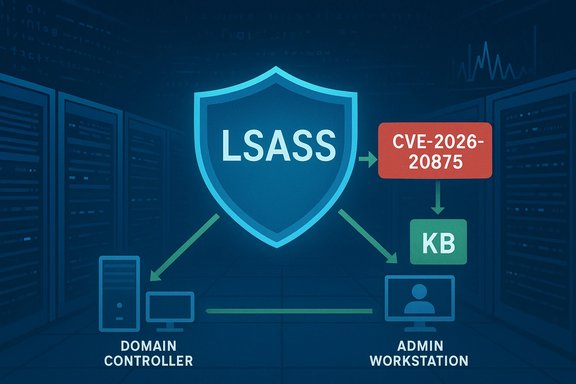
Windows’ Local Security Authority Subsystem Service (LSASS) is a foundational security process responsible for authentication, token management, and enforcing local security policy. When LSASS fails, Windows often becomes unusable for authentication and the host may reboot or drop domain services—making LSASS vulnerabilities disproportionally dangerous for domain controllers, admin workstations, and jump servers.
Microsoft’s Security Update Guide lists CVE-2026-20875 as an LSASS denial‑of‑service issue in the January 2026 security rollup, and community patch‑roundup threads and Patch Tuesday coverage have surfaced the same CVE identifier in vendor and community summaries for the January release. This feature unpacks what is publicly known about CVE‑2026‑20875, assesses the vendor confidence and technical detail available, evaluates the operational risk, and provides actionable mitigation, detection, and deployment guidance for Windows administrators and security teams.
Microsoft’s Update Guide is the authoritative starting point for mapping the CVE to KB packages and builds; use it to feed your patch orchestration toolchain and treat identity endpoints as the most critical ring for this update.
(Caveat: public details remain intentionally limited. If your detection or mitigation depends on precise function names, packet formats, or internal offsets, wait for vetted technical analyses and PoC publications from trusted researchers or Microsoft’s deeper KB notes before building automated remediation logic. Treat any unverified technical claim as uncertain and proceed conservatively in operational deployments.
Source: MSRC Security Update Guide - Microsoft Security Response Center
 Background / Overview
Windows’ Local Security Authority Subsystem Service (LSASS) is a foundational security process responsible for authentication, token management, and enforcing local security policy. When LSASS fails, Windows often becomes unusable for authentication and the host may reboot or drop domain services—making LSASS vulnerabilities disproportionally dangerous for domain controllers, admin workstations, and jump servers.Microsoft’s Security Update Guide lists CVE-2026-20875 as an LSASS denial‑of‑service issue in the January 2026 security rollup, and community patch‑roundup threads and Patch Tuesday coverage have surfaced the same CVE identifier in vendor and community summaries for the January release. This feature unpacks what is publicly known about CVE‑2026‑20875, assesses the vendor confidence and technical detail available, evaluates the operational risk, and provides actionable mitigation, detection, and deployment guidance for Windows administrators and security teams.
What Microsoft says (concise summary)
Microsoft’s Update Guide entry for CVE‑2026‑20875 records the vulnerability against the Local Security Authority Subsystem Service (LSASS) and classifies the impact as a denial‑of‑service condition. The vendor guidance in the Update Guide is the authoritative remediation mapping (CVE → KB → SKUs), and administrators must use those mappings to drive patch orchestration. Independent community trackers and enterprise discussion threads list CVE‑2026‑20875 in the January 2026 Patch Tuesday catalog alongside other Windows fixes and recommend prioritizing identity endpoints and admin workstations for remediation. These independent lists corroborate Microsoft’s classification and timing of the fix.Technical summary (what we can reliably say)
- Affected component: Local Security Authority Subsystem Service (LSASS) — the Windows process that performs authentication, stores credentials in memory, and issues security tokens.
- Vulnerability class: Denial‑of‑service (availability) — the public advisory and vendor metadata identify the impact as DoS against LSASS rather than direct code execution or information disclosure.
- Attack vector and prerequisites: Public vendor metadata and consolidated community summaries indicate a network‑accessible vector in the LSASS path that can be triggered by an authorized actor or network traffic pattern; specifics of whether the attacker must be authenticated, or what exact packet format triggers the condition, are intentionally limited in the initial vendor description. Treat the MSRC entry as the canonical statement for the vulnerability’s classification and remediation mapping.
- Exploitability and proof-of-concept status: At publication Microsoft has acknowledged the CVE and shipped the fix in the January 2026 rollup; public technical exploit details are limited and there are no widely‑published weaponized PoC samples in the open community at the time of writing. That said, absence of a public PoC is not proof of non‑exploitability—sophisticated adversaries sometimes develop private exploit chains.
Understanding the vendor confidence metric and what it means here
The vendor confidence metric measures how certain the community and vendor are about a vulnerability’s existence and technical specifics — and importantly, how much actionable detail is available to both defenders and attackers.- Low confidence: only vague public mentions, no vendor acknowledgement, little technical detail.
- Medium confidence: vendor confirms the CVE and releases a short advisory but omits exploit mechanics (typical for early MSRC entries).
- High confidence: vendor provides detailed KB diffs, PoC, or third‑party research corroborates root cause and exploitation steps.
Why LSASS DoS matters operationally
LSASS sits at the center of Windows identity and authorization. A denial of service against LSASS has outsized operational and security consequences:- Domain controllers or authentication servers that lose LSASS availability can cause authentication failures across a domain, halting logons, service authentications, and SSO flows.
- Admin workstations and jump hosts knocked offline or repeatedly rebooting are high‑value operational targets — they can disrupt incident response, patching, and forensic collection.
- Rebooting LSASS may clear volatile evidence and hamper incident response if memory snapshots are not captured quickly.
- In multi‑stage attacks, adversaries have historically used DoS conditions on identity services as cover for other activity (e.g., lateral movement or scheduled downtime to hide persistence actions).
Detection and hunting — what to look for now
Because vendor technical details are sparse, detection must start from behavior-based and tactical signals rather than a single signature. Consider the following prioritized telemetry and hunt indicators:- LSASS restarts, crashes, or unplanned service failures (System and Application event logs).
- Sudden reboots or WER (Windows Error Reporting) dumps that reference lsass.exe.
- Elevated frequency of incoming requests to identity endpoints that correlate with LSASS instability.
- EDR alerts for unusual memory access patterns on lsass.exe or telemetry indicating resource exhaustion (high CPU, huge memory spikes).
- Network traffic spikes or malformed RPC/LDAP/NTLM traffic if your environment’s asset inventory suggests LSASS is exposed to specific network paths.
- Correlate these signals with patch state — unpatched hosts that match the CVE→KB mapping should be treated as higher priority in hunts.
Immediate mitigation and deployment plan (0–72 hours)
- Map CVE → KB → Build: Use Microsoft’s Security Update Guide to map CVE‑2026‑20875 to the exact KB(s) for each Windows build in your estate. This is the single most important step. The Update Guide entry is authoritative for SKU and KB mapping.
- Prioritize patch rings:
- Pilot: admin workstations, a small set of Domain Controllers in a test domain, and jump boxes.
- Phase 1: remaining Domain Controllers and critical authentication servers.
- Phase 2: admin workstations, bastions, VDI pools and other endpoints with elevated access.
- Phase 3: broad workstation and server population.
- Verify prerequisites: some cumulative updates bundle servicing stack updates (SSU) and may require reboots. Ensure patch orchestration systems (WSUS, SCCM/ConfigMgr, Intune) pull the correct package and that pilots include an SSU check if required.
- If immediate patching is impossible:
- Harden network access to authentication services (restrict inbound access to DCs, block untrusted networks).
- Reduce attack surface by limiting which hosts can query services that surface LSASS functionality.
- Increase monitoring and capture WER dumps and EDR memory snapshots proactively for suspect systems.
- Post-patch validation:
- Confirm LSASS remains stable after update and check for regressions in authentication flows.
- Validate WER and Event Log behavior and ensure normal login flows operate as expected.
Detection rule templates (starter items for SOCs)
- Host detection (EDR):
- Alert on repeated lsass.exe process crashes or WER reports referencing lsass.exe within a short time window.
- Alert on lsass.exe memory growth above expected baselines for service types and expected platform builds.
- Network detection (if relevant):
- Correlate spikes in DCE/RPC, LDAP, or other authentication-related protocols with LSASS failures on the destination host.
- SIEM correlation:
- Rule: WER dump + Authentication service outage within X minutes on the same host → high‑priority incident.
- Rule: host is unpatched for CVE‑2026‑20875 AND abnormal lsass.exe activity → escalate.
Risk analysis — strengths and gaps in public record
Strengths:- Vendor acknowledgement and inclusion in the January 2026 rollup provide a definitive remediation path and raise the confidence level that the vulnerability is real and patched. That makes mitigation straightforward in principle: apply the update.
- Community patch roundups, SOC playbooks, and vendor trackers help operators prioritize identity-critical hosts and craft temporary compensations while patching.
- Microsoft’s public advisory omits low‑level exploit primitives and sample triggers; that leaves defenders without precise IOCs for rapid detection and increases the possibility that private exploit development already exists.
- Denial‑of‑service against LSASS is a high‑impact but sometimes hard‑to‑triage condition: similar symptoms can come from unrelated system instability or misconfiguration, increasing the chance of misattribution.
- Patch rollouts at scale can be slow in large enterprises; legacy systems, image-based deployments, or isolated production systems may lag and remain exposed. Past incidents show attackers will often probe unpatched identity infrastructure after a patch announcement.
How to communicate this to stakeholders (non‑technical summary)
- For C‑suite / IT leadership: “Microsoft published a patch for an LSASS denial‑of‑service vulnerability (CVE‑2026‑20875). Identity infrastructure — Domain Controllers and admin workstations — should be the top patching priority this cycle because LSASS outages can halt user logins and critical business systems.”
- For operations teams: “Follow the established patch ring: pilot admin hosts, then proceed to domain controllers and bastions. Capture WER dumps and memory snapshots before rebooting suspected hosts.”
- For security operations / SOC: “Tune detection for LSASS restarts and correlate with network authentication traffic. Increase monitoring and prepare an incident playbook for rapid evidence capture.”
Post‑patch verification checklist
- Confirm the KB applied to the target build (check the system’s installed updates and KB list).
- Reboot hosts where the update requires one and validate authentication flow.
- Review WER dumps and Event Viewer for lsass.exe after patching; crashes should no longer reproduce for previously vulnerable triggers.
- Run a follow‑up detection/hunt to ensure there are no residual anomalies and to confirm telemetry remains stable.
- Document the deployment and any issues for future audits.
Longer‑term hardening recommendations
- Enforce least privilege and reduce the number of accounts that have interactive logon on servers that host critical identity functions.
- Run LSASS as a protected process where supported and use Windows Defender Credential Guard on high‑risk endpoints to reduce local credential theft risks.
- Treat admin workstations, jump boxes and Domain Controllers as tier‑1 assets in patch and imaging pipelines — keep golden images up to date and centrally managed.
- Centralize logging and WER capture so that when a vulnerability like CVE‑2026‑20875 appears, incident responders can rapidly collect relevant artifacts without risking service availability.
Final assessment and recommended priority
CVE‑2026‑20875 is a vendor‑acknowledged LSASS denial‑of‑service vulnerability included in Microsoft’s January 2026 security updates. The presence of a vendor patch raises confidence that the vulnerability is real and remediated through the provided KB packages, but the lack of detailed public exploit mechanics means defenders must rely on vendor KB mapping, behavior‑based detection, and rapid patch deployment. Prioritize Domain Controllers, admin workstations, and jump boxes for immediate patching and validation. Increase monitoring for LSASS crashes and be prepared to collect WER dumps and memory artifacts before host reboots if suspicious behavior is observed.Microsoft’s Update Guide is the authoritative starting point for mapping the CVE to KB packages and builds; use it to feed your patch orchestration toolchain and treat identity endpoints as the most critical ring for this update.
(Caveat: public details remain intentionally limited. If your detection or mitigation depends on precise function names, packet formats, or internal offsets, wait for vetted technical analyses and PoC publications from trusted researchers or Microsoft’s deeper KB notes before building automated remediation logic. Treat any unverified technical claim as uncertain and proceed conservatively in operational deployments.
Source: MSRC Security Update Guide - Microsoft Security Response Center
