

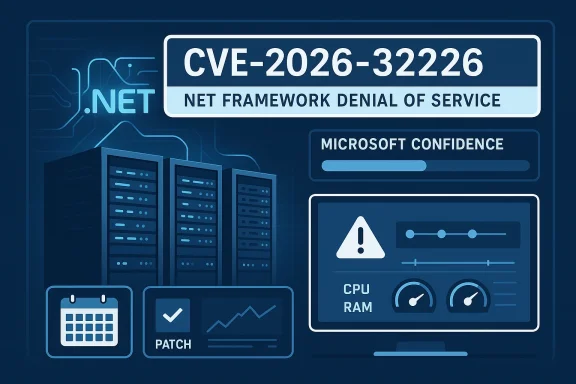
Microsoft’s Security Update Guide entry for CVE-2026-32226 identifies it as a .NET Framework Denial of Service Vulnerability, and the accompanying confidence language is the part defenders should read most carefully. Microsoft’s own metric is designed to tell customers how sure the vendor is that the flaw exists and how credible the technical details are, which means the advisory is not just naming a risk — it is signaling how much weight to give the record itself. In practical terms, that makes CVE-2026-32226 more than a line item in a patch list; it is a statement about the reliability of the disclosure and the urgency of remediation.
The .NET Framework has been part of the Windows platform for so long that many administrators treat it as background infrastructure rather than a live security surface. That is understandable, but it is also why .NET issues often catch teams off guard. The framework sits under enterprise applications, internal tools, line-of-business software, and legacy desktop programs, which means a weakness in the runtime can ripple far beyond a single application.
Denial-of-service findings in the .NET ecosystem are especially important because they often affect availability rather than confidentiality or integrity. A crash, hang, or resource-exhaustion condition can be enough to take down a service, interrupt a workflow, or force a restart cycle. In a modern enterprise, availability failures can be just as disruptive as a data leak, especially when they hit authentication flows, service backends, or automation pipelines.
Microsoft has a long history of publishing .NET-related security updates, and the pattern matters. Many of these disclosures are not about dramatic remote code execution; they are about reliability bugs, parsing issues, or edge-case failures that become security problems once they can be triggered by untrusted input. That pattern is consistent with how software ages: the more widely a framework is used, the more likely it is to accumulate brittle edges around exceptional conditions.
The confidence metric attached to Microsoft’s advisories is one of the more useful but underappreciated pieces of the Security Update Guide. It exists because not every CVE record arrives with the same level of proof, reproduction, or technical clarity. Some issues are fully validated, while others are acknowledged at a higher level with limited public detail, and that difference matters when defenders are deciding whether to treat a disclosure as actionable or speculative.
Microsoft’s approach also reflects a broader reality in vulnerability reporting: a vendor may know enough to warn customers before every implementation detail is public. That is not a weakness in the process; it is often the point of responsible disclosure. The result is a tiered signal where the title, the severity, and the confidence descriptor each add something different to the decision-making process.
In the case of CVE-2026-32226, the key takeaway is that the vendor is publicly classifying the issue as a real .NET Framework denial-of-service problem and pairing that with a confidence signal meant to convey how trustworthy the underlying report is. That combination matters because it tells defenders not to wait for a second wave of commentary before acting. If Microsoft has enough confidence to publish the record, the issue is already operationally relevant.
The practical value of the metric is that it helps readers understand how much of the advisory is confirmed versus inferred. A high-confidence entry implies the vendor has enough evidence to stand behind the report strongly, while a lower-confidence entry may indicate limited technical disclosure or incomplete public corroboration. In both cases, the record can still be important, but the operational posture changes.
It also reflects a subtle but important truth about modern vulnerability handling: not every real vulnerability is immediately well-explained. In some cases, the technical root cause is known to Microsoft and only partially public; in others, the public description is enough to justify defensive action even before exploitation mechanics are disclosed.
That matters even more in environments where older .NET Framework applications remain deeply embedded. Many organizations still depend on software written years ago, sometimes with limited vendor support and very little appetite for full redevelopment. When a framework-level issue lands, the blast radius can reach apps that were never directly designed with modern threat models in mind.
It is also worth remembering that “DoS” is not a single failure mode. It may represent a crash, a hang, a resource leak, an exception storm, or a pathological code path that consumes excessive CPU or memory. Without more technical detail, defenders should treat the label as a family of availability risks rather than a single bug class.
Older .NET advisories often followed a familiar shape: a privately reported issue, a Microsoft bulletin, and a patch tied to specific framework versions. Over time, the servicing model has become more structured, but the underlying lesson has not changed. Framework-level bugs deserve the same seriousness as application bugs, sometimes more, because they affect the platform layer that many applications share.
The CVE system itself also shapes how this information is consumed. A CVE entry tells the world that a vulnerability has been tracked and categorized, but it does not always provide the full engineering story. That leaves room for the confidence metric to do extra work, especially when the public details are intentionally thin.
For readers, the challenge is to avoid over-reading the sparse details. A denial-of-service label does not automatically mean remote exploitation is trivial, nor does it imply a wormable bug. It simply means the vulnerability can produce service disruption, and the confidence label tells you how strongly Microsoft believes the public record.
That said, sparse records force defenders to work from first principles. They need to ask which .NET Framework versions are deployed, which applications rely on them, whether services are internet-facing, and whether the patch requires restart planning. The more limited the public disclosure, the more valuable internal inventory becomes.
Administrators also have to think about service topology. Some .NET applications run behind load balancers and recover quickly from a single process fault; others are tightly coupled to a single node or VM and may need manual intervention. The difference between those two setups can turn the same vulnerability from a minor inconvenience into a major incident.
Operationally, defenders should think in terms of layered impact:
For developers, the implication is more technical and more immediate. Even when the framework vendor provides the fix, applications built on top of it may need regression testing. If the vulnerability is triggered by a specific input pattern, then developers may need to revisit validation, exception handling, or workload assumptions in adjacent code paths.
That matters because modern patch prioritization is noisy. Teams are flooded with CVEs, advisory feeds, exploit chatter, and third-party databases, many of which add context but not necessarily accuracy. A vendor-stated confidence measure helps reduce uncertainty, even if it does not eliminate it.
The metric also has a psychological benefit: it reminds defenders that not all public disclosures are equally mature. That encourages better habits, including corroborating vendor notes with asset inventories, test environments, and application telemetry. In other words, the metric is not only a signal about the vulnerability — it is a signal about how to think.
The response strategy should begin with inventory. If you do not know which machines host the affected .NET Framework versions, you cannot estimate blast radius. After inventory comes exposure assessment, then regression testing, then deployment sequencing, and finally post-patch monitoring.
There are also real opportunities for security teams to improve their own processes off the back of this kind of disclosure. A confirmed .NET Framework DoS is an invitation to tighten asset visibility, refine test coverage, and improve service resilience. In other words, the vulnerability is a risk, but the response can become an operational upgrade.
Another concern is that sparse technical disclosure can lull teams into passivity. If the public details are light, some administrators assume they can wait until more information appears. But delays are dangerous when the affected component is a core runtime that multiple applications may share.
The other thing to watch is whether this CVE is part of a broader pattern in the .NET Framework codebase. Security bugs often cluster around parsing, input handling, and resource-management edges. If so, CVE-2026-32226 may be less of a one-off and more of a sign that adjacent code paths deserve extra scrutiny.
The most important lesson in CVE-2026-32226 is that Microsoft is not merely flagging a hypothetical flaw. It is telling customers that the vulnerability is real enough to track, important enough to publish, and serious enough to affect availability in environments where .NET Framework still matters. In an era when so much enterprise software still rests on old assumptions about stability, that is a warning worth taking seriously.
Source: MSRC Security Update Guide - Microsoft Security Response Center
 Background
The .NET Framework has been part of the Windows platform for so long that many administrators treat it as background infrastructure rather than a live security surface. That is understandable, but it is also why .NET issues often catch teams off guard. The framework sits under enterprise applications, internal tools, line-of-business software, and legacy desktop programs, which means a weakness in the runtime can ripple far beyond a single application.Denial-of-service findings in the .NET ecosystem are especially important because they often affect availability rather than confidentiality or integrity. A crash, hang, or resource-exhaustion condition can be enough to take down a service, interrupt a workflow, or force a restart cycle. In a modern enterprise, availability failures can be just as disruptive as a data leak, especially when they hit authentication flows, service backends, or automation pipelines.
Microsoft has a long history of publishing .NET-related security updates, and the pattern matters. Many of these disclosures are not about dramatic remote code execution; they are about reliability bugs, parsing issues, or edge-case failures that become security problems once they can be triggered by untrusted input. That pattern is consistent with how software ages: the more widely a framework is used, the more likely it is to accumulate brittle edges around exceptional conditions.
The confidence metric attached to Microsoft’s advisories is one of the more useful but underappreciated pieces of the Security Update Guide. It exists because not every CVE record arrives with the same level of proof, reproduction, or technical clarity. Some issues are fully validated, while others are acknowledged at a higher level with limited public detail, and that difference matters when defenders are deciding whether to treat a disclosure as actionable or speculative.
Microsoft’s approach also reflects a broader reality in vulnerability reporting: a vendor may know enough to warn customers before every implementation detail is public. That is not a weakness in the process; it is often the point of responsible disclosure. The result is a tiered signal where the title, the severity, and the confidence descriptor each add something different to the decision-making process.
In the case of CVE-2026-32226, the key takeaway is that the vendor is publicly classifying the issue as a real .NET Framework denial-of-service problem and pairing that with a confidence signal meant to convey how trustworthy the underlying report is. That combination matters because it tells defenders not to wait for a second wave of commentary before acting. If Microsoft has enough confidence to publish the record, the issue is already operationally relevant.
What the Confidence Metric Actually Means
Microsoft’s confidence language is not a CVSS substitute, and it should not be mistaken for one. CVSS scores describe severity and exploitability characteristics, while the confidence metric speaks to the certainty of the vulnerability’s existence and the credibility of the technical details. Those are related, but they answer different questions.The practical value of the metric is that it helps readers understand how much of the advisory is confirmed versus inferred. A high-confidence entry implies the vendor has enough evidence to stand behind the report strongly, while a lower-confidence entry may indicate limited technical disclosure or incomplete public corroboration. In both cases, the record can still be important, but the operational posture changes.
Why defenders should care
A confidence label is especially useful when details are sparse. If the advisory says “denial of service” but does not yet describe the trigger path, the confidence metric helps readers decide whether to treat the issue as an active patching priority or as an item to monitor until more evidence appears. That makes the metric a risk-management tool, not just a documentation flourish.It also reflects a subtle but important truth about modern vulnerability handling: not every real vulnerability is immediately well-explained. In some cases, the technical root cause is known to Microsoft and only partially public; in others, the public description is enough to justify defensive action even before exploitation mechanics are disclosed.
- High confidence generally means stronger validation and more actionable technical detail.
- Medium confidence often signals a real issue with incomplete public corroboration.
- Lower confidence can still be important, but it calls for more cautious interpretation.
- All confidence levels can still justify patching if the affected component is widely deployed.
- Confidence is not severity; a low-confidence bug can still be high-impact if exploited.
Why .NET Framework Denial of Service Matters
Availability bugs in a runtime are often underestimated because they do not sound as dramatic as code execution. But in a platform component like .NET Framework, denial of service can hit shared services, business applications, and automation systems that rely on stable execution paths. If a flaw can crash a process, saturate resources, or force a reset, the downstream cost can be large.That matters even more in environments where older .NET Framework applications remain deeply embedded. Many organizations still depend on software written years ago, sometimes with limited vendor support and very little appetite for full redevelopment. When a framework-level issue lands, the blast radius can reach apps that were never directly designed with modern threat models in mind.
Availability is a security property
This is one of those cases where security and operations are inseparable. If a denial-of-service weakness can be triggered repeatedly, then attackers do not need to break into a system to cause damage; they only need to interrupt the service at the right point. For public-facing services, that can mean user-facing outages. For internal services, it can mean broken workflows, failed jobs, and helpdesk escalations.It is also worth remembering that “DoS” is not a single failure mode. It may represent a crash, a hang, a resource leak, an exception storm, or a pathological code path that consumes excessive CPU or memory. Without more technical detail, defenders should treat the label as a family of availability risks rather than a single bug class.
- Process crashes can force service restarts.
- Memory exhaustion can degrade adjacent workloads.
- CPU spikes can starve unrelated applications.
- Repeated failures can trigger watchdogs and failover loops.
- Quiet instability is often worse than a clean crash because it is harder to diagnose.
Historical Context for .NET Security Fixes
Microsoft has patched .NET Framework security issues for years, including denial-of-service bugs and other reliability defects that became security concerns once they were reachable through crafted inputs. That history matters because it shows this is not an isolated phenomenon. It is part of a long-running pattern in platform software: once a runtime becomes ubiquitous, even niche parsing or edge-case logic can become a target.Older .NET advisories often followed a familiar shape: a privately reported issue, a Microsoft bulletin, and a patch tied to specific framework versions. Over time, the servicing model has become more structured, but the underlying lesson has not changed. Framework-level bugs deserve the same seriousness as application bugs, sometimes more, because they affect the platform layer that many applications share.
How this fits the broader Microsoft patch model
Microsoft’s modern Security Update Guide is designed to give defenders a single place to evaluate impact, confidence, and remediation. That is important because Microsoft now supports a sprawling ecosystem of Windows components, cloud services, developer runtimes, and enterprise tooling. A consistent advisory structure helps security teams triage quickly across very different products.The CVE system itself also shapes how this information is consumed. A CVE entry tells the world that a vulnerability has been tracked and categorized, but it does not always provide the full engineering story. That leaves room for the confidence metric to do extra work, especially when the public details are intentionally thin.
- Microsoft has a long record of .NET security patches.
- Runtime bugs can affect many applications simultaneously.
- Advisory structure matters when detail is limited.
- A CVE is a tracking mechanism, not a full root-cause report.
- Confidence adds a second layer of meaning beyond severity.
Interpreting the Advisory Language
The language Microsoft uses around a CVE can be as important as the headline itself. When the company publishes a denial-of-service entry with a confidence descriptor, it is signaling two things at once: the issue is real enough to track, and the technical basis has a measurable level of credibility. That is more useful than vague caution, but it is still less informative than a full exploit write-up.For readers, the challenge is to avoid over-reading the sparse details. A denial-of-service label does not automatically mean remote exploitation is trivial, nor does it imply a wormable bug. It simply means the vulnerability can produce service disruption, and the confidence label tells you how strongly Microsoft believes the public record.
The value of sparse but confirmed reporting
Sparse reporting can still be highly actionable. In fact, many security teams prefer a concise vendor-confirmed record over speculative third-party commentary, because it reduces ambiguity. A short advisory with a clear confidence posture can be better than a verbose article that exaggerates the threat.That said, sparse records force defenders to work from first principles. They need to ask which .NET Framework versions are deployed, which applications rely on them, whether services are internet-facing, and whether the patch requires restart planning. The more limited the public disclosure, the more valuable internal inventory becomes.
- Treat the title as the vendor’s official classification.
- Treat the confidence metric as a credibility indicator.
- Treat missing technical detail as a signal to inspect exposure.
- Treat denial-of-service as an availability threat, not a cosmetic issue.
- Treat patching as urgent if the affected framework is widely used.
Enterprise Exposure and Operational Risk
In enterprise environments, .NET Framework remains deeply embedded in business-critical software, and that makes a DoS vulnerability particularly annoying. A problem that crashes a single component can cascade into scheduled tasks, portal outages, failed integrations, or interrupted authentication flows. Even when the bug is not remotely exploitable in a classic sense, it can still cause real business interruption.Administrators also have to think about service topology. Some .NET applications run behind load balancers and recover quickly from a single process fault; others are tightly coupled to a single node or VM and may need manual intervention. The difference between those two setups can turn the same vulnerability from a minor inconvenience into a major incident.
Patching is not just about deployment
In the enterprise, patching is also about coordination. If the update touches a runtime shared by multiple applications, teams may need regression testing, change windows, and rollback planning. That is especially true for aging line-of-business apps where the original developers are long gone and nobody fully remembers which component depends on which framework version.Operationally, defenders should think in terms of layered impact:
- Internet-facing services may be at greatest risk if the flaw is remotely triggerable.
- Internal apps may still suffer because insiders or compromised hosts can reach them.
- Virtualized workloads may see service churn if the issue destabilizes guest processes.
- Shared servers may amplify the impact across multiple apps.
- Managed platforms may inherit patch timing from the vendor rather than the enterprise.
Consumer and Developer Implications
Consumer impact is less direct, but it is still real. Home users are less likely to think about .NET Framework as a security boundary, yet many desktop applications depend on it. If a vulnerable application crashes or becomes unstable, the user sees it as a normal app problem rather than a platform vulnerability. That is one reason framework security issues can remain invisible to the public.For developers, the implication is more technical and more immediate. Even when the framework vendor provides the fix, applications built on top of it may need regression testing. If the vulnerability is triggered by a specific input pattern, then developers may need to revisit validation, exception handling, or workload assumptions in adjacent code paths.
What developers should look for
Developers should not assume the platform patch is the entire story. A runtime fix may close the vulnerable path, but application code can still reveal whether the bug was reachable in practice. Logging, synthetic testing, and input fuzzing are useful here because they help determine whether the application was relying on fragile framework behavior.- Review application dependencies on affected .NET Framework versions.
- Test for crashes or hangs under malformed input.
- Validate error handling around parsing and serialization.
- Check whether monitoring catches service restarts or exception storms.
- Confirm whether the vendor patch changes behavior in edge-case workflows.
Confidence, Disclosure, and the Security Ecosystem
Microsoft’s confidence metric sits at the intersection of vulnerability disclosure and trust. It tells defenders how certain the vendor is, but it also reflects a larger trend in the industry toward more explicit metadata. Security teams increasingly want not just the “what” of a vulnerability, but the “how sure are we?” and “how much detail can we rely on?” questions answered up front.That matters because modern patch prioritization is noisy. Teams are flooded with CVEs, advisory feeds, exploit chatter, and third-party databases, many of which add context but not necessarily accuracy. A vendor-stated confidence measure helps reduce uncertainty, even if it does not eliminate it.
Why confidence matters in triage
Confidence is especially valuable when you are sorting vulnerabilities under time pressure. If a record is highly credible, it can move straight into change planning and patch validation. If the record is less certain, security teams can still watch it closely, but they may avoid overreacting before the technical picture is clearer.The metric also has a psychological benefit: it reminds defenders that not all public disclosures are equally mature. That encourages better habits, including corroborating vendor notes with asset inventories, test environments, and application telemetry. In other words, the metric is not only a signal about the vulnerability — it is a signal about how to think.
- It improves the quality of prioritization.
- It helps separate confirmed issues from early reports.
- It supports better communication with operations teams.
- It encourages evidence-based remediation.
- It reduces the risk of over- or under-reacting to a disclosure.
Patch Prioritization and Response Strategy
For most organizations, the right response to CVE-2026-32226 is to treat it as a patching priority once Microsoft makes the fix available in the relevant servicing channel. Even when exploit details are limited, a confirmed framework-level DoS should not sit at the bottom of the queue. Availability bugs are often the ones that hurt quietly, especially when they affect systems that users assume are routine and dependable.The response strategy should begin with inventory. If you do not know which machines host the affected .NET Framework versions, you cannot estimate blast radius. After inventory comes exposure assessment, then regression testing, then deployment sequencing, and finally post-patch monitoring.
A practical response sequence
A disciplined response is often more useful than a dramatic one. The goal is not to panic; the goal is to reduce the chance that a well-placed crash or hang becomes a service event. For many teams, that means pairing patch rollout with operational observation rather than just applying an update and moving on.- Identify every host running the affected .NET Framework lineage.
- Determine which applications depend on those hosts.
- Test the patch in a nonproduction environment first.
- Schedule deployment during a maintenance window if the app is business-critical.
- Watch for post-update service restarts, exception spikes, or performance regressions.
Strengths and Opportunities
Microsoft’s publication of a confidence-bearing advisory is a strength in itself, because it gives defenders something concrete to work with rather than forcing them to guess. It also shows how the Security Update Guide has matured into a more nuanced risk communication tool. For organizations that manage large Windows estates, that is useful and overdue.There are also real opportunities for security teams to improve their own processes off the back of this kind of disclosure. A confirmed .NET Framework DoS is an invitation to tighten asset visibility, refine test coverage, and improve service resilience. In other words, the vulnerability is a risk, but the response can become an operational upgrade.
- Clear vendor acknowledgment helps separate real risk from rumor.
- Confidence metadata improves triage quality.
- Patch planning can be aligned with dependency maps.
- Regression testing can uncover brittle application behavior.
- Monitoring can be tuned to detect service instability earlier.
- Inventory cleanup often improves security beyond the immediate fix.
- Legacy modernization conversations become easier when a shared runtime is implicated.
Risks and Concerns
The biggest concern is that organizations will underreact because the issue is “only” denial of service. That would be a mistake. In production systems, downtime is costly, and repeated instability can create a cascade of operational problems long before any data is at risk. If the advisory is real and the confidence metric is strong, the issue deserves attention.Another concern is that sparse technical disclosure can lull teams into passivity. If the public details are light, some administrators assume they can wait until more information appears. But delays are dangerous when the affected component is a core runtime that multiple applications may share.
- Downtime risk can be significant even without code execution.
- Legacy dependencies may slow patch deployment.
- Incomplete public detail may complicate triage.
- Shared hosting can magnify the blast radius.
- Poor visibility into framework usage can hide exposure.
- Regression fears may tempt teams to defer remediation.
- Operational fatigue can cause a confirmed issue to be treated like background noise.
Looking Ahead
What happens next will likely depend on whether Microsoft later publishes more technical detail, whether security researchers corroborate the trigger path, and whether downstream applications show visible instability patterns. If the confidence level remains strong, defenders can assume the issue is already solid enough to merit standard patch discipline. If later updates clarify the attack surface, teams may need to revisit whether the vulnerability is locally triggerable, remotely reachable, or tied to a specific workflow.The other thing to watch is whether this CVE is part of a broader pattern in the .NET Framework codebase. Security bugs often cluster around parsing, input handling, and resource-management edges. If so, CVE-2026-32226 may be less of a one-off and more of a sign that adjacent code paths deserve extra scrutiny.
Practical watch list
- Microsoft’s follow-up advisory language and any confidence updates.
- Downstream reporting that clarifies whether the flaw is remotely triggerable.
- Patch deployment guidance for affected .NET Framework versions.
- Signs of related .NET availability bugs in neighboring components.
- Enterprise telemetry showing whether any business apps become unstable after patching.
- Community validation from researchers or incident responders.
- Revisions to Microsoft’s Security Update Guide entry if more detail becomes public.
The most important lesson in CVE-2026-32226 is that Microsoft is not merely flagging a hypothetical flaw. It is telling customers that the vulnerability is real enough to track, important enough to publish, and serious enough to affect availability in environments where .NET Framework still matters. In an era when so much enterprise software still rests on old assumptions about stability, that is a warning worth taking seriously.
Source: MSRC Security Update Guide - Microsoft Security Response Center
