

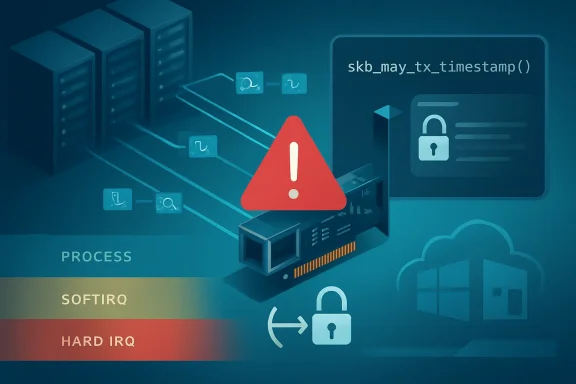
skb_may_tx_timestamp() in transmit timestamp handling. The bug is not the kind of headline-grabbing remote-code-execution flaw that sends every security team into incident mode. It is, instead, a useful reminder that the kernel’s most consequential security fixes often arrive as small concurrency corrections in code paths most users never knew existed. For WindowsForum readers running Linux fleets, WSL-adjacent tooling, appliances, containers, or mixed infrastructure, the practical lesson is simple: treat “boring” kernel deadlocks as availability vulnerabilities until your vendor tells you otherwise.
A Small Networking Fix Exposes a Large Operational Truth
The disclosed issue sits in the Linux kernel’s networking stack, specifically around transmit timestamping, the feature family that lets applications and drivers record when packets are sent. That sounds niche because it is niche, at least compared with the everyday TCP and UDP plumbing that keeps web servers and databases alive. But niche kernel paths are not fringe paths in modern infrastructure; they are often the paths used by high-performance trading systems, time-sensitive industrial networks, observability stacks, software-defined networking, and NIC offload features.
The vulnerable logic is described in almost deceptively calm language: skb_may_tx_timestamp() may acquire sock::sk_callback_lock, but that lock must not be taken in hard interrupt context. Some drivers receive transmit timestamps through a dedicated interrupt and complete the timestamp from that handler. If the same CPU already holds the lock for writing, the result can be a deadlock.
That is the whole story technically, and also not the whole story operationally. A deadlock in kernel networking code is not merely an implementation embarrassment; it is a failure mode that can freeze a path that administrators may have little ability to diagnose from user space. The kernel does not have to hand an attacker root to create security work. Sometimes it only has to stop making forward progress.
The Kernel’s CVE Machine Is Now Naming the Plumbing
The arrival of CVE-2026-43216 continues a trend that has frustrated some administrators and helped others: more Linux kernel fixes are being surfaced as CVEs even when they do not resemble traditional application vulnerabilities. The kernel project has increasingly treated bug fixes with plausible security impact as items that deserve security identifiers, and the result is a flood of records whose descriptions read more like commit messages than advisories.
That is exactly what this record looks like. There is no polished exploit narrative, no vendor severity score from NVD at publication time, and no sweeping claim about unauthenticated remote compromise. The CVE text is the engineering explanation: a lock can be acquired in the wrong execution context, some drivers complete timestamps from interrupts, and a deadlock can follow.
For enterprise defenders, this creates a classification problem. Vulnerability scanners are excellent at matching identifiers and poor at understanding whether a specific network adapter, kernel configuration, driver path, and workload make a bug practically reachable. Security teams see a new CVE. Platform teams see a kernel patch. Neither side is wrong, but neither side has the complete answer on day one.
Interrupt Context Is Where Kernel Assumptions Go to Die
The core of CVE-2026-43216 is not timestamping itself. It is context. Kernel code that is safe in one execution environment can be unsafe in another, and hard interrupt context is one of the least forgiving places to discover that distinction.
In simplified terms, Linux has different layers of execution for handling work. Some work runs in ordinary process context, where sleeping and blocking may be allowed. Some runs in softirq context, a deferred interrupt-processing environment with stricter rules. Some runs in hard IRQ context, where the kernel is handling an actual hardware interrupt and must obey a much tighter discipline.
The CVE description says the lock in question must not be taken in IRQ context, only softirq is acceptable. That line matters because locks are not abstract correctness tokens. They are contracts about what the current code is allowed to do, what else may already be running, whether the CPU can be interrupted, and whether waiting is legal.
If a driver receives a transmit timestamp through a dedicated interrupt and tries to complete that timestamp immediately, it can enter code that assumes a friendlier context than the one it is actually in. If the lock is already write-locked on the same CPU, the system can wedge itself waiting for progress that cannot occur. That is the deadlock pattern: no corruption, no shellcode, no dramatic overwrite — just two parts of the kernel making mutually incompatible assumptions.
Timestamping Is Not Just a Feature for Packet Nerds
Transmit timestamping is easy to dismiss until you look at where precise time matters. High-frequency trading, telecom systems, industrial control, audio/video transport, distributed databases, and network monitoring all care about when packets actually leave the machine. Hardware timestamping, in particular, exists because software timestamps can be too late, too noisy, or too detached from the physical event on the wire.
That means the affected path may be invisible in ordinary desktop use but meaningful in high-value environments. A home user browsing the web on a generic laptop is unlikely to be the center of gravity here. A Linux host with specialized NICs, Precision Time Protocol, driver-level timestamp support, or latency-sensitive telemetry is a different story.
The danger for administrators is not that every Linux box is suddenly on fire. The danger is that the machines most likely to exercise this path may be precisely the machines where a networking stall is most expensive. In the world of infrastructure risk, “niche” often means “small population, high consequence.”
The Fix Chooses Lifetime Rules Over Locking
The patch’s argument is elegant in the way many good kernel fixes are elegant: stop taking the lock because the lock is not actually needed for the safety property the code requires. The socket referenced by the socket buffer remains valid until the buffer is released. When the user closes the socket, related pointers such as sk_socket and file are cleared, but the underlying objects involved are freed using RCU-style lifetime rules.
That matters because the code can safely read the pointers without acquiring sk_callback_lock, provided it does so carefully. The fix uses READ_ONCE() to obtain individual pointers and adds matching WRITE_ONCE() operations where those pointers are cleared. This is not a casual removal of synchronization; it is a replacement of one kind of synchronization assumption with another that better matches the execution context.
There is a lesson here for anyone who still thinks of locking as the universal answer to concurrency. In kernel code, the wrong lock in the wrong place is itself a bug. Sometimes the safest fix is not to guard harder, but to guard differently.
The patch also reflects the kernel’s long-running evolution toward making object lifetime and memory ordering explicit. READ_ONCE() and WRITE_ONCE() are not decorative macros. They tell the compiler and the reader that these accesses are part of a concurrency contract, not ordinary variable reads and writes that can be freely optimized or assumed stable.
This Is Availability Risk, Not a Root-Shell Panic
At the time of publication, NVD had not provided CVSS scoring for CVE-2026-43216. That absence should slow down both overreaction and underreaction. Without a severity vector, security teams should avoid inventing a worst-case score from vibes; without a score, they should also avoid assuming the bug is irrelevant.
The described impact is a deadlock. In security language, that points primarily toward denial of service or availability degradation rather than privilege escalation or data theft. The record does not claim arbitrary code execution, information disclosure, or a remote exploit chain.
But availability is not a second-class security property. If a kernel networking path can be deadlocked under plausible conditions, the difference between “bug” and “vulnerability” becomes largely academic for the person responsible for uptime. A frozen datapath in a latency-sensitive environment can be more damaging than a medium-severity app bug that requires local access and never gets weaponized.
The more interesting question is reachability. Can an unprivileged local user trigger the relevant timestamping path? Does the workload need specific socket options? Does exploitation require a driver that completes transmit timestamps from a hard interrupt? Is the issue merely a reliability hazard under rare race conditions, or can it be induced repeatedly? The public record, as presented so far, does not answer those questions completely.
Microsoft’s Appearance Is a Supply-Chain Signal, Not a Windows Bug
The source provided by the user points to Microsoft’s Security Update Guide entry for CVE-2026-43216, which can surprise readers who see “Linux kernel” and “MSRC” in the same sentence. That pairing is no longer unusual. Microsoft ships, hosts, depends on, and secures a great deal of Linux across Azure, appliances, container services, developer tooling, and open-source components.
A Linux kernel CVE appearing in Microsoft’s ecosystem does not automatically mean Windows client systems are vulnerable. It means Microsoft is tracking the issue through its security disclosure machinery because some Microsoft product, service, image, dependency, or customer guidance may need to account for it. In 2026, that is simply what modern platform stewardship looks like.
This is also why Windows administrators should not tune out Linux kernel CVEs. The boundary between “Windows shop” and “Linux shop” has eroded under the pressure of containers, Kubernetes, WSL, Azure services, network appliances, CI/CD runners, and security tooling. Many organizations that describe themselves as Windows-first are quietly Linux-dependent in production.
The right response is not to panic about Windows desktops. It is to inventory where Linux kernels exist in your estate and which of those kernels are vendor-managed, image-managed, appliance-managed, or forgotten entirely. The forgotten ones are usually the problem.
The Scoring Gap Is Where Bad Patch Decisions Happen
NVD enrichment lag is not new, but it matters. CVE-2026-43216 arrived with the kind of placeholder state administrators now know well: published record, technical description, references, but no NVD CVSS assessment. In theory, this is a temporary data-quality issue. In practice, it is where organizations make rushed decisions.
Some vulnerability management programs treat “no score” as “no priority.” Others treat any newly published kernel CVE as urgent until proven otherwise. Both approaches are brittle. A missing CVSS vector is not evidence of low severity, and a kernel CVE is not automatically a production emergency.
For this class of vulnerability, prioritization should begin with exposure mapping rather than score worship. Systems using specialized NIC timestamping features, PTP-related configurations, or drivers known to complete transmit timestamps from dedicated interrupts deserve earlier attention. Generic desktop endpoints and ephemeral development VMs may fall lower in the queue if vendor guidance supports that view.
The hard part is that most asset inventories do not track “uses TX hardware timestamp completion in IRQ context.” They track hostnames, OS versions, and maybe package names. That mismatch between vulnerability detail and inventory detail is one of the quiet failures of modern security operations.
Kernel Patch Management Is Still a Test of Institutional Memory
A fix like this is likely to flow through stable kernel trees and then into distributions, cloud images, appliances, and vendor kernels at different speeds. That means the answer to “are we patched?” is rarely the upstream commit hash alone. It depends on which kernel line you run, which vendor backports fixes without changing the headline version, and whether your systems actually booted into the updated kernel after installation.
Linux administrators know this pain intimately. Package managers can install a fixed kernel while the running system remains on the vulnerable one until reboot. Live-patching can cover some classes of kernel fixes but not all. Appliances can lag behind upstream even when the patch is simple. Containers generally share the host kernel, making base-image scanning an incomplete answer for kernel vulnerabilities.
The presence of stable commit references in the CVE record helps engineers trace the fix, but it does not replace vendor advisories. Ubuntu, Debian, Red Hat, SUSE, Oracle, Amazon, Microsoft, and appliance vendors all have their own kernel packaging realities. A fix may be present in a vendor kernel whose version number looks older than an upstream fixed release, because backporting is normal.
That is why serious patch management still requires institutional memory. Someone has to know which systems are pinned to custom kernels, which appliances depend on vendor firmware, which cloud images are rebuilt automatically, and which critical workloads cannot reboot without a maintenance window. CVE-2026-43216 is small enough to look routine, but routine is where patch programs either work or reveal that they are theater.
The Real Risk Is in the Driver Boundary
The CVE text says “a few drivers” receive timestamps via a dedicated interrupt and complete the transmit timestamp from that handler. That phrase is doing a lot of work. The bug is in shared networking code, but the practical trigger appears to depend on driver behavior.
This is common in kernel vulnerabilities. The vulnerable function may be generic, while the dangerous call pattern lives in a smaller set of hardware-specific paths. That makes broad statements difficult. It also makes vendor testing essential, because the driver boundary is where upstream theory meets real devices.
For sysadmins, the driver angle changes the investigation. The question is not merely whether a kernel contains the vulnerable code. It is whether your hardware, driver, configuration, and workload can reach the bad path. A server with commodity virtual NICs may be in a different risk category from a bare-metal host using advanced timestamping features on a high-end adapter.
This is where Linux’s openness helps and hurts. The public commit gives defenders enough detail to reason about the issue, but the number of kernel versions, vendor backports, out-of-tree modules, and appliance kernels makes universal guidance hard. Transparency does not eliminate complexity; it simply lets competent teams see the complexity sooner.
Deadlocks Make Poor Headlines but Excellent Outages
Security coverage tends to reward spectacle. Remote code execution gets attention. Actively exploited privilege escalation gets emergency calls. Deadlocks in timestamping code, by contrast, sound like something for maintainers and driver authors to discuss on a mailing list.
That hierarchy is understandable and dangerous. Infrastructure reliability depends on thousands of concurrency assumptions that almost never appear in executive dashboards. When one fails, the symptom may be a hung service, a stalled network path, a watchdog reset, or a mysterious outage that disappears after reboot.
A kernel deadlock is especially frustrating because the evidence may be sparse. Logs can stop at the moment you most need them. Metrics may show an abrupt drop without an application-level exception. The root cause can look like bad hardware, driver flakiness, or a one-off workload spike until someone correlates it with a known kernel fix.
This is why availability vulnerabilities deserve better treatment in risk programs. They may not fit neatly into exploit-centric thinking, but attackers and accidents both benefit from systems that can be forced into non-progress. If the outcome is downtime, the business impact does not care whether the trigger was elegant.
The WindowsForum Angle Is Hybrid Reality
For a Windows-focused community, the practical significance of CVE-2026-43216 is not that readers should suddenly become kernel networking maintainers. It is that Windows environments increasingly sit on top of, beside, or inside Linux systems. The old mental model — Windows servers over here, Linux servers over there — has been obsolete for years.
Hyper-V hosts may run Linux guests. Windows developers may use WSL. Azure estates may mix Windows Server, Linux VMs, AKS nodes, marketplace appliances, and vendor-managed network services. Security products deployed to protect Windows fleets may themselves include Linux-based sensors, collectors, or management components.
That hybrid reality changes vulnerability triage. A Linux kernel CVE can matter to a Windows shop even when no Windows endpoint is directly affected. The exposure may live in a monitoring appliance, a container node, a VPN gateway, a storage controller, or a cloud workload nobody associates with the Windows team until it fails.
The best Windows administrators already understand this. They do not need to administer every Linux subsystem personally, but they do need visibility into where Linux is part of the service chain. CVE-2026-43216 is a small example of a much larger governance problem: platform boundaries have blurred faster than responsibility models.
The Patch Is Simple; The Estate Is Not
If all Linux systems were upstream kernels built from source, patched daily, and rebooted automatically, CVE-2026-43216 would be a short story. Apply the fix, move on. Real estates are messier.
Production kernels are often deliberately boring. They are pinned, certified, backported, live-patched, vendor-modified, or tied to application support matrices. Network appliances may hide the underlying kernel from administrators entirely. Cloud images may be rebuilt by one team and deployed by another. Kubernetes nodes may be replaced rather than patched in place, but only if the cluster lifecycle process is healthy.
That is why kernel CVEs punish weak ownership models. If no one owns the host kernel beneath a container platform, a container vulnerability scanner will not save you. If no one owns firmware and appliance patching, the CVE may remain a line item in a risk register until the next outage. If no one validates the running kernel after maintenance, patch compliance reports can become fiction.
The operational response should be proportional but real. Identify systems using affected kernel streams. Watch distribution and vendor advisories. Prioritize hosts with advanced networking and timestamping requirements. Schedule reboots where needed. Confirm the running kernel, not just the installed package.
The Quiet Kernel Bug That Teaches the Loud Lesson
CVE-2026-43216 is unlikely to become the vulnerability name everyone remembers from 2026. It has no catchy brand, no public exploit drama in the record presented here, and no NVD score at the time it surfaced. But it does offer a clean set of lessons for teams that manage mixed Windows and Linux infrastructure.
- CVE-2026-43216 concerns a Linux kernel networking deadlock risk in transmit timestamp handling, not a documented Windows client flaw.
- The vulnerable pattern involves
skb_may_tx_timestamp()acquiringsock::sk_callback_lockwhere hard interrupt context makes that unsafe. - The upstream fix removes the lock from the timestamp decision path and relies on careful pointer reads and writes aligned with kernel lifetime rules.
- The practical risk is likely highest on systems whose drivers and workloads exercise hardware transmit timestamp completion paths.
- The absence of an NVD score at publication should not be treated as proof that the issue is harmless.
- The right enterprise response is to follow vendor kernel advisories, verify running kernel versions after patching, and prioritize hosts where specialized networking features are actually in use.
The best reading of CVE-2026-43216 is not “drop everything,” and it is not “ignore it until the scanner screams louder.” It is a reminder that modern infrastructure security is increasingly about disciplined response to unglamorous fixes: a lock removed here, a pointer read tightened there, a driver assumption corrected before it becomes an outage. The organizations that handle this well will not be the ones that chase every CVE with equal panic; they will be the ones that know their kernels, know their hardware paths, and can turn a terse upstream commit into a measured operational decision before the next quiet bug becomes a very loud incident.
References
- Security Update Guide - Microsoft Security Response Center NVD / Linux Kernel