

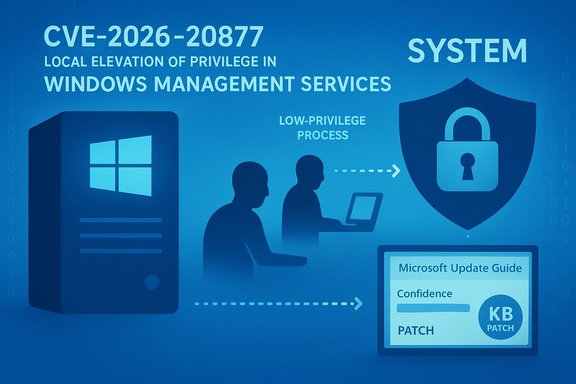
Microsoft’s Security Update Guide records CVE-2026-20877 as an Elevation of Privilege (EoP) defect in Windows Management Services — a vendor-classified local‑attack vulnerability that, if successfully weaponized, can allow a low‑privilege process or local user to gain higher privileges on an affected host. The vendor’s public entry emphasizes the confidence metric — how sure Microsoft is that the vulnerability exists and how much technical detail is being disclosed — and maps the CVE to remediation guidance in the Update Guide.
Windows Management Services (WMSvc) provides management endpoints and workflow APIs used by Windows features and some management tooling. Historically, privileged management services are a frequent source of local EoP vulnerabilities because they run elevated (often under SYSTEM or a high‑privilege service account) while accepting inputs originating from lower‑privileged user contexts. An EoP in a management service therefore presents a powerful second‑stage primitive for attackers who already have a foothold on a host or can trick a user or local process into invoking the vulnerable path.
CVE-2026-20877 was published to Microsoft’s Security Update Guide as part of the January 2026 security roll-up, which lists multiple Windows Management Services entries in that release cycle. Community mirrors and patch‑tracking threads compiled on Windows community forums list CVE‑2026‑20877 among January’s WMSvc fixes, confirming that this CVE is part of the vendor rollout defenders must triage.
Plausible root causes for Windows Management Services EoP include:
Final operational priority list
This feature condenses the available public record and community analysis into an operationally focused playbook for defenders facing CVE‑2026‑20877; the single most important action remains: verify the Update Guide→KB mapping for your exact OS builds and apply the vendor patches in a prioritized, tested rollout.
Source: MSRC Security Update Guide - Microsoft Security Response Center
 Background / Overview
Windows Management Services (WMSvc) provides management endpoints and workflow APIs used by Windows features and some management tooling. Historically, privileged management services are a frequent source of local EoP vulnerabilities because they run elevated (often under SYSTEM or a high‑privilege service account) while accepting inputs originating from lower‑privileged user contexts. An EoP in a management service therefore presents a powerful second‑stage primitive for attackers who already have a foothold on a host or can trick a user or local process into invoking the vulnerable path.CVE-2026-20877 was published to Microsoft’s Security Update Guide as part of the January 2026 security roll-up, which lists multiple Windows Management Services entries in that release cycle. Community mirrors and patch‑tracking threads compiled on Windows community forums list CVE‑2026‑20877 among January’s WMSvc fixes, confirming that this CVE is part of the vendor rollout defenders must triage.
What Microsoft’s “confidence” metric means for CVE‑2026‑20877
Microsoft’s Update Guide provides a short advisory and a separate confidence indicator that communicates two things:- Existence certainty — whether Microsoft has high confidence a vulnerability is real (confirmed by vendor analysis), or whether the public entry is preliminary and requires further corroboration.
- Technical detail disclosure — how much low‑level technical information is being published (for example: class of bug, proof‑of‑concept availability, exploitability notes).
Technical summary (what the public record says right now)
- Reported impact: Local Elevation of Privilege — attacker moves from a standard user or low‑privileged process to a higher privilege (up to SYSTEM) when exploitation succeeds.
- Attack vector: Local — exploitation requires local code execution or influence over a local process (typical for EoP in management services).
- Exploitability details: Microsoft’s Update Guide entry for CVE‑2026‑20877 is terse; it confirms the vulnerability class and remediation mapping but does not publish an exploit proof‑of‑concept or step‑by‑step weaponization details in the public advisory. Community trackers list the CVE in the January 2026 roll-up, but defenders should rely on the Update Guide / KB mapping for remediation specifics.
- Patch status: Microsoft published January 2026 security updates that include multiple Windows Management Services fixes. Administrators must map the CVE to the correct KB for each OS build before deploying. Community patch lists show CVE‑2026‑20877 included in the January updates.
Likely technical classes and exploitation models (evidence‑based inference)
Microsoft’s advisory text is intentionally concise for high‑impact local vulnerabilities. When vendor pages do not disclose low‑level details, it’s reasonable to infer likely bug classes for elevated privileges in management services — while clearly flagging such inferences as plausible rather than proven.Plausible root causes for Windows Management Services EoP include:
- Improper access control / authorization bypass — a privileged service performs an action for user‑supplied input without validating caller rights.
- Race condition / TOCTOU — time‑of‑check/time‑of‑use windows permit substitution of resources or handles between a privilege check and privileged operation.
- Memory safety defects (UAF/heap overflow) — use‑after‑free or buffer corruption in service code can be turned into write‑what‑where primitives enabling token manipulation or code execution at elevated context.
- Unsafe deserialization — deserializing untrusted data in a privileged process can lead to constructor‑based gadget execution or object injection.
Who and what is affected
- Affected components: Windows Management Services — deploys on many client and server SKUs depending on installed role/features.
- Exposure profile: Local only — requires the ability to run code locally or influence a local process that can interact with the management service.
- Enterprise risk: High for hosts that are:
- Administrative workstations,
- Jump boxes and bastion hosts,
- Domain‑joined machines used to run management tooling,
- Servers where multiple users or services can trigger management APIs.
Operational guidance — immediate (first 72 hours)
- Inventory and identify
- Query Microsoft’s Security Update Guide and the Microsoft Update Catalog to confirm the CVE→KB mapping for each Windows build in your estate. Do not rely on a single community KB number. If you cannot render the Update Guide page directly, use your vendor-support channels or the Update Catalog to find the patch packages.
- Prioritize by exposure and role
- Patch high‑value systems first: domain controllers (if management tooling runs there), admin workstations, jump boxes, build servers, remote management endpoints, and any machine with multiple users who might invoke management flows.
- Test before wide deployment
- Stage the vendor KB in a pilot ring (24–72 hours) to validate compatibility with management tooling and monitoring agents, then expand to larger rings.
- Apply compensating controls if you cannot patch immediately
- Restrict local code execution capabilities: enforce application allow‑listing (WDAC/AppLocker) on high‑value hosts.
- Reduce interactive local admin assignments and apply least privilege.
- If feasible, temporarily disable unneeded management features or limit access to management service endpoints with host firewall rules.
- Increase telemetry and hunting
- Tune EDR/SIEM to look for:
- Unexpected elevation events (processes that spawn SYSTEM shells).
- Token duplication APIs (DuplicateTokenEx/OpenProcessToken) used by non‑system processes.
- Service crashes or repeated restarts of management service binaries.
- Suspicious DeviceIoControl or IOCTL sequences if the advisory suggests driver interactions.
- Collect volatile evidence (memory snapshots, process dumps, service crash dumps) before remediation if exploitation is suspected.
Detection: hunting queries and high‑value indicators
- Windows Event Logs
- Service Control Manager events indicating unexpected crashes or restarts for WMSvc-related processes.
- Event IDs showing creation of privileged services, scheduled tasks, or local accounts shortly after a service fault.
- Process telemetry
- Non‑SYSTEM processes spawning cmd.exe, powershell.exe, or msiexec.exe with elevated parentage.
- Anomalous process ancestry chains: user processes calling into management service DLLs then creating elevated processes.
- Kernel/driver signals (if relevant)
- Repeated DeviceIoControl calls targeting service or network drivers in a short timeframe.
- High‑frequency socket control operations correlated with sudden privilege changes (useful if the advisory implicates networking code).
Patch validation and deployment checklist
- Confirm the exact KB for each Windows build using the Microsoft Update Catalog or the vendor’s Update Guide page for CVE‑2026‑20877. Do not assume a single KB across servicing branches.
- Download vendor-signed packages and apply to a pilot group.
- Reboot affected hosts where the patch requires it and confirm post‑reboot build/patch levels.
- Validate management tooling (backup jobs, update tooling, orchestration flows) against the patched test group.
- Expand rollout in prioritized waves, monitoring telemetry after each wave.
- Retain forensic captures from unpatched or suspected hosts until remediation is complete.
Threat model and attacker incentives
- EoP bugs in privileged services are valuable to attackers because they convert a limited foothold into full host control.
- Attackers typically use EoP as a second stage inside a network (phishing → code execution → local EoP → credential theft/persistence).
- There is a meaningful risk that sophisticated adversaries quietly weaponize vendor patches by diffing shipped fixes to create exploits; this is why vendor confidence and disclosure practices matter operationally. Microsoft’s advisory posture (limited technical disclosure while shipping patches) aims to reduce mass exploitation windows but leaves defenders dependent on rapid patching and telemetry tuning.
Critical assessment — strengths and risks in the vendor response
Strengths- Microsoft recorded CVE‑2026‑20877 in the Security Update Guide and included it in January 2026 updates; the presence of a vendor patch is the single most effective mitigation and reduces long‑term exposure when widely applied.
- The Update Guide’s confidence metric provides an operational signal that helps teams decide between immediate patching and defensive hardening while details are withheld.
- The Update Guide entry for some CVEs is intentionally terse and rendered client‑side, which can hamper automated ingestion and rapid KB mapping for large estates unless teams validate KB numbers manually.
- Vendor advisories often omit patch diffs and exploit primitives for high‑impact local bugs; that reduces the ability of defenders to write precise detection signatures before independent research is published.
- Public absence of a PoC does not equal absence of exploitation. Attackers may retain private PoCs and perform targeted intrusions against high‑value organizations. Historical incident data shows EoP bugs are frequently used as second‑stage tools.
How to validate claims and cross‑check patch targets (practical steps)
- Check Microsoft’s Update Guide entry for CVE‑2026‑20877 and use the Update Catalog to map KB IDs to your exact OS build and servicing branch. The Update Guide is the authoritative mapping; community lists are helpful but must be validated.
- Cross‑reference with at least two independent vulnerability feeds (for example, vendor trackers, commercial vulnerability databases, or established security vendors) to confirm public classifications and severity assessments. Rapid7 and other trackers historically mirror Microsoft’s WMSvc EoP records and provide CVSS and remediation references that can speed triage.
- If you use patch automation, ensure your tooling verifies the KB → SKU mapping rather than only the CVE string — Microsoft sometimes assigns multiple KBs per CVE across servicing branches.
Recommended defensive hardening beyond patching
- Enforce least privilege: remove unnecessary local administrator rights and enforce user roles and policies that limit local process capabilities.
- Apply application allow‑listing for high‑value endpoints to block unsigned or unexpected binaries and script interpreters from launching.
- Harden remote and management hosts by limiting who can run local management workflows and segmenting management traffic.
- Implement proactive EDR hunts for the indicators listed earlier and build YARA/EDR signatures after independent PoCs are analyzed — but do not rely solely on signature‑based detection for early containment.
Closing analysis — what defenders should take away
CVE‑2026‑20877 is a local elevation‑of‑privilege vulnerability in Windows Management Services recorded in Microsoft’s January 2026 update guidance. The vendor has published a remediation pathway within the January security roll‑up; defenders must promptly map the CVE to the correct KB for each OS build, test the update in pilot rings, and then deploy broadly — prioritizing admin and internet‑facing management hosts. Short‑term mitigations (least privilege, application allow‑listing, and host firewall rules) help reduce risk while patching is staged. Microsoft’s confidence metric plays an important practical role: it signals how much technical detail the vendor is comfortable publishing and how certain the vendor is that the vulnerability exists. Where the Update Guide entry is terse, treat technical root‑cause claims as provisional and focus operational energy on patch mapping, deployment, and telemetry tuning rather than speculative exploit mitigation.Final operational priority list
- Confirm CVE→KB mapping for each affected build and schedule a pilot deployment.
- Patch admin hosts, domain‑adjacent servers, and jump boxes first.
- Harden unpatched hosts with least privilege and allow‑listing.
- Tune EDR/SIEM to the hunting queries above and collect forensic evidence if a compromise is suspected.
This feature condenses the available public record and community analysis into an operationally focused playbook for defenders facing CVE‑2026‑20877; the single most important action remains: verify the Update Guide→KB mapping for your exact OS builds and apply the vendor patches in a prioritized, tested rollout.
Source: MSRC Security Update Guide - Microsoft Security Response Center
