

Microsoft has recorded CVE-2026-20938 as a vulnerability in Windows’ Virtualization‑Based Security (VBS) Enclave that can be leveraged by an authorized local actor to escalate privileges; Microsoft’s Update Guide identifies the entry as requiring administrators to map the CVE to per‑SKU KB updates and apply vendor fixes immediately.
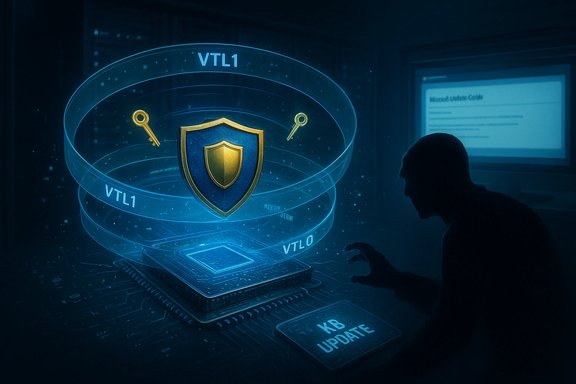
Virtualization‑Based Security (VBS) enclaves are a relatively new, high‑value trust primitive in modern Windows. They create a Trusted Execution Environment (TEE) inside Virtual Trust Level 1 (VTL1), isolating secrets and sensitive operations from the ordinary OS (VTL0). Enclaves are used to protect keys, attestation flows, credential material and other security‑sensitive assets for features such as Credential Guard, secure launch, and new enclave‑enabled application scenarios. The platform documentation describes device, firmware and OS prerequisites for enclave usage and notes that VBS/HVCI and platform attestation are central to enclave integrity. CVE‑2026‑20938 appears on Microsoft’s January 2026 security rollups as one of several VBS enclave vulnerabilities addressed that month; vendor guidance for these entries consistently points administrators to the Microsoft Security Update Guide (Update Guide) as the canonical mapping from CVE → KB → SKU. Independent bulletin summaries and community trackers that reviewed the January updates list the CVE among enclave‑related fixes and stress the Update Guide as the authoritative remediation source.
Even an “information disclosure” in enclave code can rapidly reduce the cost of subsequent exploit stages:
By following a disciplined patch‑first, telemetry‑second strategy and treating VBS enclave issues with elevated priority, organizations can materially reduce the likelihood that a local foothold becomes a catastrophic host or hypervisor compromise.
Source: MSRC Security Update Guide - Microsoft Security Response Center
 Background / Overview
Virtualization‑Based Security (VBS) enclaves are a relatively new, high‑value trust primitive in modern Windows. They create a Trusted Execution Environment (TEE) inside Virtual Trust Level 1 (VTL1), isolating secrets and sensitive operations from the ordinary OS (VTL0). Enclaves are used to protect keys, attestation flows, credential material and other security‑sensitive assets for features such as Credential Guard, secure launch, and new enclave‑enabled application scenarios. The platform documentation describes device, firmware and OS prerequisites for enclave usage and notes that VBS/HVCI and platform attestation are central to enclave integrity. CVE‑2026‑20938 appears on Microsoft’s January 2026 security rollups as one of several VBS enclave vulnerabilities addressed that month; vendor guidance for these entries consistently points administrators to the Microsoft Security Update Guide (Update Guide) as the canonical mapping from CVE → KB → SKU. Independent bulletin summaries and community trackers that reviewed the January updates list the CVE among enclave‑related fixes and stress the Update Guide as the authoritative remediation source. What Microsoft’s advisory says (and what it omits)
Microsoft’s public Update Guide entry for VBS enclave CVEs typically provides:- A short public summary of impact (for example: information disclosure or elevation of privilege).
- The attack vector classification (usually local/authorized for enclave issues).
- The KB updates mapped to each affected Windows SKU and build — the operational artifact administrators must install.
Technical anatomy — why an enclave information leak is serious
VBS enclaves and the attacker’s leverage
A VBS enclave is designed to be a high‑assurance, hardware‑backed island where secret material can be processed without exposure to the rest of the OS. When code within that enclave or the attestation/management APIs leaks pointers, keys, or layout information, the leak becomes a reconnaissance primitive for attackers.Even an “information disclosure” in enclave code can rapidly reduce the cost of subsequent exploit stages:
- Leaked pointers defeat KASLR and reveal in‑memory layout needed for kernel exploits.
- Leaked key material or attestation artifacts allow forging or replay of attestation responses.
- Exposed internal state can help craft reliable memory‑corruption exploits that produce full kernel code execution.
The reported flaw pattern for this family of CVEs
The class of errors reported across recent VBS enclave advisories (including entries in the January 2026 set) centers on untrusted pointer dereferences or insufficient validation of inputs passed into enclave/attestation paths. In practice this means enclave code followed an attacker‑influenced pointer and read privileged memory or returned sensitive information to a less‑trusted context. That single read can be the first stage in a multi‑step elevation chain.Who is affected and why this matters to enterprises
- Systems with VBS enabled: endpoints and servers where VBS, HVCI or secure enclaves are active should be treated as high priority for remediation. VBS is widely supported on modern Windows client and server builds; the set of affected SKUs is therefore broad and depends on per‑build KB mappings.
- Hyper‑V host and management systems: hosts that perform enclave provisioning, attestation or manage tenant enclaves (e.g., multi‑tenant cloud or hosting platforms) are particularly exposed because a malicious tenant or VM can sometimes exercise enclave management interfaces.
- Administrative jump boxes and attestation servers: machines used to manage enclaves or perform attestation typically have tooling that can invoke privileged enclave flows; a compromise of such tools converts “local” risk into immediate host risk.
Exploitability and realistic attacker models
- Attack vector: local/authorized — exploitation requires some local ability to call enclave/attestation APIs or to cause the enclave to process attacker‑controlled inputs. This can be achieved by:
- A compromised user account on the host.
- Malicious code running in a guest VM on a Hyper‑V host.
- A malicious tenant or semi‑trusted CI/CD artifact that triggers enclave management flows.
- Exploit complexity: the public vendor text typically omits exploit reliability; however, the historical pattern for enclave leaks shows that a skilled attacker or researcher can convert a read primitive into a reliable escalation with additional effort. Because disclosure and fixes encourage reverse engineering of the patch, the post‑patch window can be when PoCs appear publicly. Treat the post‑patch period as a higher short‑term risk.
- Scope of impact: while unauthenticated remote worm‑style exploitation is not the canonical model for VBS enclave CVEs, multi‑tenant and cloud scenarios make “local” status easier for attackers to obtain. In short: local-only does not equal low risk.
Validation and cross‑checking: what the public record shows
- Microsoft’s Update Guide is the authoritative record for CVE mapping and KB numbers; administrators must use it to determine which update to deploy for their specific OS build. The Update Guide pages are dynamic and often require an interactive browser to extract per‑SKU KB lists.
- Community trackers and security vendors included CVE‑2026‑20938 in January 2026 vulnerability summaries and classified the family of enclave CVEs as operationally significant. These third‑party summaries reinforce the vendor’s guidance to prioritize patching and confirm that the public technical details are intentionally limited.
- Platform documentation on VBS enclaves clarifies why a leak matters: enclaves are designed to be inaccessible to VTL0 and to host applications, so any exposure undercuts foundational trust assumptions.
Immediate mitigation and remediation (0–72 hours)
Follow a prioritized, operationally safe plan that maps directly to Microsoft’s guidance:- Inventory and label
- Identify VBS‑enabled hosts using Msinfo32.exe or Get‑CimInstance -ClassName Win32_DeviceGuard. Tag systems where VBS or Credential Guard is enabled and classify them as high priority.
- Query Microsoft’s Update Guide
- Use the Update Guide to map CVE‑2026‑20938 to the exact KB(s) that apply to each Windows SKU and build in the estate. Do not rely on aggregated, third‑party CVE→KB feeds for deployment decisions. Microsoft’s Update Guide is the canonical mapping.
- Pilot before mass deploy
- Apply the vendor update in a representative pilot ring (management jump boxes, Hyper‑V hosts, domain controllers) and validate enclave workflows (live migration, attestation) before broad rollout. Kernel and driver patches can interact poorly with third‑party drivers; a pilot reduces rollback risk.
- Staged rollout
- After successful pilot validation, stage rollout by asset criticality: admin hosts → hypervisor hosts → servers → endpoints. Schedule reboots in maintenance windows and confirm KB installation post‑reboot.
- Compensating controls if patching is delayed
- Restrict who can run enclave management or attestation utilities.
- Isolate management and attestation networks.
- Enforce least privilege on accounts that can perform enclave operations.
- Enable application allow‑listing (WDAC or AppLocker) for high‑value hosts.
- Enable Memory Integrity (HVCI) where supported to add kernel‑level hardening.
- Detection tuning during the window of uncertainty
- Push EDR and IDS rules that flag unusual DeviceIoControl/IOCTL activity against virtualization and attestation device objects.
- Monitor for unexpected process elevations to SYSTEM originating from user processes or guests.
- Capture memory and kernel dumps for any suspicious enclave activity; these artifacts can be critical for vendor triage.
Detection and hunting playbook (technical indicators and telemetry)
Because vendor advisories often lack low‑level IOCs, detection must focus on behavioral signals:- IOCTL/DeviceIoControl anomalies: watch for unusual or repetitive IOCTL calls to virtualization/attestation device objects, especially when issued by non‑administrative processes.
- Process ancestry anomalies: unexpected CreateProcessAsUser/DuplicateTokenOpen sequences and user processes spawning SYSTEM shells.
- Enclave management activity from unprivileged accounts: repeated or unusual calls to DRTM/attestation APIs or enclave provisioning tools.
- Kernel instability signals: sudden BSODs or minidumps that reference VBS, enclave or related drivers — preserve full memory if exploitation is suspected.
- Correlate EDR telemetry for enclave‑related device interactions with recent administrative actions (patching, driver installs).
- Triage any abnormal attestation or provisioning events by collecting full memory images and WER dumps before rebooting.
- Where possible, trigger controlled enclave operations in a sandboxed canary environment to profile normal telemetry and reduce false positives during detection tuning.
Security analysis: strengths, weaknesses and systemic risks
Strengths of Microsoft’s approach
- Vendor acknowledgement plus a KB mapping provides an actionable remediation path. Microsoft’s Update Guide is an operationally reliable source for administrators to find the exact packages to install for their builds.
- Redaction of low‑level exploit details reduces immediate mass exploitation risk and buys time for organizations to patch before PoCs appear publicly.
Weaknesses and operational friction
- The Update Guide is JavaScript‑driven and can complicate automation of KB→SKU extraction; mis‑mapping a KB to the wrong SKU risks false reassurance that a system is patched. Administrators need to validate mappings in the Microsoft Update Catalog when automating.
- The lack of technical details forces defenders to rely on behavioral detection rather than deterministic IOCs, increasing the chance of false negatives and a heavier operational load on SOC teams.
Broader systemic risk
- As VBS and enclave patterns proliferate across Windows workloads, vulnerabilities in these trust boundaries create disproportionately large attack surfaces. A single enclave‑class flaw can undermine multiple downstream protections (Credential Guard, Secure Boot attestation chains, enclave‑backed key material). Treating VBS as a black‑box trust anchor requires continuous scrutiny and defense‑in‑depth.
Operational checklist (quick, prioritized)
- Query Microsoft Update Guide for CVE‑2026‑20938 and record the exact KB(s) for every Windows build in your environment.
- Tag VBS‑enabled hosts via inventory and prioritize pilot ring selection.
- Apply updates to pilot hosts and validate critical enclave/attestation workflows.
- Stage rollout to production hosts and confirm KB installation after reboots.
- If patching is delayed, segment admin networks, restrict enclave management privileges and enable Memory Integrity where supported.
- Tune EDR and SIEM to capture IOCTL anomalies, unexpected elevates to SYSTEM, and DRTM/attestation API activity. Preserve memory artifacts if exploitation is suspected.
Final assessment and recommended posture
CVE‑2026‑20938 is vendor‑acknowledged and lives in a class of vulnerabilities that punch above their initial description’s weight. Microsoft’s Update Guide remains the primary place to find the exact fixes; independent trackers and vendor commentary corroborate the operational urgency for VBS‑enabled systems. The combination of (a) enclave secrets being high‑value reconnaissance, (b) realistic local attack vectors in cloud and multi‑tenant contexts, and (c) the historical pattern of information leaks being chained into full escalations, means organizations must prioritize remediation and telemetry hardening now rather than later. Key takeaways:- Patch promptly and validate KB→SKU mappings before deployment.
- Treat enclave information‑disclosure CVEs as high priority because of their chaining potential.
- Use behavioral detection and preserve forensic artifacts if suspicious activity occurs; vendor advisories will rarely offer crisp exploit IOCs at disclosure.
By following a disciplined patch‑first, telemetry‑second strategy and treating VBS enclave issues with elevated priority, organizations can materially reduce the likelihood that a local foothold becomes a catastrophic host or hypervisor compromise.
Source: MSRC Security Update Guide - Microsoft Security Response Center
